
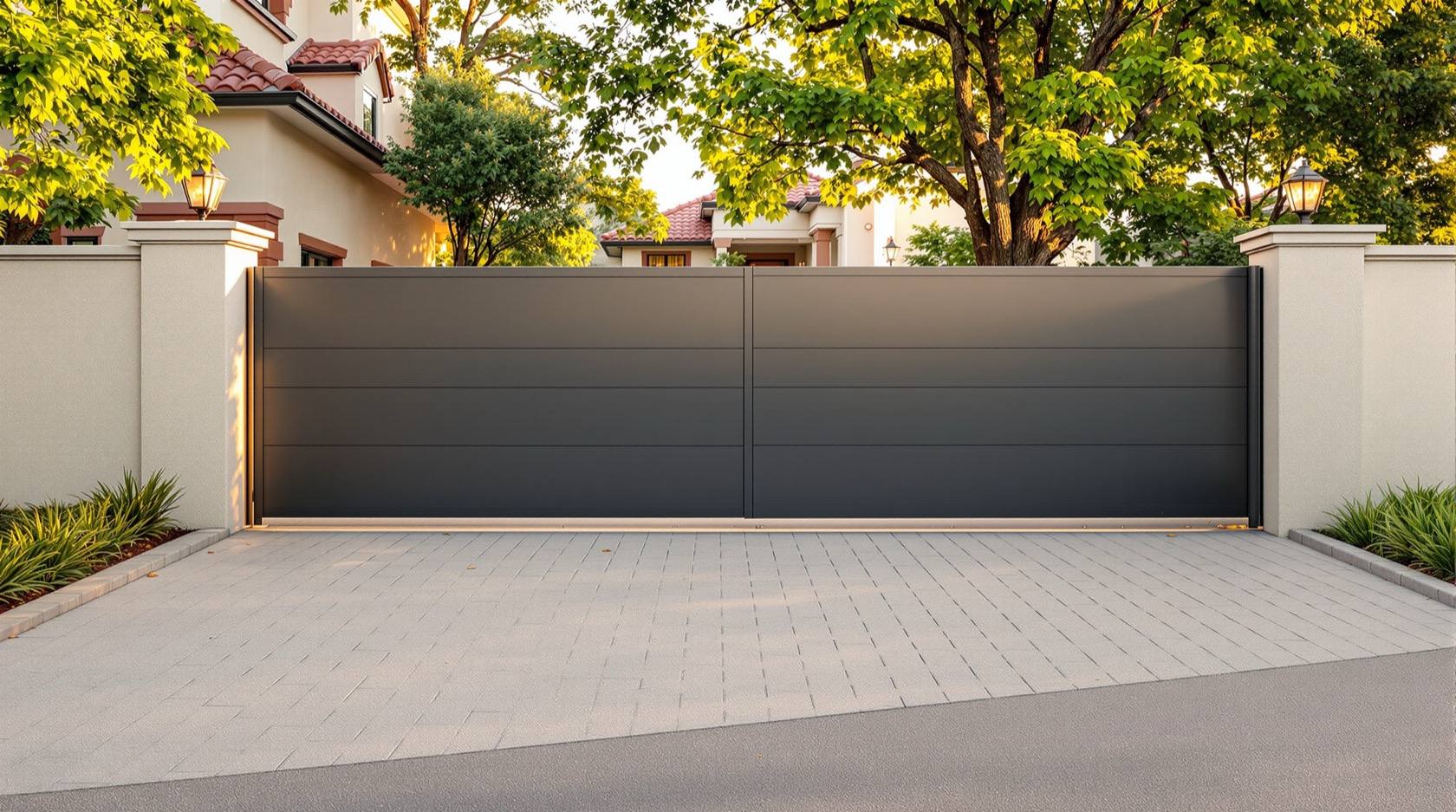
Swing vs Sliding vs Cantilever Gates in India: Which to Choose (2026)
The how-it-opens selection guide for your compound gate — swing on hinges, sliding on a ground track, or cantilever carried on a counterbalance tail with no track — compared on the one thing that actually decides it: the space each one needs beside or in front of your opening, plus slope, width, budget and fit.
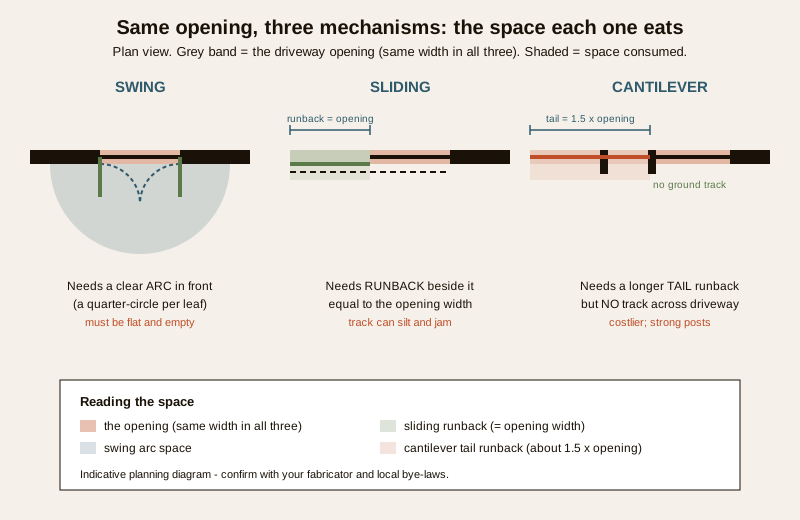
Before you choose a gate's material or its motor, you choose how it opens — and that single decision is dictated less by taste than by the space your plot actually has. A gate can swing open on hinges, slide sideways along a ground track, or cantilever across the opening carried on a counterbalanced tail with no track at all. Each one eats space in a different place: a swing gate needs a clear arc to swing into, a sliding gate needs clear runback beside the opening, and a cantilever needs a counterbalance tail parked alongside. Get the space wrong and the fanciest gate simply will not open.
This is the "how it opens" selection guide for the Compound Walls and Gates hub. It sits beside the compound gate design guide, which frames the whole gate as a designed object, and the gate size and width guide, which sets the opening. Here we compare the three mechanisms on the deciding factor — space — and point you to the folding and telescopic gates guide for tight sites where none of the three fit. Automation and security are covered elsewhere and are not re-taught here: motorised gate automation covers the motors, and gate security covers locks and anti-lift.
Scope & how to read this. This guide helps you pick the opening mechanism by the space, slope, width and budget of your site — it is not a security or automation guide (for that, see motorised gate automation and the Perimeter Security library). Every dimension is typical and indicative to help you plan — confirm your vehicle's turning needs, your fabricator's design and your local bye-laws. Structure is engineer-led where it matters: the posts or pillars that carry a heavy gate need proper footings (link the gate foundation notes), and a big solid leaf is a sail in the wind — a heavy or wide-span gate is designed and fabricated by a competent fabricator or engineer, not eyeballed.
The three mechanisms at a glance
The whole decision fits in one table. Read cost as a relative band, not a price, and read "space it needs" as the thing that most often makes the choice for you before budget ever does.
| Gate type | How it opens | Space it needs | Best for | Watch-out |
|---|---|---|---|---|
| Swing (single or double leaf) | Hinged leaves swing open through an arc, inward or outward | A clear arc to swing into — a quarter-circle per leaf, kept level and free of slope, cars, pots or steps | The cheapest, classic choice; narrower openings; plots with clear space in front | The arc must be flat and empty; an outward swing over a public footpath or road is often not allowed |
| Sliding (ground track) | Wheeled leaf rolls sideways along a rail set in the ground | Clear runback beside the opening at least equal to the opening width, on a clean level rail | Wide, level driveways; where there is a long clear wall to one side | The ground track collects silt, gravel and leaves and jams; needs a truly level run; a slope kills it |
| Cantilever (track-free) | A sliding leaf carried on rollers, balanced by a tail that overhangs past the opening; hangs clear of the ground | A counterbalance tail runback of roughly one-and-a-half times the opening, beside it — but no ground track | Wide openings, sloping or dirty ground, flood-prone or unpaved entrances | Costs more; the tail sticks out well past the opening; needs strong, deep posts to carry the load |
Two truths cut across all three. First, whichever way it opens, the gate is only as steady as the posts that carry it — a heavy leaf will lever a weak post out of the ground over time, so the posts sit on proper footings. Second, the wider and more solid the leaf, the more wind it catches; past a modest size a gate is a fabricated, engineered element, and that is also the point at which automating it starts to make sense. Use the gate swing clearance calculator to check the space maths before you commit to a type.
Swing gates: the classic that needs a clear arc
A swing gate is the oldest and simplest idea — one or two leaves hung on hinges from a post, swinging open like a door. A single leaf covers a narrow opening; a double leaf (two halves meeting in the middle) shares the load across a wider one and keeps each leaf lighter and shorter. It is the cheapest mechanism, the most familiar to every fabricator, and the easiest to make handsome.
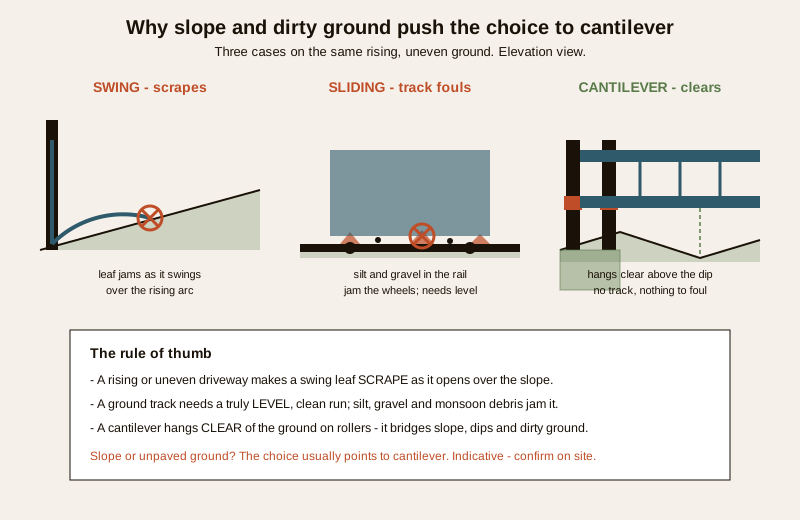
Its one demand is the arc. Each leaf sweeps a quarter-circle as it opens, and that quarter-circle must be level and empty — no rising driveway, no parked car, no planter, no step, no gravel mound in the way. Swing inward (into the plot) is the usual choice because swinging outward over a public footpath or road is frequently disallowed by bye-laws and is a hazard to passers-by. The arc is also the reason swing gates struggle on a slope: a leaf that clears the ground at the closed position will scrape or jam as it swings over rising ground.
When a swing gate is right
- The opening is narrow to medium and you have flat, clear space to swing into on the plot side.
- Budget is tight — swing is the least-cost mechanism to fabricate and to automate.
- You want a classic look — ornamental double leaves are a swing-gate signature.
- The driveway is level at the gate; no rising slope inside the arc.
If the arc is blocked, the driveway slopes, or the opening is very wide (long leaves get heavy and sag), that is exactly when people look at sliding or cantilever instead. The gate size and width guide covers how wide a single leaf can sensibly go before a double leaf or a slider makes more sense.
Sliding gates: sideways travel needs runback
A sliding gate does away with the arc entirely — the leaf rolls sideways, parallel to the wall, on wheels running in a track set into the ground. Nothing sweeps into the driveway, so a slider suits a plot with no room to swing but a clear stretch of wall to one side. It handles wide openings far more gracefully than a long swing leaf, because the leaf is supported along a rail rather than cantilevered off hinges.
The price of that is runback: the leaf has to go somewhere when open, so you need clear space beside the opening at least equal to the opening width, along a clean wall with nothing parked or planted against it. And the track is the catch — a ground rail sits in the worst possible place to collect silt, gravel, leaves and monsoon debris, and a fouled track jams the wheels. A sliding gate also needs a truly level run: the rail must be flat, so a sloping or uneven entrance fights it.
When a sliding gate is right
- The driveway is wide and level and there is clear runback beside the opening.
- There is no room to swing — the arc is blocked by cars, slope or the street.
- You want easy automation on a wide opening (sliders automate cleanly; see motorised gate automation).
- The entrance stays clean and paved, so the track will not silt up.
Where the ground is dirty, unpaved, flood-prone or gently sloping — the very places a ground track suffers most — the cantilever solves the same "slide sideways" problem without a track at all.
Cantilever gates: sliding without a track
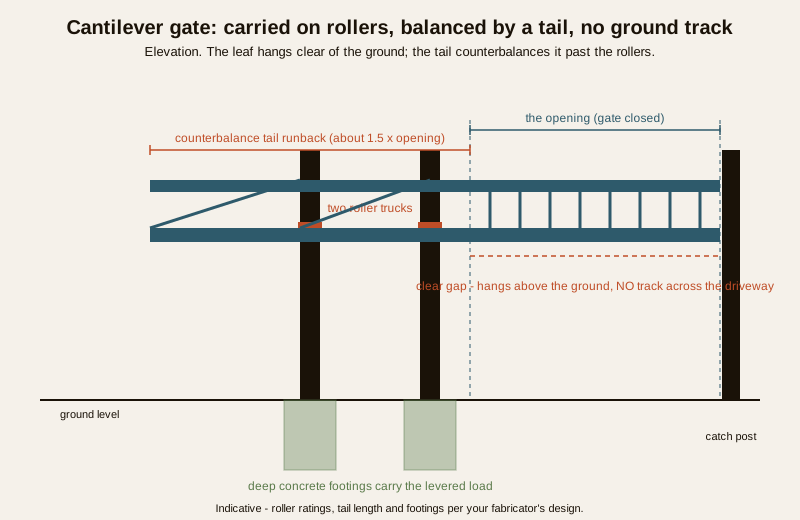
A cantilever gate is a sliding gate carried on rollers with no ground track. Instead of running on a rail across the driveway, the leaf rests on two heavy roller trucks anchored beside the opening and is counterbalanced by a tail — an extension of the frame that overhangs past the rollers. The tail's weight balances the leaf so it hangs clear of the ground across the whole opening, gliding open and shut on the rollers alone.
Removing the track removes the track's problems. There is nothing across the driveway to collect silt or jam, nothing to trip a wheel, and the gap under the gate can bridge a slope, a dip, a flood channel or unpaved ground that would defeat a ground-tracked slider. That makes cantilever the natural pick for estate, farm, industrial and flood-prone entrances — and for any wide opening where a clean track cannot be guaranteed. The farm and industrial gates guide covers those heavy-duty settings in full.
The trade-offs are real. The counterbalance tail needs runback of roughly one-and-a-half times the opening width beside it — more than a plain slider — because the tail overhangs well past the opening when the gate is shut. The gate is costlier to fabricate, and because the whole leaf is held by two roller trucks levering against the ground, it needs strong, deep posts and generous footings — this is squarely a foundation and fabrication job for someone competent, not a light bolt-on.
When a cantilever gate is right
- The ground is sloping, dipped, unpaved, dusty or flood-prone — anywhere a ground track would silt or jam.
- The opening is wide and you have the extra runback for the tail.
- It is a farm, estate, factory or warehouse entrance where reliability beats cost.
- You want a slider's sideways travel but cannot keep a track clean.
Two mechanisms for tight sites
When you have neither a clear arc nor enough runback — a narrow urban plot, a gate hard against a corner, a basement ramp — the three main mechanisms all struggle, and the answer is a gate that stacks or concertinas into a small pocket. Folding (bi-fold) gates hinge in the middle so each leaf needs only a shallow arc, and telescopic sliders overlap two or three shorter panels so the runback is only a fraction of the opening. Both are covered in the folding and telescopic gates guide; the collapsible gate doors guide covers the concertina steel type. They cost more and have more moving parts, but on a genuinely tight site they open where nothing else can.
Slope, obstruction and the space that decides it
Almost every wrong gate choice comes down to a space or slope problem that was not checked before ordering. Work down this decision checklist, measure the actual space on the ground, and the type usually chooses itself — then confirm with your fabricator and the gate swing clearance calculator.
| Question about your opening | If yes / this applies | Lean towards |
|---|---|---|
| Is there flat, clear space to swing INTO on the plot side? | Level driveway, empty arc | Swing (single if narrow, double if wider) |
| Is the arc blocked by cars, steps, planters or a rising slope? | No room to swing | Sliding or cantilever |
| Is there clear runback beside the opening at least as wide as the opening? | Long clear wall to one side | Sliding (if level and paved) |
| Is the ground sloping, dipped, unpaved, dusty or flood-prone? | A track would silt or jam | Cantilever (no ground track) |
| Is the opening wide (a long single swing leaf would sag)? | Wide driveway | Double swing, sliding or cantilever |
| Is there runback of about one-and-a-half opening-widths for a tail? | Extra clear space to the side | Cantilever becomes viable |
| Is space tight on BOTH sides and in front? | Narrow urban / corner plot | Folding or telescopic (see the tight-site guide) |
| Is the budget the hard limit? | Cost-first | Swing (cheapest to build and automate) |
A few cross-cutting notes decide more gates than people expect:
- Measure the arc AND the runback before you fall in love with a look. The prettiest ornamental swing gate is useless if the driveway rises into its arc; the widest slider is useless without runback beside it.
- Slope is the great decider. A rising driveway rules out swing (the leaf scrapes) and plain sliding (the rail cannot be level) and points straight at cantilever, which hangs clear of the ground.
- Wind loads the choice too. A big solid leaf is a sail; a heavy wide gate must be fabricated and its posts footed to take that load — see the gate design guide and foundation notes.
- The mechanism comes first, the material and motor after. Once you know how it opens, choose the body in the gate materials guide, the finish in the rust-prevention guide, and the motor in motorised gate automation.
How it connects
- Sits under the Compound Walls and Gates hub and pairs with the compound gate design guide (the whole gate as a designed object) and the gate size and width guide (setting the opening).
- Once the mechanism is chosen, pick the body in the gate materials guide and the finish in the gate finishes and rust prevention guide; for tight sites see the folding and telescopic gates guide.
- Automation and security are covered separately: motorised gate automation, gate security and the Perimeter Security library. Heavy farm and factory gates live in farm and industrial gates.
- The posts that carry any gate sit on proper footings. Check the space maths with the gate swing clearance calculator and size the opening with the gate width calculator.
Key takeaways
- The gate mechanism is decided by space, not looks: swing needs a clear arc to swing into, sliding needs clear runback beside the opening, cantilever needs a counterbalance tail runback of about one-and-a-half openings.
- Swing is the cheapest and most classic — best for narrow-to-medium, flat, clear openings with room to swing inward; blocked or sloping arcs rule it out.
- Sliding rolls sideways on a ground track — best for wide, level, paved driveways with clear runback; the track silts and jams and hates a slope.
- Cantilever slides with no ground track, hanging clear of the ground — best for sloping, dipped, unpaved or flood-prone entrances and wide farm and industrial openings; it costs more and needs a longer tail and stronger posts.
- On a genuinely tight site, folding or telescopic gates stack into a small pocket where none of the three fit.
- Whatever the mechanism, the posts need proper footings, a wide solid leaf is a sail that must be engineered, and automation and security are handled in their own guides — this one is about how it opens.
References
- IS 2062, Bureau of Indian Standards — hot-rolled steel for general structural purposes (gate frames and posts; named generally).
- IS 1161, Bureau of Indian Standards — steel tubes for structural purposes (tubular gate members; named generally).
- National Building Code of India, NBC (SP 7:2026), Bureau of Indian Standards — general building, boundary and access provisions.
- Gate fabricator and automation-manufacturer design and installation data — roller-truck ratings, tail lengths, runback and post-footing requirements (product-specific).
- Local municipal bye-laws and development-control regulations — gate setback, outward-swing over public land and access-width requirements (city-specific; these govern approval).
- Local fabricator and contractor quotations — current material, fabrication and installation rates for your specific opening and ground.
All dimensions, space requirements, cost bands and comparisons here are indicative planning aids only; confirm the mechanism, sizes and clearances against your vehicle, your fabricator's design and your local municipal bye-laws, have a competent fabricator or engineer design and footing any heavy, wide or wind-loaded gate and its posts, and follow the dedicated guides for gate automation and security.
Export this guide
Related Guides — Deep-dive reading
Compound Gate Design in India: Types, Materials and Sizing (2026)
The start-here guide to the gate as the moving part of your boundary wall — how it opens (swing, sliding, cantilever, folding, telescopic), what it is made of (MS, wrought iron, stainless, aluminium, wood), how wide it needs to be for your vehicle, how it is finished against rust, and the posts and footing that carry it. Decisions in order, with automation and security cross-linked, not rebuilt.
Compound WallsThe Homeowner's Guide to Compound Walls and Gates in India (2026)
A plain-language, start-to-finish walkthrough of building a boundary wall and gate in India — plan and permit first, then material and height, foundation and structure, building and supervision, the gate, finishes, lighting and greenery, budget and long-term upkeep — with a stage-by-stage roadmap, a full planning checklist and answers to the questions every homeowner asks.
Compound WallsCompound Wall Cost in India: Materials, Labour and What Drives the Price (2026)
An honest, indicative cost-literacy guide to what a boundary wall really costs in India — why the price swings so much (material first, then height, foundation, finish, gate and site), the full cost stack most people forget, how the wall is measured, and where to trim without cutting the wrong corner. Relative bands, not quotes — get local numbers.
Compound WallsRelated Tools — Try Free
Motorized Curtain Cost Calculator
Estimate the all-in cost to motorise curtains — motors, tracks, hub and installation.
Cost CalculatorWindow Hardware Cost Calculator
Estimate window hardware cost — hinges, handles, locks, rollers and multipoint gears.
Window CalculatorBefore vs After — Cost Reality Check
Compare what you expected to pay vs what you actually paid, category by category.
Reality Check