
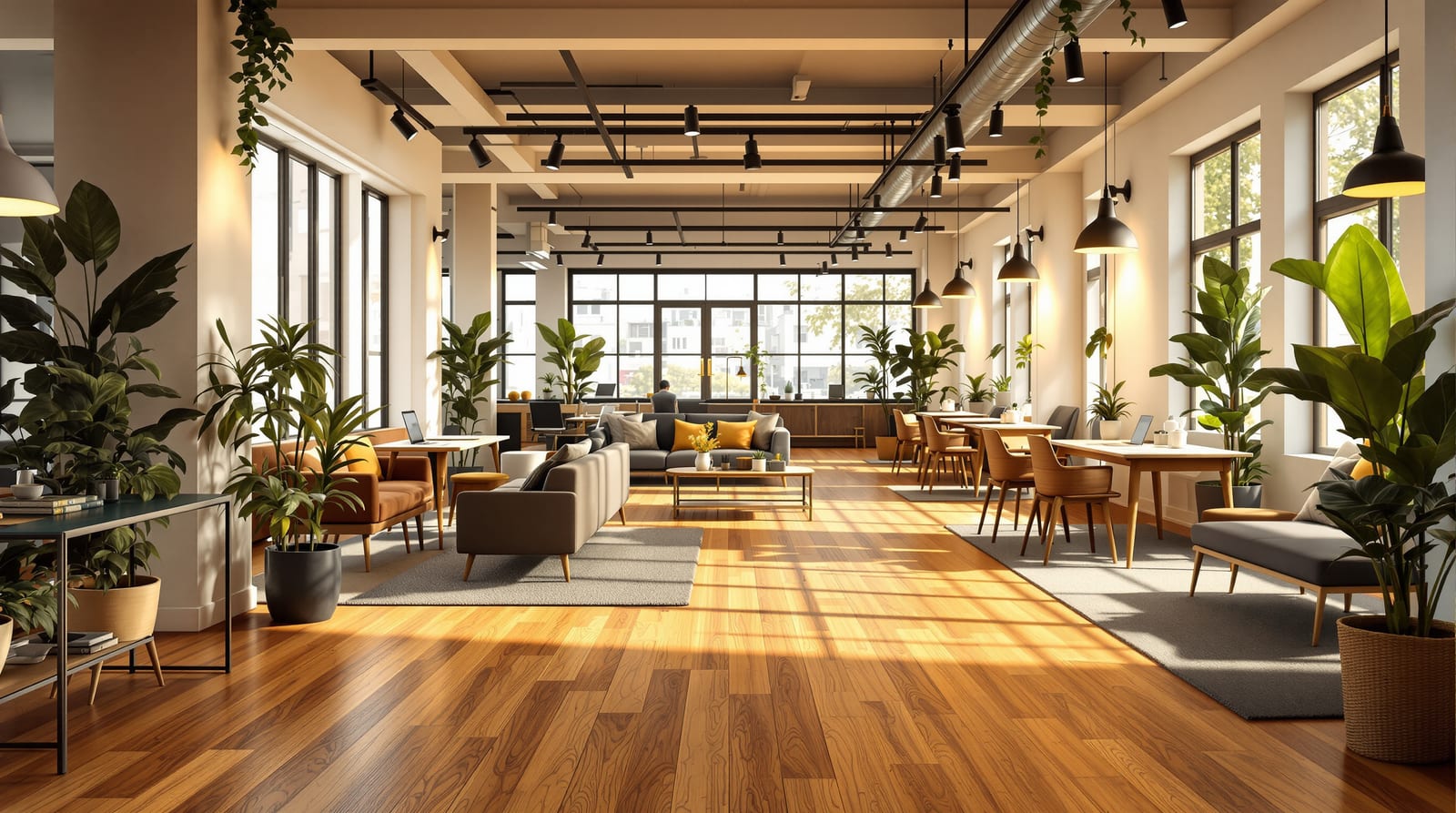
Coworking Space Flooring in India: Zone-by-Zone Picks for Hot Desks, Booths, Cafe and Lounge
How to specify design-led, fast-to-reconfigure, acoustic floors for a high-churn coworking space — carpet tile, wood-look LVT/SPC, polished concrete and vitrified — zoned for branding, wayfinding and budget.
A coworking floor has to do something no ordinary office floor does: look good enough to sell a membership in the first ten seconds, survive thousands of chairs and trolley bags every month, hush a room full of phone calls, and then change its mind every quarter when the layout flips. In India, where a single floor plate might hold hot desks, glass cabins, phone booths, a barista cafe, a lounge and a weekend event area, the answer is never one material — it is a deliberate zone-by-zone mix that doubles as wayfinding and branding. This guide ranks the right floor for each coworking zone, with Indian costs, acoustics, slip ratings and a reconfiguration-friendly spec.
Why coworking flooring is its own problem
A coworking space is design-led real estate sold by the seat. Members — startups, freelancers, remote teams — physically tour before they sign, and the floor is the largest visible surface in every photograph and reel. So aesthetics and "Instagrammability" are commercial drivers, not vanity. But the same floor faces brutal operational reality:
- High churn and reconfiguration. Layouts change every few months as community managers add desks, carve new cabins or open an event night. A floor you have to demolish to move a wall is a liability. Modular, swappable finishes win.
- Heavy, varied traffic. Hot-desk zones see constant chair roll and footfall; the cafe sees spills and grease; the event area takes heels, stages and crowds.
- Acoustics. Open hot-desk floors and call-heavy booths need soft, sound-absorbing surfaces, while cafes and lounges can take harder, livelier finishes.
- Wayfinding. With no permanent walls, a change of floor is the cheapest, clearest way to say "you are now leaving quiet zone, entering cafe."
- Budget per sq ft. Operators watch fit-out cost closely because it sits against a per-seat payback. The floor is specified zone-by-zone to spend where members notice and save where they do not.
For the broader principles that apply across any workplace, pair this guide with the office flooring guide and the cluster-level commercial flooring guide.
The zoned strategy: one floor plate, many finishes
The smartest coworking floors treat the plate as a set of "neighbourhoods", each with a finish chosen for its job and colour-coded for navigation. The diagram below shows a typical Indian coworking layout and the recommended finish per zone.
The principle: hard, photogenic, easy-clean surfaces where activity and spills happen (cafe, event, circulation); soft, acoustic surfaces where people concentrate or take calls (lounge, booths, quiet cabins); warm, durable, design-led surfaces in the open hot-desk core that every member sees daily.
Zone-by-zone picks, vibe and cost
This table maps each coworking zone to its recommended floor, the vibe it creates, and an indicative installed cost in Indian rupees per square foot (2026). Use it as a starting palette and tune to your brand and city rates.
| Zone | Recommended floor | Vibe | ₹/sq ft (installed) | Why it wins here |
|---|---|---|---|---|
| Hot desks / open work | Wood-look LVT or SPC | Warm, premium, photogenic | 150-400 | Comfortable underfoot, takes chair roll, swappable plank-by-plank, no cold echo |
| Lounge / quiet zone | Acoustic carpet tile | Cosy, hushed, brand-coloured | 120-400 | Best sound absorption; lift-and-replace single tiles; zone-colour wayfinding |
| Phone booths / call pods | Carpet tile | Silent, soft | 120-300 | Kills reverberation inside the pod; cheap to refit when pods move |
| Private cabins | Carpet tile or LVT | Calm, professional | 120-400 | Acoustic privacy or warm premium per team's brand |
| Cafe / pantry | Anti-slip vitrified (R10-R11) or polished concrete | Lively, industrial-chic | 130-420 | Handles grease, spills and trolleys; slip-safe; wipes clean |
| Event / community area | Polished concrete | Raw, urban, hard-wearing | 130-420 | Survives heels, stages and crowds; seamless, statement surface |
| Circulation spine | Durable LVT or polished concrete | Continuous, branded path | 130-420 | Acts as a wayfinding ribbon linking every neighbourhood |
For the materials themselves, link members and your fit-out team to the deep-dives: carpet tiles, luxury vinyl tile LVT, polished concrete flooring and microcement flooring for a thinner, more decorative concrete look on existing slabs. To price your specific zone mix, use the commercial flooring cost calculator.
The four workhorse materials, ranked for coworking
1. Carpet tile — the acoustic, swappable hero
Carpet tiles are the single most coworking-friendly product. They absorb the call noise of an open floor, install dry over a level screed, lift out individually when a tile is stained or a layout shifts, and come in dozens of colours so you can literally paint your brand and your wayfinding into the floor. Buy a commercial-grade tile (bitumen or PVC-backed, heavy-traffic rated) and over-order one box per zone as future replacements, because dye lots change. Best for lounges, quiet zones, phone booths and team cabins.
2. Wood-look LVT / SPC — warm, durable, Instagrammable
LVT and rigid-core SPC deliver the warm timber look members love in photos without the cost or fragility of real wood. They take chair roll, resist water spills, are quiet underfoot and — crucially for high churn — click-lock or glue-down systems can be lifted and reconfigured. This is the default for the hot-desk core and circulation spine. Specify a commercial wear-layer (0.5mm or higher) so heavy churn does not scuff it grey within a year.
3. Polished / micro concrete — industrial-chic and tough
Exposed polished concrete, or microcement over an existing slab, gives the raw, urban aesthetic that defines a lot of Indian coworking brands. It is seamless, extremely durable, easy to mop and photographs beautifully under feature lighting. Use it in the event area, cafe surrounds and circulation. Its one weakness is acoustics — it is hard and reflective — so keep it out of concentration zones and pair it with rugs, acoustic ceilings and soft furniture.
4. Anti-slip vitrified — the cafe workhorse
The barista cafe and pantry are wet, greasy, high-traffic zones, so they want an anti-slip vitrified tile at R10-R11, or polished concrete with a slip-resistant seal. Large-format matte vitrified reads as premium and continuous, while the textured surface keeps a spilled flat-white from becoming a liability claim. See anti-slip flooring for wet areas for the rating logic.
Acoustics, slip and standards
- Acoustics first in work zones. Open hot-desk floors and call pods need soft, absorptive surfaces. Carpet tile is the workhorse; where you want LVT for looks, recover the acoustics with rugs, acoustic ceiling baffles and upholstered furniture. Specify an acoustic underlay under LVT/SPC in upper-floor coworking to cut impact noise to the tenant below.
- Slip safety where it is wet. The cafe, pantry and any zone near a water point should meet at least R10 (DIN 51130), ideally R11 in the cafe core. Entrances need anti-skid in the monsoon — see anti-slip flooring standards.
- Accessibility (NBC 2016 + RPwD 2021). Keep transitions between zone finishes flush — thresholds under 12mm — so wheelchairs and trolley bags roll smoothly across the whole plate. Provide a continuous accessible path and tactile cues at level changes. See accessible flooring standards and NBC flooring requirements.
- Transition strips. Where carpet tile meets LVT meets concrete, use slim aluminium or PVC trims to protect edges and avoid trip hazards — these are also a design opportunity to draw a crisp wayfinding line.
Designing for churn and branding
The whole point of zoning is reversibility. Build the floor so a layout change does not mean a demolition:
- Modular over monolithic. Carpet tile and click LVT can be lifted and relaid; poured concrete cannot. Reserve concrete for the permanent zones (cafe, event, circulation) and keep work zones modular.
- Colour as wayfinding. Assign each neighbourhood a carpet or accent colour drawn from your brand palette so members navigate by floor, not signage. A warm timber spine threading through colour-blocked zones reads beautifully in marketing photos.
- Over-order attic stock. Keep spare tiles and planks of every product per zone; churn means damage, and matching dye lots later is hard.
- Raised-access where cabling is dense. If your hot-desk core is power-and-data heavy, consider a low-profile raised access floor under the LVT so you can re-route services without chasing the slab — useful for IT-heavy member firms.
Do and don't
- Do zone the plate by activity and code each zone by floor colour for instant wayfinding.
- Do put soft, acoustic carpet tile in lounges, booths and quiet cabins, and hard, photogenic finishes in cafe, event and circulation.
- Do specify commercial-grade wear layers (LVT 0.5mm+, heavy-traffic carpet tile) — coworking churn is brutal on thin domestic products.
- Do keep zone transitions flush and trimmed for accessibility and trolley bags.
- Don't use a single floor everywhere — you lose acoustics, wayfinding and the photo-worthy contrast that sells memberships.
- Don't put hard, reflective concrete in call-heavy zones without acoustic correction.
- Don't lay polished concrete in the wet cafe core without a slip-resistant seal.
- Don't forget attic stock — a stained tile you cannot match becomes a visible eyesore.
Care and maintenance
Different zones, different routines. Carpet tile zones need daily vacuuming and prompt spot-cleaning, with stained tiles swapped from attic stock rather than shampooed grey. LVT and SPC mop clean with a neutral cleaner; avoid harsh solvents that haze the wear layer. Polished concrete needs periodic re-sealing to keep its sheen and stain resistance — see the floor resealing guide and the general floor cleaning guide. A simple per-zone cleaning SOP handed to the housekeeping team keeps a high-churn floor looking new far longer than its traffic suggests.
Frequently asked questions
What is the best flooring for a coworking space in India?
There is no single best floor — the winning approach is zoned. Use acoustic carpet tile in lounges, quiet zones and phone booths; warm wood-look LVT or SPC in the open hot-desk core; polished concrete in the event area and circulation; and anti-slip vitrified or sealed concrete in the cafe. This mixes acoustics, durability, looks and budget where each matters most.
How much does coworking space flooring cost per square foot?
Indicatively in 2026, expect roughly ₹120-400 per sq ft for commercial carpet tile, ₹150-400 for wood-look LVT/SPC, ₹130-420 for polished concrete or microcement, and ₹130-420 for anti-slip vitrified in the cafe. Because you mix finishes by zone, blended cost depends on your zone areas — estimate it with the commercial flooring cost calculator.
Which flooring is most acoustic for open hot-desk areas?
Carpet tile absorbs the most sound and is the first choice for concentration and call-heavy zones. If you prefer wood-look LVT or SPC for its premium look, recover acoustics with an acoustic underlay, rugs, soft furniture and acoustic ceiling treatment.
How do I make a coworking floor easy to reconfigure for high churn?
Favour modular, dry-laid products — carpet tile and click-lock LVT/SPC — that can be lifted and relaid without demolition, and reserve poured concrete for permanent zones like the cafe and circulation. Keep attic stock of every product, and consider a low-profile raised access floor in cabling-dense work zones to re-route services without touching the slab.
Can polished concrete work in a coworking space?
Yes, and it defines the industrial-chic look many Indian coworking brands want — but use it strategically. It is hard, durable and photogenic for event areas, cafe surrounds and circulation, while being acoustically reflective. Keep it out of call-heavy quiet zones, or correct the acoustics with rugs and ceiling baffles, and seal it for slip resistance near the cafe.
Export this guide
Related Guides — Deep-dive reading
Cafe Flooring in India: Instagram-Able, Spill-Proof Floors That Build Your Brand
How to choose cafe and coffee-shop flooring in India that looks beautiful on camera and survives coffee, water and chair-scrape all day.
Flooring & SurfacesOffice Flooring in India: Zone-by-Zone Guide for Workstations, Cabins, Reception and Server Rooms
How to specify the right office floor for every zone — carpet tile, LVT, raised-access, vitrified and polished concrete — for acoustics, durability, cable management and brand image.
Flooring & SurfacesSupermarket Flooring in India: Zone-by-Zone Floors for Aisles, Fresh & Wet Areas, Checkout, Cold Storage and Loading
How to specify a trolley-tough, anti-slip, fast-to-clean floor across every zone of a supermarket or hypermarket — large-format vitrified or polished concrete for the aisles, R11 anti-slip for fruit-veg and dairy, PU resin for cold rooms, and VDF for the back-of-house and loading bay — at the lowest lifecycle cost per square foot.
Flooring & SurfacesRelated Tools — Try Free
Flooring Cost Calculator
Estimate the all-in cost of a floor — material, laying, wastage, skirting and GST — by area and material.
Flooring CalculatorAcoustic Privacy (STC) Visualizer
Indian healthcare acoustic visualizer — compare wall assemblies and noise sources, see received SPL after STC attenuation, and check FGI 2018 / IS 1950 / NABH speech-privacy compliance with live dual-canvas waveform.
Acoustic ToolFlooring Material Selector
Get the best flooring material for your room, budget and climate, with anti-slip checks for wet areas.
Flooring Tool