
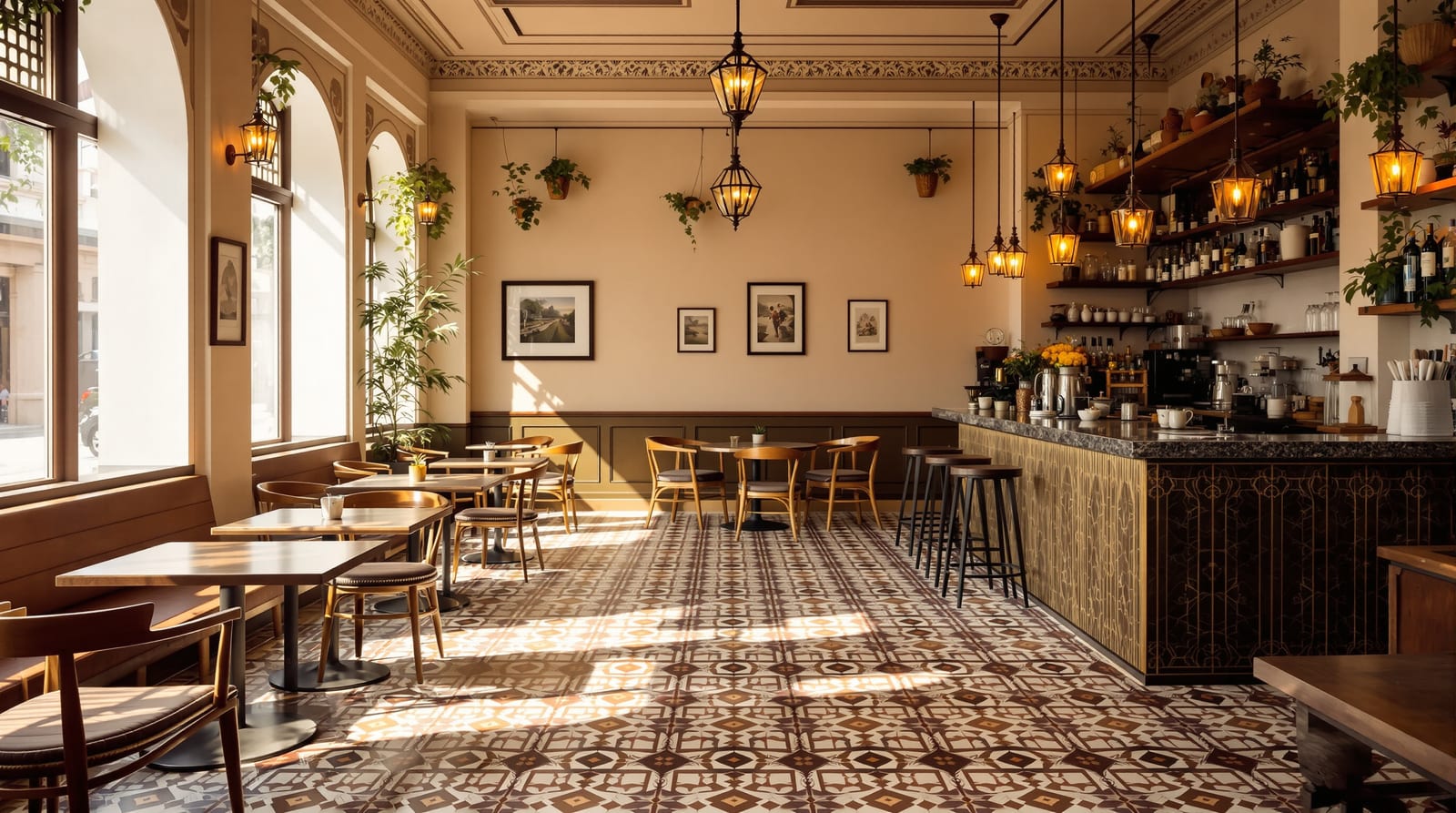
Cafe Flooring in India: Instagram-Able, Spill-Proof Floors That Build Your Brand
How to choose cafe and coffee-shop flooring in India that looks beautiful on camera and survives coffee, water and chair-scrape all day.
In a cafe, the floor is never just a floor — it is the backdrop of every flat-lay, the first thing a guest's eye drops to, and the surface that absorbs spilled lattes, monsoon footprints and the scrape of a hundred chairs a day. Get it right and the floor becomes your cheapest, most photographed brand asset. Get it wrong and you are mopping coffee out of grout lines and replacing slippery tiles within a year. This guide ranks the floors that actually work for cafes and coffee shops in India, balancing the camera against the mop bucket.
What a cafe floor really has to do
Before chasing a Pinterest aesthetic, list the demands a cafe floor faces every single day. They are unusually contradictory, which is why so many owners overspend on the wrong surface.
- Carry a brand identity. A specialty-coffee bar, a dessert cafe and a co-working cafe each read differently on the floor. The pattern, colour and texture set the mood before the menu does.
- Resist coffee, water and grease spills. Espresso, milk, syrups and cleaning water hit the floor constantly. The surface must shrug off stains and not absorb dark liquids.
- Stay anti-slip — especially near the counter. The wettest, busiest, most accident-prone strip is the 1.5 m band in front of the barista counter and the pickup point. This zone needs grip even when wet.
- Survive chairs, trolleys and footfall. Dragged chairs, bus tubs and 12-hour daily traffic abrade soft surfaces fast.
- Clean fast. Staff turn tables in minutes; the floor must wipe and mop quickly without special chemicals.
- Fit a small-cafe budget. Most independent Indian cafes fit out 600–1,500 sq ft. Flooring is one line item among fit-out, equipment and deposit, so cost per square foot matters.
A smart cafe floor answers all six — usually by zoning: a hero, photogenic surface in the seating area and a tougher, grippier surface in the wet service zone. For the broader logic of matching a floor to a use-case, see how to choose flooring in India and the restaurant flooring guide, which shares most of these constraints at larger scale.
The cafe-aesthetic favourites, ranked
1. Patterned cement and encaustic tiles — the signature cafe floor
Nothing says "design-led cafe" in India like a field of patterned cement tiles. Geometric Moroccan motifs, monochrome dots and bold florals are the most photographed cafe floors in the country for a reason: they give instant character to a plain shell. They suit boutique cafes, dessert bars and heritage-style coffee houses. The catch is practicality — true cement tiles are porous, need sealing, and can stain from coffee if neglected. Many owners now choose patterned-look vitrified tiles (PGVT) that print the same designs onto a hard, non-porous, stain-proof body. For the real material and its care, see cement tiles in India and the harder printed alternative, polished glazed vitrified tiles (PGVT).
2. Terrazzo — the timeless, premium cafe surface
Terrazzo — chips of marble, granite and glass set in a binder and ground smooth — has returned as the darling of upmarket cafes. Pastel terrazzo reads playful; grey-and-white reads minimal; warm tones read cosy. It is seamless or large-tile, durable, and photographs beautifully. Cast in-situ terrazzo is premium and slip-rated; precast terrazzo tiles are faster and cheaper. Explore both in terrazzo flooring in India and terrazzo tiles in India.
3. Wood-look LVT / SPC — warm, cosy and quiet
For a snug, homely or Scandinavian-cosy cafe, nothing beats the warmth of wood — but solid wood and coffee spills are a bad match. Wood-look luxury vinyl (LVT) and rigid SPC planks deliver the look with a waterproof, scratch-resistant, easy-clean surface that is also quieter underfoot (good for noise-sensitive reading cafes). They install fast over a level base — ideal for a quick fit-out. See luxury vinyl tile (LVT) in India.
4. Polished concrete / microcement — industrial-chic
The bare, urban, "raw" look is a coffee-culture staple. Polished concrete suits open, high-ceiling cafes and roasteries; it is tough, seamless and ages gracefully. Microcement (a 2–3 mm trowelled overlay) gives the same monolithic, seamless look over existing floors, walls and even the counter — perfect for a tight renovation. Both must be sealed against coffee staining and finished matte-textured for grip. Dig into microcement flooring in India and polished concrete flooring in India.
5. Vitrified tiles — the reliable workhorse
Not every cafe needs a statement floor. Large-format vitrified tiles in concrete-look, stone-look or marble-look finishes are the practical default: stain-proof, scratch-resistant, cheap, and available in anti-skid matt finishes for the counter zone. They are the safest budget choice for a high-turnover cafe. See vitrified tile flooring in India.
6. Heritage floors — China-mosaic and Athangudi for character cafes
For a cafe set in an old bungalow, a Chettinad-themed space or a slow-living concept, traditional handmade floors carry unbeatable soul. Athangudi tiles — handmade Chettinad cement tiles in glowing colours — are a destination floor in themselves. Read Athangudi tiles in India. They are porous and need care, so reserve them for lower-spill seating zones, not the counter line.
Vibe-to-floor recommendation table
Match your brand mood to the floor, then check what it costs and where it shines. Costs are indicative installed rates for 2026.
| Cafe vibe / concept | Recommended floor | Vibe it sells | Indicative ₹/sq ft |
|---|---|---|---|
| Boutique / dessert / Insta-cafe | Patterned cement or PGVT patterned tile | Bold, photogenic, signature | 90–250 |
| Upmarket / minimal specialty | Terrazzo (in-situ or tile) | Premium, timeless, calm | 90–250 |
| Cosy / Scandi / reading cafe | Wood-look LVT or SPC | Warm, homely, quiet | 90–400 |
| Industrial / roastery / urban | Polished concrete or microcement | Raw, modern, authentic | 130–420 |
| High-turnover / value cafe | Large-format vitrified (matt anti-skid) | Clean, reliable, low-fuss | 80–220 |
| Heritage / Chettinad / slow cafe | Athangudi or china-mosaic (seating only) | Soulful, handmade, local | 90–250 |
For a deeper price breakdown across every option, use the flooring cost calculator and the commercial flooring cost calculator.
Zone your cafe floor: hero zone vs wet zone
The single most useful decision in cafe flooring is to stop thinking of one floor and start thinking of two. The seating area can carry the photogenic hero surface; the counter and barista zone needs grip and spill-resistance above all. The diagram below shows a typical zoning plan.
In the service zone, specify a matt, textured surface rated at least DIN 51130 R10 (R11 is safer where milk and water pool). Anti-slip ratings and where each applies are explained in the anti-slip rating selector and the anti-slip flooring standards in India guide. Glossy polished concrete or high-gloss tile directly under the counter is a liability claim waiting to happen.
Costs and budgeting for a small cafe
For a typical 800 sq ft cafe, flooring usually lands between roughly ₹70,000 and ₹3,30,000 depending on the surface, before considering whether you zone in a cheaper service floor. Practical budgeting moves for independent owners:
- Zone to save. Spend on the hero seating floor; use a cheaper matt vitrified in the back-of-house and service strip.
- Patterned PGVT beats real cement tiles on lifetime cost — no sealing, no coffee staining, far less maintenance.
- Microcement is renovation-friendly — it overlays an existing floor, saving demolition and screed time.
- Account for skirting, anti-slip strips, and a sealer budget for cement, terrazzo and concrete surfaces.
Model your numbers with the flooring budget planner and compare options head-to-head in the flooring material comparison tool. For the full commercial picture, see the commercial flooring guide for India.
Design tips that make the floor work harder
- Let the floor be the feature; keep furniture quiet. A bold patterned floor pairs best with simple wood or rattan furniture.
- Use the floor to define seating from circulation — a border or change of tile guides the eye and traffic.
- Pick grout you can clean. Avoid white grout in spill zones; epoxy grout resists coffee staining far better than cement grout.
- Add felt or rubber chair tips to protect softer surfaces and cut scrape noise.
- Match the floor's warmth to your lighting — warm wood-look floors flatter warm pendant lighting in cosy cafes.
Do and don't
| Do | Don't |
|---|---|
| Zone hero vs anti-slip service floors | Lay one glossy floor everywhere |
| Specify R10–R11 matt at the counter | Use polished marble/glossy tile in wet zones |
| Use epoxy grout in spill areas | Leave wide cement grout to soak up coffee |
| Seal cement, terrazzo and concrete | Skip sealing porous handmade tiles |
| Reserve heritage tiles for dry seating | Put Athangudi tiles under the espresso machine |
Caring for a cafe floor
A cafe floor lives or dies by routine. Wipe spills immediately — coffee and syrups stain porous surfaces fast. Damp-mop with a pH-neutral cleaner daily; avoid acidic cleaners on cement, terrazzo and marble. Re-seal cement tiles, terrazzo and concrete on the maker's schedule. Keep entrance matting at the door to trap monsoon grit that scratches floors. For full routines, see the floor cleaning guide for India and the floor resealing guide.
Frequently asked questions
What is the best flooring for a small cafe in India?
For most independent cafes, large-format matt vitrified tiles or wood-look LVT/SPC give the best balance of looks, spill-resistance and cost. If brand identity is the priority, a patterned-look PGVT tile in the seating zone delivers the Instagram floor without the staining risk of real cement tiles.
Are patterned cement tiles practical for a cafe?
True cement (encaustic) tiles are gorgeous but porous — they need sealing and can stain from coffee. They work best in dry seating zones with diligent care. For high-spill cafes, choose patterned PGVT vitrified tiles that print the same designs onto a stain-proof, non-porous body.
What anti-slip rating should cafe flooring have?
The dry seating area is fine with standard finishes, but the wet service strip in front of the counter should be at least DIN 51130 R10, and R11 where milk and water regularly pool. Use a matt, textured finish — never high-gloss — in any zone that gets wet.
Is polished concrete a good cafe floor?
Yes, for industrial, roastery and urban-minimal concepts. It is tough, seamless and ages well, and microcement offers the same look as a thin overlay for renovations. Both must be sealed against coffee staining and given a matte, textured finish for grip near the counter.
How much does cafe flooring cost per square foot in India?
Indicatively for 2026: vitrified ₹80–220, patterned cement/PGVT and terrazzo ₹90–250, wood-look LVT/SPC ₹90–400, and polished concrete or microcement ₹130–420 per sq ft installed. Zoning a cheaper service floor behind a hero seating floor is the easiest way to control the total.
Export this guide
Related Guides — Deep-dive reading
Vitrified Tile Maintenance: How to Care for Vitrified & PGVT Floors in India
Vitrified and PGVT tiles are India's most common, near maintenance-free floor; the real weak point is the cement grout, not the tile, so this guide shows the simple routine, post-construction haze and stain removal, and how to keep the gloss.
Flooring & SurfacesDining Room Flooring in India: Spill-Proof Floors That Flow With Your Living Room
How to choose a dining-area floor that shrugs off food, drink and chair-scraping while flowing seamlessly with the adjacent living room and kitchen.
Flooring & SurfacesAnti Slip Flooring for Bathroom and Wet Areas in India: R-Ratings, Finishes and Genuinely Safe Tile Choices
How to choose genuinely safe flooring for bathrooms, kitchens, balconies, pools, entrances and elderly- or child-friendly homes — the R-rating system, finishes that grip wet feet, anti-skid natural stone, slope to drains and the tiles to avoid.
Flooring & SurfacesRelated Tools — Try Free
Flooring Cost Calculator
Estimate the all-in cost of a floor — material, laying, wastage, skirting and GST — by area and material.
Flooring CalculatorMaterial Schedule Generator
Generate a room-wise finish schedule — walls, floors, ceilings, trim, and joinery by location.
Material ScheduleFlooring Material Selector
Get the best flooring material for your room, budget and climate, with anti-slip checks for wet areas.
Flooring Tool