
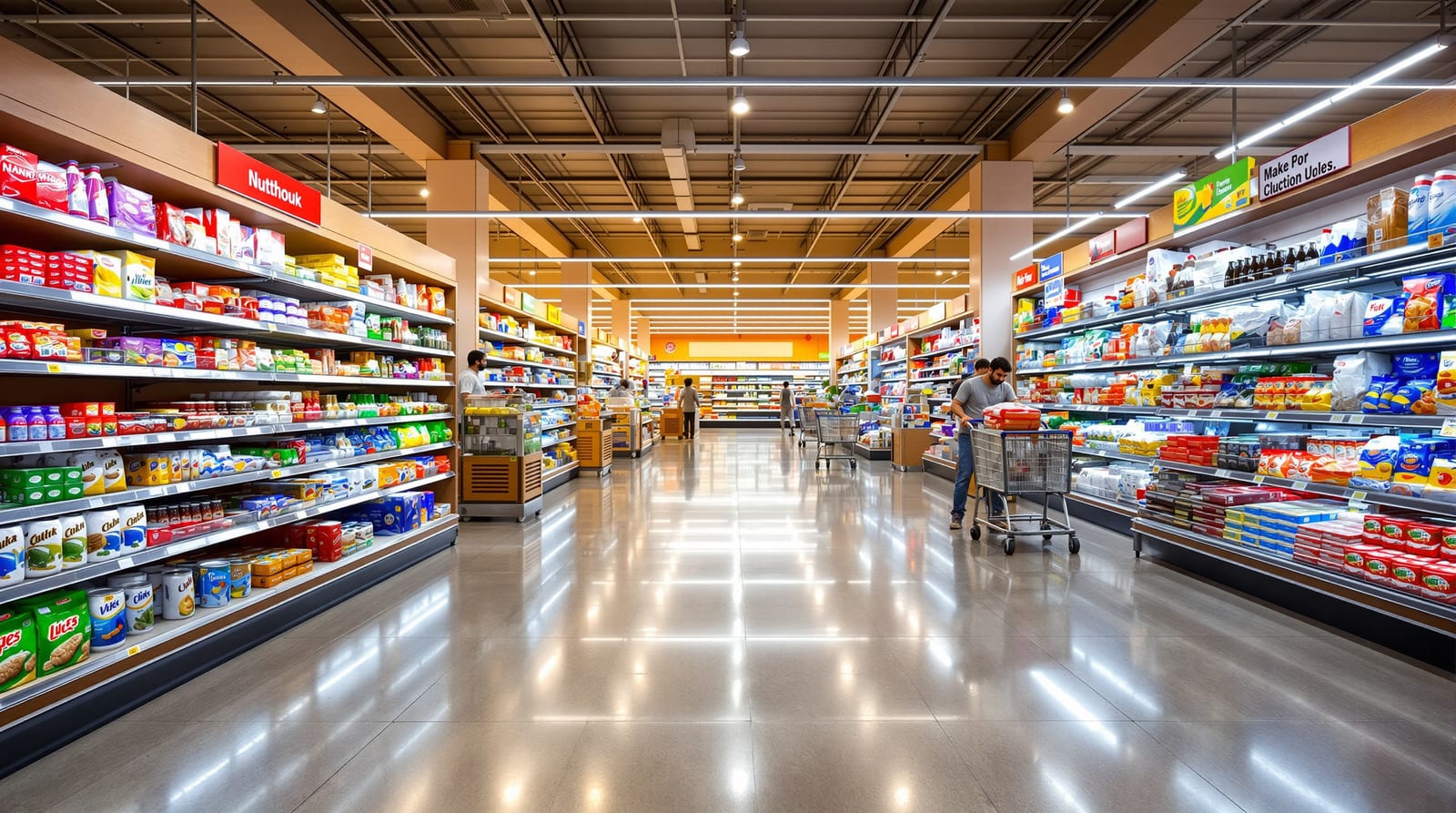
Supermarket Flooring in India: Zone-by-Zone Floors for Aisles, Fresh & Wet Areas, Checkout, Cold Storage and Loading
How to specify a trolley-tough, anti-slip, fast-to-clean floor across every zone of a supermarket or hypermarket — large-format vitrified or polished concrete for the aisles, R11 anti-slip for fruit-veg and dairy, PU resin for cold rooms, and VDF for the back-of-house and loading bay — at the lowest lifecycle cost per square foot.
A supermarket floor is one of the hardest-working surfaces in retail. It carries loaded trolleys and pallet jacks over tens of thousands of square feet, gets splashed with water at the fruit-veg misters and the fish counter, takes monsoon mud at the entrance, must survive sub-zero cold rooms at the back, and has to be cleaned every night without shutting the store — all on a thin margin that hates maintenance bills. Choosing one finish for the whole box, or buying on the lowest per-square-foot quote, is exactly how a grocery chain ends up with a slip claim at the dairy aisle or a cracked, stained aisle within three years. This guide maps the right floor to every zone of a supermarket or hypermarket in India — what to use, why, and the indicative ₹/sq ft — so the floor stays safe, clean and cheap to own.
What a supermarket floor actually has to survive
Six pressures shape every floor decision in a grocery store, and they are not the same across the box.
Trolley-wheel and footfall durability over huge areas. A hypermarket aisle sees thousands of foot passes plus loaded trolleys and pallet trucks every day, hour after hour. The aisle floor must resist hard-wheel abrasion, point loads and dragging for a decade without cracking, chipping at joints or wearing a path. Because the area is enormous — often 15,000 to 60,000 sq ft — the cost per square foot matters more here than anywhere else in the project.
Anti-slip at every wet and fresh zone — the top liability. Slips at fruit-and-vegetable misters, near the fish and meat counters, around dairy and frozen cabinets that sweat, and at the rain-soaked entrance are the single biggest injury and legal risk in a supermarket. These zones legally and practically need a slip-rated surface — DIN 51130 R10 minimum for wet public floors, R11 (and barefoot-area ratings) where standing water is routine — while the dry aisles can run at R9-R10. Getting the wet-zone rating wrong is the most expensive mistake in the building.
Seamless, fast and easy cleaning with minimal downtime. The floor is mopped, scrubber-dried and degreased nightly. Fewer joints and grout lines mean faster cleaning and fewer harbours for spilt milk, juice and produce debris. The store cannot close for a week to recoat, so any back-of-house resin or coating must be fast-curing and the front-of-house tiles must be replaceable in sections overnight.
Cold-zone and chemical suitability. Cold rooms, freezer back-stores and the chiller backs run at low or sub-zero temperatures with thermal shock from wash-downs; standard epoxy can crack and delaminate. These need cold-tolerant systems — PU (polyurethane) resin screeds rated for the temperature range. Areas with brine, fats and produce acids need chemical resistance too.
Lowest lifecycle cost per square foot. Grocery is a thin-margin business and the floor is a giant area, so total cost of ownership — buy + install + nightly cleaning + repair + replacement frequency — beats the day-one quote. A floor that simply scrubs clean and almost never needs refinishing usually wins over a cheaper finish that stains, cracks or needs annual attention.
Loading bay and back-of-house ruggedness. The receiving dock, back stores and aisles behind the shelving take pallet jacks, cages, dropped stock and trolley trains. This is an industrial floor problem — flat, abrasion-hard and impact-tough — not a decorative one.
The right floor by zone — recommendation and cost table
The table pairs each supermarket zone with the floor families that win in India, the indicative installed cost in 2026, and the one driver that should decide it. Costs are broad ranges over large areas; confirm against current quotes and the flooring cost per square foot guide.
| Supermarket zone | Recommended floor | ₹/sq ft (installed) | Key driver |
|---|---|---|---|
| Main aisles / shop floor | Large-format vitrified (double-charged / full-body), polished concrete, or VDF concrete | 90-220 | Trolley-wheel durability + easy-clean + lowest cost over huge area |
| Fresh produce (fruit & veg) | Anti-slip vitrified/porcelain R10-R11, with floor drains | 120-260 | Anti-slip at misters + water + easy debris clearing |
| Fish / meat / wet counters | R11 anti-slip porcelain or quarry tile, coved, drained | 150-300 | Slip + water + odour + frequent wash-down |
| Dairy / chiller fronts | Anti-slip vitrified/porcelain R10-R11 | 120-260 | Condensation slip + spilt-milk hygiene |
| Checkout / billing lanes | Anti-skid vitrified/porcelain R10 | 100-220 | Standing footfall + dropped-item grip |
| Entrance / lobby | Anti-skid large-format vitrified or granite + barrier matting | 130-350 | Monsoon wet-foot slip + first impression |
| Cold rooms / freezer back-store | PU (polyurethane) resin screed, cold-rated | 250-500 | Sub-zero tolerance + thermal-shock + seamless hygiene |
| Bakery / hot food back | PU resin or epoxy, anti-slip, coved | 180-450 | Grease + heat + slip + hygiene |
| Back-of-house / store rooms | Epoxy or polished concrete | 120-350 | Abrasion + easy-clean |
| Loading / receiving bay | VDF concrete with floor hardener, or granolithic | 90-260 | Pallet-jack load + impact + flatness |
Zone-by-zone diagram
This plan shows how a single store splits into three flooring jobs — the huge dry aisle field, the slip-critical wet and fresh band, and the rugged cold/back zone — each with a different finish and drainage logic.
Main aisles — the floor that decides the project
The aisles and open shop floor are the largest single area, so this choice sets the budget and the cleaning regime. Three finishes win in India.
Large-format vitrified tile — double-charged or full-body GVT in 600x600, 600x1200 or 800x800 — is the default for most Indian supermarkets and hypermarkets. It is hard, abrasion-resistant (specify PEI IV-V), trolley-tough, mops clean, comes in light commercial shades that read clean and bright, and any cracked tile can be lifted and replaced overnight. Use a rectified tile with a tight grout joint and an epoxy grout so spilt milk and juice do not stain the lines. See vitrified tile flooring for grade selection.
Polished concrete is increasingly chosen for the discount and warehouse-club format: it is the single most durable, lowest-lifecycle-cost option for a giant area, fully seamless (no grout to clean), mops and scrubs clean, and reads modern-industrial. It needs a sound slab and periodic resealing, and its slip rating must be lifted with a treatment in any zone that gets wet. The polished concrete flooring guide covers the finish levels.
Vacuum-dewatered concrete (VDF) is the value champion where looks matter least — a power-floated, dense, flat, abrasion-hard slab that can be the finished aisle floor or the base for tiles or coatings. It is the cheapest robust option over very large areas and ideal behind the scenes; the vacuum-dewatered concrete guide explains the FM2 flatness it can achieve.
Fresh, wet and checkout zones — where slip is the whole game
This band — fruit and vegetables under misters, the fish and meat counters, the dairy and frozen aisle where cabinets sweat, the checkout lanes, and the rain-wet entrance — is the supermarket's biggest liability. Every surface here needs a slip rating earned in the wet, not a glossy aisle tile carried over.
Specify R10-R11 anti-slip vitrified or porcelain with a textured or structured face, lay it to a fall toward floor drains at the fish and produce counters, and cove the skirting at the wet counters so wash-down water never sits at the wall junction. Quarry tile is a tough, classic choice at the fish and meat counters. Keep the grout epoxy and the joints tight. At the entrance, combine an anti-skid large-format tile (or granite) with proper barrier matting to take monsoon water off shoes before it reaches the aisles. Detail the slip ratings against anti-slip flooring for wet areas, and design the entry transition with monsoon-ready flooring in mind. To match each zone to an R-rating, the anti-slip rating selector is the fastest check.
Cold rooms, bakery and back-of-house
The cold rooms and freezer back-stores run cold to sub-zero with thermal shock from wash-downs, and standard epoxy will fail there. Specify a PU (polyurethane) resin screed rated for the operating temperature — it stays bonded and crack-free through freeze-thaw and hot wash-down, is seamless and coved for hygiene, and is chemical-resistant against produce acids and cleaning agents. The same family suits the bakery and hot-food back, where grease and heat are added, with an anti-slip aggregate broadcast in. See the PU resin flooring guide for the temperature classes.
Dry store rooms and back-of-house can drop to epoxy or polished concrete — abrasion-hard, seamless and easy to mop. The loading and receiving bay is an industrial floor: a VDF concrete slab with a dry-shake floor hardener, or granolithic topping, to take pallet-jack loads, cage impacts and dropped stock while staying flat. For the broader sector framework and how a supermarket compares with malls, offices and hospitals, read the commercial flooring guide, and for the high-footfall concourse logic a supermarket shares with shopping centres, see the mall flooring guide.
Lifecycle cost — why the cheapest aisle floor usually loses
A supermarket floor lives 10-15 years over a vast area, so the buy price is a fraction of the total cost of ownership. Compare on lifecycle, not the per-square-foot quote.
| Aisle floor | Buy + install ₹/sq ft | Nightly cleaning | Refresh cycle | Verdict over 10 years |
|---|---|---|---|---|
| Large-format vitrified | 90-220 | Low (scrub-dry) | Replace odd cracked tile | Excellent value, easy repair |
| Polished concrete | 130-420 | Very low (seamless) | Reseal 3-5 yr | Lowest long-run cost |
| VDF concrete | 90-200 | Low | Re-coat / re-polish if needed | Cheapest robust base |
| Standard ceramic | 50-110 | Moderate (grout) | Cracks under trolleys early | False economy in aisles |
| Vinyl / LVT | 90-400 | Low (mop) | 10-15 yr wear layer | Good in offices, soft for trolleys |
The pattern is the same as the rest of commercial: floors that scrub clean and rarely need refinishing — vitrified, polished concrete and VDF — beat softer or grout-heavy options over a decade even when they cost more on day one. Model your own numbers with the commercial flooring cost calculator, and shortlist by exact zone in the space flooring selector.
Do and don't for supermarket floors
Do specify the aisle tile by PEI/abrasion class and use epoxy grout so spills do not stain the joints. Do lift every wet and fresh zone to R10-R11 and lay it to drains with coved skirting. Do put cold-rated PU resin in cold rooms and freezers, never standard epoxy. Do plan barrier matting and an anti-skid entrance for the monsoon. Do phase any back-of-house recoating with fast-cure resin so the store stays open.
Don't carry a glossy aisle tile into the fish, produce or dairy zone — that is where the slip claims happen. Don't floor the aisles in standard ceramic to save money; it chips and cracks under trolleys and pallet jacks within a couple of years. Don't forget floor drainage at the wet counters and the entrance. Don't ignore the loading bay — a soft back-of-house floor fails fastest. Don't buy on day-one quote alone over an area this large; lifecycle cost decides it.
Frequently asked questions
What is the best flooring for supermarket aisles in India?
Large-format double-charged or full-body vitrified tile is the default — trolley-tough, easy to scrub clean, and any cracked tile lifts out overnight. For discount and warehouse-club formats, polished concrete is the most durable, lowest-lifecycle-cost choice, and VDF concrete is the cheapest robust base. Standard ceramic is a false economy in aisles because it cracks under trolley and pallet-jack traffic.
What anti-slip rating do supermarket wet and fresh zones need?
Dry aisles can run at R9-R10, but the fruit-and-vegetable misters, fish and meat counters, sweating dairy and frozen cabinets, checkout lanes and the rain-wet entrance need R10 minimum and R11 where standing water is routine, per DIN 51130 — laid to floor drains with coved skirting. This is the supermarket's biggest liability; the anti-slip flooring for wet areas guide and the anti-slip rating selector map ratings to zones.
Why can't I use epoxy in a supermarket cold room?
Standard epoxy can crack and delaminate under sub-zero temperatures and the thermal shock of hot wash-downs in cold rooms and freezer back-stores. Cold rooms need a PU (polyurethane) resin screed rated for the operating temperature, which stays bonded and crack-free through freeze-thaw while remaining seamless, coved and chemical-resistant for hygiene.
How much does supermarket flooring cost per square foot in India?
Indicatively in 2026: ₹90-220/sq ft for aisle vitrified or polished concrete, ₹120-300/sq ft for R10-R11 anti-slip tile in fresh and wet zones, ₹250-500/sq ft for cold-rated PU resin in cold rooms, and ₹90-260/sq ft for VDF concrete loading bays. Because the area is huge, lifecycle cost — cleaning, repair and replacement frequency — matters far more than the day-one quote; model both with the commercial flooring cost calculator.
Can the same floor be used across the whole supermarket?
No. The dry aisles, the slip-critical wet and fresh band, and the cold and back-of-house zones are three different flooring jobs with different durability, slip and temperature demands. Trying to run one finish everywhere either over-spends on the aisles or, more dangerously, leaves the wet zones too slippery. Zone the floor — vitrified or polished concrete in aisles, R11 anti-slip tile in fresh and wet areas, PU resin and VDF at the back. The commercial flooring guide sets out the full zoning framework.
Export this guide
Related Guides — Deep-dive reading
Commercial Flooring Guide India: The Right Floor for Every Sector, with Costs and Codes
The complete commercial flooring decision framework for India — how commercial differs from home (footfall, durability, slip, fire and accessibility codes, hygiene, lifecycle cost, downtime, brand image), plus the recommended floor, ₹/sq ft and key driver for offices, retail, restaurants, hotels, hospitals, schools, gyms, salons, banks, malls, warehouses, commercial kitchens and data centres.
Flooring & SurfacesMall Flooring in India: The Right Floor for Concourse, Atrium, Food Court and Anchor Stores, with Costs
Shopping malls floor millions of footfalls a year while projecting a premium image and passing slip checks — here is the floor, ₹/sq ft and key driver for the concourse, atrium feature, food court, entrance, anchor stores, lift lobbies, parking and washrooms.
Flooring & SurfacesIndustrial Flooring in India: Floor Hardeners, VDF, Epoxy & PU Systems for Factories, Warehouses & Parking — Method, Flatness & Cost
Industrial flooring is the family of heavy-duty floor systems built for factories, warehouses, godowns, workshops, parking and logistics — dry-shake floor hardeners, vacuum-dewatered concrete, granolithic, epoxy and PU toppings, and polished concrete, all rated for forklift traffic, point loads, abrasion, chemicals and dust control at roughly ₹80–400 per sq ft. Here is how to choose the right system by use, with the joints, curing, flatness and cost detail.
Flooring & SurfacesRelated Tools — Try Free
Flooring Cost Calculator
Estimate the all-in cost of a floor — material, laying, wastage, skirting and GST — by area and material.
Flooring CalculatorAcoustic Privacy (STC) Visualizer
Indian healthcare acoustic visualizer — compare wall assemblies and noise sources, see received SPL after STC attenuation, and check FGI 2018 / IS 1950 / NABH speech-privacy compliance with live dual-canvas waveform.
Acoustic ToolHealing View Impact Calculator
Evidence-Based Design dashboard quantifying the recovery impact of nature view + daylight factor on analgesic use, length of stay, and HCAHPS patient-experience uplift. Calibrated against Ulrich 1984 (Science), Park & Mattson 2008, and the CHD EBD evidence base.
EBD Calculator