
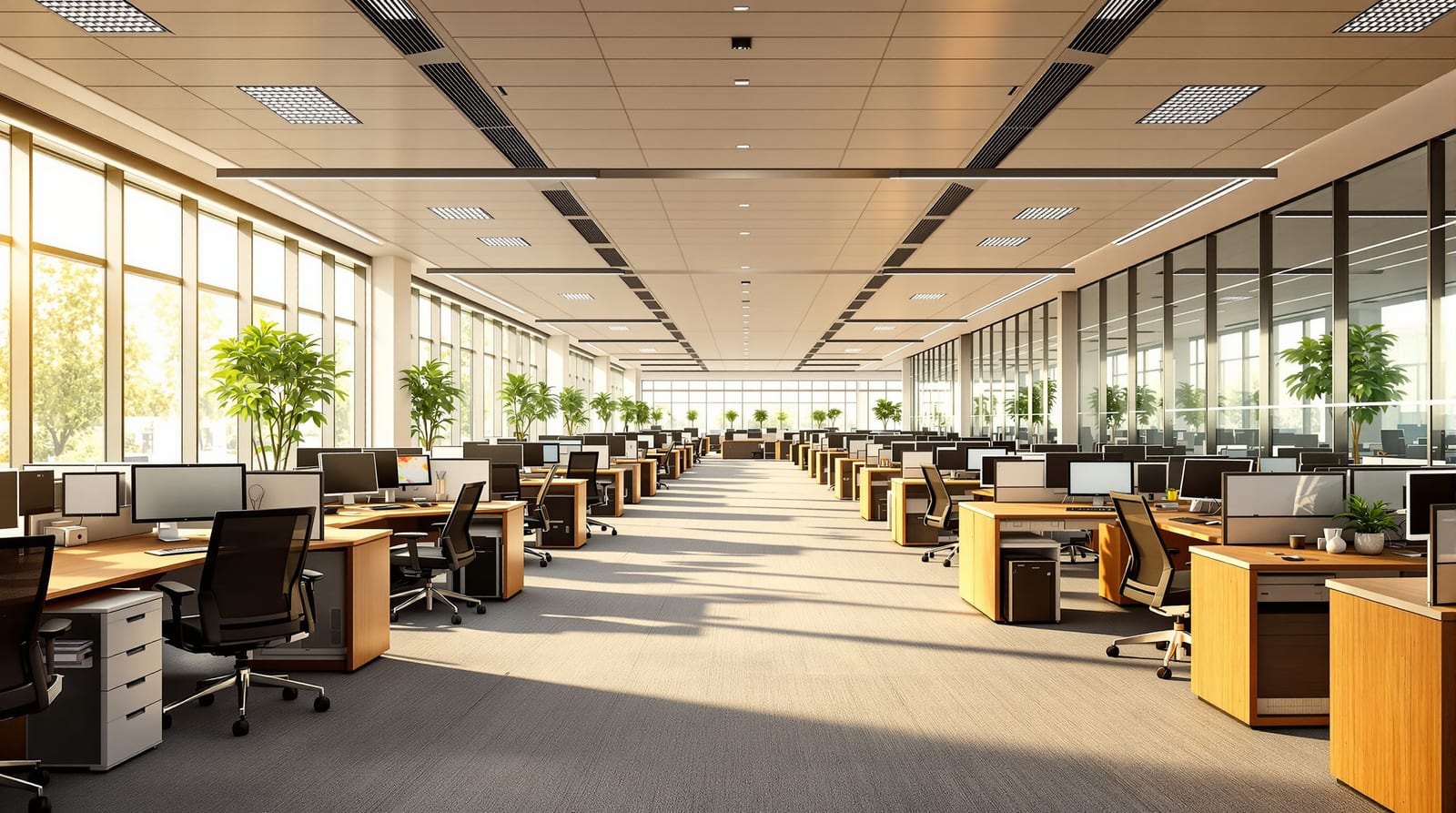
Office Flooring in India: Zone-by-Zone Guide for Workstations, Cabins, Reception and Server Rooms
How to specify the right office floor for every zone — carpet tile, LVT, raised-access, vitrified and polished concrete — for acoustics, durability, cable management and brand image.
An office is not one space, it is a dozen — and a single floor specification across all of them is the most common, most expensive mistake in a fit-out. The open-plan workstation bay wants acoustics and cable access; the reception wants brand image and a hard-wearing shine; the server room wants anti-static and a raised plenum; the cafeteria wants slip resistance and grease tolerance. Get the zoning right and the floor does invisible work for years. Get it wrong and you pay in echo, downtime, snagging and a tired-looking lobby within eighteen months.
This guide is a zone-by-zone specification map for an Indian office fit-out: for each zone it names the recommended floor, explains why, and gives indicative 2026 rates per sq ft. It complements the broader commercial flooring guide for India — read that for the principles, this for the office. To compare options for one space quickly, use the office flooring selector, and to price the whole fit-out, the commercial flooring cost calculator.
The five drivers behind every office floor decision
Before zoning, fix the priorities. Every office floor balances the same five forces, weighted differently per zone:
- Acoustics. Open-plan offices live or die on noise control. Hard, reflective floors amplify keyboard clatter, footfall and the cross-talk of a hundred conversations, raising the ambient din and wrecking concentration. Soft, resilient floors absorb it — which is why carpet tile dominates workstation bays worldwide.
- Durability under footfall and chairs. Office floors take relentless caster-chair traffic, trolley movement and thousands of footsteps. The wear layer and the chair-caster resistance decide how the floor looks in year five, not year one.
- Cable management. Offices are dense with power and data cabling. The floor either carries it — a raised-access plenum or an under-carpet flat-cable system — or it does not, in which case cabling runs overhead or in dado trunking. This is a floor decision made at the structural stage, not at handover.
- Brand image. The reception, lobby and client-facing zones are the company's handshake. A large-format vitrified, granite or polished-concrete floor signals scale and seriousness; a tired or cheap-looking lobby floor undercuts every other investment in the space.
- Maintenance and downtime. Offices run on uptime. Floors that install fast, let trades work in parallel, and can be repaired tile-by-tile without closing the floor — carpet tile and LVT especially — minimise both fit-out time and lifetime disruption. The ₹/sq ft cost is real, but so is the cost of a floor that takes the office offline to repair.
Zone-by-zone: the office floor plan
The single most useful way to think about an office floor is as a zoned plan. The diagram below maps a typical floor plate to its recommended surfaces.
Open-plan workstations — carpet tile, or LVT
This is the largest zone and the one that defines the office's acoustic comfort. Carpet tiles are the default for good reason. A high-density commercial loop pile absorbs keyboard and footfall noise better than any hard floor, keeps the workstation bay calm, and the 50x50 cm modular format is built for offices: it lays fast, runs neatly over an under-carpet flat-cable system, and when a tile stains or a chair wears a track you lift and swap a single tile instead of closing the floor. Specify a contract-grade tile with a bitumen or PVC back and a stain-resist treatment, not a domestic broadloom.
Where a harder, more contemporary look is wanted — or in agile, hot-desking layouts that move furniture often — luxury vinyl tile (LVT) is the alternative. It is tough, caster-friendly, wipes clean, and a wood-look or stone-look plank gives a warm, premium feel. It is noisier than carpet, so pair it with an acoustic underlay and soft furnishings if the bay is large.
Cabins and private offices — carpet, LVT or engineered wood
Manager cabins and director offices carry a brand expectation. Carpet tile keeps them quiet and consistent with the open plan; LVT reads as crisp and modern; and for the most senior, client-facing cabins, engineered wood brings genuine warmth and gravitas while staying stable in Indian humidity. Match the threshold transition carefully so cabin-to-open-plan changes read as deliberate.
Reception, lobby and client zones — large-format vitrified, granite or polished concrete
This is where the floor earns its keep as brand image. The reception is seen by every visitor and photographed for every brochure, so it gets the hardest, most impressive surface. Large-format vitrified tile (PGVT) in 800x800 mm or 1200x600 mm gives a seamless, marble-look expanse at a sensible cost. Granite is the durability-and-prestige pick — it shrugs off heavy footfall and rolling luggage indefinitely. For a contemporary, industrial-chic identity, polished concrete delivers a seamless, low-maintenance monolithic floor that suits tech and creative brands. Whatever the choice, the entrance threshold must stay slip-safe in monsoon — specify a lightly textured or honed finish at the door, not mirror-polished, and lay walk-off matting.
Meeting and conference rooms — acoustic carpet
Meeting rooms are acoustic-critical: speech clarity and low reverberation matter more than anywhere else in the office. Carpet — broadloom or tile — is the standard, because a soft floor cuts reverberation that makes video calls and presentations sound boomy. Combine it with acoustic ceiling and wall treatment for a room that sounds as professional as it looks.
Server and IT room — raised-access plus ESD
The server room is a specification all its own. A raised-access floor creates a plenum beneath the panels for the dense power and data cabling — and often for under-floor cooling air — while keeping the surface clear and reconfigurable. The panels must carry an anti-static / ESD finish to protect sensitive electronics from static discharge, with the system properly earthed. This is the one office zone where the floor is genuinely mission-critical; spec it with the IT and MEP consultants, not as a finishes afterthought.
Cafeteria, pantry and corridors — anti-slip vitrified
The cafeteria and pantry are the office's wet-and-greasy zone, so slip resistance leads. Specify an anti-slip vitrified or porcelain tile rated at least R10, moving to R11 right at the servery and dishwash where water and grease pool — see DIN 51130 R-ratings in the anti-slip flooring standards guide. Corridors and breakout spaces take heavy through-traffic, so a durable vitrified or polished concrete that holds up to trolleys and footfall and reads continuous with the workstation bays works best.
Office flooring: zone, recommended floor and cost
The table maps each zone to its recommended floor, the reason, and an indicative installed 2026 rate. Use it as a specification starting point and tune to your brand and budget.
| Zone | Recommended floor | Why | Indicative rate (₹/sq ft, installed) |
|---|---|---|---|
| Open-plan workstations | Carpet tile (commercial loop); LVT alt | Acoustics, swappable, cable-friendly | 80-400 (carpet tile) / 90-400 (LVT) |
| Cabins / private offices | Carpet tile, LVT, engineered wood | Quiet, premium, brand-consistent | 80-400 / 90-400 / 250-800 |
| Reception / lobby | Large-format vitrified, granite, polished concrete | Brand image, heavy footfall, durable | 120-220 / 130-350 / 130-420 |
| Meeting / conference | Acoustic carpet (tile or broadloom) | Speech clarity, low reverberation | 80-400 |
| Server / IT room | Raised-access + ESD finish | Cable/cooling plenum, anti-static | 200-650 |
| Cafeteria / pantry | Anti-slip vitrified / porcelain (R10-R11) | Slip + grease + easy clean | 80-220 |
| Corridors / breakout | Durable vitrified, polished concrete | Through-traffic, trolley-tough | 80-220 / 130-420 |
Rates are indicative all-India 2026 figures including basic installation; raised-access systems vary widely with panel grade and pedestal height, and imported carpet tile, LVT and engineered wood run higher. For your floor plate and city, model the mix in the commercial flooring cost calculator.
Cable management: the floor decision made early
How an office carries its cabling is a floor question settled at the design stage. There are three routes. A raised-access floor across the whole floor plate (common in IT-heavy and trading offices) gives total flexibility — power, data and even cooling run in the plenum and reconfigure as teams move. An under-carpet flat-cable system runs thin power and data ribbons beneath carpet tiles in selected runs — far cheaper than a full raised floor and ideal for workstation bays where carpet tile lifts to access the cable. Or cabling runs overhead and in dado trunking, leaving the floor solid — the lowest first cost but the least flexible when the office is reconfigured. Decide this before the floor finish, because it changes the floor build-up height and the screed level at every threshold.
Fast install and low downtime
In a live fit-out, programme is money. Modular floors — carpet tile and click LVT — install fast and let other trades work alongside, which is why they dominate office bays. Wet trades (large-format vitrified, granite, polished concrete) need curing and clean conditions, so they belong in the reception and core where they can be sequenced early. The lifetime advantage of modular floors is repairability: a damaged carpet tile or LVT plank is swapped in minutes without taking the floor offline, whereas a cracked large-format tile in a live office means dust, noise and a closed walkway. Keep an attic stock of every floor tile from day one so repairs match.
Do and don't
- Do zone the floor — never spec one finish across the whole plate. Acoustics, cable and brand demands differ too much between bay, lobby and server room.
- Do specify contract-grade carpet tile and LVT (commercial wear layer, stain-resist), not domestic products, in a high-traffic office.
- Do keep the reception threshold lightly textured or honed for monsoon grip, and lay walk-off matting at every entrance.
- Don't treat the server-room floor as a finishes afterthought — spec raised-access and ESD with the IT and MEP team.
- Don't lay polished, mirror-finish stone in cafeteria or wet zones; specify R10-R11 anti-slip vitrified instead.
- Don't forget attic stock — a few spare tiles of every floor make tile-by-tile repair painless.
Care and maintenance
Office floors reward a planned regime. Carpet tile wants daily dry vacuuming, periodic encapsulation or hot-water-extraction deep cleans, and tile rotation in worn chair-zones to even out wear. LVT and vitrified need only sweeping and damp mopping with a neutral cleaner; avoid harsh acids that dull the surface. Polished concrete is the lowest-maintenance of all — dust-mop and occasional re-polish — but plan periodic resealing (see the floor resealing guide). Raised-access panels should be checked for level and earthing on a maintenance cycle, especially after any cabling change. Across the board, walk-off matting at entrances is the single cheapest way to keep grit off the floors and extend their life.
Frequently asked questions
What is the best flooring for an office in India?
There is no single answer — the best office floor is zoned. Carpet tile is the default for open-plan workstations because it is acoustic, swappable and cable-friendly; LVT is the harder-wearing alternative. Reception and lobby take large-format vitrified, granite or polished concrete for brand image and durability; meeting rooms take acoustic carpet; server rooms need raised-access plus ESD; and cafeterias need anti-slip vitrified. Specify each zone for its own demands.
Why is carpet tile the standard for office workstations?
Carpet tile wins on the three things a workstation bay needs most: acoustics (it absorbs keyboard and footfall noise that hard floors amplify), cable management (it lifts to access under-carpet flat cable or a raised floor), and repairability (a stained or worn 50x50 cm tile is swapped in minutes without closing the floor). Specify a commercial loop pile with a stain-resist treatment, not domestic broadloom.
How much does office flooring cost per sq ft in India in 2026?
Indicative installed rates run roughly ₹80-400 per sq ft for commercial carpet tile, ₹90-400 for LVT, ₹120-220 for large-format vitrified, ₹130-350 for granite, ₹130-420 for polished concrete and ₹200-650 for raised-access systems. Because an office mixes zones, the blended rate depends on the plan; model your exact mix in the commercial flooring cost calculator.
Do I need a raised-access floor for the whole office?
Usually no. A full raised-access floor across the plate gives maximum cable and cooling flexibility and suits IT-heavy or trading offices, but it adds cost and height. Most offices reserve raised-access for the server and IT rooms, and handle workstation cabling with an under-carpet flat-cable system or dado trunking — a much lower first cost. Decide at the design stage, as it changes floor build-up height.
What flooring suits an office cafeteria or pantry?
Anti-slip vitrified or porcelain tile rated at least R10 (DIN 51130), stepping up to R11 at the servery and dishwash where water and grease collect. It resists slips, tolerates grease and spills, and wipes clean. Avoid polished stone and high-gloss tile in this zone — they become dangerously slick when wet. See the anti-slip flooring standards guide for the full R-rating picture.
Export this guide
Related Guides — Deep-dive reading
Bank Flooring in India: Zone-by-Zone Guide for Banking Halls, Workstations, Cabins, Server Rooms and Vaults
How to specify a dignified, durable, low-maintenance floor for every zone of a bank or corporate office — granite and large-format vitrified for the hall, acoustic carpet tile for workstations, raised-access ESD for IT, and security-grade stone for the vault.
Flooring & SurfacesCarpet Tiles in India: Modular 50x50 cm Carpet Squares for Offices, Co-working & Commercial Floors — Types, Backing, Cost & Install
Carpet tiles — modular 50x50 cm (and 25x100 cm) backed carpet squares — are the go-to soft floor for offices, co-working spaces, IT and retail because a single stained tile can be lifted and swapped instead of recarpeting the whole room. Here are the backing types, install methods, acoustic and anti-static options, costs of ₹60–300 per sq ft, pros, cons and how they compare with broadloom carpet.
Flooring & SurfacesAnti Slip Flooring for Bathroom and Wet Areas in India: R-Ratings, Finishes and Genuinely Safe Tile Choices
How to choose genuinely safe flooring for bathrooms, kitchens, balconies, pools, entrances and elderly- or child-friendly homes — the R-rating system, finishes that grip wet feet, anti-skid natural stone, slope to drains and the tiles to avoid.
Flooring & SurfacesRelated Tools — Try Free
Flooring Cost Calculator
Estimate the all-in cost of a floor — material, laying, wastage, skirting and GST — by area and material.
Flooring CalculatorAcoustic Privacy (STC) Visualizer
Indian healthcare acoustic visualizer — compare wall assemblies and noise sources, see received SPL after STC attenuation, and check FGI 2018 / IS 1950 / NABH speech-privacy compliance with live dual-canvas waveform.
Acoustic ToolOffice Flooring Selector
Get the right office floor by zone — workstations, reception, meeting rooms, server room and cafeteria.
Flooring Tool