

STP AMC Selection Guide: How to Choose an Annual Maintenance Contract That Actually Protects Your Plant
Comprehensive versus basic AMCs, what to insist is written into the scope, response times, spares, penalties and the red flags that separate a real maintenance partner from a cheap quotation — a practical guide for owners, RWAs and consultants.
A sewage treatment plant is not an appliance you install and forget. It is a small living factory — billions of microbes, a dozen pumps and blowers, filters, sensors and a chlorine line — that needs feeding, watching and fixing every single day. The equipment might carry a five-year warranty, but the biology has no warranty at all. Miss a week of dosing, let a blower trip and stay tripped, ignore a clogged diffuser, and the culture that took months to build collapses in days. When that happens the water turns septic, the complaints start, and the next inspection finds you out of compliance.
This is why the single most important decision after buying an STP is not which technology you chose — it is who maintains it, and on what terms. That contract is the Annual Maintenance Contract, or AMC. This guide walks owners, RWAs and consultants through choosing one that actually protects the plant, rather than the cheapest signature on a page.
A good STP with a bad AMC will fail. A modest STP with a disciplined AMC will run for fifteen years. The contract, not the brand of the blower, decides which one you get.
Comprehensive versus basic: the fork in the road
Almost every AMC quotation you receive will be one of two animals, and confusing them is the most expensive mistake buyers make.
A basic (or "labour" / non-comprehensive) AMC buys you people and periodic visits. The vendor supplies operators or a visiting technician, runs the plant, and tells you what is wrong. But when a pump burns out or the sand in a filter needs replacing, you pay for the part, separately, at whatever price the vendor quotes that day. On paper it looks cheap. In practice the "extras" arrive every month.
A comprehensive AMC bundles labour and all spares, consumables and repairs into one fixed annual fee. The vendor now has skin in the game: if a bearing fails, it is their cost, so it is in their interest to maintain it well and not run equipment to destruction. This is the contract most consultants recommend for any plant a building actually depends on.
| Feature | Basic / Labour AMC | Comprehensive AMC |
|---|---|---|
| Operator manpower | Included | Included |
| Routine servicing | Included | Included |
| Consumables (chlorine, media top-up) | Usually billed extra | Included |
| Spare parts & repairs | Billed extra, ad hoc | Included up to defined limits |
| Annual cost | Lower headline | Higher headline |
| Real cost predictability | Poor — surprises every month | High — one fixed number |
| Vendor incentive | To keep billing parts | To prevent failures |
The honest way to compare the two is not by the headline figure but by total cost of ownership over a year. Model both against your plant's real spare-replacement cycle with the AMC cost calculator before you sign anything — a "cheaper" basic AMC often overtakes a comprehensive one within eight months once the parts bills land. For the bigger operating picture, pair it with our STP annual operating cost guide.
What a serious AMC scope must contain

The word "comprehensive" on a cover letter means nothing. The protection lives in the scope of work, and a scope that fits on half a page is a warning sign. Insist that these are written in, explicitly:
- Manpower, named by role and shift. How many operators, what qualification, which shifts. A 500 KLD plant needs a trained operator on site through running hours — not a "we will send someone" arrangement.
- A defined preventive-maintenance schedule. Daily, weekly, monthly and quarterly task lists — blower oil changes, diffuser inspection, pump greasing, panel checks — with a signed logbook you can audit.
- All consumables listed. Chlorine or hypo, filter media top-ups, antiscalants for MBR, lab reagents. If it is consumed to run the plant, name it and say who pays.
- Water-quality testing and CPCB compliance support. Periodic lab analysis of BOD, COD, TSS and faecal coliform, and help preparing the returns your pollution-control board expects. A plant that meets STP regulations in India on paper still needs someone to keep it there.
- Repairs and spares, with limits stated. Which parts are covered, up to what value, and what is explicitly excluded (motors, membranes and civil work are common carve-outs). Ambiguity here is where disputes live.
- Reporting. A monthly report with test results, downtime, parts replaced and consumption. Without it you are flying blind between annual renewals.
Response times and uptime — put numbers on it
"We will attend promptly" is not a commitment; it is a mood. A contract worth signing states response and resolution times in hours, and attaches consequences.
- Response time — how fast a technician physically reaches the site after a breakdown call. For a plant serving occupied homes, insist on same-day for critical failures (blower, main pump, controls) and 24–48 hours for routine issues.
- Resolution time — how long until it actually works again, which matters more. A four-hour response and a two-week repair still leaves you with septic water.
- Uptime / penalty clause. Tie a portion of the fee to performance: if treated-water quality breaches norms because of vendor negligence, or if a critical asset stays down beyond the agreed window, the vendor absorbs a penalty. This single clause changes a vendor's behaviour more than any promise in the sales meeting.
Critical failures cascade. A blower down for a day starves the microbes of oxygen; if it stays down for three, you are staring at the problems in our STP troubleshooting guide — a dead culture, a fortnight of re-seeding, and complaints throughout.
Spares, stock and the parts you should never wait for
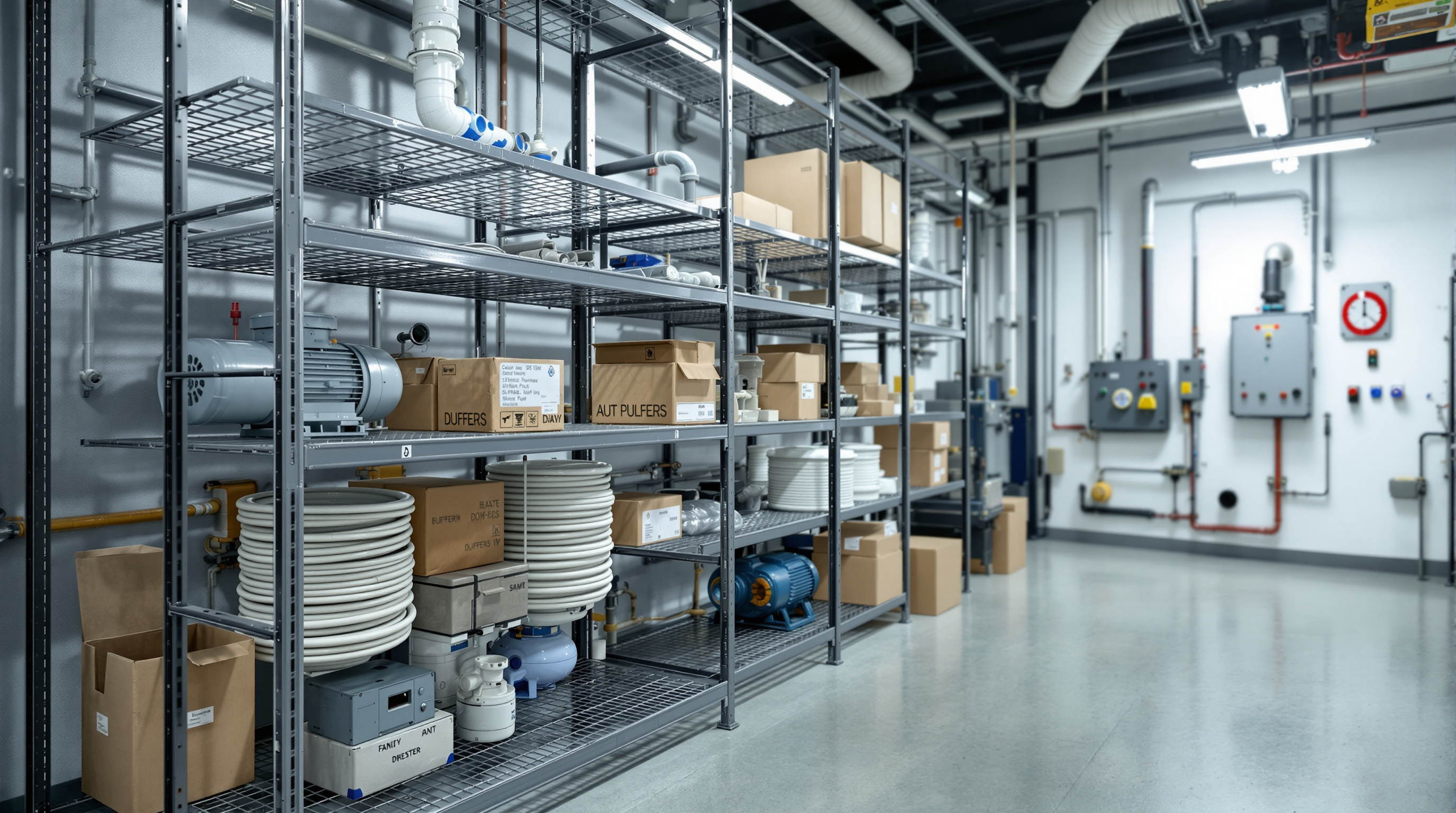
The fastest response in the world is useless if the part is three weeks away. Ask two blunt questions. First, does the vendor hold critical spares in local stock — a standby blower or motor, diffuser sets, dosing-pump parts, common valves and sensors — or does everything ship from another city on demand? Second, who owns the standby equipment? Many well-run plants keep one spare blower and one spare pump on the shelf as a condition of the AMC, so a failure means a swap in an hour, not a shutdown for a week.
Get an agreed spares list into the contract with indicative prices, so a genuine emergency purchase cannot become a hostage negotiation. For a plant with membranes or specialised media, confirm lead times honestly — an MBR membrane is not something you source overnight, so it must be planned, not improvised.
Red flags: when to walk away
Some signals should stop a signature cold:
- A quote far below the field. STP maintenance has real, roughly known costs. A number 30–40% under everyone else means corners you cannot see yet — undertrained manpower, or parts billed later.
- Vague scope, generous adjectives. "Complete O&M as required" with no task lists, no manpower count, no spares list. The vagueness is deliberate.
- No local presence or references. Ask for two or three plants of similar size and technology they maintain nearby — and call them. A vendor who cannot produce references maintains fewer plants than they claim.
- No logbook or reporting discipline. If they cannot show you a sample monthly report and a filled logbook from an existing site, they do not have a system.
- Technology mismatch. An operator fluent in MBBR is not automatically competent on an MBR or SBR plant. Membranes, in particular, punish inexperience quickly. Confirm they have run your technology.
- Pressure to skip the trial. A confident vendor will accept a shorter initial term or a performance review at 90 days. Reluctance tells you something.
Before you sign
Do three things. Walk an existing site the vendor maintains and look at the logbook, the housekeeping and the treated water with your own eyes. Get the scope, spares list, response times and penalty clause in writing — not in the sales deck. And model the true annual cost of the comprehensive versus basic options for your plant size and technology.
An AMC is not an expense to minimise; it is the insurance policy on an asset you are legally required to keep running. Choose the partner who keeps the microbes alive on the quiet days, and the plant will quietly keep you compliant on the day the inspector arrives.
For the wider decision set — sizing, technology, cost and compliance — return to the Sewage Treatment Plants guide library, or dig into ongoing running costs with the STP maintenance cost guide.
Export this guide
Related Guides — Deep-dive reading
Annual STP Maintenance & Overhaul: The Complete Yearly Shutdown Checklist
Once a year your STP needs a full stop, a drain-down, and an honest look at everything the daily rounds never reach — tanks, blowers, membranes, instruments, concrete and the AMC. Here is the complete annual overhaul, in the right order.
Sewage Treatment PlantsSTP Final Handover Checklist: Documents, Spares, Training & Defect Liability
The complete handover from contractor to owner: the drawings, O&M manuals, warranties and test reports you must collect, the spares and tools to count, the operator training to insist on, and the defect-liability terms that protect you for the next year.
Sewage Treatment PlantsComparing STP Vendors: How to Evaluate Suppliers Fairly
A practical framework for developers, owners, RWAs and consultants to compare sewage treatment plant vendors on track record, technology, guarantees, after-sales support and truly apples-to-apples quotes — instead of just picking the lowest number.
Sewage Treatment PlantsRelated Tools — Try Free
Interior Contract Clause Checklist
16 sections and 98 checkboxes covering scope, BOQ, milestones, penalties, warranty, and disputes.
Contract ChecklistRainwater Tank Sizer
How big should your rainwater tank be? Computes annual harvest, recommended tank capacity in litres, water-bill savings, and payback — for 10 Indian cities.
RWH CalculatorSTP Technology Comparison Matrix
Compare Extended Aeration, MBBR, SBR, MBR and UASB across six criteria, set your priority, and see the best-fit STP technology instantly.
Comparator