
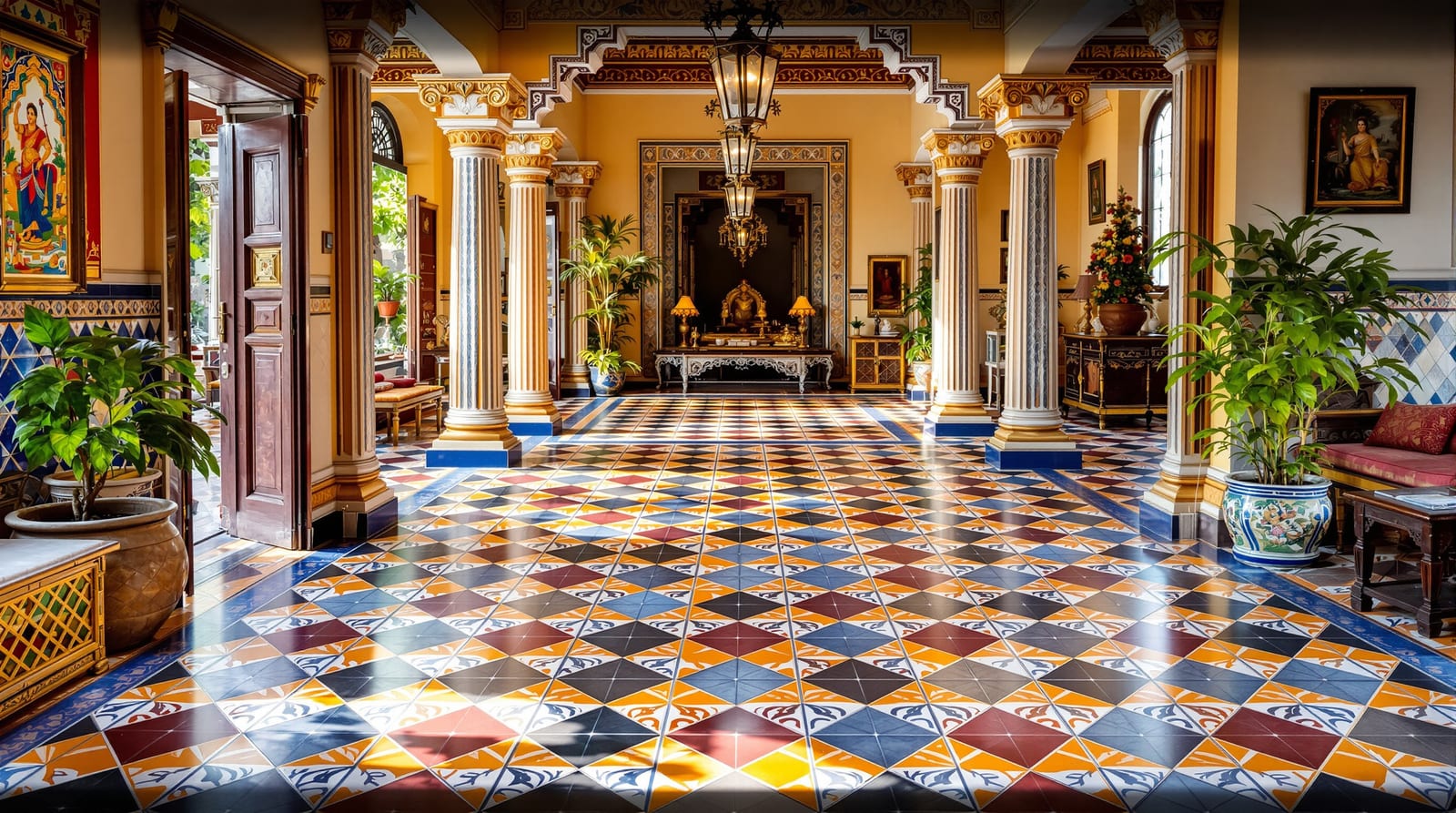
Athangudi Tiles in India: Handmade Chettinad Cement Tiles, Patterns, Cost & Care
Vivid, one-of-a-kind handmade cement tiles from Athangudi village in Chettinad, Tamil Nadu — poured by hand onto patterned glass plates, sun-and-water cured, cool underfoot — here is how they are made, the bold floral and geometric patterns, costs of ₹80–250 per sq ft, laying, sealing and the coconut-oil care.
Walk into an old Chettinad mansion and the floor stops you before the walls do — a sea of saturated mustard, oxblood, peacock-blue and bottle-green tiles, each carrying a hand-poured floral or geometric motif, no two quite identical, cool as river water under bare feet even at the height of a Tamil Nadu summer. These are Athangudi tiles, made for over a century in a single cluster of villages around Athangudi in the Chettinad region, by hand, on patterned glass plates, with coloured cement and nothing more high-tech than the sun and a tank of water to cure them. At ₹80–250 per sq ft they are an affordable way to put genuine handmade craft, deep colour and real cooling comfort underfoot — and buying them keeps a fragile artisan tradition alive. This guide explains exactly how they are made, the patterns and colours, where they suit, what they cost, how they are laid and sealed, and the honest caveats — handmade size variation and slipperiness when wet-polished — you should know before you commit a floor to them.
What Athangudi tiles actually are
An Athangudi tile is a handmade, through-coloured cement tile, typically 8 inch x 8 inch (about 20 x 20 cm) and roughly 20–25 mm thick, with the pattern formed in a top layer of pigmented cement and a backing of grey cement and sand. The defining detail is the manufacturing surface: the coloured cement slurry is poured onto a sheet of patterned glass, so when the cured tile is peeled off, the glass gives the face a smooth, naturally glossy sheen without any factory glaze. That glass-cast surface, the river sand of the Chettinad region, and the all-hand process are what make the tiles uniquely theirs — and why every tile carries tiny variations of tone and line that machine tiles cannot reproduce.
They belong to the same broad family as the hydraulically-pressed encaustic cement tiles covered in our cement-tiles-india guide, but they are not the same thing. Cement (encaustic) tiles are made in a metal mould under a heavy hydraulic press in a workshop; Athangudi tiles are hand-poured onto glass with no press, which is why they are softer-edged, glossier and more variable. Both sit alongside the in-situ cement and red-oxide traditions of South India in the wider map of alternative floors in our specialty-flooring-guide-india pillar.
How Athangudi tiles are made — the glass-plate process
The process is almost meditative and has barely changed in a hundred years. Understanding it explains both the beauty and the quirks of the finished floor.
First, a flat sheet of glass is cleaned and laid on a level table — the glass is the casting surface and the secret to the gloss. A thin metal stencil frame carrying the pattern (a kind of partitioned brass or aluminium template) is placed on the glass. The artisan then hand-pours coloured cement — grey or white cement mixed with oxide pigments and a little water to a thick slurry — into each compartment of the stencil by hand, building up the floral or geometric motif colour by colour, judging quantities by eye. The stencil is lifted away, leaving the wet coloured pattern sitting on the glass.
Over this, a layer of dry cement and fine sand is sprinkled and then a backing mix of cement, sand and stone is laid and tamped to give the tile body and thickness. A wooden frame around the edge defines the 8 x 8 inch square. The whole assembly — glass, pattern, backing — is set aside, then demoulded: the cured tile is lifted off the glass, taking the smooth glossy face with it. Tiles are then sun-dried and water-cured by soaking in tanks for days, which hardens the cement and sets the colour. No kiln, no firing, no electricity in the core process — sun and water do the work. Because every tile is poured by a person, slight differences in colour density, line thickness and even tile size are inherent, not defects.
Patterns, colours and the Chettinad look
The character of an Athangudi floor comes from its motifs. The classic repertoire is bold and unmistakably South Indian — large floral medallions, lotus and mango motifs, peacocks, geometric grids and stars, interlocking borders, and the famous "carpet" layouts where a field of plain or simply-patterned tiles is framed by an elaborate decorative border and corner tiles, mimicking a woven rug in cement. Chettinad mansions used these to define rooms, thresholds and the central courtyard.
The palette is rich and saturated: deep maroon and oxblood, mustard and ochre yellow, peacock and teal blue, bottle and emerald green, terracotta, black and creamy off-white, often three or four colours dancing in a single tile. Because the pigment is mixed through the top layer of cement, the colour is the tile, not a printed surface, so it does not wear off the way a glaze can chip.
Designs are made to order. You can pick a traditional Chettinad pattern, a plainer single-colour tile for a contemporary minimalist floor, or commission a custom motif and colourway — many modern homes use a quiet plain field with one striking patterned border, or a single feature panel, rather than wall-to-wall pattern. This made-to-order, hand-poured nature is exactly why the regional craft traditions in our regional-flooring-traditions-india guide matter: the floor carries the maker's hand.
The cool-underfoot comfort
One of the most practical reasons Athangudi tiles endure in South India has nothing to do with looks. Cement tiles have high thermal mass and stay genuinely cool to the touch, even through hot Tamil Nadu and coastal summers — barefoot, the floor feels like polished stone or a red-oxide floor, never warm like wood or carpet. In a climate where homes are open and people sit and sleep on the floor, that cooling comfort is a real, daily benefit, the same reason red-oxide-flooring-india and Kota stone remain loved across the south and west. It pairs well with cross-ventilated, naturally-cooled homes and reduces reliance on air-conditioning in the way our wider thinking on climate-appropriate floors describes.
Cost, spec and where Athangudi tiles suit
The table below maps the main Athangudi options against finish, indicative all-in cost and best use. Costs are 2026 indicative, vary by design complexity, order size, vendor and freight from Tamil Nadu, and exclude 18% GST; patterned and custom tiles cost more than plain, and laying is extra.
| Tile / option | Look | Cost (₹/sq ft) | Best use |
|---|---|---|---|
| Plain single-colour Athangudi tile | Solid glossy colour, minimalist | 80–130 | Modern homes, plain field, large floors, kitchens-of-character |
| Simple geometric / two-colour | Subtle pattern, versatile | 110–170 | Living rooms, bedrooms, verandahs, cafes |
| Classic floral / multi-colour Chettinad | Bold heritage motif | 150–220 | Heritage homes, feature floors, entrances, courtyards |
| Custom design / carpet border + corners | Elaborate, bespoke | 200–250+ | Statement floors, restored mansions, boutique hospitality |
| Patterned wall / dado panel | Vertical accent | 150–250 | Feature walls, pooja rooms, café and shop fronts |
For comparison within the cluster, plain Athangudi tiles sit close to a pigmented IPS or red-oxide floor in price, while elaborate patterns approach pressed encaustic cement-tiles-india, traditional marble-chip mosaic-flooring-india and precast terrazzo-tiles-india. Use the Studio Matrx /utilities/flooring-cost-calculator to turn ₹/sq ft into a total for your area, /utilities/tile-quantity-calculator to count the 8 x 8 inch tiles you need, and /utilities/floor-sealer-calculator to size the sealer.
Where they suit
Athangudi tiles are at home in heritage and restoration projects, where they are often the only correct way to repair or extend an original Chettinad floor. They shine as feature floors — an entrance hall, a dining room, a pooja room or a single "carpet" panel that anchors a space. They work beautifully in courtyards and verandahs of traditional homes, and increasingly in cafes, boutiques, hotels and studios that want handmade character and a sense of place. And, importantly, they suit modern homes wanting craft: a plain single-colour Athangudi field reads as a sophisticated minimalist cement floor, while one patterned border adds soul without overwhelming a contemporary interior.
They are less suited to constant-wet zones used carelessly — a polished Athangudi tile is slippery when wet, so in bathrooms and around pools you want a matte or unpolished face and the slip thinking from our anti-slip-flooring-wet-areas-india guide. And because they are handmade with size variation, they demand a patient, skilled layer.
Pros and cons
| Pros | Cons |
|---|---|
| Genuinely handmade, one-of-a-kind tiles — no two identical | Handmade size and thickness variation needs skilled laying |
| Vivid through-coloured pattern that will not wear off | Polished surface is slippery when wet — care in wet areas |
| Cool underfoot, high thermal mass, climate-friendly | Cement is porous — must be sealed and not acid-cleaned |
| Affordable craft at ₹80–250/sq ft | Long lead time; made to order and freighted from Tamil Nadu |
| Supports a living artisan tradition and rural livelihoods | Edges chip if mishandled; needs gentle, regular care |
| Develops a beautiful patina and gloss with age and oiling | Limited local fitters outside the south may charge a premium |
Laying Athangudi tiles
Because the tiles vary slightly in size and thickness, laying is more craft than commodity tiling, and a good mason makes all the difference.
Tiles are bedded on a cement mortar bed over a sound, level, cured base — the traditional method uses a thick mortar bed rather than thin-bed adhesive, which lets the layer accommodate the slight thickness variation and bring every tile to a true plane. Joints are kept tight and thin, often nearly butt-jointed, because wide grout lines fight the seamless heritage look; a colour-matched or neutral grey grout is worked in and cleaned off before it hazes. The layer dry-lays the field first to plan the pattern, borders and corner tiles, and to distribute natural colour variation evenly so no patch looks off. Cutting is done carefully — these are softer than vitrified tiles and chip if rushed. Order 10–15% extra for cuts, breakage and future repairs, since re-ordering an exact custom batch later is hard. For the base preparation and mortar-bed principles, our floor-screed-and-mortar-bed-india and how-to-lay-floor-tiles-india guides apply directly. Given the variation and the value of the tiles, this is rarely a DIY job — use a mason experienced with handmade or Athangudi tiles.
Sealing, polishing and coconut-oil care
This is where Athangudi floors reward a little ritual. The cement is porous, so the floor must be sealed after laying and full cure (cement wants roughly 21–28 days) with a penetrating cement-or-stone sealer to resist staining and water; an enhancing sealer deepens the colours. Many traditional homes skip chemical sealers entirely and instead rub the floor with coconut oil or wax — the classic Chettinad practice. Periodically applying a thin coat of coconut oil (or a stone wax) and buffing it brings up a deep, soft gloss, feeds the surface, and over years builds the lustrous patina that old Athangudi floors are loved for. It is the same logic as oiling a red-oxide floor.
For everyday care, mop with plain water or a mild pH-neutral cleaner — never use acidic cleaners (no vinegar, no acid, no harsh bathroom chemicals), which etch and dull cement, a rule our floor-cleaning-guide-india covers in full. Wipe spills of turmeric, oil, wine and acidic foods promptly. Reseal or re-oil every 1–2 years, more often in high-traffic or wet zones, on the schedule in our floor-resealing-guide-india. Treated this way, an Athangudi floor genuinely improves with age.
The artisanal-revival story
For decades the Athangudi craft was at risk — cheap vitrified tiles, the decline of the great Chettinad mansions, and younger generations leaving the trade thinned the number of working units. Its survival now rests on a revival driven by heritage restoration, designers, conscious homeowners and hospitality projects that specifically choose handmade tiles. Every order placed with an Athangudi unit supports rural artisan families and keeps a fragile, non-industrial skill alive — the same ethic behind choosing handmade and low-impact floors in our sustainable-flooring-materials-india guide. The tiles are also low-energy by nature: no kiln firing, locally sourced cement and sand, sun-and-water curing, and no glaze. Buying Athangudi is, quite directly, voting for craft over commodity.
When you source them, buy from genuine Athangudi or Chettinad units (directly or through specialist dealers and designers), confirm the lead time and freight, and ask for samples — handmade colour can shift between batches, so order your whole floor in one go where possible.
Frequently asked questions
What are Athangudi tiles made of?
They are handmade cement tiles made from grey or white cement, river sand and oxide pigments. The coloured pattern is hand-poured through a metal stencil onto a sheet of glass, a sand-and-cement backing is added for body, and the tile is demoulded off the glass and cured in sun and water. The glass gives the face its natural gloss — there is no glaze and no kiln firing.
How much do Athangudi tiles cost per sq ft in India?
Roughly ₹80–130 for plain single-colour tiles, ₹110–170 for simple two-colour or geometric designs, and ₹150–250 or more for classic floral, multi-colour and custom Chettinad patterns, before 18% GST and before laying. Price rises with pattern complexity, custom design and freight from Tamil Nadu. Use the Studio Matrx /utilities/flooring-cost-calculator to size it for your area.
Are Athangudi tiles slippery?
A polished Athangudi tile has a smooth, naturally glossy face and can be slippery when wet, so in bathrooms, around pools and in outdoor wet zones choose a matte or unpolished face and follow the guidance in our anti-slip-flooring-wet-areas-india guide. In dry living areas the gloss is a feature, not a hazard.
How do you maintain and clean Athangudi tiles?
Seal the floor after laying, then mop with plain water or a mild pH-neutral cleaner — never acidic cleaners, which etch cement. Many homes traditionally rub the floor with coconut oil or wax and buff it to build a deep patina. Wipe spills promptly, and reseal or re-oil every 1–2 years per our floor-resealing-guide-india. Treated well, the floor improves with age.
What is the difference between Athangudi tiles and cement (encaustic) tiles?
Both are through-coloured cement tiles, but Athangudi tiles are hand-poured onto a glass plate with no press, giving a glossier, softer-edged, more variable tile, while encaustic cement tiles are pressed in a metal mould under a hydraulic press for crisper, more uniform results — see our cement-tiles-india guide. Athangudi is the more artisanal, heritage-specific Chettinad craft.
Export this guide
Related Guides — Deep-dive reading
Epoxy Grout vs Cement Grout for Tiles in India: Which to Specify (2026)
A plain-English guide to tile grouts for Indian homes: what grout does, how cementitious grout compares with epoxy grout on cost, stain and water resistance, hygiene and durability, and exactly where each one belongs - kitchens, bathrooms, pools, dry rooms and more.
Building MaterialsFloor Sealing and Resealing Guide India: How to Seal Marble, Granite, Kota, Sandstone, Terrazzo and Cement Grout
Why porous natural stone and cement grout floors need sealing, the simple water-drop test to check if resealing is due, penetrating versus topical sealers, how to clean-dry-coat-buff, how often to reseal, and what you should never seal.
Flooring & SurfacesLimestone Flooring India: Honed Matte Stone, Colours, Cost and Care
The soft sedimentary stone family — beige, grey, blue and cream limestone with an elegant honed matte look, cool underfoot — plus its porosity, sealing needs, ₹/sq ft cost and where it suits Indian homes.
Flooring & SurfacesRelated Tools — Try Free
Full-Room BOQ — Living, Bedroom, Kitchen, Bath
Room-wise BOQ across living, bedrooms, kitchen, utility, and bathrooms with line-item pricing.
Full-Room BOQHome Building & Interior Cost Calculator — 20 Cities
Construction + interior costs for 20 Indian cities across kitchen, wardrobes, flooring, painting, ceiling.
Cost CalculatorPool Tile Calculator
Floor, wall and waterline area and the total number of tiles for your pool, with a wastage allowance.
Pool Calculator