
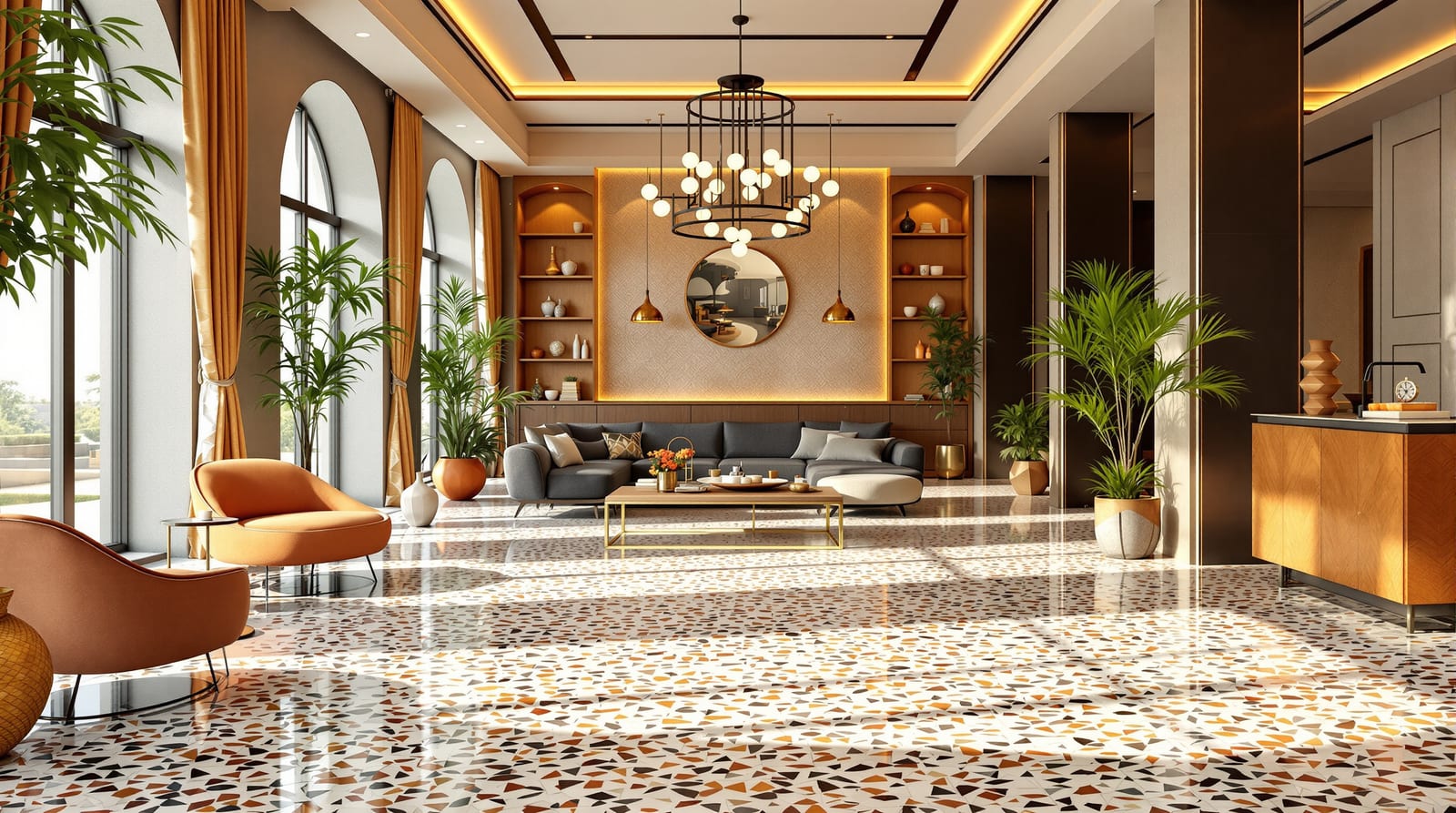
Terrazzo Tiles in India: Precast Marble-Chip (Mosaic) Tiles, Costs, Colours & Care
The factory-made, polished cement-and-marble-chip tile that built mid-century India and is back in fashion — how precast terrazzo differs from in-situ, the chip sizes and colours, costs of ₹60–200 per sq ft, laying, sealing and the everyday care.
If you grew up in an Indian home built between the 1950s and the 1990s, you almost certainly walked on terrazzo without knowing its name — the cool, speckled, polished floor that everyone simply called "mosaic". That floor came in two very different forms, and the difference matters when you specify one today. This guide is about the precast version: factory-made cement-and-marble-chip tiles you buy by the box and lay like any other tile — distinct from in-situ terrazzo, which is poured and ground on site. Precast terrazzo tiles are firmly back in fashion, they cost ₹60–200 per sq ft, and they give you the retro chip-scatter look without the on-site grinding mess.
Precast terrazzo tiles, in plain terms
A precast terrazzo tile is a cement tile with a decorative top layer of marble (or granite, glass, even mother-of-pearl) chips set in coloured cement, hydraulically pressed and then cured, ground and polished in a factory. You receive a finished, calibrated tile — typically square, in sizes like 300x300, 400x400 or 600x600 mm — ready to be laid on a mortar bed or adhesive like any vitrified or ceramic tile. The chips and the polish are already there; nothing is ground on site.
This is the tradition that Bharat Floorings & Tiles (founded in Mumbai in 1922) and the broader "mosaic tile" industry built across India for most of the twentieth century. For decades these tiles were the default quality floor in apartments, bungalows, schools, hospitals and offices before vitrified tiles displaced them in the 1990s. The recent revival of mid-century and "retro" interiors — and terrazzo's photogenic confetti of chips — has pulled them firmly back into specification, both as faithful heritage tiles and as new, large-chip designer ranges.
The look is the whole point: a calm cement field sprinkled with stone, endlessly variable, warm and handmade compared with the flat print of a vitrified tile. Because the chips are real stone, the surface has genuine depth and a polish that gets better, not worse, with age.
Precast vs in-situ terrazzo: which floor are you actually buying?
This is the single most important distinction, and it is where most confusion lives. In-situ terrazzo is mixed, poured, cured, then mechanically ground and polished in place on your site — one continuous, jointless floor. Precast terrazzo tiles are finished tiles laid with grout joints. They are made from the same ingredients and look closely related, but they behave very differently to install and to live with. Our companion terrazzo flooring guide covers the in-situ pour in depth; treat this guide as its precast counterpart.
| Factor | Precast terrazzo tiles | In-situ (poured) terrazzo |
|---|---|---|
| How it is made | Factory-pressed, cured and polished tiles | Mixed, poured and ground on your site |
| Surface | Many tiles with grout joints (visible lines) | One continuous, seamless field — no joints |
| On-site mess | Minimal — laid like any tile, no grinding dust | Heavy wet-grinding slurry and dust for days |
| Consistency | Very consistent, factory-controlled, you see samples | Varies with the mason's skill and the day's mix |
| Chip size | Usually small-to-medium chips per the tile design | Can go to very large, dramatic chips |
| Repair / replacement | Lift and replace a single tile | Patch-and-regrind, harder to match |
| Skilled labour | Standard tile-laying crew | Specialist terrazzo artisans (fewer now) |
| Speed | Fast — lay, grout, light buff | Slow — pour, cure, multi-stage grind, polish |
| Typical cost (material) | ₹60–200 per sq ft | Often higher once site grinding labour is added |
| Best when | You want the look fast, modular, low-mess, repairable | You want a truly seamless, jointless, bespoke floor |
The short version: precast wins on cleanliness, speed, consistency and easy replacement, and is far kinder to an occupied or renovation project because there is no wet grinding indoors. In-situ wins when you specifically want a seamless floor with no grout lines and are willing to pay for specialist labour and tolerate the on-site mess. For most homes today, precast tiles deliver 90% of the look for a fraction of the disruption.
Chips and colours: where the design lives
The character of a terrazzo tile is set almost entirely by two things — the cement matrix colour and the chips suspended in it.
| Chip / aggregate | Look it gives | Notes |
|---|---|---|
| White & coloured marble | Classic creamy, soft, pastel terrazzo | The traditional Indian "mosaic" chip; widest colour range |
| Granite chips | Harder, darker, speckled, more contemporary | Tougher aggregate; good for high-traffic |
| Glass chips | Bright jewel flecks, modern designer ranges | Catch the light; popular in new boutique terrazzo |
| Mother-of-pearl / shell | Iridescent shimmer in the polish | Premium, decorative, feature spaces |
| Mixed / large chips | Bold, chunky, statement "Venetian" scatter | Trend-led; reads dramatic in large format |
The cement base is pigmented — pale greys and creams for a soft heritage feel, or saturated terracotta, ochre, charcoal, teal and pink for the bolder current ranges. Combine a coloured matrix with a chosen chip palette and you can land anywhere from a quiet 1960s government-office grey to a punchy designer floor. Because everything is factory-controlled, the box you order will match the sample you approved — a real advantage over the lottery of an in-situ mix.
What it costs in India
Precast terrazzo tiles sit in an accessible mid band — dearer than the cheapest ceramic, broadly comparable with good vitrified tiles, and usually below imported marble. As an indicative 2026 guide (material only, +18% GST, laying extra):
| Item | Indicative ₹/sq ft |
|---|---|
| Standard terrazzo / mosaic tiles (common chips, grey/cream) | ₹60–110 |
| Mid-range coloured / larger-chip designer tiles | ₹100–160 |
| Premium designer ranges (glass, shell, big Venetian chips) | ₹150–200+ |
| Heritage / made-to-order tiles (e.g. Bharat Floorings) | ₹150–200+ |
| Laying labour (mortar bed or adhesive) | ₹30–70 |
| Grouting, light polishing & sealing | ₹15–35 |
| Installed, typical interior floor | ₹120–280 |
The big swing factors are chip quality, tile size (large format costs more), colour and brand — a plain grey government-spec mosaic tile is cheap, a designer glass-chip range is several times that. To convert your room area into the number of boxes (plus wastage) and a budget, use our tile quantity calculator; for a whole-floor estimate that folds in laying and sealing, the flooring cost calculator does the rest.
Where precast terrazzo tiles suit best
Homes are the obvious revival market — living rooms, bedrooms, lobbies and verandahs where the speckled retro look reads as warm and characterful. The floor is cool underfoot, which suits most Indian summers, and it ages gracefully.
Cafes, restaurants and boutiques love terrazzo for exactly the photogenic, mid-century, handmade quality that vitrified tiles lack; bold coloured ranges have become a hospitality signature.
Commercial and institutional floors — offices, schools, hospitals, banks — were terrazzo's historic stronghold because it is hard-wearing and easy to keep clean, and it still serves there well.
Heritage and restoration projects use precast terrazzo and the related cement-tile family to match or sympathetically replace original floors. If you are weighing the patterned, through-body alternative, see our cement tiles guide; for the broader in-situ marble-chip tradition that preceded terrazzo, the mosaic flooring guide traces the lineage.
For the bigger picture of how terrazzo tiles fit among all the alternative and specialty floors — seamless, cementitious, resilient and paving — start from the specialty flooring guide for India, the pillar that maps the whole category.
Laying, sealing and care
Terrazzo tiles are durable, but they are cement-and-marble, so they want the same respect as any natural-stone-based floor.
- Lay on a sound, level bed. Tiles go on a mortar bed or with tile adhesive over a properly cured screed. Keep grout joints tight and consistent; pick a grout colour close to the matrix so the joints read quietly. Our floor screed and mortar bed guide and the how to lay floor tiles guide cover the substrate and laying method.
- Always seal. Both the cement matrix and the marble chips are porous and mildly acid-sensitive, so an impregnating (penetrating) sealer after laying is essential — it resists oil, curd, tamarind and tea stains. Re-seal roughly every two to three years; our floor resealing guide covers products and method.
- Light buff, not heavy grind. Unlike in-situ terrazzo, precast tiles arrive polished, so they need only a light buff after laying (and a sealer), not full mechanical grinding.
- Clean gently. Use a pH-neutral stone cleaner and avoid acidic descalers and harsh abrasives, which etch the marble chips and dull the polish over time. The floor cleaning guide covers the routine.
- Mind wet areas. A polished terrazzo floor is slippery when wet, so for bathrooms, terraces and uncovered verandahs choose a matte/honed finish or apply an anti-slip treatment — see the anti-slip flooring for wet areas guide.
The relevant Indian standard is IS 1237 (cement concrete flooring tiles, which covers terrazzo and mosaic tiles); reputable makers manufacture and test to it, so ask for the specification when ordering.
Terrazzo tiles vs vitrified tiles, and vs in-situ terrazzo
Two comparisons come up constantly.
Versus vitrified tiles: vitrified is harder, near-zero porosity, needs no sealing, comes in endless printed designs and is cheaper to maintain — it is the practical, low-care default. Terrazzo tiles win on authenticity and depth: real stone chips and a genuine polish instead of a printed glaze, plus the heritage character vitrified can only imitate. If you want a true material with patina and are willing to seal it, terrazzo; if you want maximum convenience and the lowest care, vitrified. Our vitrified tile flooring guide covers that side in full.
Versus in-situ terrazzo: covered in the table above — precast gives you the look fast, modular and low-mess with grout joints; in-situ gives you a seamless, jointless floor at the cost of specialist labour and heavy on-site grinding. Read the terrazzo flooring guide before deciding which route fits your project and budget.
Frequently asked questions
What is the difference between terrazzo tiles and in-situ terrazzo?
Terrazzo tiles are factory-made, pre-polished cement-and-marble-chip tiles laid with grout joints, like any tile. In-situ terrazzo is mixed, poured and then mechanically ground and polished on your site into one seamless, jointless floor. Tiles are faster, cleaner and easy to replace; in-situ is seamless but needs specialist labour and creates heavy grinding mess.
How much do terrazzo tiles cost in India?
Indicatively ₹60–200 per sq ft for the material in 2026 — roughly ₹60–110 for standard grey/cream mosaic tiles, ₹100–160 for coloured or larger-chip ranges, and ₹150–200+ for premium designer or heritage tiles. Add about ₹30–70 for laying, ₹15–35 for grouting and sealing, and 18% GST. Prices vary by chip quality, tile size, colour and brand.
Do terrazzo tiles need sealing?
Yes. Both the cement matrix and the marble chips are porous and mildly acid-sensitive, so an impregnating sealer after laying is essential to resist oil and food stains, and it should be refreshed roughly every two to three years. Sealing is what keeps a terrazzo floor stain-resistant and easy to clean.
Are terrazzo tiles good for Indian homes today?
Yes — they are cool underfoot, very durable, age gracefully and carry a strong retro-revival appeal, which is why they are back in fashion for homes, cafes and boutiques. They need sealing and gentle cleaning, and a polished finish is slippery when wet, so choose a matte finish or anti-slip treatment for bathrooms, balconies and terraces.
Terrazzo tiles or vitrified tiles — which should I choose?
Choose vitrified for the lowest maintenance, no sealing and the widest range of printed designs at a lower running cost. Choose terrazzo tiles when you want a genuine material with real stone chips, true polish and heritage character, and you are willing to seal and clean it gently. Terrazzo offers authenticity and depth; vitrified offers convenience.
Export this guide
Related Guides — Deep-dive reading
Mosaic Flooring in India: In-Situ Marble-Chip Mosaic, Glass & Tile Mosaic, Cost and Care
Mosaic flooring spans two worlds — the traditional in-situ marble-chip mosaic that paved old Indian homes and became the precursor to terrazzo, and decorative glass, ceramic and stone mosaic mats used for borders, bathrooms, pools and feature zones; here is what each is, how in-situ mosaic is laid, ground and polished, where each suits, and costs of ₹60–180 per sq ft.
Flooring & SurfacesLimestone Flooring India: Honed Matte Stone, Colours, Cost and Care
The soft sedimentary stone family — beige, grey, blue and cream limestone with an elegant honed matte look, cool underfoot — plus its porosity, sealing needs, ₹/sq ft cost and where it suits Indian homes.
Flooring & SurfacesTerrazzo Bathroom India: Chip-in-Cement Floors, Walls & Basins (2026)
The revived speckled terrazzo look for Indian bathrooms — traditional in-situ IPS terrazzo versus modern precast tiles and slabs, on floors, walls, counters and basins, plus sealing, slip, custom chip colours and honest rupee costs.
BathroomsRelated Tools — Try Free
Flooring Cost Calculator
Estimate the all-in cost of a floor — material, laying, wastage, skirting and GST — by area and material.
Flooring CalculatorTile Quantity Calculator
Work out how many tiles and boxes to buy for a floor, by tile size and area, with wastage and skirting.
Flooring ToolInterior Budget Planner
Live room-wise and component-wise cost breakdown in ₹ with contingency, GST, and PDF summary.
Budget Calculator