
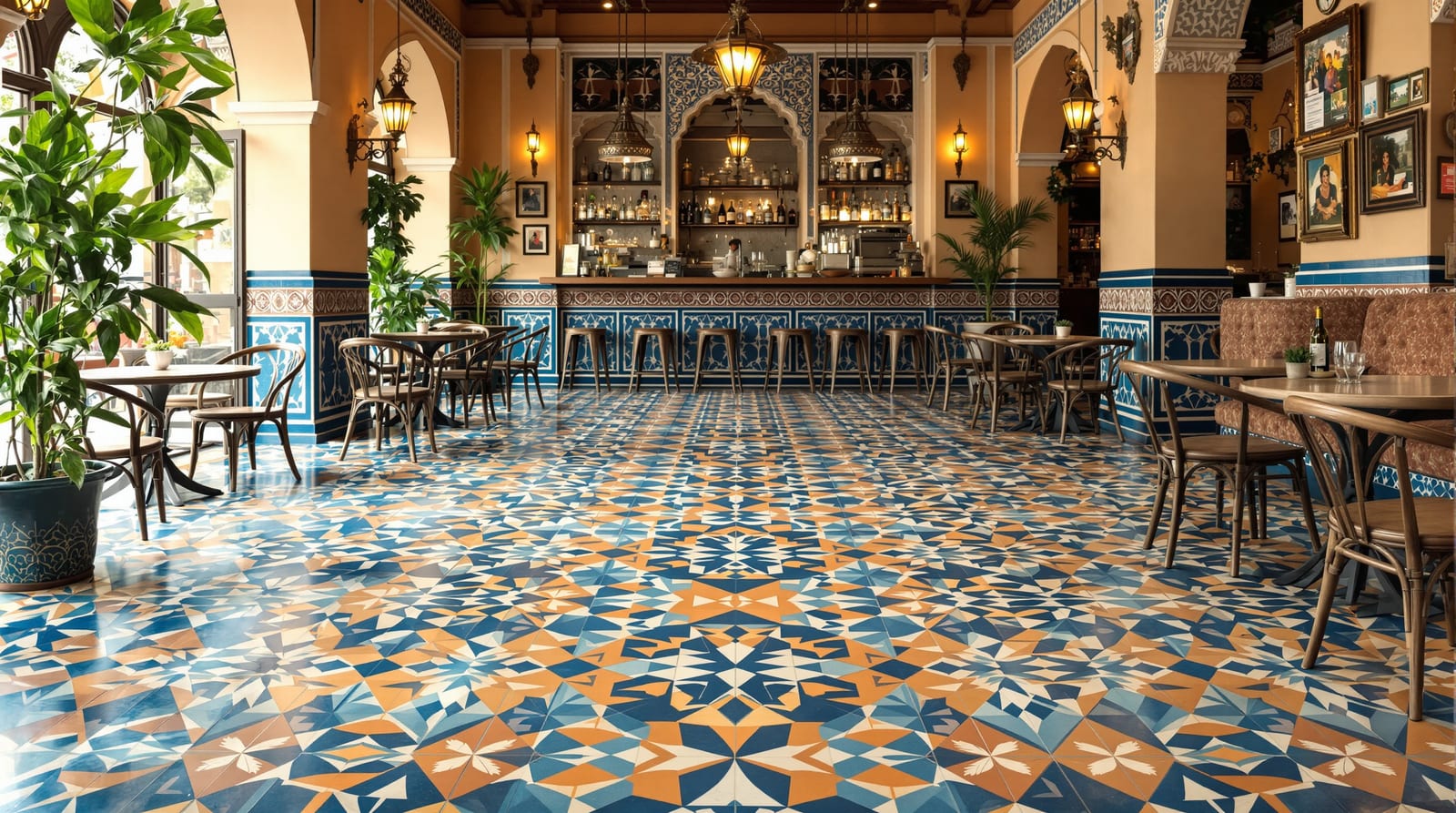
Cement Tiles in India: Encaustic Heritage Floors, Patterns, Cost, Sealing & Care
Encaustic cement tiles are the hydraulically-pressed, through-body patterned floors of the Bharat Floorings tradition — pigmented cement face on a concrete body, hand-laid, with the pattern running deep so it wears beautifully; here is what they are, the retro colonial and Portuguese patterns, costs of ₹120–400 per sq ft, and how to seal and care for them.
Encaustic cement tiles are the patterned floors you have walked across in old Bombay flats, Goan villas, colonial-era bungalows and the new wave of heritage-styled cafes — those richly coloured geometric and floral tiles that look painted but never fade because the pattern is solid pigment running deep into the tile. They are not ceramic and they are not fired in a kiln. They are pressed cement, made by hand, and they have been made in India for well over a century. At ₹120–400 per sq ft they sit in the affordable-luxury bracket, rewarding you with a floor of genuine character that ages into a soft, lived-in patina.
This guide explains exactly what encaustic cement tiles are and how they differ from ordinary tiles, the heritage patterns and where they suit, real Indian costs, how they are laid, and — the part most people get wrong — how to seal and care for them so they last generations.
What encaustic cement tiles actually are
The word "encaustic" is a bit of a misnomer borrowed from an old enamelling technique, but in flooring it now simply means a tile whose pattern is built from layers of coloured material rather than printed or glazed onto the surface. An encaustic cement tile is made in two distinct parts, pressed together into one body.
The top wearing face — usually around 3 to 5 mm thick — is a fine slurry of white or grey cement, marble or stone powder and mineral pigments. This coloured cement is poured into a thin brass or metal stencil (a "divider" mould) that holds each colour of the pattern in its own compartment, so the geometric or floral design is laid by hand, colour by colour. Once the mould is lifted away, the colours sit edge to edge as a crisp pattern.
Beneath that face sits a much thicker backing body of coarser grey cement, sand and stone aggregate — ordinary concrete, in effect — which gives the tile its strength and bulk. The two layers are then placed in a hydraulic press and squeezed under tonnes of pressure. That pressing fuses the face and body into a single dense slab and is what makes the modern cement tile far flatter, harder and more uniform than older hand-tamped tiles.
Crucially, the tile is never fired. There is no kiln. After pressing, the tiles are simply cured in water and then air-dried over several weeks while the cement gains strength chemically — exactly as concrete does. The colour you see is the colour of the cement itself, mixed with pigment, all the way down through that 3–5 mm face. That is the single most important fact about these tiles: because the pattern has real depth, light surface wear, scuffing and even a careful re-polish never erase it. A glazed ceramic tile loses its printed pattern the moment the glaze wears through; an encaustic cement tile keeps its pattern as it ages, softening into a chalky, antique patina instead.
The diagram below shows the through-body construction — why the pattern survives wear.
The Indian heritage: Bharat Floorings and the colonial tradition
India has one of the oldest living traditions of cement-tile making in the world. Bharat Floorings & Tiles, founded in Bombay in 1922 during the swadeshi movement, is the name most associated with it — their tiles floor heritage buildings, the Taj, old courts, churches and countless Art Deco apartments across Mumbai. The craft arrived through Mediterranean and colonial trade, which is why the visual language is so recognisably Portuguese, Spanish, Victorian and Art Deco: interlocking geometrics, eight-pointed stars, scrolling florals, borders and corner motifs that build into full-room "carpets" of pattern.
You will find this same tradition woven through Goan and Mangalorean homes (the Portuguese-influenced "mosaico" floors), in Chettinad mansions of Tamil Nadu, and in the bungalows of Kolkata, Pune and Chennai. Today there is a strong revival: heritage homeowners restoring original floors, designers using a bold patterned tile as a feature "rug" in an otherwise plain room, and the entire boutique-cafe and restaurant aesthetic in Indian cities leaning heavily on these retro patterns. Manufacturers ranging from Bharat Floorings to a number of smaller Athangudi and Morbi-region workshops now produce both faithful heritage designs and contemporary monochrome and pastel ranges.
Patterns, colours and formats
The pattern is the whole point. Common families include:
- Geometric — diamonds, hexagons, interlocking cubes, stars and Art Deco fans; the most popular for a modern interpretation.
- Floral and Victorian — scrolling vines, rosettes and the classic four-tile bloom that resolves only when four tiles meet.
- Border and carpet sets — field tiles, border tiles and corner tiles designed to be laid as a framed "rug" within a room.
- Plain and monochrome — solid colours or simple two-tone, increasingly used for a quieter contemporary look.
Standard sizes are 200 x 200 mm and 250 x 250 mm, with 300 x 300 mm also available; thickness is typically 16–22 mm. Because each tile is hand-cast, there is a gentle natural variation in colour and a slight relief to the surface — part of the charm, not a defect.
Cost in India: ₹ per sq ft
Encaustic cement tiles cost more than plain vitrified or ceramic tiles because they are hand-made and labour-intensive, but far less than imported stone. The table gives indicative ranges (material only unless stated; laying, sealing and the mortar bed are extra; add 18% GST; figures vary by city, pattern complexity and vendor).
| Tile / option | Indicative ₹/sq ft | Pattern depth | Best use |
|---|---|---|---|
| Plain / monochrome cement tile | ₹120–180 | Through-body | Quiet contemporary floors, large areas |
| Standard geometric pattern | ₹160–280 | Through-body | Feature floors, living and dining |
| Heritage / intricate multi-colour pattern | ₹250–400+ | Through-body | Restoration, statement zones, foyers |
| Laying labour (skilled, level bed) | ₹50–120 (extra) | — | Mason with cement-tile experience |
| Sealing + first cut-polish | ₹30–80 (extra) | — | Penetrating sealer, mandatory |
| Printed patterned vitrified tile (for contrast) | ₹50–120 | Surface print only | Budget look-alike, no real depth |
So an installed, sealed heritage cement-tile floor commonly lands around ₹250–500 per sq ft all-in. Use the Studio Matrx flooring cost calculator and tile quantity calculator to size a real quote, and the tile pattern calculator if you are setting a bordered carpet layout with wastage.
Durability — and the porosity you must respect
Cement tiles are tough. A pressed, well-cured tile is hard and dense, and because the colour runs through the face, a heritage floor can take a century of foot traffic and only grow more beautiful. But there is one non-negotiable: cement is porous. Unlike a glazed ceramic tile, an unsealed cement tile will drink up water, oil, wine, turmeric, coffee and any acidic spill, staining permanently. This is the single most common reason people are disappointed by a cement-tile floor — they treat it like a vitrified tile and it stains within weeks.
The fix is straightforward: cement tiles must be sealed, and then cared for gently. Do that, and they are wonderfully durable. Skip it, and even a beautiful floor will look tired fast.
Laying cement tiles
Encaustic tiles are hand-laid in a thick cement mortar bed, much like traditional stone or mosaic, not stuck with thin-set on a wall like ceramic. Key points an experienced mason will follow:
- Acclimatise and dry-lay first. Cement tiles arrive damp from curing; let them dry, and dry-lay the pattern on the floor to plan borders, set out the centre and check colour batches before fixing.
- Lay on a level, fully cured bed. They go onto a 20–40 mm cement-sand mortar bed over a sound, level screed. The bed must be true — these tiles are flat and unforgiving of an uneven base.
- Tight, fine joints. Cement tiles are butt-jointed or laid with very thin 1–2 mm joints and grouted in a matching cement-colour grout, never wide tile spacers. Keep grout off the face and clean it immediately.
- Seal BEFORE grouting, ideally. Because the porous face will soak up pigmented grout and stain, many installers apply the first coat of penetrating sealer before grouting, then grout, then seal again. This is the professional sequence and worth insisting on.
- No acid, ever, during install. A mason who reaches for hydrochloric (muriatic) acid to clean cement haze will etch and bleach your tiles. Haze comes off with a sealer-safe cement-film remover and water only.
- Cut with care. Cutting is done with a wet diamond cutter; the dense body cuts cleanly but chips if rushed.
A floor laid by a mason who has done stone or mosaic floors — and who respects the seal-before-grout step — will be flat, tight and stain-free from day one.
Sealing and care: the rules that matter
Cement tiles reward a little discipline. The non-negotiables:
- Seal on installation, then re-seal. Apply a penetrating (impregnating) sealer designed for cement or natural stone after laying and curing. This soaks in and blocks staining without changing the matte look. A surface "wet-look" sealer can be added on top if you want a slight sheen. Re-seal roughly every 1–3 years, sooner in heavy-traffic or wet zones — see the Studio Matrx floor resealing guide.
- Never use acids. No muriatic acid, no harsh descalers, no acidic bathroom cleaners, no vinegar or lemon. Acid eats cement and strips both sealer and pigment. This is the number-one killer of cement-tile floors.
- Clean gently and neutral. Sweep or vacuum grit (it scratches), then mop with plain water or a pH-neutral, stone-safe cleaner. Wipe spills — especially turmeric, oil, wine and coffee — promptly.
- Expect and embrace patina. A faint efflorescence (white cement bloom) and a softening of colour in the first months is normal as the cement finishes curing; it settles. Over years the floor develops a gentle sheen and antique character that is the whole appeal.
- Re-polish if needed. Because the pattern is full-depth, a badly worn or stained old floor can be lightly machine-honed and re-sealed to look new again — something impossible with a printed tile.
Where cement tiles suit in India
These tiles are at their best where character matters and you control the spills:
- Heritage homes and restoration — the authentic floor for colonial bungalows, Goan and Chettinad houses, Art Deco flats; often the original floor worth saving.
- Feature floors — a bold patterned "rug" of tiles in a living room, dining nook, foyer or under a bed, framed by plain tiles or a border set.
- Cafes, restaurants and boutiques — the signature retro look of the Indian hospitality scene; durable under traffic and full of personality.
- Bathrooms and kitchens — with care — beautiful here, but only if sealed thoroughly and re-sealed on schedule, and paired with sensible slip awareness (a polished cement floor can be slick when wet; see the Studio Matrx anti-slip guidance for wet areas).
They are less ideal for harsh utility wet zones, terraces in full monsoon, or anywhere acidic cleaning is unavoidable. For an outdoor or terrace floor, a stone or paver is a better fit.
Cement tiles vs ceramic patterned tiles vs Athangudi
Three things look superficially similar — a patterned floor tile — but are made very differently.
| Encaustic cement tile | Printed patterned ceramic/vitrified | Athangudi tile | |
|---|---|---|---|
| How made | Hand-laid pigment in a stencil, hydraulically pressed, water-cured | Pattern digitally printed, glazed, kiln-fired | Hand-cast on glass plates, no press, air-cured |
| Pattern depth | Through-body, 3–5 mm | Surface print only | Through-body, on the glass-cast face |
| Wears to | Same colour beneath — ages into patina | Worn glaze loses the pattern | Same colour beneath — ages into patina |
| Surface | Matte, slight relief, hand variation | Uniform, glossy or matte, machine-perfect | Glossy from the glass mould, vivid, irregular |
| Porosity | Porous — must seal | Non-porous (glazed) — no sealing | Porous — must seal |
| Cost ₹/sq ft | ₹120–400 | ₹50–120 | ₹80–250 |
| Character | Heritage, hand-made, restorable | Consistent, cheap, low-maintenance | Artisanal, one-of-a-kind, vivid |
Versus printed ceramic/vitrified: a printed tile is cheaper, fully non-porous and maintenance-free, and can mimic the look from a distance — but the pattern is skin-deep, it has none of the hand-made depth, and it cannot be restored when worn. Choose it for budget and convenience; choose a cement tile for authenticity and longevity.
Versus Athangudi: both are handmade, porous, through-pattern cement tiles, so they are close cousins. The defining difference is the process. Encaustic cement tiles are hydraulically pressed, which makes them flatter, denser, harder and more dimensionally uniform — better for large modern floors and tighter joints. Athangudi tiles are cast by hand on glass plates with no press, which gives them a glossier surface (from the glass), more vivid and unrepeatable colour, and a charming irregularity — but slightly softer, less flat tiles. Think of pressed cement tiles as the refined, scalable heritage option and Athangudi as the artisanal, characterful one. The Studio Matrx Athangudi guide goes deeper on that craft.
Cross-links and where this fits
This guide is part of the Studio Matrx flooring cluster. For the wider map of traditional and specialty floors, start with the specialty flooring guide. For close relatives in the cementitious and handmade family, see Athangudi tiles, mosaic flooring and terrazzo tiles. For the regional craft context, read regional flooring traditions. And because sealing is the make-or-break for cement tiles, pair this with the floor resealing guide.
Frequently asked questions
Are cement tiles the same as ceramic tiles?
No. Ceramic and vitrified tiles are clay-based bodies fired in a kiln, with the pattern printed and glazed onto a sealed surface. Encaustic cement tiles are not fired at all — they are pigmented cement pressed onto a concrete backing and water-cured. The pattern is solid colour running 3–5 mm into the face, so it wears beautifully, but the tile is porous and must be sealed, unlike a glazed ceramic tile.
Do cement tiles stain easily?
Unsealed, yes — they will absorb water, oil, turmeric, coffee, wine and acidic spills and stain permanently, because cement is porous. Sealed correctly with a penetrating sealer and re-sealed every one to three years, they resist staining well. Always wipe spills promptly and never clean them with acidic products, which strip the sealer and damage the cement.
How much do cement tiles cost in India?
Material costs run roughly ₹120–400 per sq ft — plain and monochrome tiles at the lower end, intricate heritage multi-colour patterns at the top. Add ₹50–120 per sq ft for skilled laying and ₹30–80 for sealing, so an installed, sealed floor commonly lands around ₹250–500 per sq ft all-in, plus 18% GST. Prices vary by pattern, region and vendor.
What is the difference between cement tiles and Athangudi tiles?
Both are handmade, porous, through-pattern cement tiles, but encaustic cement tiles are hydraulically pressed, making them flatter, denser and more uniform, while Athangudi tiles are hand-cast on glass plates with no press, giving a glossier surface and more vivid, irregular colour. Pressed cement tiles suit large modern floors with tight joints; Athangudi offers a more artisanal, one-of-a-kind look.
Can cement tiles be used in bathrooms?
Yes, and they look striking, but only if you seal them thoroughly on installation and re-seal on schedule, and accept that a polished cement surface can be slippery when wet — so consider slip safety in showers and around basins. Avoid acidic bathroom cleaners entirely. For high-splash utility wet zones, a fully non-porous tile may be lower-maintenance.
Export this guide
Related Guides — Deep-dive reading
Athangudi Tiles in India: Handmade Chettinad Cement Tiles, Patterns, Cost & Care
Vivid, one-of-a-kind handmade cement tiles from Athangudi village in Chettinad, Tamil Nadu — poured by hand onto patterned glass plates, sun-and-water cured, cool underfoot — here is how they are made, the bold floral and geometric patterns, costs of ₹80–250 per sq ft, laying, sealing and the coconut-oil care.
Flooring & SurfacesVitrified Tile Maintenance: How to Care for Vitrified & PGVT Floors in India
Vitrified and PGVT tiles are India's most common, near maintenance-free floor; the real weak point is the cement grout, not the tile, so this guide shows the simple routine, post-construction haze and stain removal, and how to keep the gloss.
Flooring & SurfacesTile Grouting Guide India: Cement vs Epoxy Grout, Joint Width, Mixing, Curing and Sealing
How to grout tile floors properly in Indian homes: choosing cement versus stain-proof epoxy grout, getting timing and joint width right, floating it in, clearing haze, curing and sealing.
Flooring & SurfacesRelated Tools — Try Free
Flooring Cost Calculator
Estimate the all-in cost of a floor — material, laying, wastage, skirting and GST — by area and material.
Flooring CalculatorHome Building & Interior Cost Calculator — 20 Cities
Construction + interior costs for 20 Indian cities across kitchen, wardrobes, flooring, painting, ceiling.
Cost CalculatorMaterial Schedule Generator
Generate a room-wise finish schedule — walls, floors, ceilings, trim, and joinery by location.
Material Schedule