
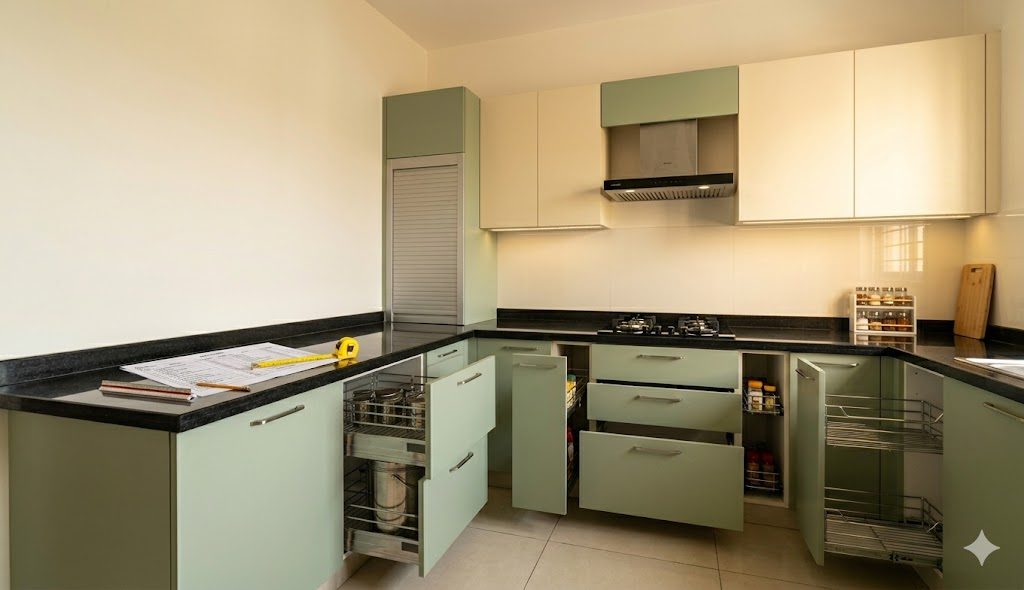
Budget Modular Kitchen Planning
Where to spend, where to save, and what never to cut in an Indian modular kitchen quote
A modular kitchen quote in India is a fog of opinions. One vendor returns ₹1.6 lakh, another ₹4.8 lakh, for what looks like the same 10 by 8 kitchen. The carcase material is described in five different terms, the hardware is named by brand on one quote and by category on another, and the hood line says "as per market" on both. Without a framework, picking between them is guesswork.
This guide is that framework. It is about where every rupee in a modular kitchen actually goes, which lines are non-negotiable, which are safe to downgrade, and how to spot the padding in a vendor BOQ. The single most under-appreciated fact in Indian kitchen buying: a smart ₹2 lakh kitchen, with money put into the right lines, will out-last and out-perform a dumb ₹5 lakh kitchen that spent on the wrong ones.
It is a deep-dive companion to our best modular kitchen layout for Indian cooking, and it pairs with the modular kitchen guide, the interior cost per sqft in India breakdown, why cheap interiors become expensive later, and our piece on the hidden costs of interiors in India.
1. Real per-sqft tiers — 2026 ranges
Kitchen rates are quoted per square foot of carcase footprint (length × depth of the base run). Most vendors will not volunteer this number; they show a lump-sum so the rate cannot be compared. Decode every quote to a per-sqft figure before you compare. Indicative 2026 ranges for tier-1 Indian metros:
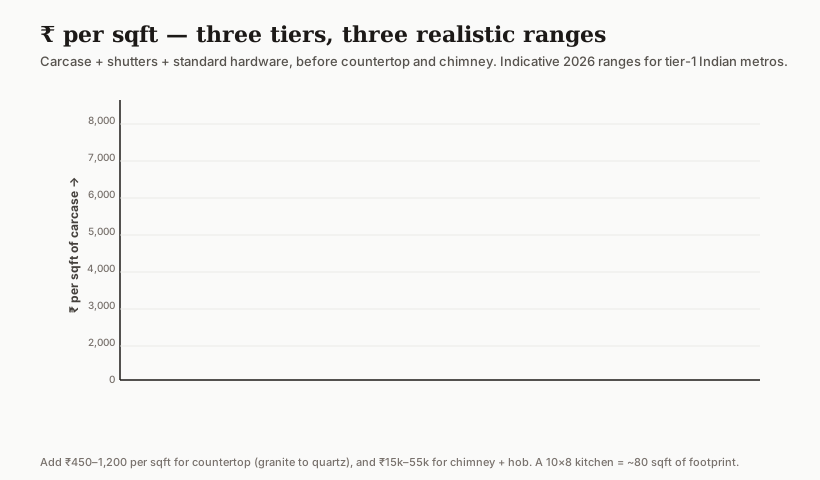
| Tier | ₹ per sqft (carcase) | What you get | Sample 10×8 total |
|---|---|---|---|
| Budget | ₹1,500 – 2,500 | MR ply, laminate, basic hinges, two slides | ₹1.2 – 2.0 L |
| Mid | ₹2,500 – 4,500 | BWR/BWP ply, laminate or acrylic, soft-close, tandems | ₹2.0 – 3.6 L |
| Premium | ₹4,500 – 7,500+ | BWP ply, acrylic/PU/veneer, Blum/Hettich, servo + corner units | ₹3.6 – 6.0 L+ |
The numbers above are carcase + shutters + standard hardware only. Add ₹450–1,200 per sqft for countertop (granite to quartz), ₹15k–35k for the chimney, ₹6k–18k for the hob, and ₹6k–14k for the sink. A 10 by 8 footprint is roughly 80 sqft.
Two metro-specific caveats: Bengaluru and Mumbai BWP ply carries a 7–12% premium over Delhi-NCR; carcase rates south of Bengaluru run 8–10% lower because of lower fabrication labour.
2. The line items in a vendor BOQ — and what each should cost
A typical mid-range ₹3 lakh kitchen splits roughly like this. Memorise these percentages — they are the fastest sanity-check on any quote.
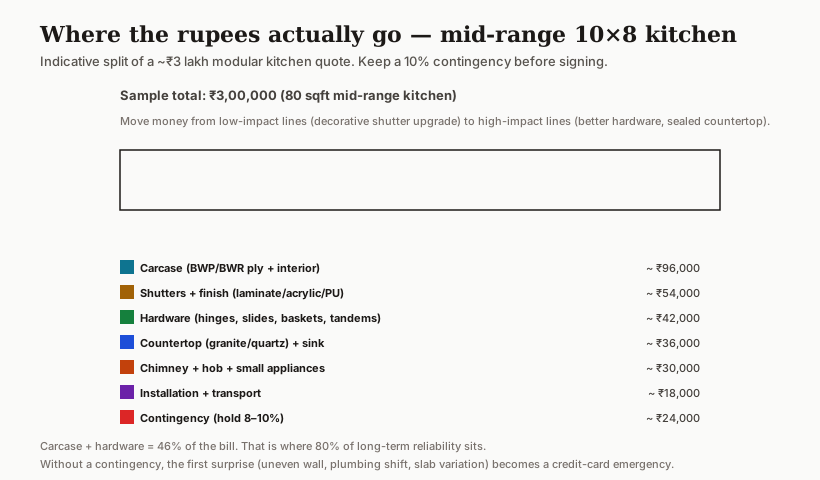
| Line | Share | Indicative ₹ on a ₹3L quote | Sanity-check |
|---|---|---|---|
| Carcase (BWP/BWR ply + interior) | 32% | ~ ₹96,000 | Ask for the ply brand by name |
| Shutters + finish | 18% | ~ ₹54,000 | Per-sqft rate must reconcile to spec |
| Hardware (hinges, slides, baskets) | 14% | ~ ₹42,000 | List brand + model per item |
| Countertop + sink | 12% | ~ ₹36,000 | Stone slab spec + sink gauge |
| Chimney + hob + small appliances | 10% | ~ ₹30,000 | CFM + warranty in writing |
| Installation + transport | 6% | ~ ₹18,000 | Lump-sum or hourly — ask |
| Contingency (hold) | 8% | ~ ₹24,000 | Keep this — see section 7 |
If carcase is under 28% or over 40% of the total on a quote, something is mis-priced or undisclosed. If hardware is under 10%, you are getting cheap fittings or the vendor has under-quoted brand items.
3. The NEVER-CUT list — the four lines where saving costs you the kitchen
There are four line items where downgrading kills the kitchen. Skip these conversations at your own risk:
- BWP / BWR plywood substrate in every wet zone. Standard MR (moisture-resistant) ply absorbs water through unsealed edges and delaminates within three to five years near a sink or behind a kadhai. BWP (boiling-water-proof) and BWR (boiling-water-resistant) ply costs roughly ₹400–700 more per sheet but is the difference between a 12-year kitchen and a 4-year kitchen. Demand the brand name in writing — Centuryply Club Prime, Greenply Greenpanelmax, Kitply Sigma — not just "BWP".
- Soft-close hinges and slides on daily-use drawers. The kadhai drawer, the cutlery drawer, the trash pull-out, the atta pull-out — these are slammed two-to-six times a day. Without soft-close, the carcase joint loosens, the shutter alignment drifts, and within eighteen months the doors hang wrong. Blum or Hettich at the daily drawers, brand-agnostic at the loft.
- Chimney CFM and the duct. Indian cooking releases a daily aerosol of oil and turmeric. A 750 CFM chimney with a long, kinked, ill-fitted aluminium-foil duct extracts about half its rated air — and the difference between an extracted kitchen and an un-extracted one is what eats your shutters and your wall paint. Insist on a 1000+ CFM hood for Indian frying and a smooth duct route.
- Countertop edge seal and the splashback joint. Granite and quartz are inert; the joints between them are not. Unsealed back-splash joints and unmitred countertop edges are where water creeps into the carcase and where ply rots from inside. A good vendor mitres the front edge and silicones the back joint as a matter of course; cheap vendors skip both.
4. The SAFE-TO-SAVE list — money that does not change the kitchen
These four lines are where vendors push spec you can see but cannot use. Downgrading them does not affect daily life:
- Shutter finish in low-touch zones. The loft shutter, the tall-unit shutter behind the fridge, the side-wall shutter you walk past — these can be plain laminate even in a premium kitchen. The eye sees finish at the prep run and at the hob; everywhere else, laminate reads as acrylic at apartment-light levels.
- Fancy handles on rarely-used cabinets. A ₹2,200 imported handle on the cup-and-saucer overhead is wasted money. Save handles for the daily drawers and run a budget profile elsewhere.
- Decorative crockery units, glass-fronted shutters, mullions. These cost two-to-three times a plain shutter for the same internal volume. If you are not actively displaying crockery, skip.
- Premium hardware on rarely-used cabinets. Standard hinges on the loft and on the cabinets above the fridge are fine. Reserve Blum/Hettich for the cabinets you open five-plus times a day.
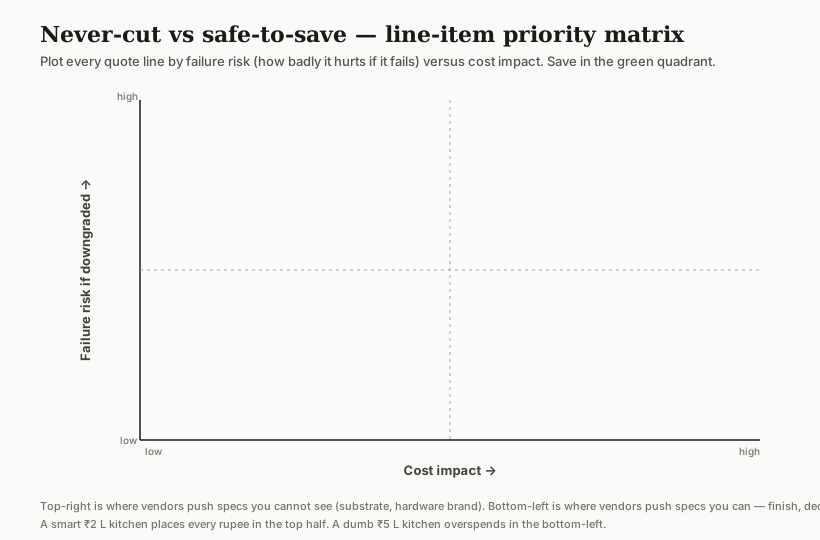
The right way to think about it: plot every line item on a two-by-two matrix of cost impact versus failure risk if downgraded. The top-right is the never-cut zone. The bottom-left is the safe-to-save zone.
5. How to read a vendor BOQ and spot the padding
A vendor BOQ (bill of quantities) is the line-itemised quote that breaks the lump-sum into measurable parts. If a vendor refuses to share a BOQ, walk. Here is the read-it-in-ten-minutes checklist:
| Red flag | What it means | What to ask |
|---|---|---|
| Lump-sum only, no per-sqft | Vendor cannot justify the rate | Get a per-sqft sheet by zone |
| Ply spec "BWP grade" with no brand | Cheap ply re-labelled | Brand + IS 710 certification |
| Hardware "soft-close" with no brand | Generic Chinese fittings | Blum/Hettich/Hafele model number |
| Chimney "1200 CFM auto-clean" with no make | Filterless cheap unit | Make + warranty in writing |
| Countertop "Indian granite 20 mm" | Pricing fog — there are 30 grades | Specific slab name and quarry |
| Installation "as per site" | Open invoice | Fixed-fee bracket with site conditions |
| "Misc. + tax" line > 8% of total | Padding | Ask for itemisation |
A clean BOQ has the brand against every hardware line, the substrate by IS code (IS 710 for BWP), the chimney by make and CFM, and the countertop by slab name. Anything else is a negotiation invitation.
The vendor who quotes lowest by hiding the spec is also the vendor who substitutes the spec at delivery. Cheap is fine; opaque is not.
6. The contingency rule — hold 10%
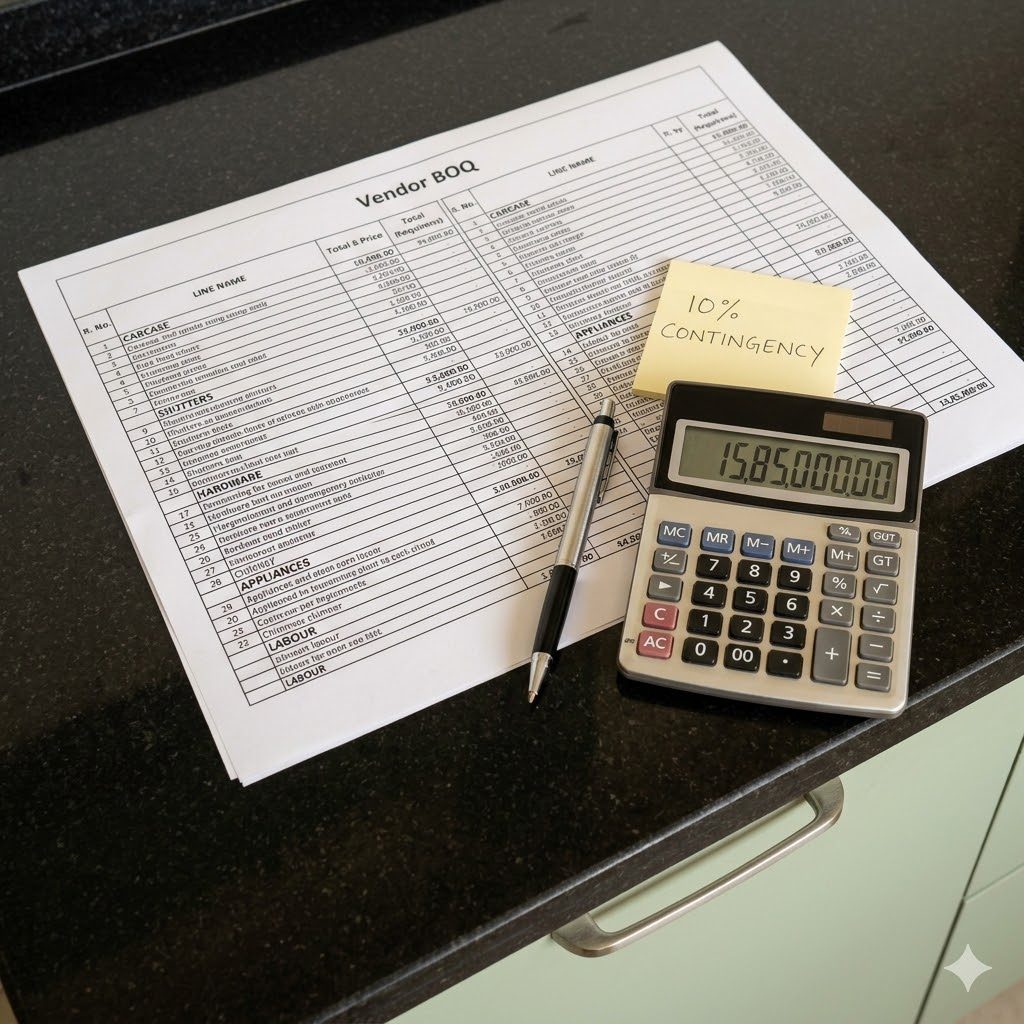
The single biggest mistake first-time buyers make is signing for 100% of the budget. There is always a surprise — a wall is not plumb, a slab is 30 mm thicker on one end, the plumbing rough-in is at the wrong height, the gas pipe takes a detour around a column. Each fix is ₹2,000–₹15,000. Without a contingency, the first surprise becomes a credit-card emergency and the kitchen quality drops everywhere else to make it fit.
Hold 8–10% of the kitchen budget in a separate line and only release it as actual variations come in. On a ₹3 L kitchen, that is ₹24,000–30,000. Whatever is left is your post-handover spend on the toe-kick drawer, the splashback rail, or a better mixer.
7. Spend-where-it-matters — the smart ₹2 L beats the dumb ₹5 L
A worked example. Two homeowners, same 10 by 8 kitchen footprint:
| Line | Smart ₹2 L kitchen | Dumb ₹5 L kitchen |
|---|---|---|
| Carcase | BWP Centuryply, every cabinet | MR ply with "BWP face only" |
| Shutters | Plain laminate front; loft in budget board | Acrylic full-height, mirror finish |
| Hardware | Blum soft-close on daily drawers | Imported handles, generic slides |
| Hob | 4-burner Elica, schott glass | 5-burner gas, no auto-ignition warranty |
| Chimney | 1200 CFM ducted, smooth pipe | 1500 CFM filterless "ductless" |
| Countertop | Sealed-edge granite, mitred front | Quartz unsealed, square-edge |
| Pull-outs + corner | Magic corner + tall pull-out | Mirror crockery unit |
| Contingency | 10% held | 0% — over-spent on shutter finish |
The smart kitchen will look identical at three feet, will perform better daily, and will outlast the expensive one by years. The dumb kitchen put money where the eye sees it once and the cook never feels it. By year four, the BWP-faced MR ply has delaminated under the sink, the filterless chimney has dropped a quarter of its extraction, the unsealed quartz back-edge has a yellow water-line, and the imported handles look the same as the ₹120 handles on the smart kitchen.
8. The order in which to negotiate
Negotiating a vendor down 15% is impressive, but the wrong line items move. Negotiate in this order:
1. Get the BOQ first. Without it, you are negotiating fog.
2. Lock the never-cut lines at brand. BWP ply by name, soft-close hardware by brand, chimney CFM and duct, countertop spec.
3. Trim the safe-to-save lines — shutter finish in low-touch zones, decorative shutters, premium handles outside daily drawers.
4. Push installation + transport down. This is the most negotiable line; vendors pad it to absorb haggling room.
5. Hold 10% as contingency. Take it out of the headline number, not out of the never-cut lines.
The fix, in order
1. Decode every quote to ₹/sqft before comparing. Anyone who refuses, walk.
2. Demand a BOQ with brand names. No brand, no contract.
3. Lock the never-cut four — BWP ply, soft-close hardware, chimney + duct, countertop seal.
4. Trim the safe-to-save four — finish, handles, decorative shutters, premium hinges on loft.
5. Hold 10% as contingency — not spent until variations come in.
6. Audit the final invoice against the BOQ at handover. Substitution is the most common ground-level cheat.
Prevent it / Plan it: Build the BOQ with our Kitchen BOQ tool, set a realistic envelope with the Kitchen Budget calculator, and run vendor quotes through the Quote Comparison and Cost Reality Check tools. Read the modular kitchen guide, the interior cost per sqft in India deep-dive, why cheap interiors become expensive later, the hidden costs of interiors in India, and the pillar — the best modular kitchen layout for Indian cooking.
References
- Bureau of Indian Standards (2014) IS 710: Marine Plywood — Specification. New Delhi: BIS.
- Bureau of Indian Standards (1993) IS 303: Plywood for General Purposes — Specification. New Delhi: BIS.
- Bureau of Indian Standards (2016) National Building Code of India 2016, Part 8: Building Services. New Delhi: BIS.
- National Kitchen and Bath Association (2016) Kitchen and Bathroom Planning Guidelines with Access Standards. Hoboken, NJ: John Wiley & Sons.
- CIDC (Construction Industry Development Council of India) (2022) Schedule of Rates — Interiors and Joinery. New Delhi: CIDC.
Part of the Studio Matrx Kitchen Design series.
Export this guide
Related Guides — Deep-dive reading
The Design Decisions With the Biggest Cost Consequences
A cost-leverage map of Indian home interiors — the handful of decisions that swing your total budget the most, so you spend your attention where a single choice has an outsized rupee impact.
Cost & MoneySmart Storage Interiors — A 2026 Working Reference for Indian Homes
Inventory-driven · Floor-to-ceiling · Hardware-engineered · Zone-mapped
Room PlanningBudget vs Premium Interiors: What Actually Changes?
Where the extra money really goes — and where premium is just a markup
Cost & MoneyRelated Tools — Try Free
Material Comparison Sheet
India's interior material cheatsheet — plywood, finishes, hardware, countertops, paints, waterproofing.
Reference GuideInterior Red Flag Checklist — Before Signing
54 red flags across 8 categories with a live risk score and personalised PDF.
Red Flag ChecklistModular Kitchen BOQ Template
11-category kitchen Bill of Quantities with 3-vendor quote comparison and OK/LOW/HIGH status per line.
Kitchen BOQ