
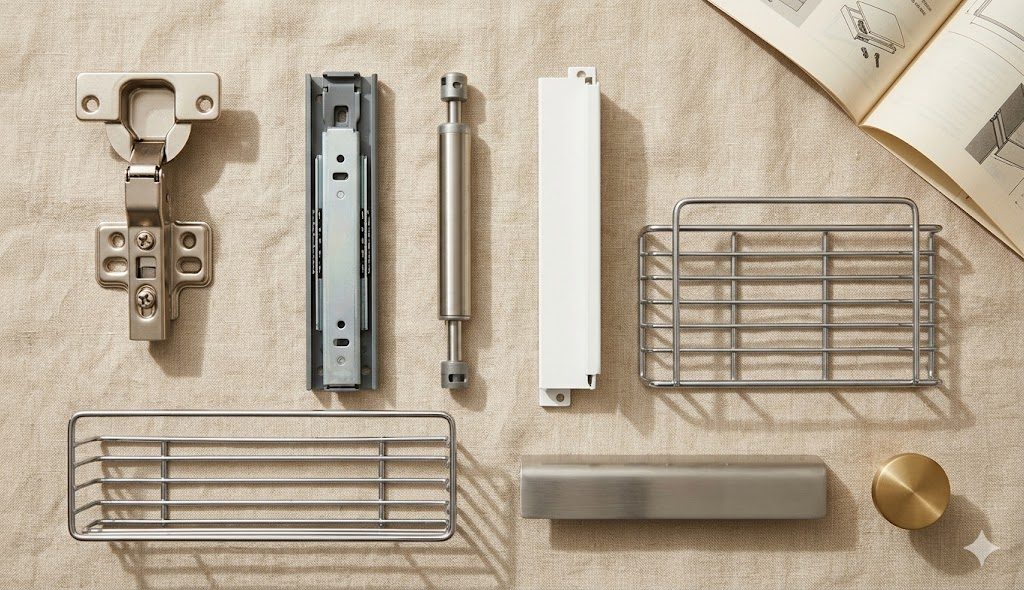
Complete Guide to Interior Hardware
The 8–12% of the interior budget that decides whether everything else works
Hardware is the most under-discussed and most under-specified line in an Indian interior budget. Homeowners agonise over laminate shades, marble veining and granite slabs that get touched twice a week, and then sign off on "all soft-close hardware included" — a single phrase that controls how the kitchen, the wardrobes, the TV unit and the bathroom vanity open and close every day for the next twenty years.
The maths is brutal. A modular kitchen for a 2 BHK contains roughly 28 to 36 hinges, 18 to 24 drawer slides, 5 to 9 pull-out systems, 14 to 18 handles, two to three locks and several hundred anchors. Each one is a small mechanical device that absorbs the daily impact of a hurried morning, a tired evening, a small child slamming a cabinet. The lifespan of the kitchen is, almost exactly, the lifespan of the cheapest piece of hardware in it.
This guide maps the ten interior hardware families used in an Indian home, the IS codes that govern each, the brand-tier landscape, the cycle ratings that decide real-world life, and the way to read "soft-close included" in a quote and know whether it means Blum or no-name OEM. It is a deep-dive companion to our complete guide to plywood grades in India, and pairs with the premium kitchen hardware guide and why cheap hardware destroys expensive interiors.
The ten hardware families inside an Indian home
There are dozens of niche items in a hardware catalogue, but the working interior of an Indian home is built from ten families. Each does a specific job, each is governed by a specific IS code or international standard, and each has a budget, mid and premium tier with measurable differences.
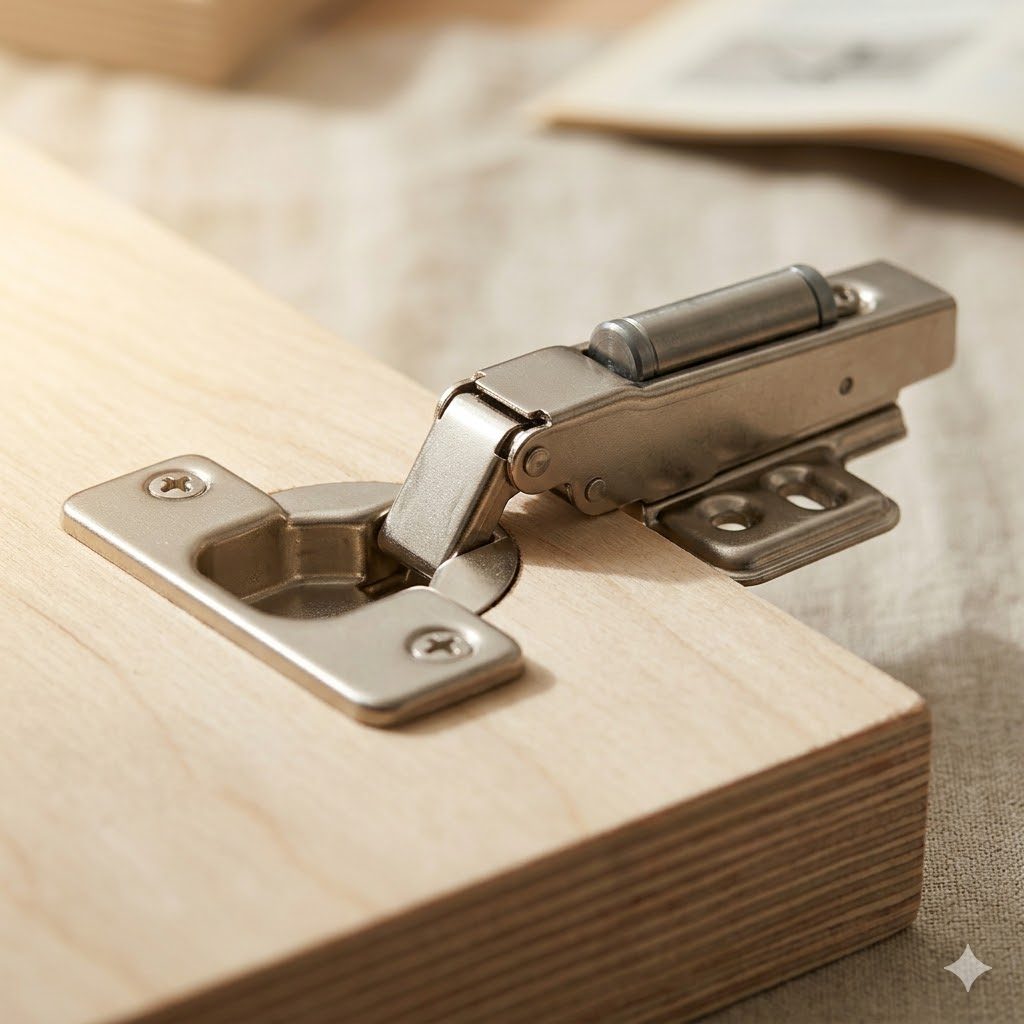
Concealed hinges (IS 7196) are the most-cycled component in the home. A premium clip-on cup hinge is tested to 80,000 to 200,000 open-close cycles; a budget hinge fatigues at 30,000 to 50,000. The hinge is also the highest-leverage failure point: when it goes, the shutter sags, the laminate edge chips, and the failure cascades into the carcase.
Drawer slides carry the drawer body and the load. Premium ball-bearing or undermount slides are rated to 25–70 kg with full extension and soft-close, 80,000+ cycles, lifetime mechanical warranty. Budget roller slides bend the drawer fronts within 18 months.
Locks (IS 5930) are a smaller line — main door, wardrobe shutter, drawer cam locks. Yale, Godrej and Dorset dominate the mid-tier; digital smart locks are increasingly mainstream.
Handles and pulls are the most-visible hardware and the least functionally critical. SS-304 stainless, solid zinc-alloy and brass with PVD coatings are durable; chrome-plated zinc fails to corrosion in 2–4 years in coastal climates.
Dampers are the hidden geometry that turns a slam into a whisper. They live inside the hinge cup, inside the drawer slide, or as separate cylinder add-ons. Premium dampers (Blum Blumotion, Hettich Silent System) are oil-filled hydraulic units tested to 50,000+ cycles.
Sliding-door tracks (IS 9134) carry wardrobe and partition leaves. Top-hung systems (Hettich TopLine, Hafele Slido) are quieter, smoother and longer-lived than bottom-roll systems. Leaf load ratings of 50 to 100 kg are typical for residential wardrobes.
Wardrobe internals are the productivity layer: pull-down rods, tie racks, belt racks, trouser racks, vanity drawers with soft-close, dimmed LED strips. Hettich Cargo and Hafele Loox are the dominant systems.
Kitchen pull-outs are the highest-leverage modular-kitchen line. A 600 mm tall pull-out, a corner magic pull-out and a waste-bin pull-out together represent ₹15,000 to ₹40,000 of hardware in a single kitchen. Premium units are tested to 60,000 cycles at full load.
Anchors and fasteners are the silent base layer — the wall plug, sleeve anchor, M-bolt or knock-down fitting that holds everything else. Cheap anchors are the reason cabinets fall off walls. Fischer and Hilti are the premium names.
Tower bolts, stays and stops (IS 3389) are the unglamorous workhorse. Brass and SS-304 in a coastal climate; cheap zinc oxidises within four years.
The brand-tier × hardware-family grid
Reading a quote means decoding which brand is supplying which line. Five names cover the premium tier in India — Blum (Austrian), Hettich (German), Hafele (German), Grass (Austrian) and Ebco (Indian, mid-tier strongest). Below them is a long tail of unbranded OEM hardware that looks identical in a renderings book and fails years faster in service.
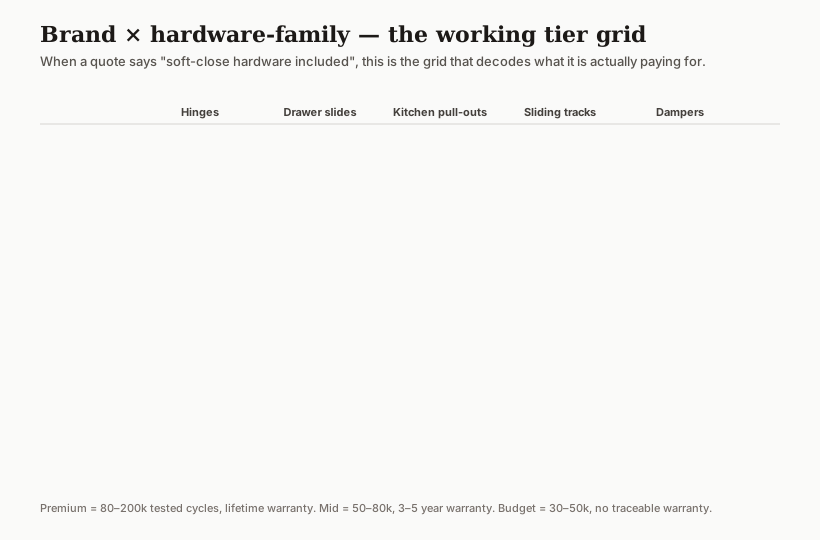
| Brand | Hinges | Slides | Pull-outs | Tracks | Dampers | Notes |
|---|---|---|---|---|---|---|
| Blum | Premium | Premium | Premium | Limited | Premium | Austrian, kitchen-first |
| Hettich | Premium | Premium | Premium | Premium | Premium | Widest catalogue in India |
| Hafele | Premium | Premium | Premium | Premium | Premium | Strongest on retail-trade reach |
| Grass | Premium | Premium | Mid+ | Mid | Premium | Premium hinges, narrower |
| Ebco | Mid | Mid | Mid+ | Mid | Mid | Best Indian-made value |
| Aristo / Polo / OEM | Budget | Budget | Budget | Budget | Often missing | Avoid in load-bearing items |
The honest reading: for the load-bearing items — hinges, slides, pull-outs — pay for the premium tier. For the cosmetic items — handles, pulls, decorative knobs — mid-tier and Indian brands are perfectly acceptable. For the structural items — anchors, fasteners — never go below mid-tier from a named brand.
Cycle ratings — what "soft-close" actually means
Every modular-kitchen brochure in India contains the phrase "soft-close hardware included". The phrase is meaningless without three numbers: the cycle rating, the brand, and the model.
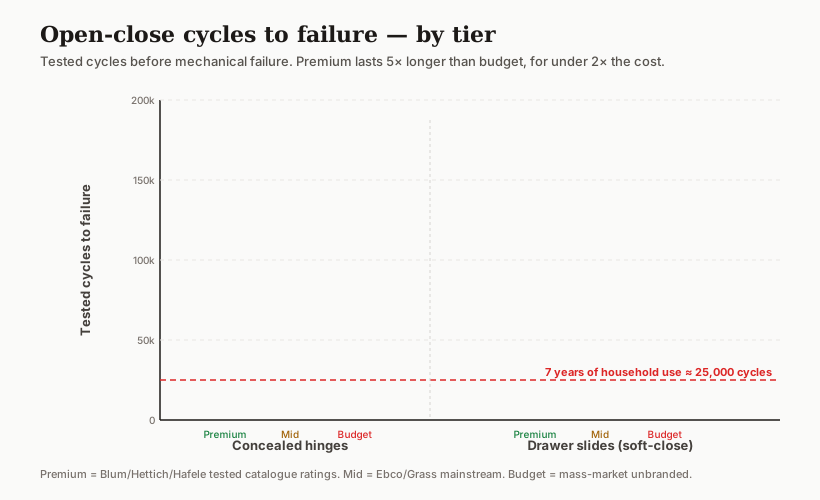
A typical household opens a kitchen cabinet 8 to 12 times a day. Across seven years that is roughly 25,000 cycles per shutter. A premium Hettich Sensys or Blum Clip-top hinge is rated to 200,000 cycles — eight times the household's seven-year demand. A budget hinge is rated to 35,000 cycles — barely seven years of daily use before mechanical failure. A "soft-close" spec from a budget supplier typically means a spring-and-cam mechanism with no oil damper; it works for the first 5,000 cycles and degrades steadily after that.
The right BOQ-line attributes for any hinge or slide are:
| Attribute | What to demand |
|---|---|
| Brand | Named (Hettich / Hafele / Blum / Grass) |
| Model number | E.g. Hettich Sensys 8645i |
| Cycle rating | ≥ 80,000 for hinges, ≥ 50,000 for slides |
| Finish | Nickel-plated, PVD or brushed SS-304 |
| Warranty | Lifetime mechanical (premium) or 7 yr (mid) |
Anti-corrosion finishes that matter in coastal India
In Chennai, Mumbai, Kochi or Mangalore, the salt-laden air is hostile to cheap finishes. A chrome-plated zinc-alloy handle that looks identical to a brushed SS-304 handle in the showroom will pit and bubble within three monsoons. The finish chemistry decides life.
- Brushed SS-304 / SS-316. The default coastal-resistant finish for handles, tower bolts and visible hardware. SS-316 is preferred within 5 km of saltwater.
- PVD coatings. Physical vapour deposition — a vacuum-deposited ceramic layer over brass or stainless. Excellent coastal resistance, scratch-resistant, multiple decorative colours (gold, rose gold, black, gunmetal).
- Nickel plating. The default for concealed hinges and slides. Acceptable in non-coastal climates; specify PVD or SS in coastal zones.
- Powder coating. Used on aluminium sliding tracks. Specify thickness ≥ 60 microns for coastal climates.
- Chrome-plated zinc-alloy. The most common budget "chrome finish". Avoid for any coastal application.
The hinge you cannot see is the part of the kitchen you live with. Specify it like you would specify the engine of a car — by brand, by model, by rated life, by warranty.
The lifecycle-cost reality
Premium hardware adds 12 to 18% to a kitchen budget — and removes roughly 80% of the 5-year failure modes. On a ₹4 lakh modular kitchen the premium-hardware delta is ₹50,000 to ₹70,000. The five-year cost of replacing budget hardware after cascading damage averages ₹40,000 to ₹70,000 plus the disruption of multiple service visits and a partially-functional kitchen for weeks at a time.
The brutal arithmetic is that the cheap kitchen costs the same as the premium one within five to seven years — and looks dramatically worse for every day after year three.
A hardware checklist for every joinery type in the home
| Joinery | Hinges | Slides / runners | Other essentials |
|---|---|---|---|
| Kitchen base cabinet | 80k-cycle, soft-close | 50 kg ball-bearing | Anchor M-bolt, SS-304 pull |
| Kitchen tall unit | 100k-cycle, soft-close | 70 kg full-extension | Cargo system, brushed pull |
| Kitchen overhead | 80k-cycle, soft-close | — | Lift-up flap stay |
| Wardrobe (hinged) | 80k-cycle, soft-close | — | Pull-down rod, drawer set |
| Wardrobe (sliding) | — | Top-hung 80 kg leaf | Floor guide, soft-close brake |
| Bathroom vanity | 80k-cycle, marine-grade | 30 kg corrosion-rated | SS-316 pull |
| TV unit | 80k-cycle, soft-close | 30 kg ball-bearing | Cable grommet, lift-up flap |
| Pooja unit | 80k-cycle, soft-close | 25 kg ball-bearing | Brass pull, magnetic catch |
The fix, in order
1. Make hardware a separate BOQ section — never bundled into "modular kitchen rate".
2. Name brand, model and cycle rating for every hinge, slide and pull-out.
3. Demand the catalogue page in the contract annexure — photo proof against substitution.
4. Specify finish to the climate — SS-304 inland, SS-316 or PVD on the coast.
5. Write a no-substitution clause — any change requires written approval.
6. Audit on delivery — check the brand stamps on actual installed hinges, not on a sample.
Prevent it / Plan it: Build the spec line with the material quality checklist, benchmark vendors with the quote comparison tool, and study the premium kitchen hardware guide, why cheap hardware destroys expensive interiors and wardrobe finish ideas before signing the contract.
References
- Bureau of Indian Standards (2011) IS 3389: Specification for Cup Board Locks, Drawer Locks and Cup Board Bolts. New Delhi: BIS.
- Bureau of Indian Standards (2007) IS 7196: Specification for Hold Fasts. New Delhi: BIS.
- Bureau of Indian Standards (1995) IS 9134: Specification for Hinges for General Building Purposes — Sliding Door Hinges. New Delhi: BIS.
- Bureau of Indian Standards (2017) IS 5930: Specification for Mortice Locks (Vertical Type). New Delhi: BIS.
- Bell, V. B. and Rand, P. (2014) Materials for Architectural Design. London: Laurence King Publishing.
Part of the Studio Matrx Materials & Finishes series.
Export this guide
Related Guides — Deep-dive reading
Smart Storage Interiors — A 2026 Working Reference for Indian Homes
Inventory-driven · Floor-to-ceiling · Hardware-engineered · Zone-mapped
Room PlanningWhy Cheap Hardware Destroys Expensive Interiors
The catalogue trick where the carcase is premium and the hardware is invisible — and how to prevent it
Materials & FinishesPremium Hardware Guide for Kitchens
The soft-close drawers, hinges, pull-outs and basket systems that are actually worth paying for
Kitchen DesignRelated Tools — Try Free
Before vs After — Cost Reality Check
Compare what you expected to pay vs what you actually paid, category by category.
Reality CheckInterior Contract Clause Checklist
16 sections and 98 checkboxes covering scope, BOQ, milestones, penalties, warranty, and disputes.
Contract ChecklistMaterial Comparison Sheet
India's interior material cheatsheet — plywood, finishes, hardware, countertops, paints, waterproofing.
Reference Guide