
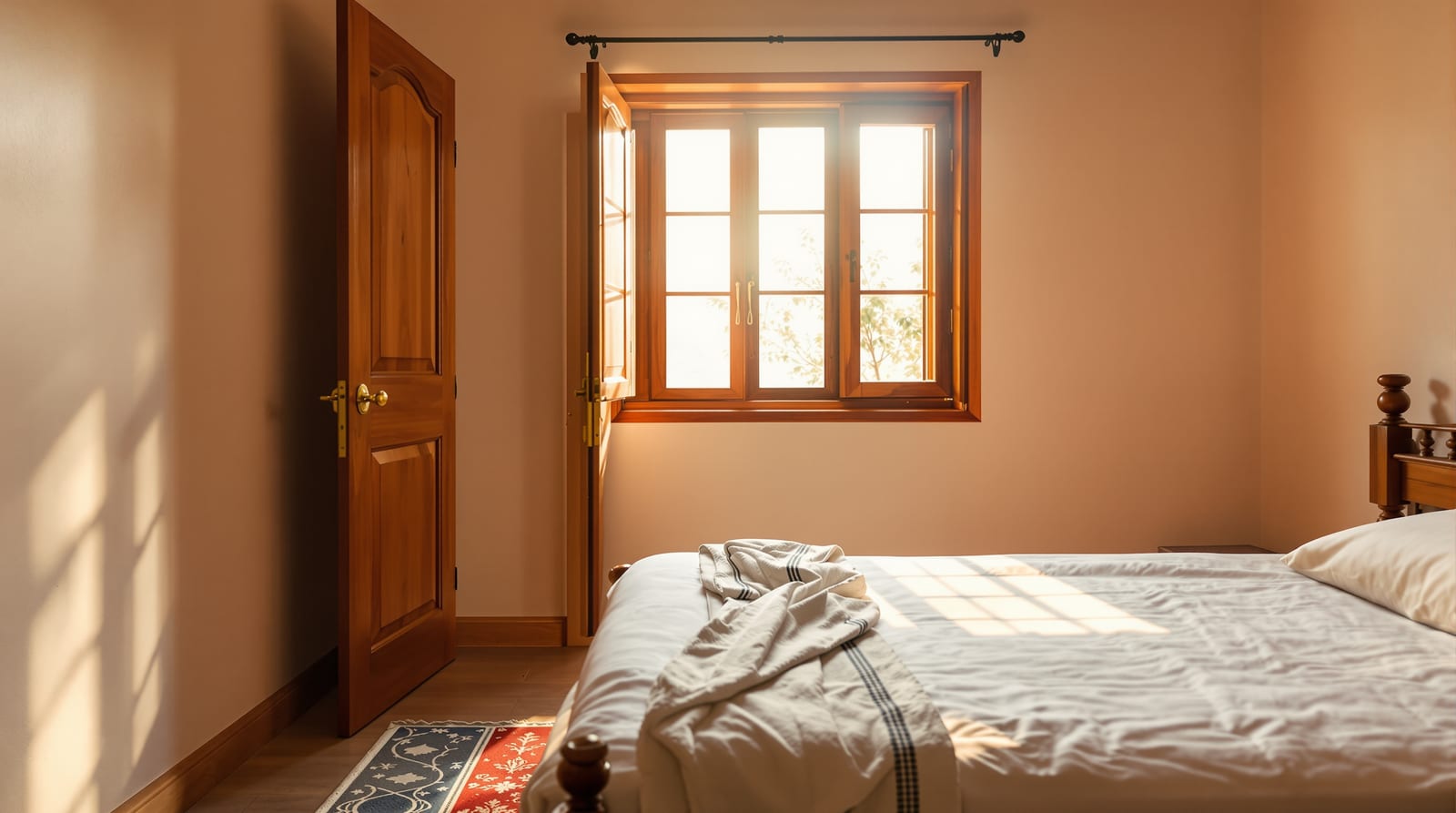
Bedroom Door Vastu for Indian Homes: Direction, Placement & Remedies
Master, kids and guest bedroom door directions, why a door should not face the bed or another door, and practical remedies that respect both belief and buildability.
Where you put a bedroom door changes how a room feels long before anyone talks about Vastu. A door that opens onto the foot of the bed, or that lines up straight with a second door across the room, makes a space feel restless and exposed. Vastu Shastra reached the same conclusions centuries ago through a different vocabulary, of direction, energy and dwar vedha, and Indian families still build by it. This guide gives you the traditional bedroom door rules and, alongside each one, the practical reasoning a designer would use, so you can plan a door that satisfies elders and works as architecture too.
Bedroom door Vastu is one layer of a larger system. For the principal entrance of the home see our main door Vastu guide and the broader entrance Vastu primer. This page stays focused on the doors of the bedrooms themselves.
How Vastu thinks about a bedroom door
In Vastu Shastra the door is the mouth of a room, the opening through which prana, the life-energy, enters and circulates. The placement of that mouth is held to set the tone of rest, relationships and health for the people who sleep there. The system divides every room into a grid of directions and sub-directions (the ashtadik), and assigns qualities to each: the north-east is the most auspicious and light-filled, the south-west is grounding and stable, the south-east is fiery, and so on.
A modern designer does not invoke prana, but does care about almost the same things: morning light, the path you walk when you enter, privacy from the door line, and where the bed sits relative to the opening. That overlap is why so much of bedroom door Vastu reads as sensible spatial planning once you translate it. Throughout this guide we mark each rule as belief (the traditional reasoning) and practical (why it also tends to make a better room).
Master bedroom: why the south-west
The single firmest rule in bedroom Vastu concerns the master bedroom itself, not just its door: the master bedroom is ideally located in the south-west (Nairutya) zone of the house.
Belief. The south-west is the direction of Earth and stability, ruled in tradition by Nairuti. Placing the head of the family here is said to lend authority, steadiness and a settled relationship. The heaviest, most grounded room of the home belongs in its heaviest corner.
Practical. The south-west corner receives the least harsh morning sun and the most evening warmth, and in most plot orientations it is the quietest corner, furthest from the entrance and the street. It is, simply, a good place to sleep.
Within that south-west master suite, the door is then placed to draw energy in from a more auspicious direction. The preferred bedroom door directions are north, east or north-east of the room's wall, so that you enter from a lighter, more active quadrant while the bed itself rests in the south-west of the room. The bed's headboard is traditionally kept to the south or west, so the sleeper's head points south while resting, never north.
Door directions by bedroom type
Not every bedroom carries the same weight in Vastu. The table below summarises the traditional door guidance per room type, with the practical reasoning beside it. Treat directions as the wall on which the door is set, read from inside the room.
| Bedroom type | Preferred room zone | Preferred door direction(s) | Traditional reasoning (belief) | Practical reasoning |
|---|---|---|---|---|
| Master bedroom | South-west (Nairutya) | North, east or north-east wall | Grounding zone for the head of family; door draws auspicious morning energy | Quietest corner, gentle morning light, longest walk from entrance = privacy |
| Children's bedroom | West or north-west | North, east or north-east wall | Growth, study and outward energy from east light | Morning light aids waking and study; active wing of the home |
| Guest bedroom | North-west (Vayavya) | North or west wall | North-west governs movement and transient stays, suiting guests | A room near the entrance, easy to reach without crossing private zones |
| Elderly / parents' room | West or south | West or north wall | Stability and rest for elders | Ground-floor proximity, away from noise and stairs |
| Teenager's room | West or south | North or east wall | Encourages focus and discipline | Light for study desk; separation from common areas |
Across every type, the recurring instruction is the same: avoid a door on the south or south-west wall of the bedroom where you can, and favour the north and east. Where the plot leaves no choice, the remedies later in this guide apply.
The two rules that matter most
If you remember nothing else from bedroom door Vastu, remember these two, because both have the strongest practical backing.
1. The door should not directly face the bed
Belief. A door opening straight onto the bed, especially onto the feet of the sleeper, is considered a path for energy to rush at the body during rest, disturbing sleep and health. The classic instruction is that you should not lie with your feet pointing at the door, sometimes called the coffin position in folk reasoning.
Practical. Sleep researchers and designers describe a real instinct here, sometimes called the commanding position: people rest more easily when they can see the door without being directly in line with it. A door facing the bed also means light, draught and corridor noise spill straight onto the pillow every time it opens. Set the bed so it is diagonal to the door, visible from it but not in its direct axis.
2. Two doors should not directly face each other (dwar vedha)
Belief. When the bedroom door lines up exactly opposite another door, a bathroom door, a cupboard, or a door in the corridor beyond, Vastu calls it dwar vedha, a piercing of one threshold by another. It is held to scatter energy and to cause friction between the people of the two spaces.
Practical. Two aligned doors create a direct sightline and a wind tunnel. Privacy collapses: open the bedroom door and you look straight into a bathroom or out into the hall. Aligned doors also mean draughts slam shutters and carry sound. Offsetting the two doors by even 200 to 300 mm breaks the line and solves both the belief and the building problem. Our door alignment Vastu guide covers dwar vedha in depth, and the Vastu door remedies guide lists the fixes when an offset is not possible.
A bedroom plan, at a glance
The diagram below shows the configuration most Vastu consultants will steer you toward for a south-west master bedroom: door on the north or east wall, bed in the south-west out of the door's line, and no second door opposite.
Single shutter, opening inward, clockwise
Beyond direction, Vastu has views on how the bedroom door is built and hung. These are gentler rules, and most have a clean practical reading.
- Single shutter for a bedroom. Double doors are reserved for the main entrance and grand rooms; a bedroom door is traditionally a single leaf. Practically, a single 900 mm leaf is the right scale for a private room, swings clear in a smaller space, and is cheaper to hang and to fit with a quality mortise lock.
- Open inward. The door should open into the room, drawing energy in rather than pushing it out, and (the belief continues) sweeping in a clockwise arc. In practice an inward, clockwise swing keeps the door off the corridor where it could clash with another opening, and puts the handle on the natural side as you enter. (Note: this is the opposite of the rule for fire-escape and main exit doors, which by NBC 2016 Part 4 must open in the direction of egress; bedroom interior doors are not exit doors.)
- Even number of panels. If the leaf is panelled rather than flush, an even number of panels (two, four) is preferred. This is a softer guideline and rarely a deal-breaker.
- Threshold (dehleez). A modest threshold strip at the door is traditional. Keep it shallow, NBC accessibility practice wants thresholds of 12 mm or less so it does not become a trip hazard, especially for elders.
- Quality, well-finished leaf. A solid-core flush or panelled leaf in a good material is preferred over a hollow, flimsy door. See bedroom door design for the leaf-and-finish side of the decision.
The squeak-free door: belief meets maintenance
There is one charming convergence of tradition and good housekeeping: a bedroom door should not squeak. In Vastu a creaking door is said to invite negativity, disturbance and quarrels into the room, and to disturb the rest of those who sleep there.
The practical truth is almost identical. A squeak means dry or worn hinges, a sagging leaf, or a frame moving with monsoon humidity, all real problems that get worse if ignored, and a squeak genuinely wrecks sleep when someone opens the door at night. The fix is simple: a few drops of light machine oil or a silicone spray on the hinge knuckles, tightening loose hinge screws, and replacing a worn hinge if the leaf has dropped. Keeping the door silent satisfies the belief and is good maintenance either way; our dedicated walkthrough on curing a creak is at fix a squeaky door.
Materials and the Indian climate
Vastu favours wood for bedroom doors, teak above all, as a warm, living, grounding material, and is cool on cold metal for the sleeping room. That preference happens to suit Indian conditions well:
- Teak and seasoned hardwood resist termite and monsoon swelling and last for decades; see teak wood doors.
- Engineered wood and WPC flush doors give the warm, even look Vastu likes at a lower cost and with good moisture resistance, useful in coastal and high-humidity homes; see WPC doors.
- Avoid leaving raw timber unsealed in monsoon belts; a good polish or membrane finish keeps the leaf from swelling and squeaking.
Indicative bedroom door costs (leaf only, fitting and hardware extra, plus 18% GST; varies by city and vendor): a flush or engineered-wood single leaf runs roughly ₹1,500 to 9,000, a solid teak leaf ₹10,000 upward, and good hinges and a mortise lock-set add ₹700 to 6,000. For a tailored figure use the door cost calculator, and check the right opening size with the door size calculator.
When the plot fights the rules: remedies
Real Indian homes, especially flats, rarely let you place every bedroom door on the ideal wall. Vastu accepts this and offers remedies; most are also just sensible design moves. A few of the common ones:
- Door facing the bed? Shift the bed so it is diagonal to the door, or hang a curtain or place a tall headboard / screen to break the direct line. If neither is possible, a small wind chime or a decorative panel on the door line is the traditional softener.
- Two doors facing each other (dwar vedha)? Offset one door by 200 to 300 mm in the next renovation, or hang a thick curtain, a beaded screen or a wooden partition between them. Many families place a toran across the bedroom doorway, both a remedy and a welcome; see toran and threshold Vastu.
- Door on a south or south-west wall? Where it cannot move, keep that door especially well-finished, solid and silent, and balance the room with light and a north-east window. The door alignment Vastu and Vastu door remedies guides go through the full remedy set.
- Door behind the bed or in a cramped corner? Reconsider the bed wall first; a small layout change usually beats any object-based remedy.
Plan it visually before you commit: the door Vastu planner lets you test directions and bed positions for a room.
Frequently asked questions
Which direction should a master bedroom door face as per Vastu?
For a master bedroom placed in the south-west of the home, the door is best set on the north, east or north-east wall of the room, so you enter from a lighter quadrant while the bed rests in the grounded south-west. Avoid placing the bedroom door on the south or south-west wall where the plan allows.
Why should a bedroom door not face the bed in Vastu?
Tradition holds that a door opening straight onto the bed lets energy rush at the sleeper and disturbs rest and health, and you should never sleep with your feet pointing at the door. Practically, an in-line door means light, draught and noise hit the pillow every time it opens, and most people sleep better with the bed diagonal to the door, visible but not in its direct path.
What is dwar vedha and how do I fix it?
Dwar vedha is when two doors directly face each other, said in Vastu to scatter energy and cause friction. The cleanest fix is to offset one door by 200 to 300 mm so the two no longer align; where that is not possible, hang a curtain, beaded screen, partition or toran between them. See our door alignment Vastu and Vastu door remedies guides.
Should a bedroom door be single or double, and which way should it open?
A bedroom is traditionally a single-shutter door (double doors are kept for the main entrance), and it should open inward into the room in a clockwise arc. This also makes building sense: a single 900 mm leaf suits a private room, swings clear of the corridor, and keeps the handle on the natural side as you enter.
Does a squeaky bedroom door really matter in Vastu?
Yes, a creaking door is traditionally said to invite disturbance and quarrels and to spoil rest. The practical reason is the same: a squeak signals dry or worn hinges or a sagging leaf, and it genuinely disturbs sleep at night. Oil the hinge knuckles, tighten loose screws, and replace a worn hinge; the fix a squeaky door guide walks through it.
Export this guide
Related Guides — Deep-dive reading
Double Doors in India (2026): Two-Leaf Entrances, Proportions, Hardware & Cost
When a double-leaf door makes sense for Indian main entrances, pooja rooms and master suites, plus active/inactive leaf hardware, the Vastu note on even panels, security at the meeting stile and the rupee premium over a single door.
Home Doors & EntrancesMinimalist Door Designs in India (2026): Flush, Frameless & Concealed-Frame Doors
The clean-line, no-architrave, hidden-hardware door language behind modern Indian apartments and designer interiors — flush-to-wall doors, concealed hinges, recessed pulls, tall leaves and what the look really costs.
Home Doors & EntrancesOrientation, Light & Views: Designing With Your Space, Not Against It
How reading your plot's sun, breeze and views — and placing each room on the right face — gives an Indian home that is cooler, brighter and quietly right, instead of one that fights its site forever.
Design PrinciplesRelated Tools — Try Free
Cross-Ventilation Analyzer
Estimate airflow and air changes per hour (ACH) from room size, window areas, layout, and local wind — with NBC 2016 Part 8 compliance check.
Ventilation CalculatorMain Door Vastu Planner
Check your main door direction against Vastu, with remedies and colour and material suggestions.
Vastu PlannerDoor Cost Calculator
Estimate the all-in cost of a door — leaf, frame, hardware, fitting and GST — by type, material and size.
Door Calculator