
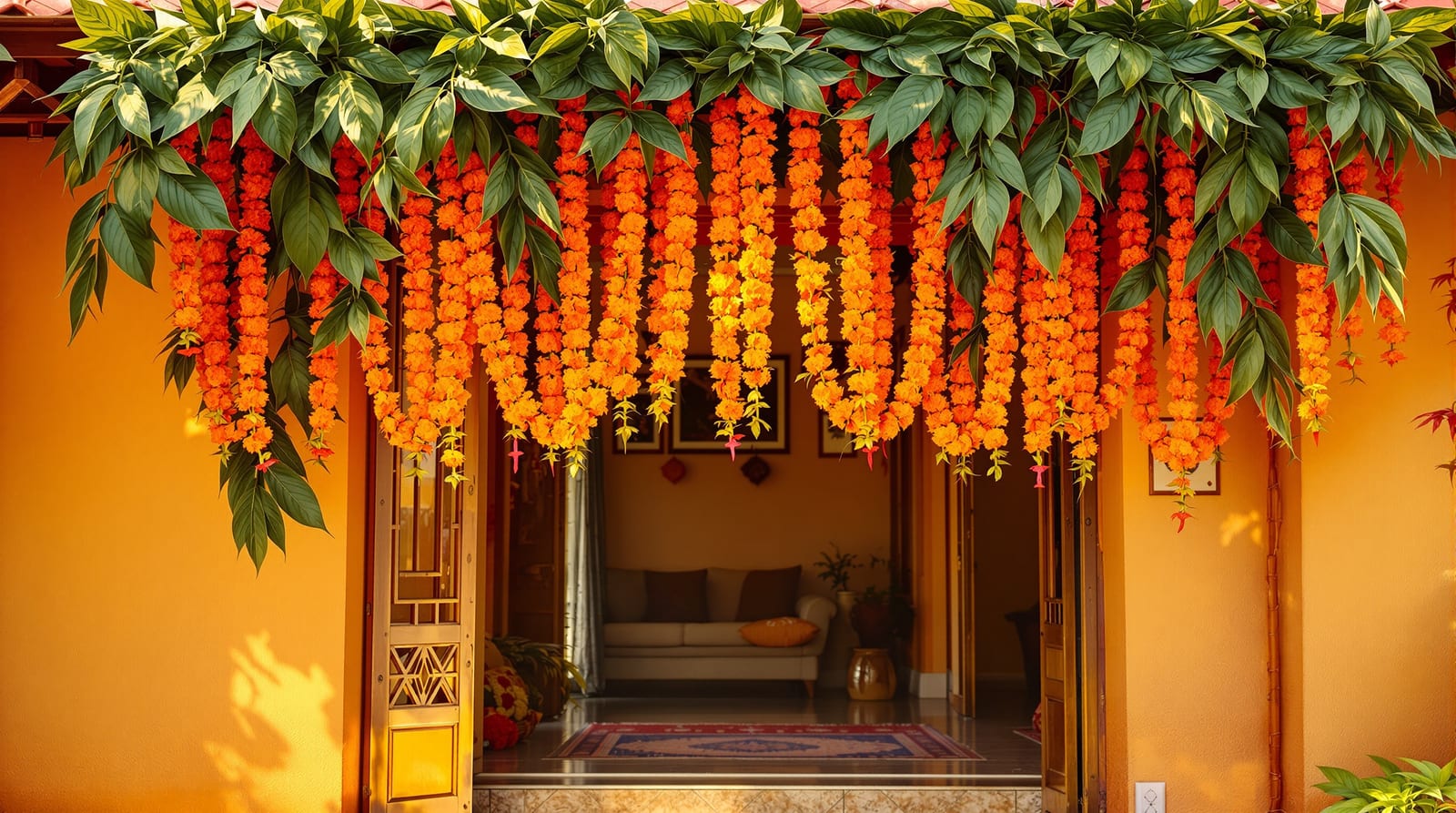
Toran and Threshold (Dehleez) Vastu for Indian Homes: Tradition Meets Practical Sense
Why the toran over the door and the dehleez underfoot endure: their auspicious meaning and their genuine job as a barrier, level marker and welcome signal.
Walk up to almost any Indian home on a festival morning and two things greet you before the family does: a string of marigolds and mango leaves arched across the doorway, and a raised line of stone or wood you instinctively step over to enter. The toran above and the dehleez below are among the oldest, most universal elements of the Indian threshold - and unlike a lot of ritual, both happen to do something genuinely useful. This guide treats them as exactly that: tradition worth honouring, and practical detailing worth getting right.
We will keep the two ideas separate where they need to be. Vastu and custom give the toran and threshold a layer of meaning - welcome, auspiciousness, a symbolic barrier to negativity. Building sense gives the threshold a second, very real job - keeping out dust, water and insects, and marking a clean level change. Where a belief is belief, we will say so; where a detail is measurable (a 12 mm threshold height, a slope away from the door), we will be specific. For the broader entrance picture, this sits alongside our main door Vastu guide and the entrance Vastu companion; for the hard numbers on thresholds, pair it with door threshold standards.
What a toran is - and what it is meant to do
A toran (also called bandanwar, toranam, or bandhanwar) is a decorative hanging strung across the top of a doorway, usually the main entrance. The word traces to the Sanskrit torana, the ceremonial gateway you see at Sanchi and at temple entrances - so the household toran is, in a sense, a miniature of a sacred gate marking the boundary between outside and inside.
In tradition, the toran does three things. It welcomes - Lakshmi, guests, prosperity, the new day. It signals auspiciousness - which is why one goes up for Diwali, Navratri, weddings, Griha Pravesh (housewarming) and a new baby's arrival. And it is felt to act as a subtle barrier - mango leaves and marigolds are believed to absorb or repel negative energy and keep it at the threshold rather than letting it cross in. None of this is engineering; it is belief and culture, and it is meaningful on those terms.
There is a thread of practical sense underneath, though. Fresh mango leaves and marigold release aromatic compounds; marigold in particular is a known mild insect deterrent, which is partly why it borders so many Indian gardens and doorways. A fresh toran is also a visible cue that a home is cared for and occupied - a small but real signal. So the custom that "a toran keeps bad things out" maps loosely onto a doorway that smells fresh, looks tended and gently discourages insects.
Types of toran, where to hang, festival vs permanent
Torans split broadly into the fresh/temporary kind (made and hung for an occasion, then composted) and the permanent/reusable kind (beaded, fabric, metal). Both have a place; many homes run a permanent toran year-round and add a fresh one for festivals.
| Toran / threshold type | Traditional meaning | Genuine practical role |
|---|---|---|
| Marigold + mango-leaf toran (fresh) | Auspicious welcome; Lakshmi; festival joy | Pleasant scent; mild insect deterrent; "home is tended" signal; fully compostable |
| Ashoka / neem leaf toran (fresh) | Purity, health, removing grief (Ashoka = "no sorrow") | Aromatic; neem is a traditional insect repellent |
| Beaded / bead-and-bell toran (permanent) | Prosperity; the bells' sound is believed to clear stale energy | Year-round decoration; bells give an audible cue when the door moves |
| Fabric / embroidered toran (permanent) | Regional craft, festive colour, hospitality | Durable, washable, no daily replacement |
| Brass / metal / bell-metal toran (permanent) | Durability of fortune; temple association; OM/Lakshmi motifs | Long-lasting; pairs with brass door fittings; low maintenance |
| Coconut-and-leaf toranam (South) | Strong auspiciousness for Griha Pravesh, weddings | Robust, lasts the multi-day event |
| Raised stone / granite threshold (dehleez) | Boundary of the sacred home; Lakshmi rests here; not to be stepped on | Dust + water + insect barrier; level marker; durable wear edge |
| Low timber / brass-capped threshold | Same boundary symbolism; warmth of wood | Seals the door bottom; brass cap resists wear and looks ceremonial |
On where to hang: the toran goes across the top of the door frame, ideally fixed so its lowest point clears head height - you should not have to duck. It should span the opening evenly and hang level. Vastu preference is for the main door to be on a favourable side (north, east or north-east) and to be the home's largest and most prominent door; the toran simply emphasises that already-important entrance - see main door direction Vastu and main door design. A fresh toran is replaced when it wilts (a day or two for marigold); a permanent one is dusted and rehung.
A small etiquette point that is widely observed: you do not normally place a toran over a bathroom or store-room door. It belongs to the welcoming, auspicious openings - main door first, then pooja room or living spaces. For the pooja entrance specifically, see pooja room door Vastu.
The dehleez (threshold): meaning and the real job it does
The threshold - dehleez in Hindi, vaasal padi or padi in the South, umbar in Marathi - is the raised strip at the base of the doorway. In tradition it is the line between the outside world and the protected, auspicious interior. Lakshmi is said to pause at the threshold, which is why so many homes draw a rangoli or place small footprint motifs (Lakshmi padam) just inside it, and why you are taught from childhood not to step on the threshold but to step over it, and never to sit on it.
Strip away the symbolism and the threshold is doing honest work:
- Dust and water barrier. A small raised lip stops wind-blown dust and rain-driven water at the door rather than letting it sheet inside - which matters enormously in the Indian monsoon and in dusty plains cities.
- Insect barrier. A continuous threshold plus a door-bottom seal closes the gap that ants, lizards and cockroaches use. (For the seal itself, see door seals and weatherstripping.)
- Level marker and wear edge. It cleanly resolves a small floor-level change between outside and inside, and a granite or brass-capped threshold takes the daily scuffing that would otherwise wear the floor and door bottom.
Here is where tradition and modern building standards have to be reconciled. Older homes built thresholds high - sometimes 50-75 mm or more - which suited the symbolism but is a genuine trip hazard and is impossible for a wheelchair, a walker, or a parent with a stroller. Modern accessible practice, and the NBC 2016 / RPwD Harmonised Guidelines 2021 direction, is to keep thresholds low - ideally 12 mm or less, with any edge bevelled. You can absolutely keep the meaning of a threshold while making it accessible: a flush or near-flush granite strip, 6-12 mm proud with a chamfered edge, still reads as a dehleez, still sheds water, still gives you the rangoli line - and an elderly grandparent will not catch a toe on it. This is covered in depth in door threshold standards and tied to wider access in accessible home design.
Threshold materials and a simple detail
| Threshold material | Indicative cost | Notes for Indian homes |
|---|---|---|
| Granite / stone strip | ~₹150-600 per running ft (material + fitting; indicative, varies by city/vendor) | Most common; tough, monsoon-proof, ceremonial; keep height 6-12 mm, bevel the edge |
| Marble | ~₹200-800 per running ft | Elegant but softer; can stain - better for interior than exposed main door |
| Brass-capped timber | ~₹400-1,200 per running ft | Warm, traditional, brass cap resists wear; pairs with brass door fittings |
| Aluminium / SS threshold strip | ~₹120-500 per running ft | Slim, modern, near-flush; works well with weather seals; easy 12 mm profile |
| WPC / composite | ~₹150-500 per running ft | Termite- and water-proof; useful for bathroom/utility door bottoms |
Costs include 18% GST in most quotes; raw material plus carpenter/mason fitting labour. Always confirm with your vendor - these are benchmarks, not bills.
A good main-door threshold detail in plain terms: a low granite strip set into the frame, its top 6-12 mm above interior floor, the outside floor sloped gently away so rain runs off rather than pooling at the door, a chamfered (sloped) top edge so it is not a trip lip, and a brush or door-bottom seal on the leaf meeting it to close the insect and draught gap. That single detail does the dust, water and insect job that the symbolism only gestures at.
A simple threshold + toran diagram
Bringing tradition and practicality together
The honest position is that you lose nothing by treating these elements as both. Hang the toran because it is beautiful, because it welcomes people, and because it carries meaning your family understands - and enjoy that a fresh one also makes the entrance smell of marigold and gently keeps insects off. Build the threshold because Vastu and custom give it weight - and detail it low, bevelled and sealed so it actually keeps the monsoon out and never trips your grandmother.
For wider Vastu remedies at the entrance (mirrors, plants, nameplates, fixing a door that faces another door), see Vastu door remedies. To plan the entrance holistically, our door Vastu planner and main door design selector tools walk you through direction, size and material; for thresholds and accessibility numbers, door threshold standards has the full detail.
Frequently asked questions
Should the toran be replaced daily or can it stay up all year?
Both customs exist. A fresh marigold-and-mango-leaf toran is hung for festivals and special days and replaced once it wilts (a day or two). Many homes also keep a permanent beaded, fabric or brass toran up year-round and simply add a fresh one for Diwali, Navratri, weddings or a Griha Pravesh. There is no rule that it must be daily.
Is a high threshold better for Vastu, or is the low accessible one fine?
Tradition values having a threshold at all - the boundary it marks matters more than its exact height. A low threshold (6-12 mm, bevelled) still reads as a dehleez, still carries the symbolism and still sheds water, while being safe for the elderly and wheelchair users. A dangerously high threshold helps no one; keep it low and accessible, in line with NBC and RPwD guidance.
Which leaves are traditionally used in a toran, and why?
Mango leaves and marigold are the most common - both are auspicious, fragrant and easy to source. Ashoka and neem leaves also feature (neem as a known insect repellent). Coconut and mango toranams are popular in the South for major events. The shared logic is fresh, aromatic, mildly insect-deterrent greenery at the door.
Can I put a toran on every door in the house?
Custom reserves the toran for welcoming, auspicious openings - the main door first, and often the pooja room or main living entrance. It is generally not placed over bathroom or store-room doors. So it is not wrong to use more than one, but it is usually limited to the doors you want to mark as auspicious.
What is the practical reason not to step on the threshold?
The cultural reason is that Lakshmi is believed to rest there. The practical overlap is simple: a threshold is a small raised edge and a wear point, so stepping over rather than on it is both respectful and a habit that avoids tripping and reduces wear on the strip and the door bottom.
Export this guide
Related Guides — Deep-dive reading
Door Threshold Standards for Indian Homes: Sill, Weather Bar & Accessibility (2026)
What the strip under your door actually does - water, dust, draft and insect barrier, level transition and trip-safe accessibility - with the right material, the 12 mm accessibility limit, weather-bar and drip-groove detailing for external doors, and the wet-bathroom threshold.
Home Doors & EntrancesZero Threshold Doors in India: Level Access (India 2026)
How to detail a flush, step-free door threshold for wheelchairs and ageing-in-place while still keeping monsoon water out.
Home Doors & EntrancesUniversal Design Doors for Indian Homes: Inclusive Doors That Work for Everyone (2026)
How to design and specify doors that serve children, the elderly, pregnant women, the injured and wheelchair users by default - generous width, lever handles, near-flush thresholds, low-force closing, contrast and good lighting - without your home ever looking medical.
Home Doors & EntrancesRelated Tools — Try Free
Main Door Vastu Planner
Check your main door direction against Vastu, with remedies and colour and material suggestions.
Vastu PlannerMain Door Design Selector
Answer a few questions and get a main-door style — traditional, contemporary, luxury or budget-smart — plus material.
Design SelectorCross-Ventilation Analyzer
Estimate airflow and air changes per hour (ACH) from room size, window areas, layout, and local wind — with NBC 2016 Part 8 compliance check.
Ventilation Calculator