
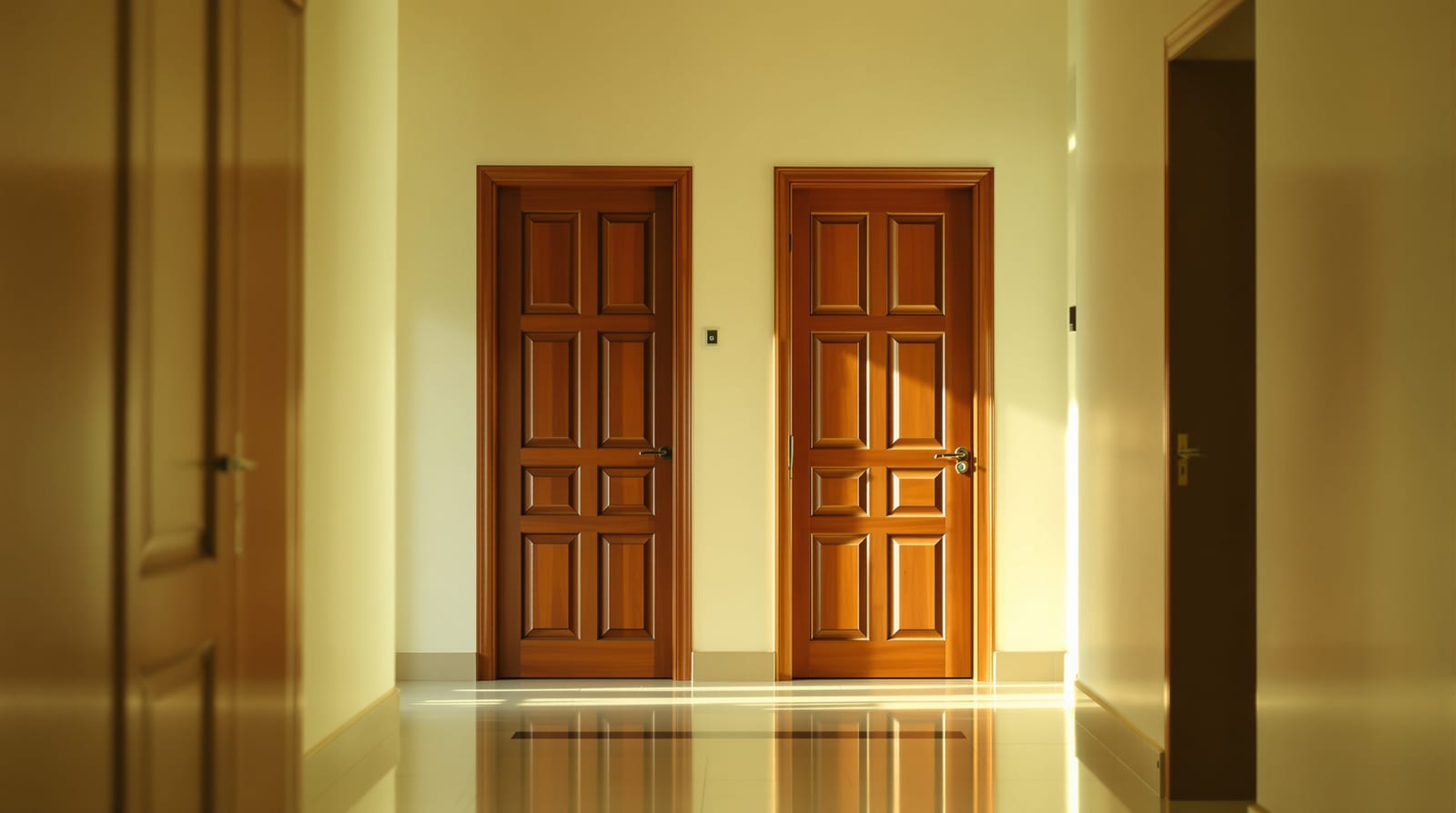
Door Alignment Vastu (Dwar Vedha) for Indian Homes: Doshas & Remedies
Why two doors facing each other, a door facing a toilet or stair, or a straight line from the main door to the back door is called dwar vedha, the reasoning behind the belief, and practical, buildable remedies.
In traditional Indian Vastu Shastra, it is not just the direction a door faces that matters, but how doors line up with one another. When two doors stand directly opposite, or the main door looks straight through the house to the back door, or a door opens onto a toilet, staircase or kitchen fire, the old texts call it "dwar vedha" — an obstruction or piercing of the door's energy. This guide explains, strictly as tradition and reasoning, what the common alignment doshas are, why they were said to matter, and the practical, buildable remedies a homeowner can actually use without tearing down a wall.
This is a deep-dive companion. For door direction itself, see main-door-direction-vastu-india and the pillar vastu-main-door-india. For the full remedy toolkit, see vastu-door-remedies-india, and for sleeping spaces bedroom-door-vastu-india.
What "dwar vedha" means
"Dwar" means door or gateway; "vedha" means a piercing, obstruction or affliction. In Vastu Shastra, every doorway is treated as a mouth through which prana — life energy, but in plain terms also light, air and people — enters and moves through the home. Vedha is the idea that something interrupts, deflects or directly opposes that flow. Alignment vedha is the sub-category that deals with how doors and openings relate to each other along a sightline.
Two ideas sit underneath the tradition, and both have a practical core worth understanding:
- Energy should circulate, not shoot straight through. A long uninterrupted line from front to back is said to let energy (and, practically, draft and prying eyes) rush out as fast as it enters, leaving nothing to settle.
- A door should not "face" a space of decline or instability. Toilets, staircases, store rooms and the kitchen fire were classed as draining or volatile zones; a door opening straight onto one was thought to pull that quality back into the room.
You do not have to accept the metaphysics to design well around it. As the sections below show, most alignment rules map cleanly onto privacy, comfort and circulation — which is why so many homeowners follow them even when they are sceptical.
The common alignment doshas
Below are the alignments most often flagged in Vastu consultations, with the traditional concern and the everyday design logic behind each. Treat the doshas as a checklist to walk your floor plan against.
| Alignment dosha | Traditional concern (belief) | Practical reasoning |
|---|---|---|
| Two internal doors directly facing each other | Energy "clashes" or escapes; arguments between occupants | Loss of privacy; one open door reveals the next room; cross-draft |
| Main door in a straight line to the back door | Prana enters and exits without settling; wealth "flows out" | Sightline straight through home; security and privacy weakened; tunnel draft |
| Three or more doors in one straight line ("through-line") | Strongest form of dwar vedha; instability | Long exposed corridor of sightlines; no visual rest |
| Door facing a toilet door | Negative or draining energy pulled into the room | Odour, damp air and unpleasant view directly opposite a living space |
| Door facing a staircase (especially descending) | Energy "falls" or drains downward | Safety risk of stepping out onto a stair; noise; visual clutter |
| Bedroom/main door facing the kitchen fire (agni) | Conflict between fire and the room's element | Heat, smoke and cooking smells drift into private space |
| Door facing a sharp corner or beam edge | "Cutting" energy aimed at the doorway | Awkward circulation; a column edge people walk into |
| Main door facing a lift, another flat's door, or a sharp external object | External vedha; opposing energy | Privacy loss across a landing; flats overlooking each other |
Note how every "belief" row pairs with a sober building reason. Vastu codified, in symbolic language, what experienced builders knew about privacy and airflow.
A plan diagram: the dosha and the offset remedy
The single most reliable remedy for facing doors is the offset — shifting one door along the wall so the two no longer share a centreline. The diagram shows the problem on the left (two doors aligned, a clear straight sightline) and the fix on the right (one door moved, the sightline broken).
If you are setting out a new build or a major renovation, ask your carpenter or architect to plan a minimum offset of roughly 150-300 mm between facing door centrelines wherever it can be done. It costs nothing at the drawing stage and quietly solves both the Vastu concern and the privacy one.
Practical remedies, dosha by dosha
In most existing homes you cannot move a wall. The good news is that the tradition itself offers layered remedies, and they happen to be the same devices an interior designer would reach for to manage sightlines and draft. Use the table as a menu — pick the lightest remedy that solves your case.
| Alignment dosha | Primary remedy | Lighter / decorative remedies |
|---|---|---|
| Two facing internal doors | Offset one door (if renovating); keep one normally closed | Heavy curtain or fabric panel; a low console or screen between; differing door sizes |
| Main door to back door in line | Place a partition, jali screen or furniture to break the line | Foyer console with tall plant; bead/fabric curtain; a runner rug that "turns" the eye |
| Three doors in a line | Break the run with a partial partition or arch at one threshold | Curtain on the middle door; potted plants staggered along the corridor |
| Door facing a toilet | Keep the toilet door shut; add a self-closing hinge or magnetic catch | Curtain over the toilet door; a small screen; ensure exhaust to kill the "negative" (and real) air |
| Door facing a staircase | Add a small landing, planter or rail-end detail to deflect | Curtain on the room door; a console or plant at the stair foot |
| Door facing kitchen fire | Reposition the hob within the kitchen if possible | Keep the kitchen door closed while cooking; curtain; exhaust hood (also the real fix for smoke) |
| Door facing a beam/corner edge | Round or chamfer the corner; box the beam | Hang a small mirror or crystal per tradition; place a plant at the corner |
The traditional symbolic remedies
Alongside the physical fixes, Vastu prescribes a set of auspicious objects placed at thresholds. These are matters of belief and culture, offered here as part of the tradition:
- Toran (door hanging). A string of mango leaves, marigold or a decorative beaded/metal toran hung over the doorframe is the classic remedy for a door that faces something inauspicious. It is said to filter energy and welcome positivity; in practice it also softens and frames the opening. See toran-threshold-vastu-india for the full tradition.
- Dehleez / threshold (umbara). A raised threshold strip — wood, brass-edged or stone — marks the boundary of a space and is said to stop energy rushing straight through. Keep thresholds shallow (≤12 mm) where accessibility or a wheelchair user is a concern.
- Swastik, Om or kalash motifs above or beside the door, and a clean, well-lit, clutter-free threshold, are considered the simplest daily remedies.
- Mirrors and crystals are sometimes prescribed to "deflect" a facing dosha. Place mirrors thoughtfully — a mirror that reflects the main door back outward is itself discouraged in Vastu.
These symbolic remedies cost little (a fabric toran runs roughly ₹100-800; a brass-edged threshold strip ₹500-2,500 depending on size, indicative and varies by city and vendor) and let a homeowner honour the belief without structural work.
The buildable middle path
The sane approach, for believers and sceptics alike, is to treat alignment Vastu as a privacy-and-circulation audit dressed in older language. Walk your plan and ask three plain questions at every doorway: Can someone standing outside one door see straight into a private or unpleasant space? Is there a wind tunnel from front to back? Does anyone step out of a door into a hazard like a stair? Wherever the answer is yes, a curtain, a screen, an offset or a closed-door habit fixes both the dosha and the real discomfort.
For new construction, fold the offsets into the drawings — it is free at that stage and impossible to retrofit cheaply later. For existing homes, start with the lightest remedy (keep a door closed, hang a curtain) and escalate to a partition or jali only where the sightline genuinely bothers you. When in doubt about whether a slug or detail applies to your specific layout, consult an architect rather than forcing a remedy. The interactive door vastu planner can help you sketch directions and check facing relationships before you commit.
Frequently asked questions
Is it really bad if my two bedroom doors face each other?
By tradition it is considered a dwar vedha, said to cause friction between occupants. In practical terms the issue is privacy and cross-draft. The simplest remedies are keeping one door closed, hanging a curtain, or — if you are renovating — offsetting one door by 150-300 mm so the centrelines no longer align. None of these are expensive.
My main door looks straight through to the back door. Do I need to wall it up?
No. The traditional concern is that energy (and, practically, draft and sightlines) rushes straight out. You break the line, not the doors: a foyer console, a jali or wooden partition, a tall plant, or even a fabric curtain placed to "turn" the eye is enough. A small entrance vestibule, where space allows, is the most elegant fix.
What is the remedy if a room door faces the toilet?
Keep the toilet door shut by default — add a self-closing hinge or magnetic catch so it never stands open. Beyond that, a curtain or small screen over the toilet door, good exhaust ventilation, and a toran over the room door cover both the Vastu belief and the genuine concern of damp, odorous air.
Does an even number of door panels matter for alignment?
Panel count (an even number is preferred in Vastu) is a separate rule about the door leaf itself, not about alignment. It is covered under main-door tradition rather than dwar vedha. Alignment is purely about how doors and openings line up with each other along a sightline.
Are toran and threshold strips enough, or do I need structural changes?
For most homes the symbolic remedies plus a curtain or screen are enough to satisfy both the tradition and everyday comfort. Reserve structural changes — moving a door, building a partition — for new construction or for a sightline that genuinely bothers you in daily use. Start light and escalate only if needed.
Export this guide
Related Guides — Deep-dive reading
Bedroom Door Vastu for Indian Homes: Direction, Placement & Remedies
Master, kids and guest bedroom door directions, why a door should not face the bed or another door, and practical remedies that respect both belief and buildability.
Home Doors & EntrancesToran and Threshold (Dehleez) Vastu for Indian Homes: Tradition Meets Practical Sense
Why the toran over the door and the dehleez underfoot endure: their auspicious meaning and their genuine job as a barrier, level marker and welcome signal.
Home Doors & EntrancesVastu Door Remedies: Practical Fixes for Door Defects (India Guide)
When you cannot move or rebuild a door, these are the common Vastu remedies for a wrong-facing entrance, two doors facing each other, a missing threshold, doors near a toilet or under stairs, and squeaky or broken doors — each framed as belief plus the practical reasoning that makes it sensible anyway.
Home Doors & EntrancesRelated Tools — Try Free
Cross-Ventilation Analyzer
Estimate airflow and air changes per hour (ACH) from room size, window areas, layout, and local wind — with NBC 2016 Part 8 compliance check.
Ventilation CalculatorMain Door Vastu Planner
Check your main door direction against Vastu, with remedies and colour and material suggestions.
Vastu PlannerVastu Shastra Compliance Checker
Score your home across 21 Vastu criteria with a weighted score, compliance band, and remedial guidance.
Vastu Scoring