
Vastu Door Remedies: Practical Fixes for Door Defects (India Guide)
When you cannot move or rebuild a door, these are the common Vastu remedies for a wrong-facing entrance, two doors facing each other, a missing threshold, doors near a toilet or under stairs, and squeaky or broken doors — each framed as belief plus the practical reasoning that makes it sensible anyway.
Most Vastu "problems" with a door are discovered after the slab is poured and the frame is cast in — long past the point where you can shift it a foot or change its facing. The good news is that traditional Vastu has always been a system of remedies (upay) as much as rules: when a door cannot be moved, there is almost always an accepted fix. This guide is a practical remedy reference. Each remedy is presented as belief — what the tradition says and why — alongside the plain practical reasoning that usually makes it a sensible thing to do regardless of whether you follow Vastu. Treat it as guidance for harmony and habit, not as engineering or a substitute for a structural or safety fix.
A note on spirit: Vastu remedies work best when they are calm corrections, not anxious ones. A toran, a threshold, a coat of paint and an oiled hinge cost very little and improve a doorway in ways anyone can feel — better light, a defined entry, a door that closes properly. That is the lens this guide uses.
The remedy table at a glance
If you only read one thing, read this. Each row is a common door defect, the remedy the tradition prescribes, and the practical reasoning that sits alongside it.
| Door defect | Common Vastu remedy | Practical reasoning alongside |
|---|---|---|
| Main door faces a "weak" direction (e.g. south, south-west) | Vastu pyramid / strip on frame, copper or brass plate, helpful door colour, auspicious pada correction, lead-foil strips behind frame | A confident, well-lit, freshly painted entrance reads as cared-for; the act of "correcting" often means cleaning and decluttering the threshold zone |
| Two doors directly facing (dwar vedha) | Toran or beaded curtain between them, a partition/screen, wind chime in the gap, offset by curtains | Breaks a long sightline and through-draught; adds privacy and softens a corridor that funnels noise and dust |
| Missing threshold (no dehleez) | Add a raised marble or wood threshold (12 mm or less) | Stops water/dust ingress, defines inside vs outside, seals the door gap, helps a weather seal work |
| Door near or facing a toilet | Keep toilet door shut, exhaust running, a curtain or screen, salt bowl, threshold + good seal | Contains smell and damp; a closed, ventilated WC is simply better hygiene |
| Door under or beside a staircase | Mirror/painting to "lift" the space, good lighting, keep clutter out, paint underside light | Dark under-stair zones collect junk and feel oppressive; light + tidy fixes the real problem |
| Broken, cracked or squeaky door | Repair, re-hang, oil the hinge, fill cracks, repaint — replace if rotten | A door that sticks, sags or shrieks is a daily irritation and a security weakness; fixing it is overdue maintenance |
| Bare or "uninviting" main door | Nameplate, Om/Swastik/Ganesha, toran, clean brass, lamp | A welcoming, identifiable entrance is good manners and good security (a named, lit door deters chancers) |
Costs below are indicative and vary by city and vendor; add 18% GST and fitting labour where relevant.
When the door faces the "wrong" direction
This is the single most common reason people reach for remedies, because facing is the one thing you cannot change without rebuilding. Vastu favours north, east and north-east for the main door and treats some southern and south-west placements as less auspicious (see our main door direction in Vastu guide for the full pada-by-pada picture). If your door faces a direction the tradition dislikes, these are the accepted remedies — none of which require touching the structure.
Vastu pyramids and strips. Small multi-layer pyramids (often brass, copper or a resin composite) are fixed to the door frame or wall above the door; thin "Vastu strips" or lead-foil tapes are sometimes run behind or along the frame. Belief: they are said to balance the energy of an unfavourable facing. Cost: ₹150-1,500 for a set, indicative. Practical note: they are harmless and inexpensive, and the discipline of mounting them usually comes with cleaning and tidying the entrance — which is the part that actually changes how the doorway feels.
Copper or brass plates and pyramids underfoot. A small metal plate set near the threshold is a traditional balancing remedy. Practically, brass and copper at an entrance are also just durable, easy to keep gleaming, and read as cared-for.
Helpful door colours. Colour is the cheapest, most effective "remedy" and the one with the most real-world payoff. Traditional pairings: a south-facing door is often given warm earthy tones (terracotta, deep red, ochre); a west door silver/white/metallic; north blues and greens; east wood tones or light pastels. See door colour ideas for the palette logic. Practical reasoning: a fresh, deliberate colour makes an entrance look intentional and maintained — which matters far more to visitors and to your own daily mood than the compass bearing. A repaint costs ₹300-1,500 in materials for a single leaf, more for a polished or duco finish.
Pada correction. Within every direction, Vastu divides the wall into padas (zones) and treats some as auspicious and others not. If the door sits in a disliked pada but the wall has room, a remedy is to relocate the leaf within the same wall to a better pada — a much smaller job than changing facing, and sometimes possible during a renovation. If that is not feasible, the symbolic remedies above are used instead.
For a guided walk-through of facing, padas and remedies tailored to your plan, the Door Vastu planner is a free starting point.
Two doors facing each other (dwar vedha)
Vastu dislikes two doors placed directly opposite each other on the same axis — called dwar vedha — and especially the main door lining up straight through to a back door. Belief: energy (and prosperity) rushes straight in and straight out without settling. The practical truth underneath is real and easy to feel: a straight-through alignment creates a wind tunnel, carries dust and noise deep into the home, and removes privacy because anyone at the front can see clear through. Our door alignment in Vastu guide covers the alignment rules in depth; here are the remedies when you cannot re-hang either door.
- Toran across one door. A toran (door hanging of marigold, mango leaves, beads or fabric) above the front door is the classic remedy and is covered fully in toran and threshold in Vastu. It visually breaks the straight line and, with a fresh garland, scents and frames the entrance.
- Beaded or fabric curtain. Hung in the gap between the two doors, it interrupts the sightline and slows the draught while still letting people pass. ₹300-1,500.
- A partition or screen (jali, MDF screen, plant stand). The most effective physical break — it stops the through-view entirely and creates an arrival moment instead of a corridor. A simple jali screen or a tall planter does the job.
- Wind chime in the gap. Belief: it disperses the rushing energy. Practically, it is a gentle signal of movement and air, and harmless.
- Keep one door normally closed if both are not in daily use, which removes the alignment problem outright.
Missing threshold — add a dehleez
A great many Vastu door defects resolve with one cheap addition: a threshold (dehleez). Vastu holds the dehleez as the boundary between the sacred inside and the outside world, the place where you pause, where the toran sits, where guests are welcomed. The practical case is just as strong — and this is genuinely one remedy where belief and building science agree completely.
A raised threshold of marble, granite or hardwood (kept to 12 mm or less so it does not become a trip hazard or block wheelchair access, per accessibility guidance) does several real jobs: it stops rainwater and monsoon run-off creeping under the door, blocks dust and insects, gives a door-bottom seal something to close against, and physically defines "you are now inside." Add it during any flooring or door work; a stone threshold piece runs ₹400-2,500 indicative plus fitting. See door threshold standards for the dimensions and detailing, and toran and threshold in Vastu for the tradition.
A simple threshold + seal detail
Door near a toilet, or under the stairs
Two awkward placements that turn up constantly in flats where the layout is fixed.
A door near or facing a toilet. Vastu dislikes a bedroom or pooja door opening straight onto a WC. Belief: the inauspicious energy of the toilet flows into the room. The practical reality is smell, damp and noise. Remedies that satisfy both: keep the toilet door shut by default (a self-closing hinge or a magnetic catch helps), run the exhaust fan, hang a light curtain or screen across the line of sight, add a threshold and a good door-bottom seal to the WC so air and damp do not creep out, and — the traditional touch — keep a small bowl of rock salt inside the bathroom, refreshed weekly (which, practically, also absorbs a little moisture). A pooja-room door deserves extra care here; see pooja room door in Vastu.
A door under or beside a staircase. Belief: a door tucked under stairs sits in suppressed, heavy energy. The real problem is almost always that under-stair zones are dark, cramped and collect clutter. Remedies that fix both: light the space well, keep it clutter-free, paint the soffit a light colour to lift it, and hang a small mirror or bright painting opposite to make the entry feel larger. If the door is to a store or pooja niche, keep it tidy and closed.
Broken, cracked or squeaky doors
This is where "remedy" and "maintenance" are the same thing, and the tradition is refreshingly direct. Vastu holds that a main door that creaks, sticks, sags or is cracked invites discord and obstacles — and almost everyone, Vastu or not, knows the low-grade irritation of a door that shrieks every time it opens or scrapes the floor. The remedy is simply to fix it.
- Squeaky hinge: a few drops of oil or a graphite/silicone spray on the hinge pin usually silences it in seconds. If it returns, the pin or hinge is worn — replace it (SS butt hinge ₹40-250 each). Full method in fix a squeaky door.
- Sagging or scraping leaf: tighten or repack the top hinge, or shim it; a dropped door is usually a loose hinge, not a warped leaf. See fix a sagging door.
- Cracks and splits: fill with matching wood filler, sand and repaint or repolish; a clean, sound door surface is the "remedy."
- Rot or termite damage: this is the one case where remedy means replace. A rotten or termite-eaten main door is both inauspicious and a genuine security and safety failure — see termite-proofing doors and door replacement.
In monsoon-prone and coastal India, swelling and sticking are seasonal; a light easing of the leaf edge plus a sealed/painted edge usually prevents the annual jam.
Main door colour, symbols and the welcome
The most positive remedies are the ones that make a doorway inviting rather than "correcting" a fault — and the tradition is full of them. These are the touches that turn a plain door into a threshold.
- Colour as covered above — the cheapest, highest-impact remedy.
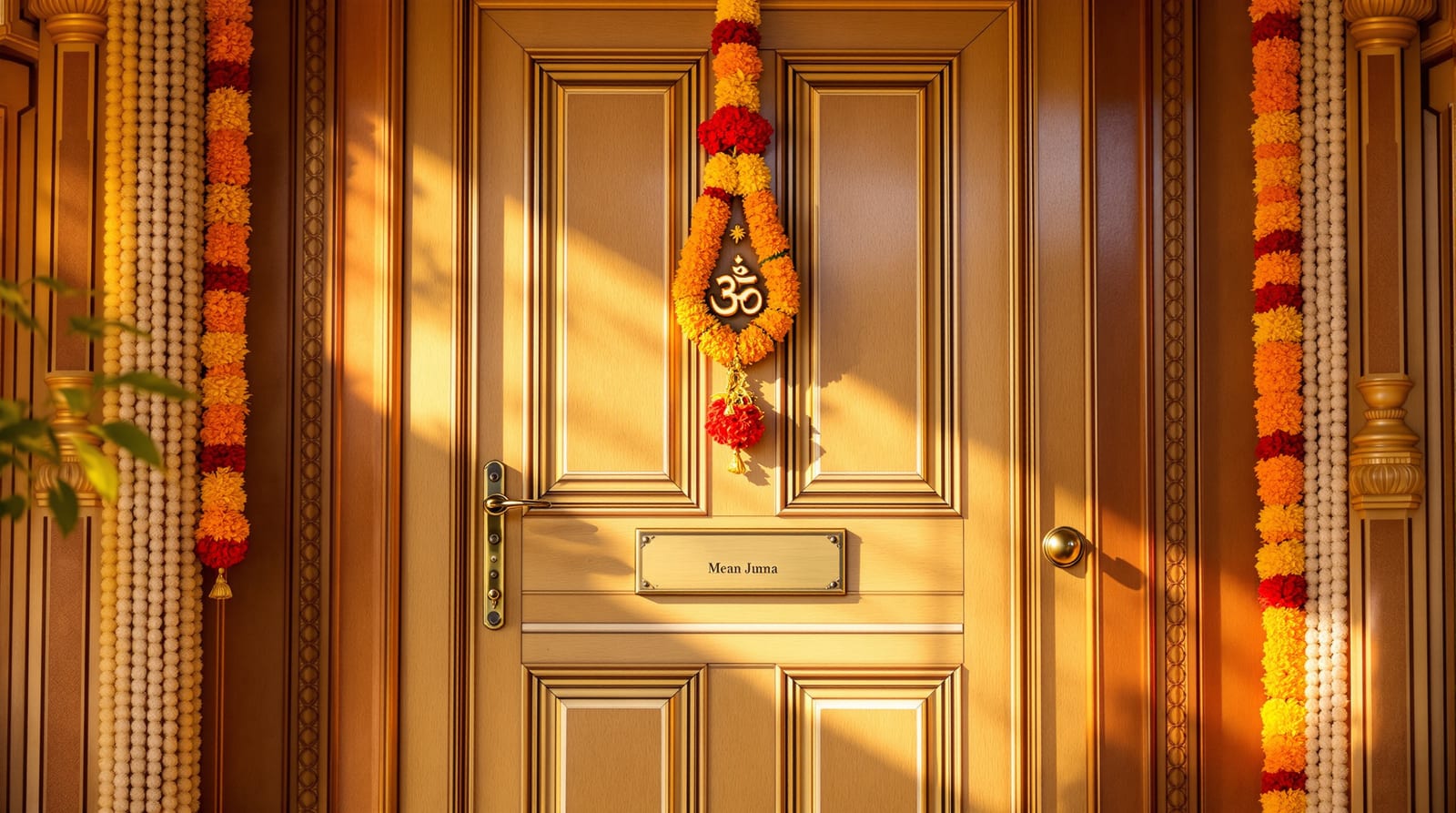
- Om, Swastik or Ganesha at or beside the door. Belief: they invite auspiciousness and ward off negativity. Practically, a small brass Om or Ganesha and a hand-painted Swastik personalise an entrance and are quietly beautiful. ₹150-1,500 for a brass piece.
- A nameplate. Vastu values a clear, well-kept nameplate (favoured near the top of the frame); practically a named, legible door helps deliveries, guests and security alike.
- A toran of marigold and mango leaves, refreshed often — auspicious in belief, fragrant and welcoming in fact.
- Clean, polished brass fittings and a lit entrance (a lamp or diya nook). A door you can see and that looks cared-for is both auspicious and, genuinely, a better-secured door.
For the deeper tradition behind the main door itself — facing, panels, opening direction and the welcome — see our pillar on the Vastu main door and the broader entrance Vastu guide.
Frequently asked questions
Do Vastu door remedies actually work?
Treat them as belief-led guidance for harmony, not as guaranteed cause-and-effect or a structural fix. What is reliably true is that the practical layer of almost every remedy — a fresh coat of paint, a defined threshold, a tidy lit entrance, an oiled hinge, a closed and ventilated WC — genuinely improves how a doorway looks, smells, secures and feels. Follow them in that spirit and you cannot lose.
My main door faces south and I cannot move it. What is the simplest remedy?
Start with colour: a warm earthy tone (terracotta, deep red, ochre) is the traditional south-facing remedy and instantly makes the entrance look intentional. Add a Vastu pyramid or copper plate on the frame if you wish, fix a clean nameplate and an Om or Ganesha, keep the threshold clear, and ensure the door opens smoothly. The combination satisfies the tradition and visibly upgrades the entrance.
What do I do about two doors facing each other if I rent and cannot change anything?
Use the non-permanent remedies: a toran or beaded curtain above or between the doors, a freestanding screen or a tall planter to break the sightline, or simply keep one door closed when not in use. All are reversible and landlord-friendly.
Is adding a threshold (dehleez) really necessary?
It is the remedy where Vastu and building science agree completely. A raised threshold of 12 mm or less blocks rainwater, dust and insects, gives a door-bottom seal something to close against, and defines inside from outside. It is cheap, reversible-ish and almost always worth doing.
How do I remedy a squeaky or sticking door the "Vastu" way?
By fixing it — that is the remedy. Oil or spray the hinge pin to stop a squeak, tighten or shim the top hinge to stop scraping, and ease and seal a swollen edge in the monsoon. A door that opens silently and smoothly is exactly what the tradition asks for.
This guide explains traditional Vastu remedies as belief alongside their practical reasoning; it is not structural, safety or religious advice. Costs are indicative and vary by city and vendor. Plan your entrance with the free Door Vastu planner from Studio Matrx.
Export this guide
Related Guides — Deep-dive reading
Door Alignment Vastu (Dwar Vedha) for Indian Homes: Doshas & Remedies
Why two doors facing each other, a door facing a toilet or stair, or a straight line from the main door to the back door is called dwar vedha, the reasoning behind the belief, and practical, buildable remedies.
Home Doors & EntrancesDoor Repair Guide India: Fix Holes, Dents, Swelling, Hinges & Locks (2026)
A fix-it reference for Indian homes: every common door problem with a quick fix, a proper repair, a replace verdict, the materials needed, and indicative rupee costs.
Home Doors & EntrancesMain Door Direction in Vastu: Best Facing & Padas (India Guide)
Which direction your main door should face according to Vastu Shastra — the favoured north, east and north-east, the auspicious padas within each direction, what each facing is said to bring, and the practical light-and-access logic that sits alongside the tradition.
Home Doors & EntrancesRelated Tools — Try Free
Main Door Vastu Planner
Check your main door direction against Vastu, with remedies and colour and material suggestions.
Vastu PlannerAcoustic Privacy (STC) Visualizer
Indian healthcare acoustic visualizer — compare wall assemblies and noise sources, see received SPL after STC attenuation, and check FGI 2018 / IS 1950 / NABH speech-privacy compliance with live dual-canvas waveform.
Acoustic ToolColour Palette Generator
5 harmonious colour palettes with hex codes, Asian Paints and Berger shade names — by room and mood.
Palette