
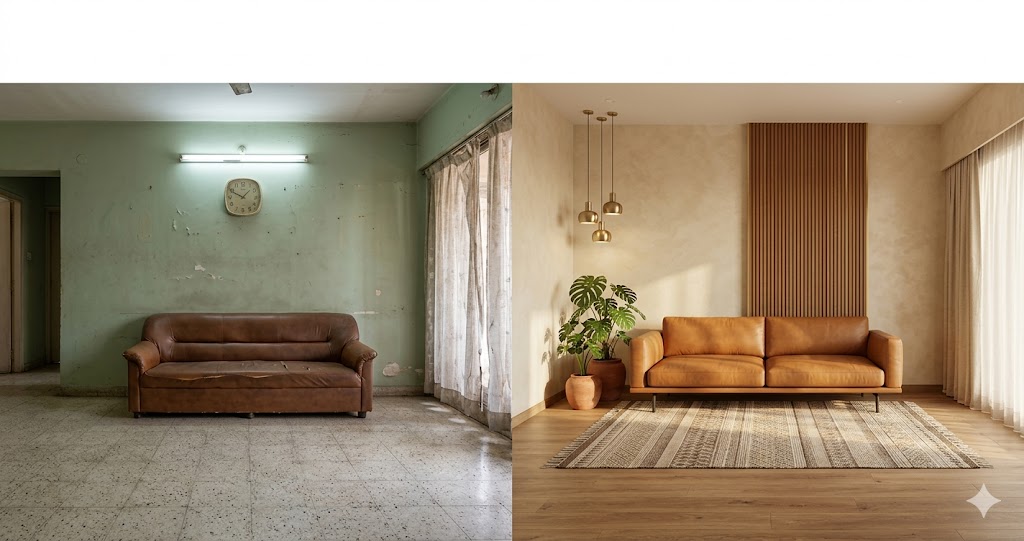
AI Home Renovation — Photo-to-Renovated AI for Existing Indian Homes (2026)
Before/after AI · Demolish vs retain · Renovation BoQ · 1990 Andheri 720 sqft worked example
AI home renovation is the use of computer-vision and generative models to take photos of an existing room, identify what can be retained vs demolished, and produce a photoreal "after" render plus a renovation BoQ — before a single tile is chipped off the wall. It is the use-case that matters most to India's urban middle class in 2026: a 15-year-old 2 BHK in Andheri, a 30-year Koramangala bungalow, a 1990s DDA flat in Vasant Kunj — homes that don't need rebuilding but desperately need rethinking. And it is the use-case where generic AI design tools quietly fail, because renovation is not greenfield: the AI is reasoning over a room that already has walls, plumbing, electrical, structural history, and a homeowner who will live in two of the three rooms while the third gets gutted.
This guide is for the homeowner staring at their fifteen-year-old apartment wondering "what would this look like if we just opened up the kitchen and redid the master?" — and for the designer who needs to give them an answer in two hours, not two weeks. We assume you have read ai-interior-design and ai-home-design for the broader context; this guide focuses specifically on the renovation pathway, where AI is reasoning from photographs of an existing room, not from a blank plot.
"The hardest BoQ line in any renovation isn't the new vanity. It's the demolition, debris removal, and the two weeks of patch-up nobody costed."
If you are still upstream of this — comparing whether to renovate at all, or shortlisting a designer — see ai-room-planner, choosing-an-interior-designer-india, and budget-luxury-interiors for adjacent decisions.
This guide refreshes every 12 months. Last verified: May 2026 · Next verify: May 2027.
What AI Home Renovation Actually Means (and What It Doesn't)
AI home renovation, in 2026, refers to a specific workflow: you upload one or more photographs of an existing room — your kitchen, your living room, your master bedroom — and a stack of computer-vision and generative-image models reasons over those photos to do four things. First, it segments the image into surfaces (wall, floor, ceiling, window, door, cabinet, plumbing fixture). Second, it lets you specify a target style or brief ("warm minimal, more daylight, open kitchen"). Third, it generates a photoreal "after" image of the same room renovated to that brief, with the structurally fixed elements (window positions, load-bearing walls if marked, plumbing risers) preserved. Fourth, it produces a renovation BoQ that accounts not just for new work but for demolition, debris removal, patch-up, and the dozens of hidden line items new-build BoQs never have to think about.
The keyword is existing. AI home design (greenfield) is a different beast: there, the AI is reasoning from a floor plan and a brief, and there are no constraints from history. Renovation AI has to respect the room as it stands — the awkward 200mm step between hall and kitchen, the column nobody can move, the plumbing riser that determines where the toilet has to go. That is harder, not easier, and most consumer AI tools sold as "AI interior design" are actually new-build tools forced into a renovation context. They produce gorgeous renders that quietly delete your plumbing wall.
Five things AI home renovation is not:
1. It is not a structural engineer. A photo cannot tell the model whether a wall is load-bearing. The model can guess from thickness, position, and visual cues, but it cannot replace a structural engineer's site visit. Any AI output that says "demolish this wall" without an engineering note is offering you an opinion, not a verdict.
2. It is not an X-ray of your walls. AI cannot see the conduit routing behind your plaster, the cast-iron drain stack inside your bathroom wall, or the 1985 aluminium wiring that is going to fail your electrical inspection. Renovation always reveals things photos cannot.
3. It is not a permit application. Mumbai building society NOCs, Bengaluru BBMP modification approvals, Delhi DDA society permissions — these are paperwork problems no AI handles end-to-end. AI can draft the application; humans still file it.
4. It is not free. A good AI renovation flow costs ₹2,000 to ₹15,000 per room in tool fees plus the cost of a one-day site validation by a contractor or designer. Compared to a ₹3 lakh design fee, this is small. Compared to "I'll just sketch on paper," it is real money.
5. It is not a substitute for living in the house. The AI does not know that your mother-in-law visits four months a year and needs the second bedroom usable as a guest room with full wardrobe storage. That context comes from the homeowner, not the photo.
Why AI Home Renovation Matters in 2026 India
India's housing stock is ageing fast. The 2011 census counted roughly 33 crore housing units; the 2025 mid-cycle estimates put us closer to 38 crore, but the new construction growth rate has slowed since 2022 as land prices, interest rates, and post-pandemic remote-work patterns have shifted demand from new flats to better existing flats. In the big four metros — Mumbai, Delhi NCR, Bengaluru, Pune — over 40% of occupied housing is now more than 12 years old, and a meaningful slice is 20+ years old. These are the homes whose owners are sitting on ₹3-15 crore of capital appreciation and are asking the obvious question: do we sell and move, or renovate and stay?
For most families with school-going children, established commutes, and social networks tied to a neighbourhood, the answer is renovate. And renovation in 2026 looks different from renovation in 2016. The category that has exploded is the photoreal preview: homeowners want to see what their kitchen will look like before they sign a ₹12 lakh contract, not after. That demand is what generative AI tools have stepped into. The pre-2023 alternative — a designer's hand sketch, a static 3D rendering done in SketchUp at ₹15,000 per view, or simply "trust me, it'll look great" — no longer satisfies a customer who has seen what diffusion models can do to a photograph in under sixty seconds.
The market sizing matches the sentiment. Houzz India's 2025 renovation report estimated the addressable renovation spend in the top eight cities at ₹85,000 crore annually, growing 14% year-on-year, and called out that 71% of homeowners now expect some form of AI-assisted visualisation in the design phase. Three years ago that number was under 12%.
"Renovation is the bigger India market. New construction sells the magazine covers; renovation pays the EMIs."
The seam Studio Matrx fills is specifically the India renovation seam. Generic Western tools — Reroom, RoomGPT, Interior AI — treat every room as a North American suburban context: they default to open-plan kitchens, white shaker cabinetry, hardwood floors, and renovation BoQs in USD that have no relationship to Indian labour rates or material costs. Studio Matrx defaults to Indian realities: Hettich/Hafele hardware lines, Asian Paints/Berger colour libraries, marble vs vitrified tile economics, the actual rates a Bengaluru contractor will quote for hacking 200 sqft of skirting in May 2026. That India calibration is the moat.
The Six Capabilities That Matter
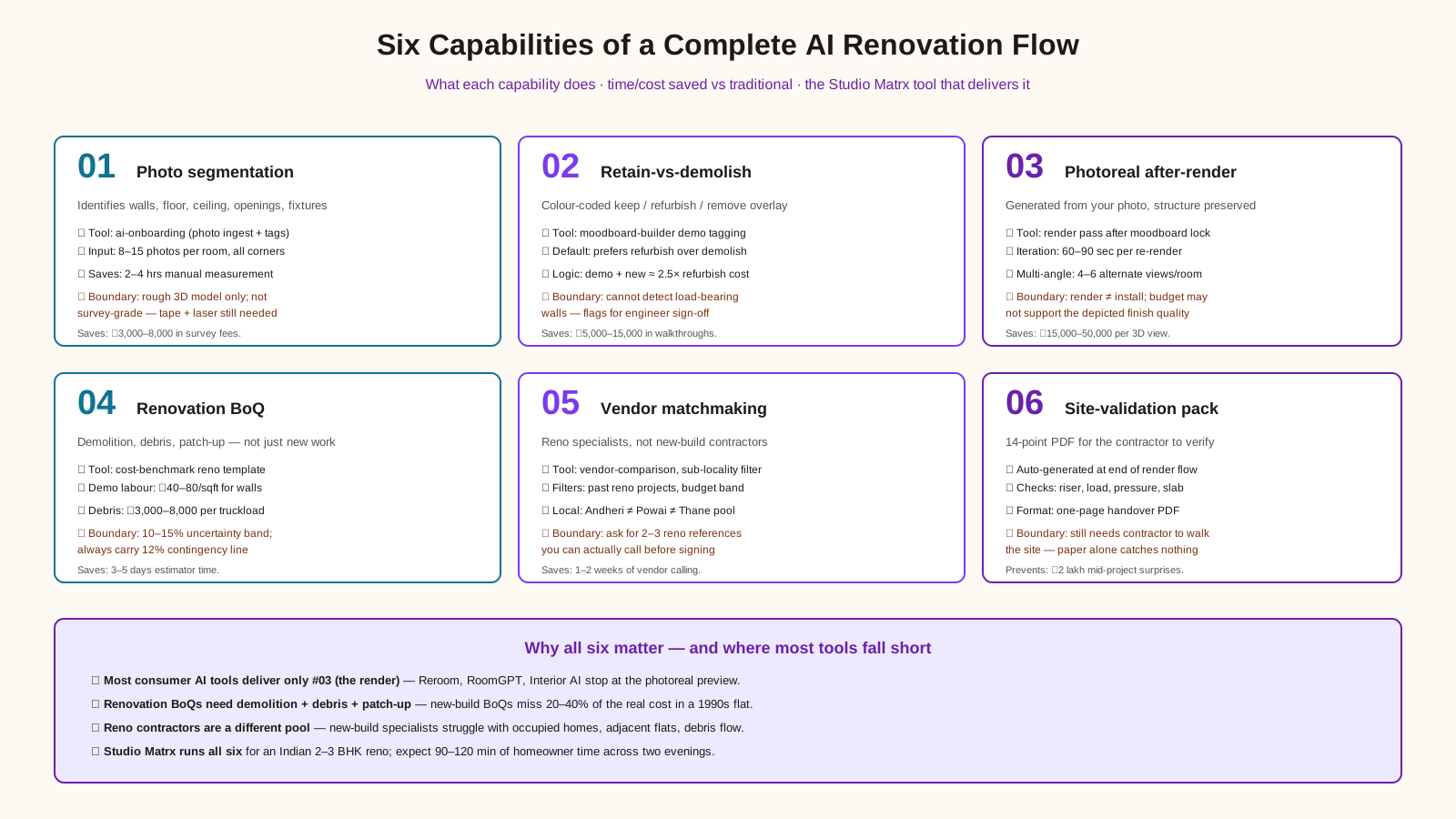
A complete AI home renovation flow has six capabilities, and most tools have only two or three. The table below is the lens to use when you evaluate any tool — including Studio Matrx — for a renovation project.
| Capability | What it does | Time/cost saved vs traditional | Studio Matrx flow that does it |
|---|---|---|---|
| Photo segmentation | Identifies walls, floor, ceiling, openings, fixtures from a photograph | 2-4 hours of manual measurement; ₹3,000-8,000 in survey fees | ai-onboarding ingests photos with room-type tagging |
| Retain-vs-demolish classification | Suggests which elements to keep, refurbish, or remove based on age, style, function | 1 day of designer assessment; ₹5,000-15,000 in walkthrough fees | Demolition tagging inside moodboard-builder before render |
| Photoreal after-render | Generates a photoreal image of the renovated room from the photo + brief | 1-2 weeks of 3D modelling; ₹15,000-50,000 per view | Render pass after moodboard lock; multi-angle support |
| Renovation BoQ (debris, patch-up included) | Prices not just new work but demolition, debris cartage, hidden hours | 3-5 days of estimator time; the most common ₹50,000-2 lakh under-quote in industry | cost-benchmark with renovation line-item template |
| Vendor matchmaking for renovation | Surfaces contractors who specialise in renovations (a different pool than new-build) | 1-2 weeks of vendor calling; weeks of avoidable rework if mismatched | vendor-comparison filtered by renovation experience |
| Site-validation checklist | Generates a one-page list of "what your contractor must verify on site before you commit" | 1 day of project management; tens of lakhs in mid-project surprises | Auto-generated PDF at end of render flow |
Most consumer "AI interior design" tools nail capability three (the render) and ignore the other five. Studio Matrx's claim — and we will be honest about where we still fall short later — is that the renovation flow runs the whole table.
How Studio Matrx Does AI Home Renovation — End-to-End Walkthrough
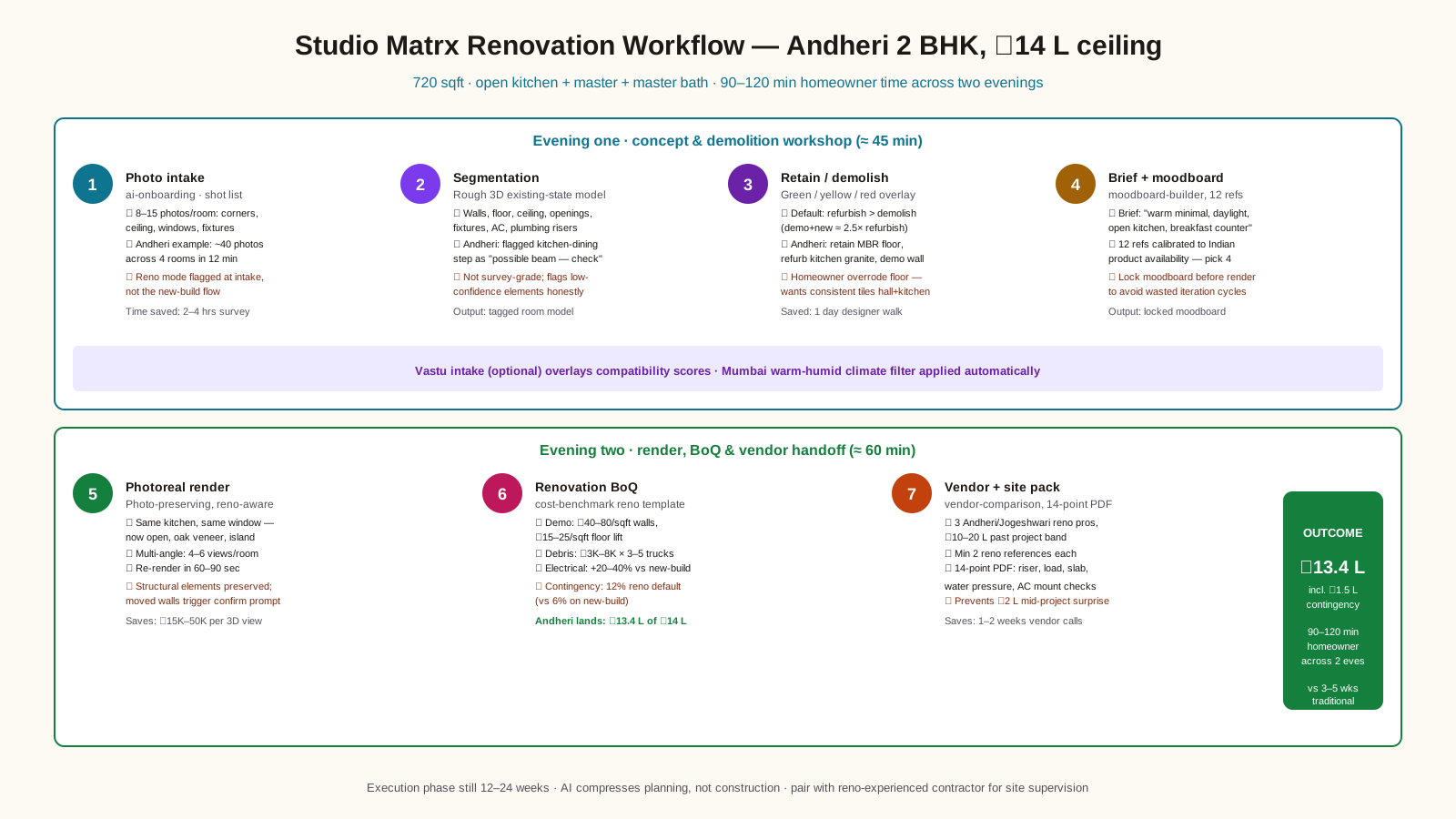
This is the actual flow a homeowner runs for a renovation project on Studio Matrx in 2026. We are walking through the canonical example: a 720 sqft 2 BHK in a 1990s building in Andheri West, owner wants to open up the kitchen, redo the master bedroom and bath, leave the children's room alone for now. Budget ceiling ₹14 lakh.
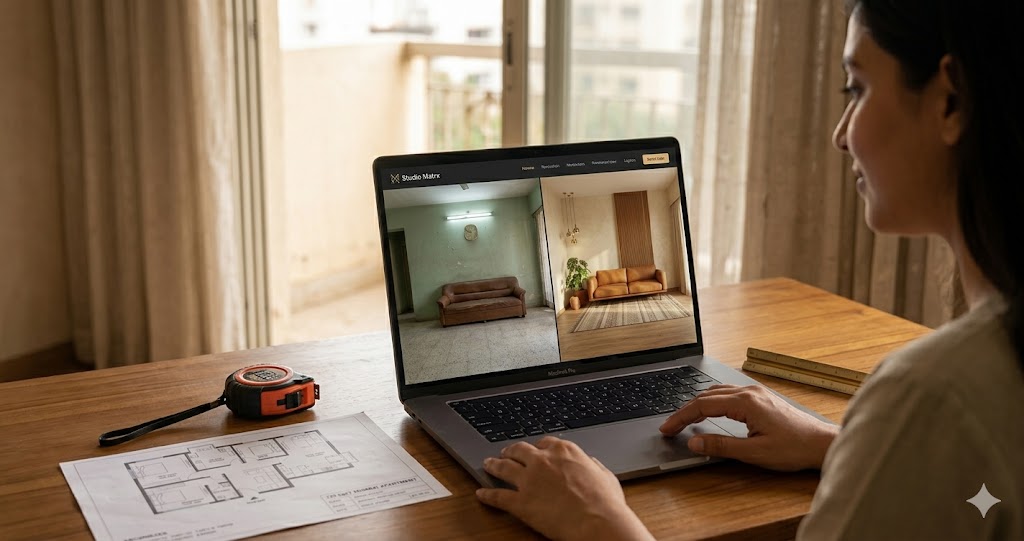
Step 1 — Photo intake and room tagging. The homeowner opens Studio Matrx, selects "Renovate an existing home" rather than "Design a new home," and uploads 8-15 photographs per room they want to renovate: at least one from each corner, one of the ceiling, one of each window and door, close-ups of any plumbing fixture. The ai-onboarding tool walks them through the shot list. For the Andheri 2 BHK, that is roughly 40 photos across kitchen, master bedroom, master bath, and the connecting hallway.
Step 2 — Segmentation and existing-state model. Studio Matrx's computer-vision pass segments each photograph into structural surfaces (walls, floor, ceiling), openings (doors, windows), and fixtures (sink, toilet, AC unit, plumbing risers). It builds a rough 3D model of each room from the photos — not survey-grade, but good enough to reason about. It flags any element it cannot confidently classify. For the Andheri flat, it correctly identifies the kitchen wall but flags the small step between kitchen and dining as "possible structural beam — recommend engineer check." This is honest hedging, not bravado.
Step 3 — Retain-vs-demolish workshop. The homeowner is presented with a side-by-side view: the existing photo, and an overlay showing each element colour-coded retain (green), refurbish (yellow), demolish (red). They can override every call. The AI's defaults are conservative — it prefers to refurbish a 15-year-old wardrobe rather than demolish, because demolition cost + new wardrobe cost is usually 2.5x refurbishment cost. For Andheri, the AI suggests retaining the master bedroom floor (good vitrified tile, no need to replace), refurbishing the kitchen counter (granite, just polish), demolishing the kitchen-hall wall (open the room), and rebuilding the master bath from scratch (1990s sanitaryware, all-or-nothing). The homeowner accepts most calls but vetoes the floor retention — they want consistent flooring across kitchen and hall, so the floor is going.
Step 4 — Brief and moodboard. The homeowner describes the target style in their own words: "warm minimal, lots of natural light, open kitchen, no clutter, my wife wants a south-Indian breakfast counter at the kitchen edge." Studio Matrx's moodboard-builder returns 12 reference images calibrated to the brief and to Indian product availability. The homeowner narrows to four. The system locks the moodboard.
Step 5 — Photoreal after-render with renovation constraints. This is the differentiator. The render is generated from the input photograph, with the structural elements preserved (window positions, ceiling height, retained walls), with the demolished elements removed, and with the new elements styled to the moodboard. The Andheri homeowner sees their kitchen — recognisably the same kitchen, same view out of the same window — but now open to the hall, with the breakfast counter, new island, warm oak veneer cabinetry. They can request 4-6 alternate views per room. They can ask for adjustments ("can we try this with darker counters") and the render iterates in 60-90 seconds.
Step 6 — Renovation BoQ generation. The system invokes cost-benchmark with the renovation template, which differs from new-build in critical line items: debris removal (₹3,000-8,000 per truck-load, 3-5 truck-loads for a 2 BHK), demolition labour (₹40-80 per sqft for walls, ₹15-25 per sqft for floor), patch-up plastering (₹35-60 per sqft for surfaces adjacent to demolition), hidden electrical rework (typically 20-40% above new-build per-point rate because old conduit must be chased out), and contingency for hidden plumbing surprises (Studio Matrx defaults to 12% contingency on renovation BoQs vs 6% on new-build). For the Andheri renovation, the BoQ lands at ₹13.4 lakh inclusive of ₹1.5 lakh contingency — within the ₹14 lakh ceiling.
Step 7 — Vendor matchmaking and site-validation pack. vendor-comparison surfaces three contractors in Andheri/Jogeshwari with renovation specialism (not new-build), filtered by past project size in the ₹10-20 lakh range and at least two previous reno projects with positive reviews. The system also generates a one-page PDF for the homeowner to share with whichever contractor they choose, listing the 14 things the contractor must verify on site before signing: plumbing riser condition, electrical load capacity from the meter, water pressure at the topmost outlet, ceiling slab condition near AC mounts, and so on. This is the document that prevents the ₹2 lakh mid-project surprise.
The whole flow from photo upload to vendor shortlist takes a homeowner roughly 90-120 minutes spread over two evenings. Traditional equivalent: 3-5 weeks and ₹35,000-1.5 lakh in design fees before you have anything tangible.
AI Home Renovation vs Traditional Renovation Design
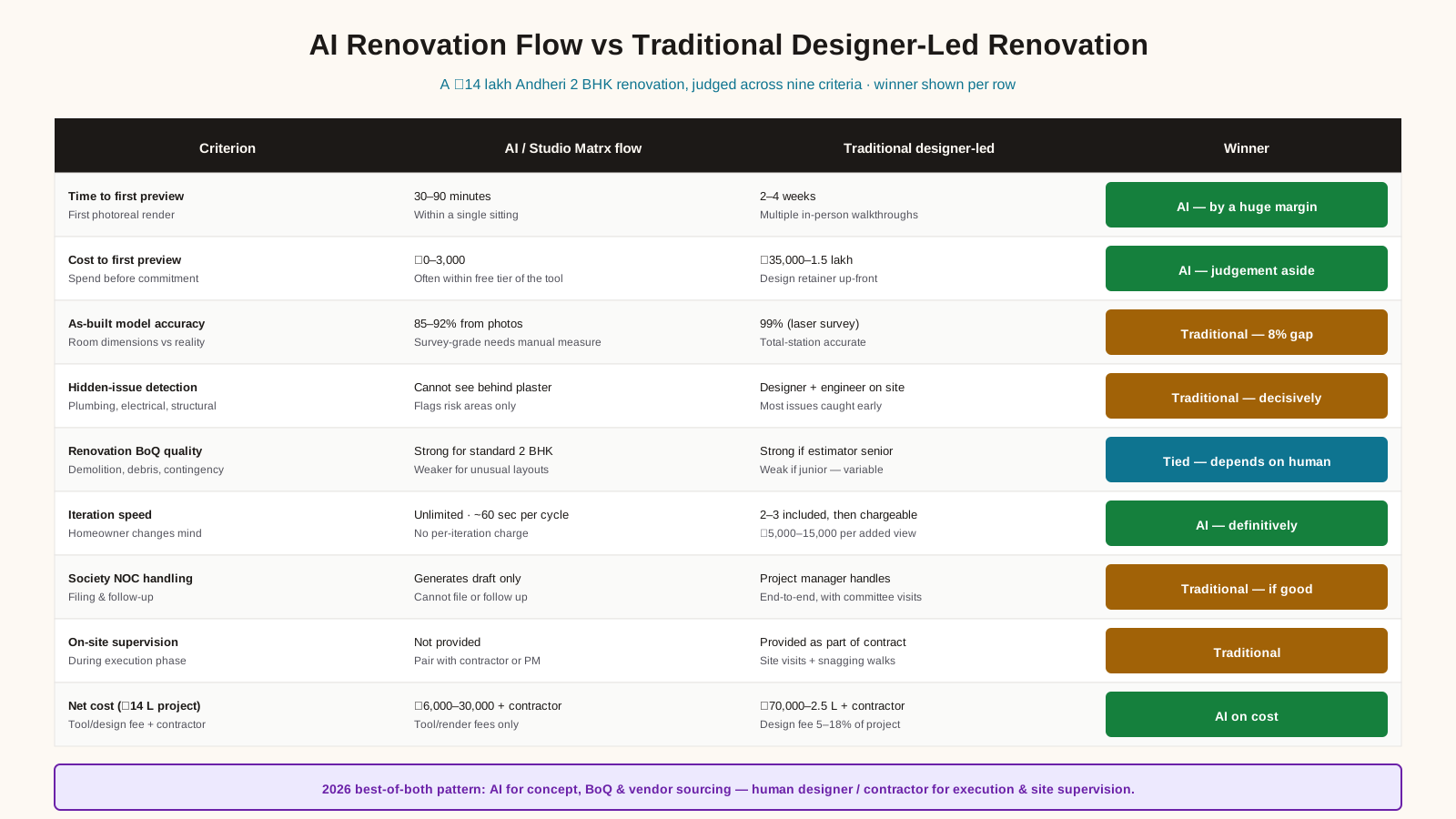
| Criteria | AI / Studio Matrx renovation flow | Traditional designer-led renovation | Winner + caveat |
|---|---|---|---|
| Time to first photoreal preview | 30-90 minutes | 2-4 weeks | AI, by a huge margin |
| Cost to first preview | ₹0-3,000 | ₹35,000-1.5 lakh in design retainer | AI, but designer adds judgement |
| Accuracy of as-built room model | 85-92% from photos; survey-grade requires manual measurement | 99% (laser survey) | Traditional — but the 8-15% gap rarely matters at concept stage |
| Quality of demolition BoQ | Strong for typical 2 BHK; weaker for unusual layouts | Strong if estimator is experienced; weak if junior | Tied; depends on the human |
| Detection of hidden issues (plumbing, electrical, structural) | Cannot detect from photos; flags risk areas only | Designer + engineer on site can detect most | Traditional, decisively |
| Vendor sourcing for renovation specialists | Curated database, filtered by reno experience | Designer's personal network — strong if they have renovation specialism, weak otherwise | Tied; AI is more transparent |
| Iteration cycles (homeowner changes mind) | Unlimited, ~60 seconds per iteration | 2-3 included, each subsequent costs ₹5,000-15,000 | AI, definitively |
| Society/society NOC handling | Generates draft; cannot file or follow up | Designer's project manager handles end-to-end | Traditional, if designer is good |
| Permits, structural sign-offs | Generates checklist; requires engineer | Designer coordinates engineer; better workflow | Traditional |
| Final on-site supervision | Not provided | Provided | Traditional |
| Net cost (₹14 lakh project) | ₹6,000-30,000 in tool/render fees + contractor cost | ₹70,000-2.5 lakh in design fees + contractor cost | AI on cost; traditional on completeness |
The honest read: AI wins decisively at the concept-to-decision phase. Traditional designers win at the execution phase. The 2026 best-of-both pattern, which Studio Matrx is built around, is AI for concept, BoQ, and vendor sourcing — human designer or experienced contractor for execution and site supervision.
Tool Landscape 2026
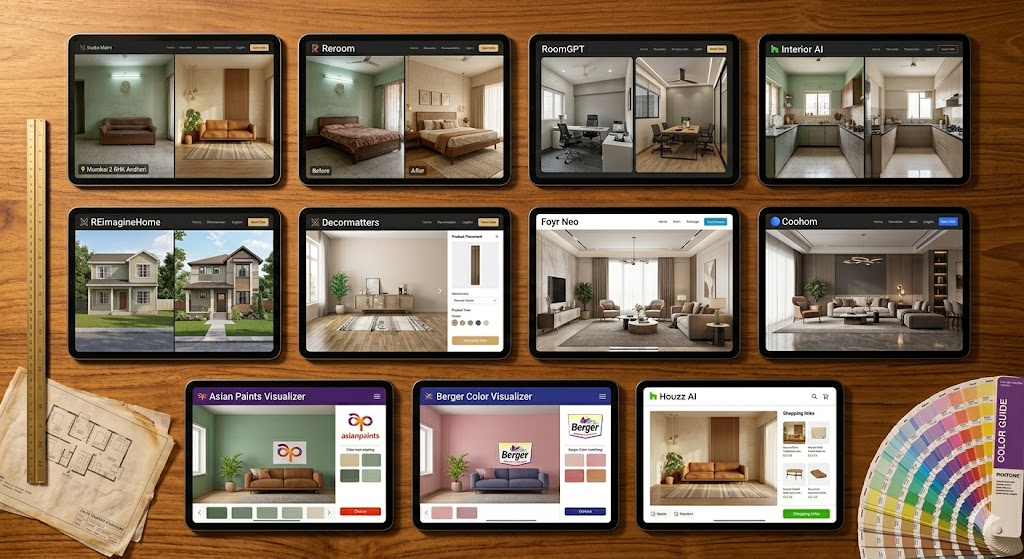
| Tool | Renovation-specific? | India calibration | Photoreal from photo | Renovation BoQ | Vendor matchmaking | India price (per project) |
|---|---|---|---|---|---|---|
| Studio Matrx | Yes — explicit renovation flow | Native: ₹, IS codes, Indian product libraries, Hindi/Tamil/Kannada/Marathi roadmap | Yes, photo-preserving | Yes, includes demolition + debris + contingency | Yes, filtered by reno experience | ₹2,000-15,000 |
| Reroom | Partial — restyle from photo, not full reno | None — USD pricing, US fixtures | Yes | No | No | $9.99-29.99/mo |
| RoomGPT | Partial — restyle from photo | None | Yes | No | No | $9-39/mo |
| Interior AI | Partial — restyle from photo | None | Yes | No | No | $19-99/mo |
| REimagineHome | Partial — focused on staging, not reno | None | Yes | No | No | $19-99/mo |
| Decormatters | No — primarily AR product placement | Limited | Partial | No | No | Freemium + IAP |
| Foyr Neo | No — designer tool for new-build | Some India SKUs | Yes (manual 3D) | Manual | No | $49-149/mo |
| Coohom | No — designer tool, predominantly new-build | Some India SKUs | Yes | Partial | No | $49-249/mo |
| Visualizer 3D (Asian Paints) | Partial — paint visualisation on existing walls | Strong (Asian Paints SKUs) | Yes for paint only | No | No | Free |
| Berger Color Visualizer | Partial — paint only | Strong (Berger SKUs) | Yes for paint only | No | No | Free |
| Houzz AI | Partial — restyle and product placement | Limited; US-centric Houzz product catalog | Yes | No | Yes (Houzz Pro directory) | Freemium + Pro tier |
A few honest reads. The Western generative tools (Reroom, RoomGPT, Interior AI, REimagineHome) are excellent at the restyle step — give them a photo of your room and a style prompt, and they will produce a stunning render. But they stop there. They do not produce a BoQ in rupees, they do not know what a Hettich Architrac runner costs in Mumbai, they do not source you a Bengaluru contractor. For the restyle-only use-case ("I just want to see what my living room would look like in warm minimal"), they are great. For a real renovation project, they are an inspiration tool, not a planning tool.
Foyr Neo and Coohom are designer-oriented tools — they assume a designer is at the keyboard, not a homeowner. They produce excellent output if you know what you are doing, but the learning curve is 10-20 hours. Asian Paints and Berger Visualizer are single-purpose tools (paint), and within that scope they are excellent and free; we recommend them as a complement, not a substitute, for a renovation flow.
Eight Risks, Pitfalls and Honest Limits
1. The "AI deleted my plumbing wall" failure. Generic restyle tools sometimes generate renders where the wall containing your plumbing riser has been visually moved or removed. The render looks beautiful; the contractor cannot build it. Mitigation: use a tool that explicitly preserves structural elements from the input photo. Studio Matrx flags moved-wall scenarios and asks for confirmation.
2. Hidden electrical surprises. No AI can see behind your wall plaster. Homes built before 2005 often have undersized wiring, no earthing on individual circuits, and conduit too tight for modern cable thickness. Mitigation: bake a full electrical audit (₹3,000-8,000) into the project plan before signing the contractor. Treat the AI BoQ's electrical line as 60-70% of the likely real cost in pre-2005 homes.
3. Plumbing riser truth. Bathrooms cannot be relocated freely — the soil stack and water risers are where they are. AI tools without renovation specialism will gleefully render your bathroom in a different corner of the apartment. Mitigation: lock plumbing-fixture positions in the brief unless your engineer has confirmed a riser move is feasible (rare in apartment buildings).
4. Load-bearing wall misidentification. AI cannot reliably detect load-bearing walls from photos. It can guess from thickness and position, but a 230mm wall in a 1990s apartment might be load-bearing or might be a brick partition — only a structural engineer or the original drawings can tell you. Mitigation: any wall demolition over 1m wide requires an engineer's sign-off. Studio Matrx's renovation flow auto-prompts for this.
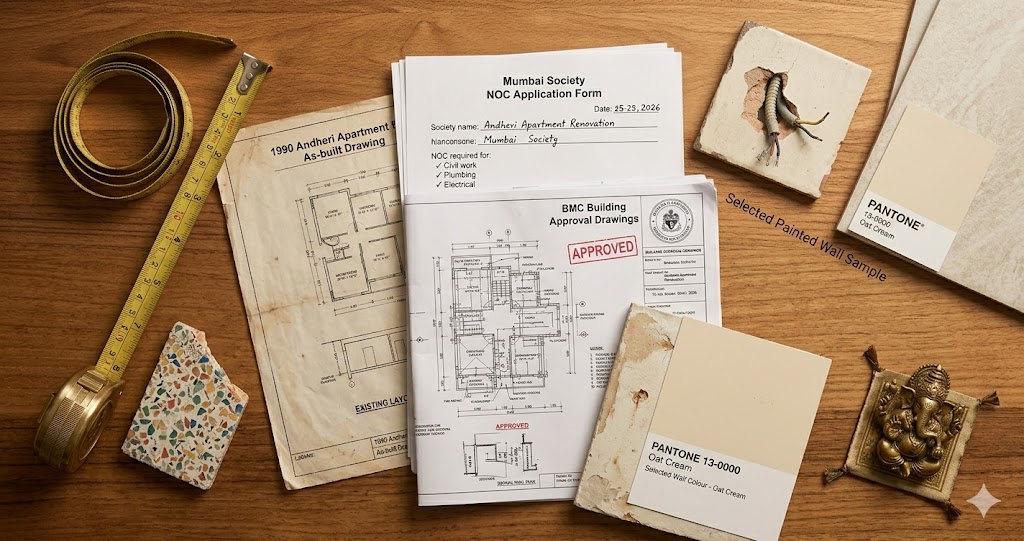
5. Society NOC paperwork. Mumbai cooperative societies, Bengaluru apartment owners' associations, Delhi DDA-built societies — all require formal NOC for interior renovations, especially anything affecting plumbing or walls. AI does not file paperwork. Mitigation: factor 2-6 weeks for NOC into your timeline, regardless of how fast the AI flow runs.
6. The "AI vendor isn't a renovation specialist" mismatch. Many contractors in Indian cities specialise in new-build (greenfield apartments, builder fit-out) and have little experience with renovation — which is messier, slower, and requires different skills (debris management, working in occupied homes, dealing with adjacent flats). Mitigation: filter vendor lists explicitly for renovation experience, and ask for 2-3 past reno project references you can call.
7. Overconfidence in the BoQ. Even a well-built renovation BoQ has 10-20% uncertainty because of the hidden-issue category. Mitigation: always carry a 12-15% contingency line, and do not over-commit your budget — if your ceiling is ₹14 lakh, design to ₹12 lakh.
8. Aesthetic overreach. AI render quality is so high that homeowners sometimes commit to ambitious aesthetics — exposed brick walls, microcement floors, dark veneer ceilings — that are hard to execute well in India's contractor reality. Microcement applied badly cracks within 18 months; the AI render does not show that. Mitigation: cross-reference your aesthetic to budget-luxury-interiors for what genuinely works at your price point, and ask your contractor for sample panels of any unfamiliar finish.
India-Specific Considerations
NBC 2016 and renovation. The National Building Code 2016 applies to renovations involving structural changes, plumbing rework, or fire-safety-relevant alterations (e.g., kitchen relocation in high-rise apartments often triggers Part 4 fire safety considerations). Most cosmetic renovations — paint, wardrobes, vanities, lighting — do not require formal NBC compliance review. The grey zone is opening up walls; if your renovation involves removing a non-load-bearing wall over 1.2m wide, document it formally and keep the engineer's sign-off in your file.
IS codes that matter for renovation. IS 1893 (seismic; relevant if you are doing anything structural in zones III/IV/V — most of Mumbai is zone III, Delhi NCR is zone IV), IS 875 (loads; relevant for any new fixed furniture exceeding 200kg dead load), IS 3370 (waterproofing; relevant for any bathroom or kitchen demolition exposing slab). Studio Matrx's renovation flow flags when an IS code reference is likely relevant to a design choice, but it is the contractor's job to comply.
DPDP Act 2023 and your renovation photos. When you upload photos of your home to any AI tool, you are sharing personal data under the DPDP Act 2023 definition (photos can reveal location, family composition, financial status, security setup). Studio Matrx complies with DPDP Act 2023 — data is stored in India, photos are processed and then optionally purged within 90 days, and you have the right to delete on request. Several Western tools store photos on US servers; check the data residency clause before uploading photos of your home to any service.
Vastu in renovation context. Renovation is often the moment when Vastu-conscious homeowners want to fix layout problems from the original build — toilet in the northeast, kitchen in the northwest, missing pooja space. The AI should not silently ignore this. Studio Matrx's renovation flow asks at intake whether Vastu is a priority; if yes, it overlays Vastu compatibility scores on each demolish/retain decision. Cross-references: vastu-house-plan-india, vastu-modern-homes, entrance-vastu, vastu-for-kitchen.
Regional vendor reality. Renovation vendors are highly local. A great contractor in Andheri West may have no presence in Powai, let alone Thane. Studio Matrx's vendor-comparison filters by sub-locality, not just city. Bengaluru: Indiranagar/Koramangala vendors are different from Whitefield/Marathahalli vendors. Delhi NCR: South Delhi (Greater Kailash, Defence Colony) is a different vendor pool from Gurgaon DLF/Sushant Lok. Pune: Koregaon Park/Kalyani Nagar vs Hinjewadi/Wakad.
Language. Renovation involves dozens of conversations with contractors, helpers, and vendors who may not speak English fluently. Studio Matrx generates the homeowner's project documents in English by default; Hindi-language BoQ and contractor handoff is on the roadmap (Marathi, Kannada, and Tamil follow). Until then, the BoQ PDF includes a glossary of Hindi/regional construction terms for the common line items.
Climate zones. India spans hot-dry (Delhi, Jaipur), warm-humid (Mumbai, Chennai, Kolkata), composite (Bengaluru, Pune, Hyderabad), and temperate (parts of South Karnataka, hill stations) zones. Renovation choices — insulation, glazing, ceiling treatment, ventilation — must respect climate. AI render tools that default to Western examples often suggest carpet, heavy drapery, or fully sealed windows that make no sense in warm-humid Mumbai. Studio Matrx's renovation flow applies a climate filter automatically based on city.
The Studio Matrx Stack for AI Home Renovation
These are the specific Studio Matrx tools that map to the renovation use-case. A homeowner can use them à la carte or via the full renovation flow.
- ai-onboarding — photo intake, room tagging, automatic segmentation of existing-state photos.
- client-discovery — captures the lived-in context (family composition, daily routines, what's working and not working in the current home) that the AI needs to respect.
- lifestyle-persona-mapping — translates "we want to entertain more but our kitchen is closed off" into specific renovation hypotheses.
- project-feasibility — checks whether the renovation idea is feasible within budget and timeline before deep work begins.
- moodboard-builder — the workspace where retain/refurbish/demolish tagging happens alongside style reference selection.
- material-palette — locks the new materials within budget, drawing from Indian product libraries.
- color-scheme — finalises the colour story; integrates Asian Paints/Berger SKU codes for the contractor's procurement.
- furniture-planner — places retained furniture (the homeowner is not buying everything new) alongside new pieces in the renovated room.
- kitchen-rulebook — for kitchen renovations specifically, validates the new layout against work-triangle, ventilation, and Vastu rules.
- wardrobe-planning — for bedroom renovations, sizes and lays out new wardrobes around retained structural elements.
- cost-benchmark — the renovation BoQ engine, including demolition, debris, contingency lines.
- vendor-comparison — filters for renovation-experienced contractors by sub-locality.
- cost-escalation-tracker — tracks the inevitable mid-project changes against the original BoQ to keep the project from creeping past the ceiling.
When NOT to Use AI Home Renovation
There are use-cases where AI renovation flows are the wrong tool. Honesty here matters more than marketing.
Heritage / listed buildings. If your home is in a heritage precinct (parts of Fort Mumbai, Bengaluru Cantonment, Delhi's Lutyens zone, Kolkata's heritage circuits) or is itself a listed structure, renovation requires conservation expertise, heritage-committee approvals, and material-specific knowledge AI tools do not have. Use a conservation architect.
Major structural changes. If your renovation involves removing structural walls, adding a floor, cutting new openings in load-bearing walls, or changing the footprint of the building, you are no longer doing renovation in the AI-friendly sense. You need a structural engineer and an architect engaged from day one. AI can support the visual brief, but it cannot lead.
Wet area only / kitchen-only with no design change. If you are simply replacing your old kitchen with a new modular kitchen from a standard brand (Sleek, Häcker, Hettich showroom), and not changing the layout, the modular kitchen showroom will do the design work for free as part of the sale. AI rendering adds little value to this constrained use-case.
Sub-₹2 lakh cosmetic projects. If your total scope is "paint the apartment and replace the curtains," a free Asian Paints or Berger visualiser plus a local painting contractor is the right answer. The Studio Matrx full flow is calibrated for ₹5 lakh-plus projects where the planning value justifies the tool cost.
Owners who don't know what they want and don't have time to learn. AI tools require the homeowner to articulate a brief, react to options, make decisions. If you genuinely have zero time and zero opinions, hire a full-service designer and let them lead. The AI flow is for engaged owners.
Time-pressured before-sale staging. If you are renovating purely to stage the apartment for sale in 4-6 weeks, you do not need a full renovation flow — you need a stager, fresh paint, and decluttering. Tools like REimagineHome are explicitly designed for this and are a better fit.
The 5-Year Trajectory: AI Home Renovation in 2030
Five things will change by 2030, and one will not.
Multi-photo to volumetric model. Today's photo-to-render is 2D-anchored: the AI reasons from photographs and produces images. By 2028-2030, smartphone LiDAR and improved photogrammetry will let any homeowner with an iPhone or recent Pixel capture a survey-grade 3D model of their apartment in 15-20 minutes. This collapses the accuracy gap between "AI guess" and "laser survey" almost completely.
On-device hidden-feature inference. Models will get better at inferring what is behind your walls — not by X-ray, but by reasoning from building era, location, slab pattern, and visible fixtures. A 2030 AI will look at your 1990s Andheri apartment, see the visible AC drain pipe routing, and tell you with 80%+ confidence what your in-wall plumbing layout probably looks like. This will dramatically reduce the surprise factor.
Real-time vendor pricing. By 2028, the BoQ will pull live pricing from contractors in your sub-locality based on their current capacity, current material rates, and current labour availability. Today the BoQ uses benchmarks updated monthly; in 2030 it will use real quotes refreshed nightly.
AR walkthrough. By 2027, Studio Matrx's render output will support AR overlay through phone or headset — you stand in your existing kitchen and see the renovated version overlaid in real time. This is on our roadmap, not shipped in May 2026.
Society NOC automation. By 2028, the larger cooperative society management platforms (MyGate, NoBrokerHood, ApnaComplex) will likely have API integrations that let an AI renovation tool submit and track NOC paperwork directly. Today it is a manual paper trail.
What will not change: the need for a human on site during execution. AI will not be supervising a debris truck arrival, negotiating with an upstairs neighbour about water leakage during plumbing rework, or noticing that the marble batch delivered does not match the sample. Renovation is a human-on-site discipline, and that is unlikely to change in five years.
Frequently Asked Questions
Can AI renovate my 15-year-old apartment from photos? Yes, in the sense that an AI renovation flow can take photos of your existing rooms and generate photoreal "after" renders, a renovation BoQ, and a vendor shortlist. It cannot replace site validation by a contractor or engineer, and it cannot see hidden plumbing or electrical issues. Treat the AI output as a strong starting point for a real renovation project, not as the final plan.
Will AI detect load-bearing walls in my photo? No, not reliably. AI can guess from wall thickness and position, but only a structural engineer (or the original building drawings) can confirm load-bearing status. Any AI tool that confidently tells you "demolish this wall" without an engineering note is overstepping. Studio Matrx's renovation flow always flags load-bearing-suspect walls for engineer review before demolition.
How accurate is the AI renovation cost estimate? A well-built renovation BoQ — one that includes demolition, debris removal, patch-up, and contingency — is typically accurate to within 10-15% of the final cost for standard 2-3 BHK renovations. For unusual layouts, pre-2000 buildings, or significant structural change, the uncertainty is 15-25%. Always carry a 12-15% contingency line on top of the AI estimate.
Can AI tell me which walls to demolish? AI can suggest which walls would improve the layout based on the brief (open kitchen, larger master bedroom, etc.), and it can flag which walls are visually non-load-bearing. The final demolish decision needs three inputs: AI's design suggestion, a structural engineer's load-bearing verification, and your society's NOC. AI handles the first; you handle the other two.
Renovation vs rebuild — can AI decide? Partially. Studio Matrx's project-feasibility tool will compare the cost of renovating your existing home against the cost of selling-and-buying-new or rebuilding (where rebuilding is legally possible), factoring in your budget, your emotional attachment, and the depreciation curve of your current building. But the final decision is yours — it involves family, neighbourhood, and personal factors no tool can weigh fully.
Does AI handle Mumbai building society approval paperwork? No, not end-to-end. AI can generate the draft NOC application based on your renovation plan, list the documents you need to attach (engineer's letter, BoQ summary, contractor details), and remind you of the typical Mumbai society process (committee review, 15-30 day waiting period). But you (or your contractor's project manager) must file it, attend the society committee meeting if asked, and follow up. Treat the AI as drafting support, not as a filing service.
Can I use AI renovation tools without uploading photos of my home? Partially. You can use the moodboard, material palette, and BoQ-estimation portions of Studio Matrx without uploading photos — you would manually input room dimensions and existing-state details instead. But the photoreal "after" render of your room specifically requires your photos. The alternative is a generic render based on a similar room template, which is far less compelling for the renovation use-case.
How long does the AI renovation flow take versus a traditional designer? AI flow: 90-120 minutes of homeowner time spread over 1-2 evenings, with photoreal renders available within the same session. Traditional designer: 3-6 weeks from first meeting to first render, with multiple in-person walkthroughs. Both approaches still need 12-24 weeks for actual execution; AI compresses the planning phase, not the construction phase.
What if I hate the AI's rendered output? Iterate. Studio Matrx supports unlimited iteration cycles within a project (compared to 2-3 with most traditional designers). Adjust the brief, swap moodboard references, change retain/demolish decisions, request alternate angles. Most homeowners arrive at a render they love within 5-8 iteration cycles. If after 10+ iterations you are still unhappy, that usually signals a brief problem — the underlying design intent needs reframing, not the render.
Should I get an engineer involved before or after the AI flow? Both, ideally. Before: a quick structural assessment (₹3,000-8,000) confirms what walls are load-bearing, so the AI's retain/demolish suggestions are constrained to reality from the start. After: a more detailed engineer's review of the chosen plan, especially if any demolition or new fixed loading is involved. Skipping the "before" step often means redoing the AI flow because suggested demolitions turn out to be structurally impossible.
References
1. National Building Code of India 2016, Bureau of Indian Standards. https://bis.gov.in/
2. IS 1893 (Part 1): 2016 — Criteria for Earthquake Resistant Design of Structures, BIS.
3. IS 875: 1987 (reaffirmed 2018) — Code of Practice for Design Loads, BIS.
4. IS 3370: 2009 — Concrete Structures for Storage of Liquids (waterproofing reference), BIS.
5. Digital Personal Data Protection Act 2023, Ministry of Electronics and Information Technology. https://www.meity.gov.in/data-protection-framework
6. Houzz India Home Renovation Trends Report 2025, Houzz Inc. https://www.houzz.in/research
7. Knight Frank India Residential Insights 2024-25, Knight Frank India. https://www.knightfrank.co.in/research
8. KPMG India Real Estate Outlook 2025, KPMG India. https://home.kpmg/in/en/home/insights.html
9. IBEF Indian Real Estate Industry Report, India Brand Equity Foundation. https://www.ibef.org/industry/real-estate-india
10. Statista — India Home Improvement Market Size 2020-2025. https://www.statista.com/markets/420/topic/971/home-improvement/
11. McKinsey & Company — The State of AI in 2024, McKinsey Global Institute.
12. Anuradha Mathur and Dilip da Cunha, Soak: Mumbai in an Estuary (urban context for Mumbai renovation), Rupa, 2009.
13. Christopher Alexander, A Pattern Language (foundational reference for retain-vs-demolish reasoning), Oxford University Press, 1977.
14. National Real Estate Development Council (NAREDCO) — Renovation Market in India 2024.
15. Asian Paints Colour Visualiser Product Notes (paint visualisation reference). https://www.asianpaints.com/
16. Bureau of Energy Efficiency — Energy Conservation Building Code (ECBC) 2017, updated 2023, for any renovation involving HVAC or envelope changes.
Related Guides
Export this guide
Related Guides — Deep-dive reading
The Trade-Offs Every Homeowner Has to Make
No one gets everything — every home is a stack of compromises. This is about the sacrifices: the cost-quality-time triangle, the recurring homeowner trades, and how to make your cuts on purpose instead of having them forced by a blown budget.
Planning Your ProjectThe Truth About Cost Per Square Foot
Why a ₹/sqft interior quote is the most misleading number in Indian home costing — and how to convert it into a real BOQ
Cost & MoneyAI Home Visualization — Decision-Maker Lens for Indian Homeowners (2026)
Compare 3 wall colors · A/B sofa options · Phone AR · Studio Matrx walkthrough · Render-to-reality fidelity
Design StylesRelated Tools — Try Free
Cross-Ventilation Analyzer
Estimate airflow and air changes per hour (ACH) from room size, window areas, layout, and local wind — with NBC 2016 Part 8 compliance check.
Ventilation CalculatorApartment Interior Planning Checklist
51-item checklist across structural, ceiling, lighting, furniture, storage, electrical, kitchen, bathroom.
ChecklistHome Colour Studio
Colour every room — living, bedroom, dining, kitchen, bathroom — surface by surface in any HEX/RGB/CMYK colour, or from 80+ curated Indian shades.
Colour Studio