
Rotating Biological Contactor (RBC): The Rotating-Disc STP Explained
A rotating biological contactor cleans sewage with large discs that turn slowly through the water, growing a living biofilm that dips into the sewage and then into the air. Here is how the rotating-disc STP works, where it shines, where it struggles, and how it compares to MBBR.
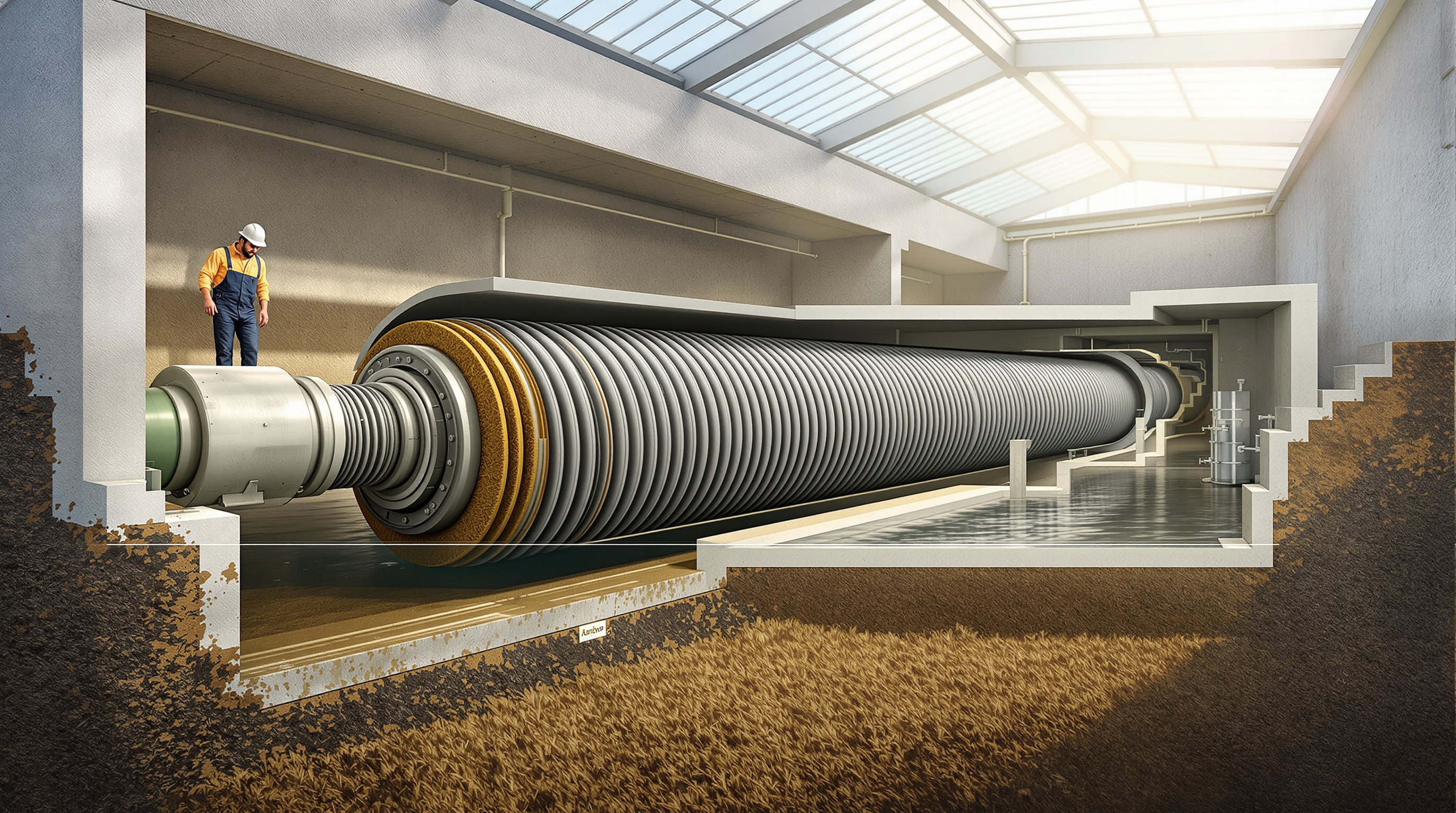
Most sewage treatment plants clean water by blowing air through it — bubbles, blowers, foam, a constant electricity bill. The rotating biological contactor, or RBC, does something quieter and, when you first see it, almost strange: it grows the cleaning microbes on a stack of large discs, mounts those discs on a slowly turning shaft, and half-sinks them in the sewage. As the discs rotate, each patch of microbe-covered surface dips into the dirty water to feed, then lifts up into the open air to breathe. Round and round, all day, at a walking pace.
That single mechanical idea — turn the biofilm through water and air instead of pumping air through the water — is what makes the RBC distinctive. It is one of the oldest attached-growth technologies still in service, and in the right setting it remains one of the simplest, lowest-power ways to treat sewage. This guide explains how it works, what it is genuinely good at, where it lets you down, and how it stacks up against its modern cousin, the Moving Bed Biofilm Reactor (MBBR).
An RBC is a merry-go-round for microbes. Instead of forcing air down to the bugs, it carries the bugs up to the air — using a slow, steady rotation that costs a fraction of the energy a conventional aeration tank demands.
Attached growth vs suspended growth: the key idea
Every biological STP works by feeding sewage to microbes that eat the dissolved waste. The technologies split into two families based on where those microbes live:
- Suspended growth — the microbes float freely in the water as a "mixed liquor," kept alive by air bubbled through the tank. The classic Activated Sludge Process, SBR and MBR all work this way.
- Attached growth (fixed film) — the microbes live glued to a surface as a slimy biofilm, and the water flows past them. The RBC, the MBBR and the old trickling filter belong here.
The RBC is the purest, most visible expression of attached growth. The "surface" is a series of thin, closely spaced circular discs — often made of corrugated plastic to pack in as much area as possible — keyed onto a horizontal shaft. Roughly 40% of each disc sits below the water line and 60% above it. When the shaft turns, every point on the disc alternates, minute by minute, between submersion in sewage and exposure to air.
How a rotating biological contactor works
Follow one patch of biofilm through a single rotation and the whole process makes sense.
1. Dip — the feeding stroke. As the disc rotates that patch down into the tank, the biofilm is submerged in sewage. The microbes absorb the dissolved organic waste — the BOD — as food.
2. Lift — the breathing stroke. The rotation carries the same patch up out of the water into open air. A thin film of sewage clings to it, and now, exposed to the atmosphere, the microbes draw in oxygen directly to digest what they just ate. No blower required — the rotation is the aeration.
3. Repeat. Each disc makes a slow, continuous turn (typically a couple of revolutions per minute), so every patch feeds and breathes over and over. The biofilm thickens as it grows.
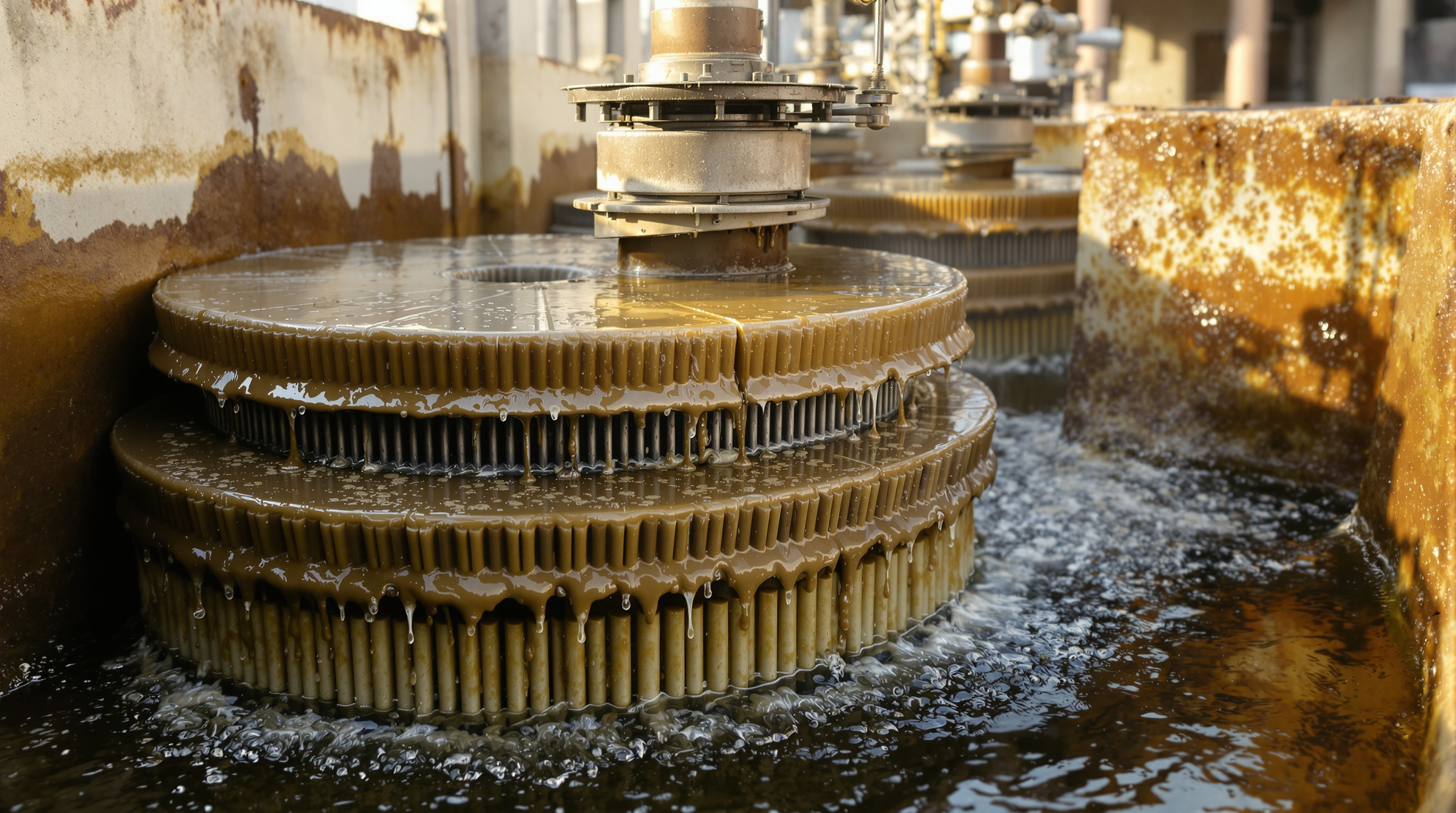
4. Shear and settle. As the film gets too thick, the shearing action of moving through the water sloughs off the excess. These shed clumps of dead biomass drift on with the flow to a secondary clarifier, where they settle out as sludge, leaving clear treated water.
Plants are usually built as several disc stages in series — the sewage flows from the first bank of discs to the second to the third. The first stage meets the strongest sewage and grows the heaviest, darkest biofilm; by the last stage the water is much cleaner and the film is thin and pale. Staging like this lets different microbial communities specialise, and it is what allows a well-designed RBC to also achieve nitrification — converting ammonia to nitrate — in its later stages.
If terms like BOD, TSS and nitrification are unfamiliar, the guide on wastewater characteristics explains exactly what each one measures and why an STP is built to drive them down.
Why people choose an RBC: the strengths
The RBC survives in a market full of flashier technologies because it does a few things genuinely well.
- Very low power. There are no air blowers — the single biggest energy draw in most STPs. All the RBC spends electricity on is turning a shaft slowly. For a small plant this can mean a fraction of the running cost of an equivalent aeration system.
- Low operator skill. This is the RBC's quiet superpower. There is no delicate "sludge age" to manage, no dissolved-oxygen level to chase, no mixed liquor to balance. The biofilm looks after itself. For a small township, a resort, a school or a village cluster without a trained plant operator on site, that simplicity is worth a great deal.
- Robust to shock and low flow. Because the biomass is fixed to the discs rather than floating in the water, it cannot be "washed out" by a sudden surge or a slug of stronger sewage the way a suspended-growth plant can. It also copes gracefully with the wildly variable flows of a small community — busy mornings, empty afternoons.
- Compact footprint and little noise. A stack of discs packs enormous biofilm surface into a small tank, and without blowers the plant runs almost silently.
- Stable, quick recovery. Left idle over a long weekend, the biofilm survives and picks up again quickly when flow returns.
Where it falls short: the weaknesses
None of this makes the RBC a universal answer. Its drawbacks are real, and most of them trace back to that one moving part — the rotating shaft.
- Shaft and bearing wear. The whole load of discs, plus the weight of wet biofilm clinging to them, hangs on a single horizontal shaft turning continuously for years. Shaft fatigue, bearing failure and — in older or overloaded units — the shaft actually snapping under the biofilm load are the classic RBC failure modes. When the shaft stops, the plant stops.
- Weather and temperature sensitivity. The biofilm breathes in the open air, which means it is exposed to the weather. In cold conditions the microbes slow down and performance drops; in strong sun or heavy monsoon the exposed discs need a cover or enclosure, adding cost. An RBC is more climate-sensitive than a fully submerged process.
- Limited scalability. RBCs are a small-community technology. Scaling up means adding more and more disc banks and more shafts — it gets clumsy and expensive fast. For a large apartment complex, hotel or IT park, suspended-growth or MBBR systems are usually more economical.
- Odour if overloaded. Push too much sewage through and the first-stage biofilm goes thick and septic, producing smell — a common complaint on undersized units.
- Harder to retrofit. The discs and shaft are a fixed mechanical assembly; you cannot simply "add capacity" the way you can toss more media into an MBBR tank.
RBC vs MBBR: choosing between the two biofilm processes
The RBC and the MBBR are close relatives — both grow microbes on plastic media rather than in suspension — so they are the natural pair to compare. The difference is one of movement: the RBC moves the media through the water, while the MBBR keeps the media in the water and moves air (and the media) around it.
| Factor | Rotating Biological Contactor (RBC) | Moving Bed Biofilm Reactor (MBBR) |
|---|---|---|
| Biofilm carrier | Fixed discs on a rotating shaft | Free-floating plastic media, tumbling in the tank |
| Aeration | Rotation lifts biofilm into air — no blower | Air blowers keep media suspended and supply oxygen |
| Power use | Very low (turns a shaft) | Moderate (continuous blowers) |
| Moving parts | One critical shaft — a single failure point | No submerged moving parts; blowers only |
| Operator skill | Very low | Low to moderate |
| Weather sensitivity | High (biofilm exposed to air) | Low (fully submerged) |
| Best scale | Small communities, resorts, schools | Small to very large buildings and estates |
| Main risk | Shaft/bearing failure, weather | Media loss, blower dependence |
The honest summary: choose the RBC where power is scarce or costly, there is no skilled operator, the flow is small and variable, and the climate is mild or the unit can be covered. Choose the MBBR where you need to treat larger or growing flows in a compact, weather-independent tank and you can accept a modest, steady power bill. For most mid-to-large Indian buildings the MBBR (or SBR/MBR) tends to win on scalability; the RBC holds its ground in decentralised, low-resource settings.
Where the RBC fits in India
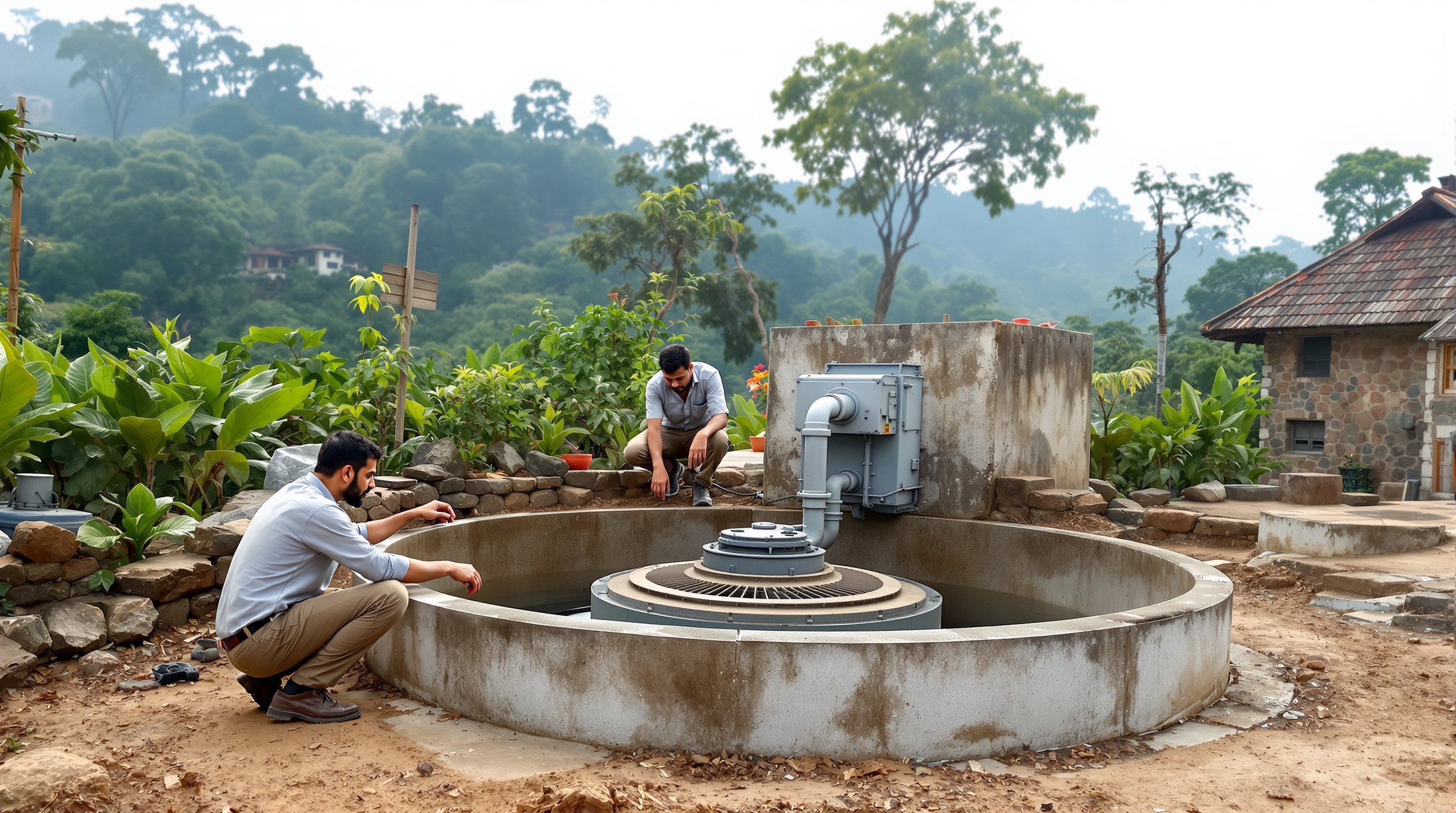
The RBC is not the default choice for a Bengaluru high-rise, but it has a clear niche. It suits small, dispersed communities exactly where centralised infrastructure and skilled operators are hardest to find: eco-resorts and homestays, hill-station properties, rural schools and hostels, small institutional campuses, and standalone facilities off the municipal grid. This is the same territory covered by decentralised wastewater treatment (DEWATS), and the RBC is often one component within such a scheme. Its low power draw also makes it attractive where the electricity supply is unreliable and every kilowatt of blower load is a liability.
For any of these, the design still starts from the same number: how much sewage the community actually produces. The sewage generation calculator turns a headcount into a daily flow in litres, and the STP capacity calculator converts that into the plant size you need to build.
The bottom line
The rotating biological contactor is a lesson in doing more with less. By carrying the microbes up to the air instead of forcing air down to the microbes, it strips out the blowers, the complexity and much of the power bill — leaving a simple, forgiving plant that a small community can run without an expert on hand. Its Achilles' heel is mechanical: everything hangs on one slowly turning shaft, and it is fussier about weather than a submerged process. Know those trade-offs and the RBC is an elegant, appropriate choice for the small, off-grid settings it was made for.
To place it in the wider family of treatment technologies, start with the pillar guide What is a Sewage Treatment Plant? and browse the full Sewage Treatment Plants hub — where the RBC sits alongside ASP, SBR, MBBR, MBR and the anaerobic UASB as one of the tools an engineer weighs for the job at hand.
Export this guide
Related Guides — Deep-dive reading
Trickling Filter Systems in Wastewater Treatment: How Attached-Growth STPs Work
The trickling filter treats sewage by dripping it over a bed of media coated in living biofilm — a low-power, low-maintenance workhorse. Here is how it works, where it fits in India, and how it stacks up against activated sludge.
Sewage Treatment PlantsMoving Bed Biofilm Reactor (MBBR): Media, Working & Benefits
The most popular STP technology in Indian apartments, explained: how thousands of free-floating plastic carriers grow a living biofilm, why that packs high treatment into a small tank, what the media fill ratio means, and how MBBR compares to ASP and MBR.
Sewage Treatment PlantsConstructed Wetlands & Root Zone Systems: Natural STPs Explained
How engineered gravel beds planted with reeds and canna clean sewage using roots and microbes instead of blowers and motors — the low-energy, low-maintenance natural STP, and exactly where it fits in India.
Sewage Treatment PlantsRelated Tools — Try Free
STP Technology Comparison Matrix
Compare Extended Aeration, MBBR, SBR, MBR and UASB across six criteria, set your priority, and see the best-fit STP technology instantly.
ComparatorSTP Capacity Calculator
Size a sewage treatment plant in KLD from your building's occupancy — water demand, sewage generated and recommended STP capacity.
STP CalculatorApartment STP Planner
Plan an apartment complex sewage treatment plant from flats and occupancy — get population load, sewage flow, recommended STP capacity in KLD, treatment technology and approximate space.
Planner