
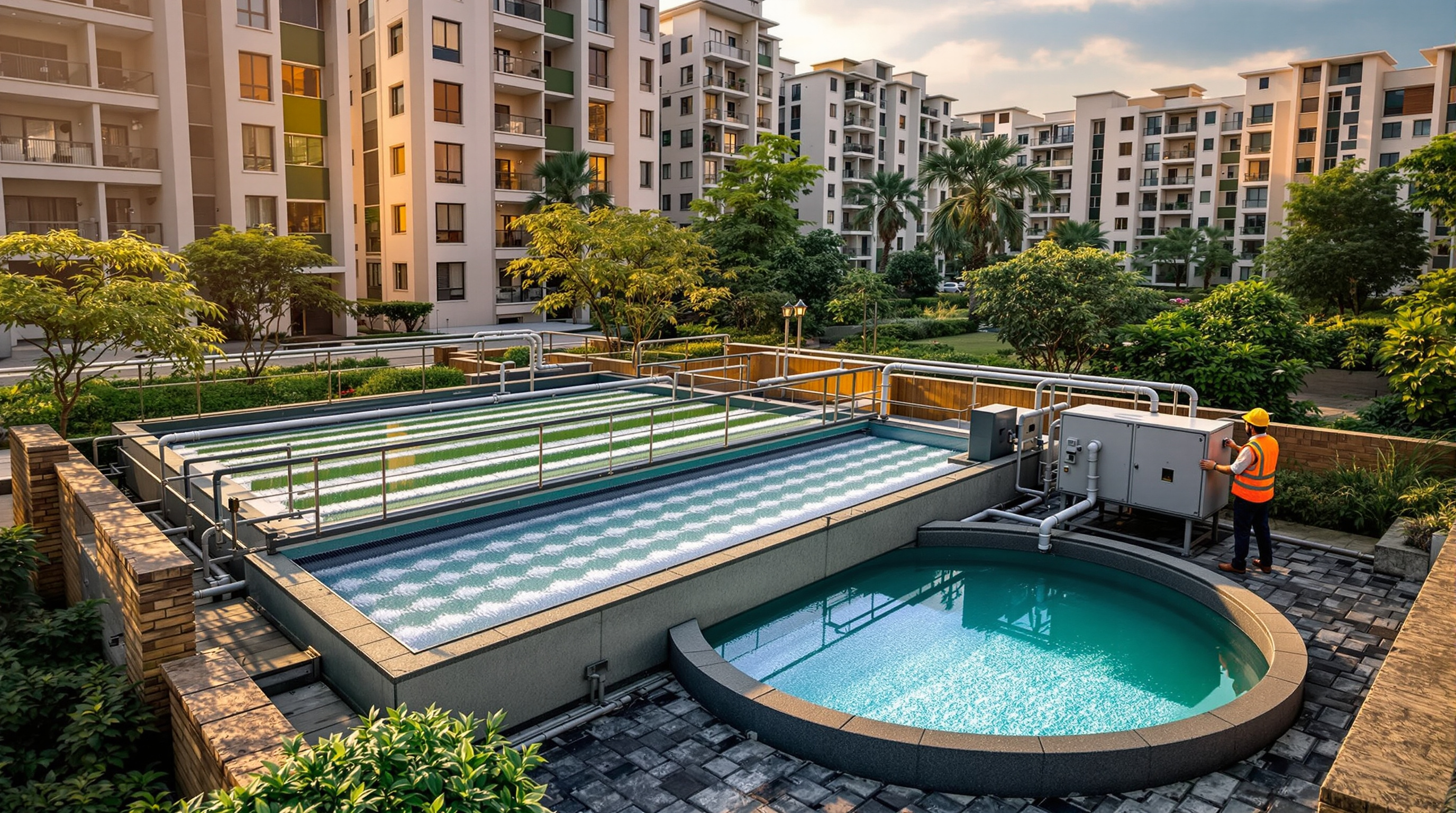
Extended Aeration Process: The Simple, Robust STP for Small Sites
A long-aeration variant of activated sludge that stabilises its own sludge in one tank — forgiving, low-maintenance and the quiet workhorse behind most packaged STPs for Indian apartments and institutions. How the long aeration works, the power-for-simplicity trade-off, and where it fits.
Walk into the plant room of almost any mid-sized apartment complex, school or hospital in India and look at the STP quietly running in the corner. More often than not, you are looking at an extended aeration system — even if the nameplate calls it something grander. It is the default workhorse of Indian packaged sewage treatment for one simple reason: it is hard to break, easy to run, and it forgives the messy, uneven flows that a residential building actually produces.
Extended aeration is not a different family of technology. It is a variant of the activated sludge process — the same microbes, the same aeration tank, the same clarifier — but run deliberately slow and hungry. That one design choice changes everything about how the plant behaves, what it costs to run, and where it makes sense. This guide explains how the long aeration works, the trade-off it buys, and how to judge whether it suits a site.
Conventional activated sludge feeds its microbes well and keeps them busy. Extended aeration deliberately starves them. Kept hungry for far longer than they are fed, the bacteria run out of sewage to eat and begin consuming their own cell mass — which is exactly how the process stabilises its own sludge inside the same tank, with no separate digester.
What "extended" actually means
In a plant like an STP, the two numbers that define how a biological reactor is loaded are HRT and F/M ratio.
- HRT (Hydraulic Retention Time) is how long the water sits in the aeration tank. A conventional activated sludge plant holds sewage for roughly 4–8 hours. Extended aeration holds it for 18–36 hours — often around a full day.
- F/M ratio (Food-to-Microorganism ratio) is how much fresh waste each kilogram of microbes has to eat. Conventional plants run a fairly rich diet; extended aeration runs a deliberately lean one, roughly 0.05–0.15, a fraction of the conventional load.
The plant is also run at a long sludge age (SRT) — the average time a bacterium stays in the system before being wasted — of 20–30 days or more, against a handful of days in a conventional plant.
Put plainly: extended aeration gives a small population of sewage to a large, patient population of microbes, and keeps them together for a long time. The microbes eat all the easy food quickly, then keep respiring on their own reserves and dead cell material. This final phase — bacteria eating themselves for want of anything else — is called endogenous respiration, and it is the whole trick of the process.
Why the long aeration matters: self-stabilising sludge
In a normal activated-sludge plant, the surplus microbes you remove (the waste activated sludge) are still full of undigested organic matter. They are alive, smelly, and unstable, so they must be sent to a separate sludge digester to be broken down before they can be dried and disposed of. That is an extra tank, extra process, extra cost.
Extended aeration skips that stage. Because the microbes have already spent a full day or more in endogenous respiration, the sludge that leaves the plant is already stabilised — largely digested inside the same aeration tank it was grown in. The practical consequences are exactly what a small-site operator wants:
- Far less excess sludge to remove. Long endogenous respiration means much of the biomass is consumed rather than accumulated, so wasting is infrequent — often weekly rather than daily.
- The sludge that does come out is well-behaved. It is stable, dewaters reasonably, and does not turn septic and reek the way raw waste-activated sludge does.
- No separate digester. One less unit process to build, operate and understand.
- Strong, reliable nitrification. The long sludge age gives slow-growing nitrifying bacteria time to establish, so extended aeration naturally converts ammonia to nitrate — useful for meeting the ammonia and nitrogen limits that Indian norms increasingly enforce.
This is why extended aeration dominates the packaged, decentralised STP market. A builder wants a plant that an association's caretaker can run without a resident chemist. Fewer tanks, fewer things to get wrong, and a sludge that does not create a nuisance is worth a great deal on a small site inside a residential compound.
The trade-off: you pay for simplicity in power
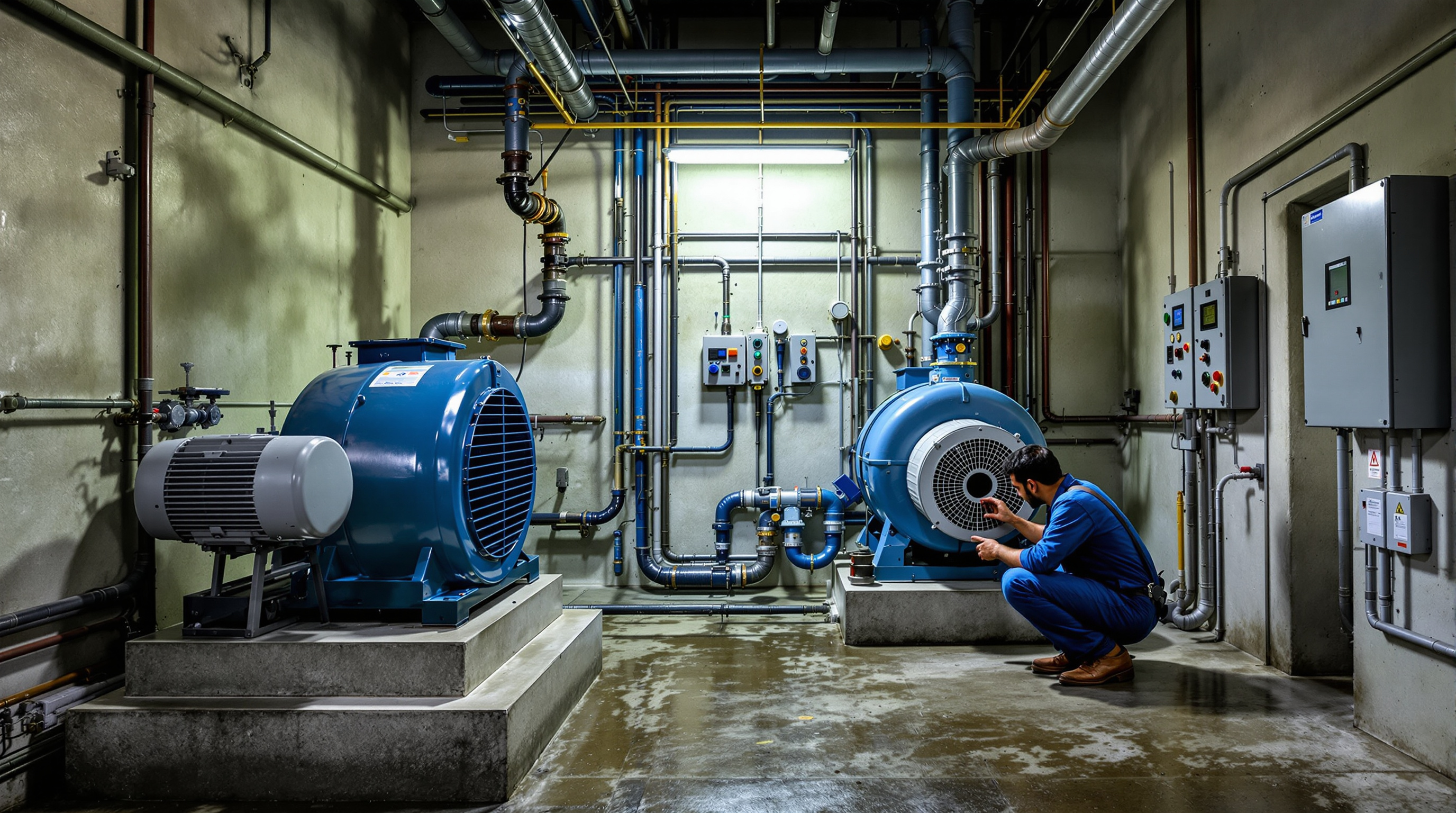
Nothing is free. The same features that make extended aeration robust also make it the energy-hungry choice.
Keeping microbes aerated for 24 hours instead of 6 means running blowers roughly four times longer, moving air into a much larger tank. And endogenous respiration itself consumes oxygen — the bacteria need air to eat themselves, just as they needed it to eat the sewage. Add the extra oxygen demand of full nitrification, and the result is a plant with a high aeration energy per kilolitre treated. In a technology where blowers already dominate the electricity bill, that is the central cost of the approach.
The second cost is footprint. A 24-hour HRT needs a tank several times larger than a conventional plant treating the same daily flow. On a tight urban plot this matters, though it is usually manageable at the small-to-medium capacities where extended aeration is used.
So the trade is honest and easy to state: you spend more electricity and more tank volume to buy simplicity, robustness and low sludge handling. On a small site with limited operator skill, that is very often the right trade. On a very large plant where the power bill dominates every decision, it usually is not — which is why big-city and high-flow projects lean toward SBR, MBBR or MBR systems that treat more water per unit of energy and land.
Extended aeration at a glance: pros and cons
| Strength | Matching weakness |
|---|---|
| Simple and robust — few unit processes, easy for a non-specialist caretaker to run | High aeration power — blowers run long hours, giving high energy cost per kL |
| Self-stabilising sludge — digested inside the same tank, no separate digester | Large tank footprint — an 18–36 hour HRT needs several times the reactor volume |
| Low excess sludge, stable and less odorous, wasted infrequently | Sludge is low in volume but the long retention still ties up tank space |
| Forgiving of shock and variable loads — absorbs the surges of real residential flow | Slow to recover if the biomass is badly upset, given the long sludge age |
| Reliable nitrification from the long sludge age, helping meet ammonia limits | Prone to sludge bulking and foaming if aeration or F/M drifts out of band |
| Proven, cheap to build, ubiquitous as a packaged STP | Not the economical choice at large scale, where energy dominates cost |
Where extended aeration fits
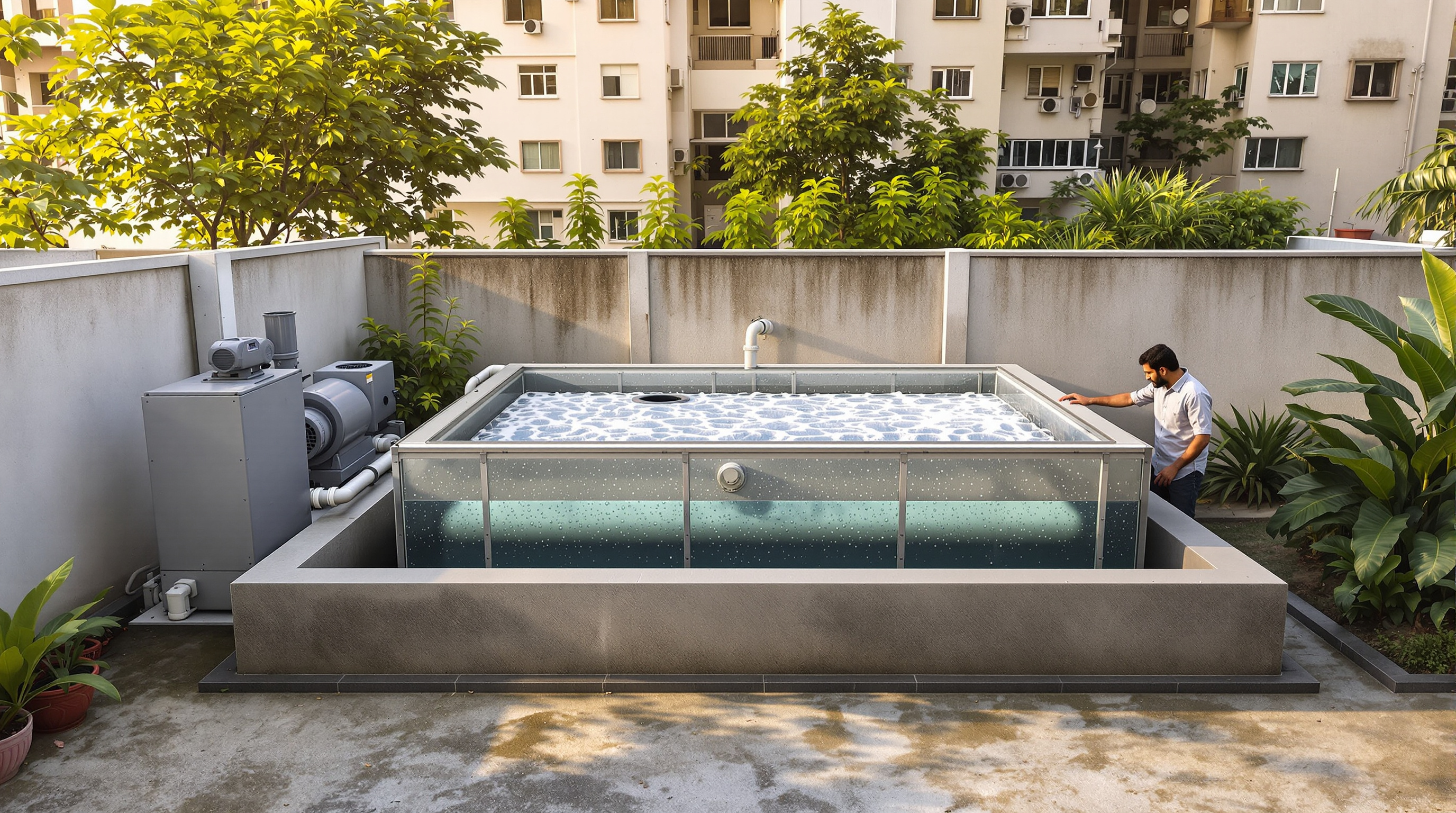
Extended aeration is at its best exactly where most Indian on-site STPs live: small to medium, decentralised, and operated by generalists rather than process engineers. It is a natural fit for:
- Apartment complexes and gated communities, where flow swings wildly between the morning rush and midday quiet, and where the operator is a facility caretaker.
- Schools, colleges and institutions, which run intermittently — busy in term time, near-empty in holidays — and need a process that survives long lean spells without the biomass collapsing.
- Hotels, resorts and hospitals of modest size, where reliability and a nuisance-free, low-odour sludge matter more than squeezing out the last unit of energy.
- Any project buying a standard packaged/prefabricated STP, where extended aeration is very often what is inside the skid whatever the brochure calls it.
Its poorer fit is the mirror image: very large municipal-scale flows, sites with severe space constraints, or projects where electricity cost is the deciding factor. There, the extra energy and tank volume stop being a fair price for simplicity.
Before you can judge which technology suits a project, it helps to be fluent in the underlying numbers — the BOD, COD, TSS and pH parameters that every process is trying to move, and the overall way an STP works stage by stage. And whatever technology you settle on, the sizing starts from one figure: the daily load the plant must treat. The STP Capacity Calculator turns a building's occupancy into that number in litres per day, which is where any extended-aeration design — with its long HRT and large tank — actually begins.
The bottom line
The extended aeration process is activated sludge run slow, lean and patient. By holding sewage for the better part of a day and starving the microbes into endogenous respiration, it digests its own sludge in the same tank — delivering a plant that is simple to build, forgiving to run, and light on excess sludge, with reliable nitrification thrown in. The bill for all that robustness is paid in aeration power and tank volume. For the small, variable, lightly-staffed sites that make up most of India's building-level sewage treatment, that is a bargain — and it is why, more often than not, the quiet grey box in the plant room is running exactly this process.
To compare it against the alternatives, continue through the Sewage Treatment Plants guide library, or start from the what-is-an-STP pillar guide if you are new to the subject.
Export this guide
Related Guides — Deep-dive reading
STP for Schools, Colleges & Universities: A Campus Design Guide
Why educational-campus sewage swings hard between packed term-time days and empty vacations, which STP technology handles that rhythm, how to size for peaky daytime flow, and how to reuse treated water on grounds — with O&M simple enough for a campus caretaker.
Sewage Treatment PlantsThe Oxidation Ditch Process: A Complete Guide for Indian STPs
A looped-channel variant of extended aeration that runs sewage around a racetrack under slow surface aerators — robust, forgiving, low on sludge, and heavy on land. How it works, where it fits, and its honest pros and cons.
Sewage Treatment PlantsBiological Culture Management in an STP: The Heart of Good O&M
The microbes in your aeration tank do the actual work of cleaning sewage. Keep them healthy — the right MLSS, food, oxygen and nutrients — and everything else falls into place. Here is how operators manage the living culture, diagnose bulking and foaming, and recover after a crash.
Sewage Treatment PlantsRelated Tools — Try Free
STP Technology Selector
Weight your priorities — footprint, effluent quality, cost, power and simplicity — and get a scored recommendation between Extended Aeration, MBBR, SBR and MBR.
SelectorApartment STP Planner
Plan an apartment complex sewage treatment plant from flats and occupancy — get population load, sewage flow, recommended STP capacity in KLD, treatment technology and approximate space.
PlannerHealing View Impact Calculator
Evidence-Based Design dashboard quantifying the recovery impact of nature view + daylight factor on analgesic use, length of stay, and HCAHPS patient-experience uplift. Calibrated against Ulrich 1984 (Science), Park & Mattson 2008, and the CHD EBD evidence base.
EBD Calculator