

Building Bye-laws for STPs in India: What Your Occupancy Certificate Depends On
How municipal building bye-laws and India's Model Building Bye-Laws / NBC turn an on-site sewage treatment plant, dual plumbing and treated-water reuse into a legal condition for occupying a building above a plot or built-up-area threshold.
For a developer, an apartment association or a facility manager in India, the sewage treatment plant is rarely a design choice — it is a permission. Long before an STP treats a single litre, it appears in the paperwork that decides whether a building can legally open its doors. That paperwork is the building bye-laws: the municipal rulebook, adopted from national models, that says which buildings must have an STP, how the treated water must be reused, and — critically — that the occupancy certificate will be withheld until it is all in place.
This guide explains how the STP requirement is written into Indian building bye-laws, what plot-size and built-up-area thresholds trigger it, why "dual plumbing" keeps appearing in the fine print, and how the whole thing ties back to the occupancy or completion certificate. It is written for the people who actually have to comply.
A building bye-law does not ask you to treat sewage as a favour to the environment. It makes on-site treatment and reuse a precondition of occupancy — no working STP, no certificate, no legal tenancy.
A note before the numbers: wastewater rules in India are layered (national model, state adoption, pollution-control notifications, tribunal orders) and they change. Every threshold and standard below should be confirmed against your current municipal bye-law and State Pollution Control Board (SPCB) requirement before you design or sign off. Where a figure is contested or state-specific, this guide says so rather than pretending there is one national number.
Who writes the rule: the bye-law hierarchy
There is no single "STP law." Instead, four layers stack up:
- The National Building Code (NBC 2016) — the Bureau of Indian Standards' technical recommendation, including plumbing, drainage and on-site treatment. It is advisory until a state adopts it.
- The Model Building Bye-Laws (MBBL) 2016 — issued by the Town and Country Planning Organisation under the Ministry of Housing and Urban Affairs, as a template for states and municipalities. Its Chapter on Green Buildings and Sustainability is where wastewater recycling, reuse and dual plumbing live. See the Model Building Bye-Laws 2016.
- State and municipal building bye-laws — the version that is actually legally binding on your plot. Karnataka, Delhi, Maharashtra and others have each adopted and amended the model. This is the document your architect submits against.
- Environmental and pollution-control law — the EIA Notification 2006 (for environmental clearance) and CPCB/SPCB effluent standards, which set what quality the STP must achieve.
The practical takeaway: the MBBL and NBC tell you whether and roughly how; your local bye-law tells you the binding threshold; and the SPCB tells you the discharge quality. For the pollution-control side of this, see our guides on STP regulations in India and CPCB guidelines for STPs.
What triggers the STP requirement

Bye-laws use two kinds of trigger — plot / built-up area and wastewater volume. The Model Building Bye-Laws 2016 established the templates most states work from:
| Trigger in the Model Building Bye-Laws 2016 | Typical requirement |
|---|---|
| Buildings generating 10,000 litres/day or more of discharge | Mandatory on-site wastewater recycling system (an STP) |
| Plots of 100 sq m and above | Rainwater harvesting proposal mandatory with the plan |
| Group housing / commercial / institutional on larger plots (commonly ≥ 2,000 sq m) | Full sewage treatment plus treated-water reuse |
| Built-up area 20,000 sq m and above | Environmental clearance integrated with building permission (EIA route) |
The 20,000 sq m built-up-area line is the one that matters most for medium and large projects. Under the December 2016 amendment to the EIA Notification 2006, environmental conditions — including a full-capacity STP with reuse — are integrated into the building permission itself: projects under 20,000 sq m file a self-declaration, while 20,000 to 150,000 sq m projects get environmental clearance bundled with the building sanction through the local authority's environmental cell (PIB, MoEFCC). Above that, State (SEIAA) or central appraisal applies. We cover this route in environmental clearance for STPs.
Because the exact numeric trigger is set by the state or city, treat the table as the pattern, not the promise. Confirm your building's threshold in the municipal bye-law that governs your plot.
A current, concrete example: Karnataka 2026
States keep tightening these rules, which is why a live example is more useful than the generic template. Karnataka's Municipalities Model Building (Amendment) Bye-Laws, effective 21 February 2026, apply sewage-management provisions to all new construction above 5,000 sq m built-up area and set a three-tier structure (SCC Online summary):
- 5,000 to under 20,000 sq m — 100% wastewater treatment via on-site STP or a septic-plus-greywater system.
- 20,000 to 50,000 sq m — full STP treating all wastewater for reuse, with expert certification of adequacy.
- 50,000 to 150,000 sq m — full-capacity STP, mandatory reuse, certified adequacy, metering, CPCB-standard discharge and CPHEEO-compliant sludge disposal.
It also prohibits discharge of untreated sewage into storm-water drains, water bodies or groundwater and mandates treated-water recycling even where an off-site common facility is used. If you operate in Karnataka, this — not the 2016 national model — is your binding text. Every state has, or is heading toward, its own version.
Dual plumbing: why the bye-law cares about your pipes
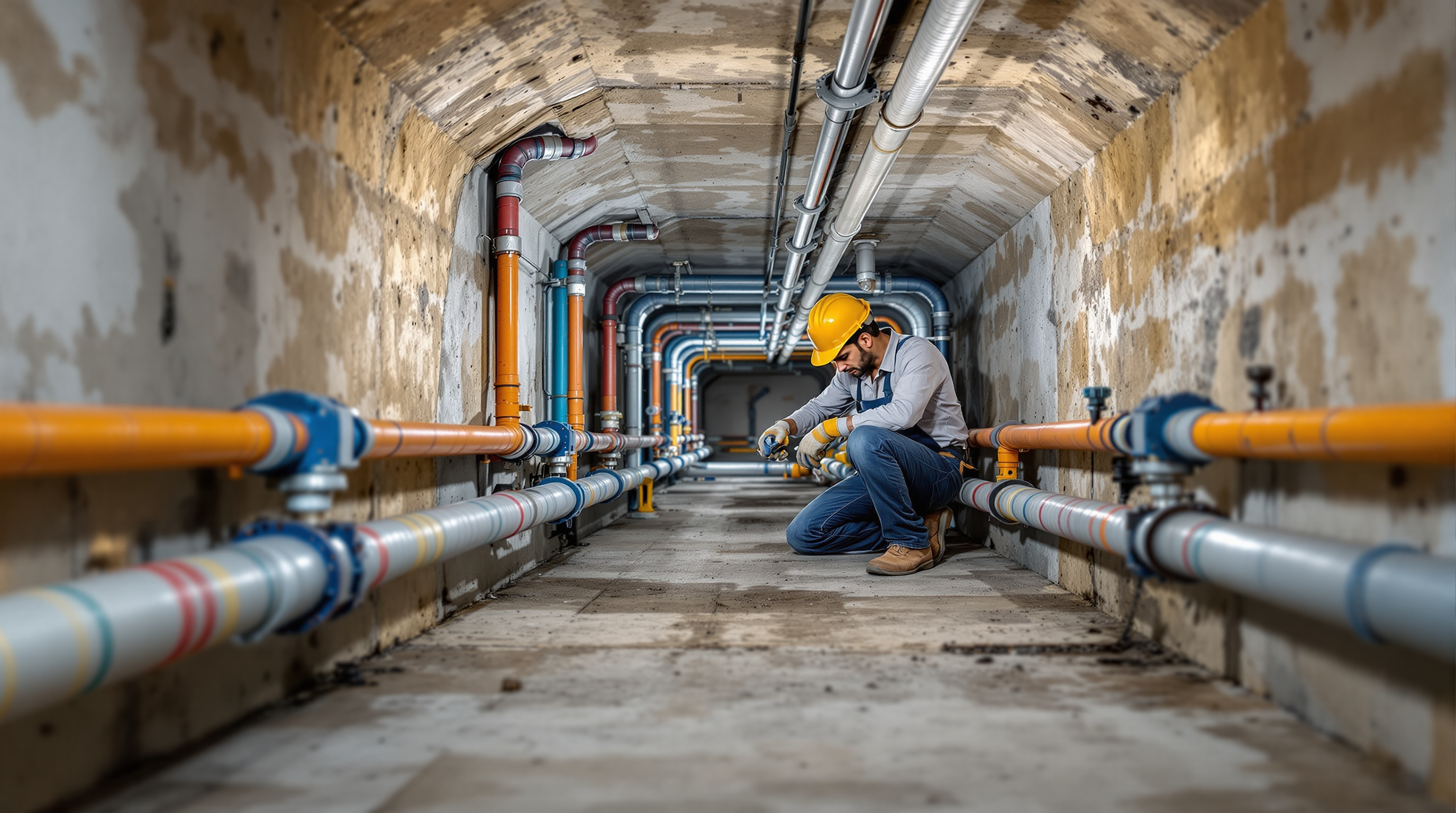
The phrase that trips up first-time developers is dual plumbing. Bye-laws increasingly require two separate distribution networks inside the building:
- a fresh-water line for drinking, cooking and bathing, and
- a treated-water line carrying STP output for toilet flushing, landscaping, floor washing and cooling towers.
Without the second line, the treated water has nowhere to go — so an STP that "works" but discharges everything to the drain does not satisfy a reuse-mandating bye-law. This is why reuse plumbing is a design decision, not an afterthought: the flushing network must be laid during construction. Our guide on treated water for toilet flushing walks through the plumbing, and treated-water reuse standards covers the quality reuse demands.
The quality target: an honest look at the standards
Building bye-laws say treat and reuse; they defer the how clean to CPCB/SPCB effluent standards — and this is the genuinely contested part of Indian STP regulation. Represent it accurately:
| Regime | Indicative BOD / TSS | Status |
|---|---|---|
| General standards, Environment (Protection) Rules — inland surface water | BOD ≤ 30, TSS ≤ 100 mg/L | Long-standing baseline (CPCB general standards) |
| MoEFCC STP-specific notification, Oct 2017 | Two-tier: tighter BOD (≈20) for metros/state capitals, ≈30 elsewhere, with fecal-coliform limits | Notified, then contested |
| NGT-directed norms (2019 onward) | BOD ≤ 10, COD ≤ 50, TSS ≤ 10, ammoniacal-N and fecal-coliform limits | Enforced by many SPCBs; the design target most consultants now use |
The direction of travel is clear — toward BOD 10 / TSS 10 — and several SPCBs (including Karnataka and Delhi) design around the stricter figures. But the precise legally applicable value has moved through the 2017 notification, National Green Tribunal orders and subsequent litigation, and it varies by state and by whether you discharge or fully reuse (India Water Portal on uniform standards). Do not quote a single national number to your board. Confirm the current limit in your SPCB's consent conditions. Our treated-water quality standards guide tracks this in detail.
How it connects to the occupancy certificate
Here is the mechanism that makes all of the above non-negotiable. The NBC and bye-laws are advisory nationally, but once a state adopts them they become conditions of the building sanction. The completion or occupancy certificate (OC) — the municipal document certifying the building was built per sanctioned plans and bye-laws — is issued only when those conditions are met. No OC means the building is legally not fit for occupation.
For STP-triggering projects the chain typically runs:
1. Consent to Establish (CTE) from the SPCB before construction — see Consent to Establish.
2. STP built and commissioned per the sanctioned plan, with dual plumbing and reuse in place.
3. Consent to Operate (CTO) from the SPCB, confirming the STP meets discharge norms — see Consent to Operate and SPCB approvals.
4. Occupancy / completion certificate from the municipal authority, which in many states requires the CTO and a functioning STP as a precondition.
Skip the STP and the sequence breaks at step 3 or 4 — the building cannot be legally occupied or sold. This is why bye-law compliance is a scheduling problem as much as an engineering one.
What to do next
If you are planning or auditing a project, work in this order:
- Confirm the trigger. Pull your city's current building bye-law and check the plot-size, built-up-area and discharge thresholds against your project. Do not rely on the 2016 national model alone.
- Size the plant to actual load. Bye-laws assume a plant matched to occupancy. Start with our how to size an STP guide and the STP Capacity Calculator.
- Design the reuse network in. Dual plumbing for flushing and landscaping must be laid during construction, not retrofitted.
- Sequence the approvals. Line up CTE → build → CTO → OC so the certificate is not held hostage at handover. The STP compliance checklist and apartment STP planning guides map the full path.
Building bye-laws have quietly turned the STP from an environmental nicety into the gatekeeper of occupancy. Get the threshold, the reuse plumbing and the approval sequence right early, and the certificate follows. Get them wrong, and a finished building sits empty. For the wider regulatory picture, continue through the Sewage Treatment Plants guide library.
Export this guide
Related Guides — Deep-dive reading
CPCB Guidelines for STPs Explained: Discharge Standards & the 2017/2019 History
What the Central Pollution Control Board actually prescribes for sewage treatment plants — the effluent parameters, the contested 2015–2017–2019 notification history, the NGT interventions, and which numbers your plant is really held to today.
Sewage Treatment PlantsMoEFCC Rules Affecting STPs: How the EIA Notification 2006 Brings Sewage Treatment Into the Approval Net
The Ministry of Environment's EIA Notification 2006 is the law that decides whether your building needs environmental clearance at all — and it makes a working STP a condition of getting it. Here is how the thresholds, the clearance process and the contested discharge standards actually fit together.
Sewage Treatment PlantsEnvironmental Clearance for STPs & Projects: When Your Build Needs EC (and How the STP Fits In)
When a building or township project must obtain prior Environmental Clearance under India's EIA Notification 2006, how it differs from SPCB consent, and why the sewage treatment plant is written into the clearance as a binding condition — explained honestly, with the contested discharge standards laid out.
Sewage Treatment PlantsRelated Tools — Try Free
Rainwater Tank Sizer
How big should your rainwater tank be? Computes annual harvest, recommended tank capacity in litres, water-bill savings, and payback — for 10 Indian cities.
RWH CalculatorSTP Compliance Checklist Tool
Interactive self-audit that ticks off STP consents, discharge norms, reuse metering, online monitoring and O&M records to give a live compliance readiness score.
ChecklistSTP Building Approval Checklist
An interactive checklist that tracks every sewage-treatment-plant requirement from building-plan sanction through Consent to Establish/Operate to occupancy, showing live completion and readiness.
Checklist