

Decentralised Wastewater Treatment Systems (DEWATS): Treatment at Source
What it means to treat sewage where it is produced instead of piping it miles away — the modular, low-energy, gravity-and-anaerobic DEWATS approach, its building blocks, its honest limits, and how STPs fit this philosophy.
For most of the twentieth century, the plan for sewage was the same everywhere: collect it, pipe it far away, and let a giant municipal plant on the edge of the city deal with it. That model works beautifully — when the pipes exist, when the central plant has capacity, and when there is money to keep both running. Across much of urban and peri-urban India, at least one of those conditions usually fails. Sewer networks are incomplete, central plants are overloaded, and the gap between the sewage a city produces and the sewage it actually treats is enormous.
Decentralised wastewater treatment flips the logic. Instead of transporting sewage to the treatment, you bring the treatment to the sewage — cleaning it at or near the building, cluster or neighbourhood that produced it. The most influential expression of this idea has a name of its own: DEWATS, short for Decentralised Wastewater Treatment Systems.
The core insight of DEWATS is disarmingly simple: sewage is easiest and cheapest to deal with exactly where it is made. Move it, and you spend money on pipes, pumps and power before you have cleaned a single litre.
What DEWATS actually is
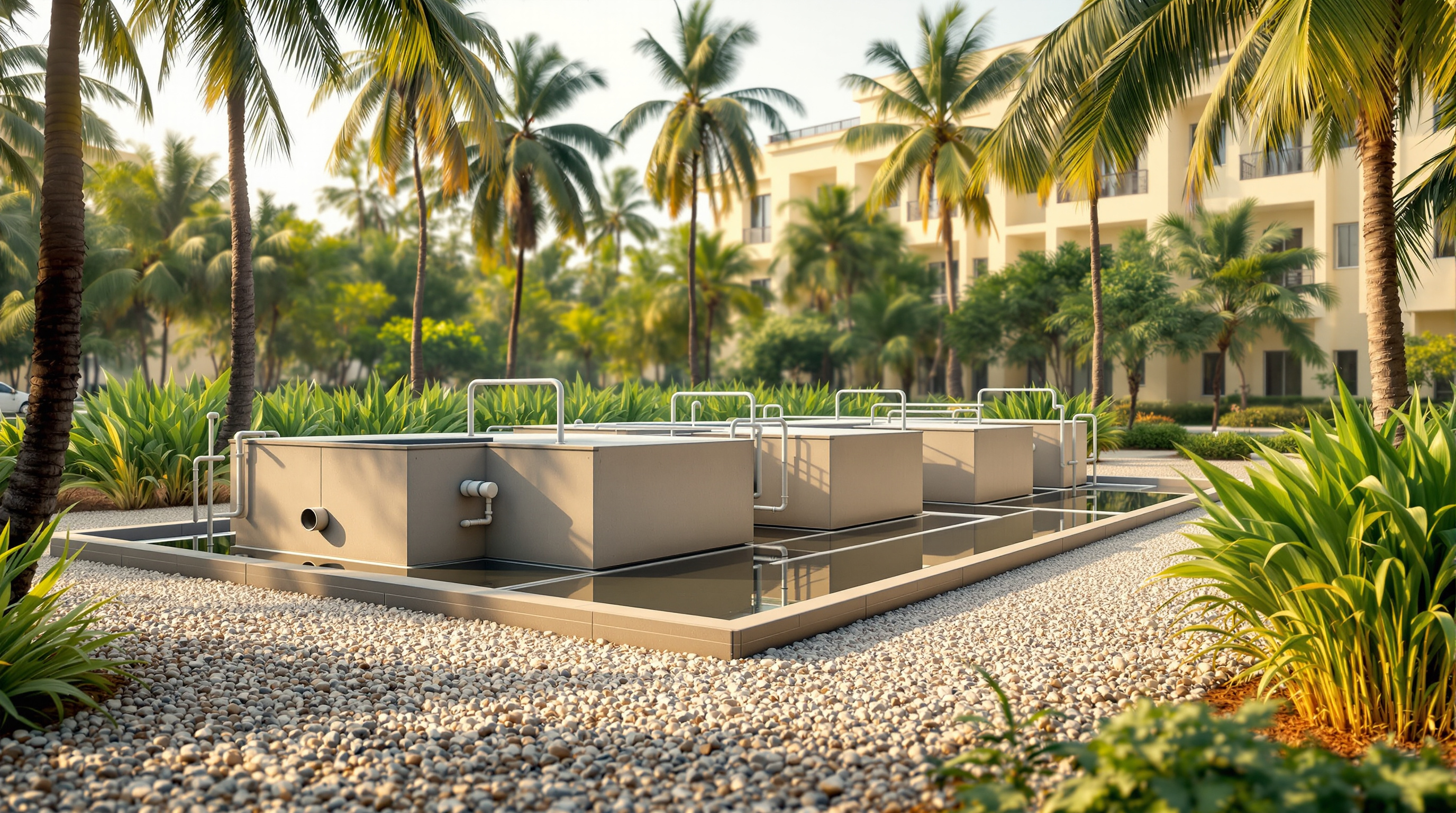
DEWATS is not a single machine or a branded product. It is a design philosophy — a family of treatment modules assembled to suit a specific site — with a few defining principles that set it apart from the conventional big-plant approach:
- Treatment at source. The system sits on the plot or within the community it serves, so there is little or no sewer network to build and maintain.
- Gravity first, power last. Wherever the site allows, water flows downhill through the modules on its own. Many DEWATS configurations use little or no electricity.
- Anaerobic at the heart. Much of the biological work is done by microbes that thrive without oxygen — which means no energy-hungry air blowers running around the clock.
- Modular and robust. Units are sized in standard steps and built from concrete, brick or planted gravel beds. There is very little to break, and what there is can be fixed by a local mason, not a specialist crew.
- Low, forgiving maintenance. A well-built DEWATS train tolerates swings in flow and load and can run for years with only periodic desludging and simple checks.
Developed and popularised for tropical conditions — with significant early work by BORDA and its partner network, and many hundreds of installations across South and Southeast Asia — DEWATS was designed precisely for places where reliable power and skilled operators cannot be assumed. That makes it a natural fit for Indian schools, resorts, factory townships, gated communities, institutional campuses and small settlements.
The building blocks: DEWATS modules
A DEWATS plant is best understood as a train of modules, each doing one job, arranged so the water gets progressively cleaner as it flows through. A designer picks and sizes the modules to match the sewage strength, the land available and the final quality the treated water needs to reach.
| Module | What it does | Principle | Typical role |
|---|---|---|---|
| Settler / sedimentation tank | Lets heavy solids sink and scum float, removing a large share of suspended solids up front | Physical (gravity) | Primary treatment; protects everything downstream |
| Anaerobic Baffled Reactor (ABR) | Forces sewage to flow up and down through a series of chambers, so it stays in close contact with settled sludge | Anaerobic biology | Core secondary treatment; strips dissolved organic load |
| Anaerobic Filter (AF) | Sends the water up through a bed of gravel or media coated in biofilm that traps and digests fine organic matter | Anaerobic biology | Secondary polishing after the ABR |
| Planted gravel filter / constructed wetland | Passes water horizontally or vertically through a reed-planted gravel bed where roots and microbes finish the job | Aerobic + phyto | Tertiary treatment; pathogen and nutrient reduction |
| Polishing / collection pond | Holds the treated water in the open, where sunlight and settling give a final clean-up before reuse | Natural / storage | Final polishing and reuse storage |
Two things are worth noticing about this table. First, the early, workhorse stages — the settler, the ABR, the anaerobic filter — are entirely gravity-driven and anaerobic, running with zero electricity. Second, the anaerobic reactors produce biogas as a by-product; at larger scales this can be captured and used, turning a treatment cost into a modest energy return.
If the anaerobic reactor idea interests you, the same principle scaled up industrially is the Upflow Anaerobic Sludge Blanket (UASB) reactor, and the planted-bed stage is explored in depth in our guide to constructed wetlands.
Why treat at source? The real benefits
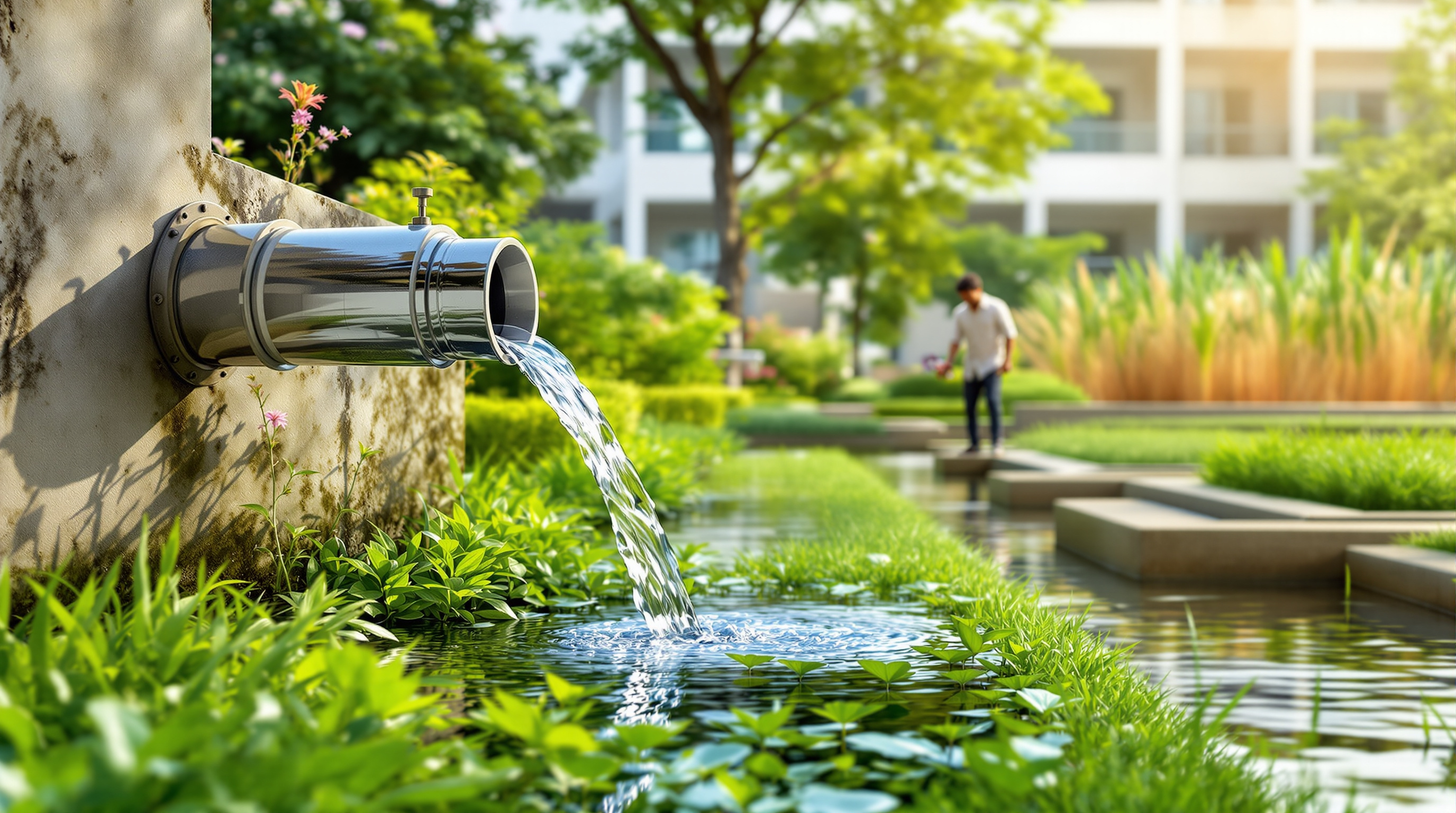
The case for decentralised wastewater treatment is not ideological — it is practical, and it stacks up on cost, resilience and reuse.
1. No expensive sewer network. The single biggest hidden cost of centralised treatment is the underground pipe network that feeds it — kilometres of sewers, lift stations and the power to pump against gravity. Treating at source shrinks or eliminates that network entirely. For a standalone campus or a new layout on the urban fringe, this can be the difference between a project that pencils out and one that does not.
2. Reuse where the water is needed. Treated water is heavy and expensive to move. When you clean it on site, the reuse points — toilet cisterns, gardens, cooling towers, groundwater recharge pits — are right there. A decentralised plant closes the water loop at the building instead of discharging a resource kilometres away and then buying fresh water back.
3. Resilience and independence. A central plant is a single point of failure for an entire city zone. A landscape of small, independent systems has no such fragility — one unit going down affects only its own users, and each can run through power cuts and municipal shortfalls that would cripple a pumped, centralised network.
4. Low operating cost and simplicity. With gravity flow and anaerobic biology carrying the load, energy bills are a fraction of an aerobic plant's, and the operating skill required is modest. There is no delicate machinery to babysit.
5. Incremental, affordable growth. Cities can add capacity cluster by cluster as neighbourhoods develop, rather than committing to one enormous plant and the decades of debt that come with it.
The honest limits
A good engineer sells the constraints as clearly as the benefits. DEWATS is powerful, but it is not a universal answer.
- It needs land. Anaerobic reactors and especially planted gravel filters have a real footprint. On a cramped urban plot with no room for a wetland, a compact, tank-based aerobic plant may be the only option.
- Anaerobic alone rarely meets strict reuse norms. Anaerobic stages remove the bulk of the organic load cheaply, but on their own they leave the water short of the tight standards Indian pollution-control authorities expect for discharge or reuse. A tertiary stage — a wetland, filtration and disinfection — is essential to close that gap.
- Limited nutrient and pathogen removal without polishing. Nitrogen, phosphorus and pathogens need the aerobic and natural polishing stages; skip them and the effluent is not reuse-grade.
- It is a slow, steady system, not a high-rate one. DEWATS trades compactness and speed for simplicity and low energy. Where flows are very large and land is very costly, high-rate mechanised processes win on space.
The practical resolution, seen on most serious Indian sites, is a hybrid: use the cheap, robust anaerobic modules to do the heavy lifting, then finish with a controlled tertiary stage to hit the numbers.
Where the STP fits into all this
Here is the point that confuses many people. An on-site Sewage Treatment Plant is itself a form of decentralised wastewater treatment — it just usually leans on mechanised, aerobic processes rather than passive anaerobic ones. Both philosophies agree on the fundamental move: treat the sewage where it is produced. They differ mainly in how.
- A conventional packaged STP — using processes such as the Activated Sludge Process, SBR or MBBR — is compact, fast and reliably meets tight norms, but it runs blowers continuously and needs trained operation.
- A DEWATS train is larger in footprint but sips energy, tolerates neglect and costs little to run.
Neither is universally "better." A dense high-rise with no spare land will fit a mechanised STP in its basement; a spread-out resort, school or industrial township with room to spare may treat the same volume far more cheaply with a DEWATS-style anaerobic-plus-wetland train. Increasingly, designers blend the two — an anaerobic front end to cut energy and sludge, an aerobic or membrane polish to guarantee reuse quality.
For a fuller grounding in the machine at the centre of this discussion, start with What is a Sewage Treatment Plant? and how an STP works stage by stage, then browse the full Sewage Treatment Plants guide library for the individual technologies.
The bottom line
Decentralised wastewater treatment is a deliberate answer to a hard question: how do you clean a country's sewage when the pipes and central plants to carry it simply are not there? DEWATS answers by refusing to move the problem at all — treating water at source through a robust train of gravity-fed, largely anaerobic modules that need little power and little supervision, finished with a polishing stage to make the water reusable. It will not fit every plot, and it is rarely a complete solution without a tertiary polish. But as a philosophy — treatment at source, modular, low-energy, resilient — it underpins nearly every serious approach to on-site sewage in India today, packaged STPs included.
To size the treatment your own project would need, spend a minute with the STP Capacity Calculator or estimate your daily flow with the Sewage Generation Calculator — the litres-per-day figure is where every decentralised design, DEWATS or mechanised, begins.
Export this guide
Related Guides — Deep-dive reading
Constructed Wetlands & Root Zone Systems: Natural STPs Explained
How engineered gravel beds planted with reeds and canna clean sewage using roots and microbes instead of blowers and motors — the low-energy, low-maintenance natural STP, and exactly where it fits in India.
Sewage Treatment PlantsAnaerobic Baffled Reactor (ABR): The Low-Energy Heart of DEWATS Explained
A series of baffled compartments where sewage snakes up and down beneath a blanket of anaerobic sludge, destroying pollution with no power, no moving parts and almost no attention — how the baffles and sludge blanket work, why DEWATS schemes across India are built around it, and why it always needs a polishing step to finish the job.
Sewage Treatment PlantsHow Does an STP Work? A Step-by-Step Explanation
Follow a single drop of sewage from the building drain to reusable water — through screening, settling, the living microbial heart of the plant, and final polishing — with every stage explained in plain language and no engineering background assumed.
Sewage Treatment PlantsRelated Tools — Try Free
STP Capacity Calculator
Size a sewage treatment plant in KLD from your building's occupancy — water demand, sewage generated and recommended STP capacity.
STP CalculatorSTP Technology Comparison Matrix
Compare Extended Aeration, MBBR, SBR, MBR and UASB across six criteria, set your priority, and see the best-fit STP technology instantly.
ComparatorPopulation Equivalent (PE) Calculator
Convert an organic pollution load into Population Equivalent from flow and BOD concentration — the BOD load in kg/day and equivalent number of people.
STP Calculator