
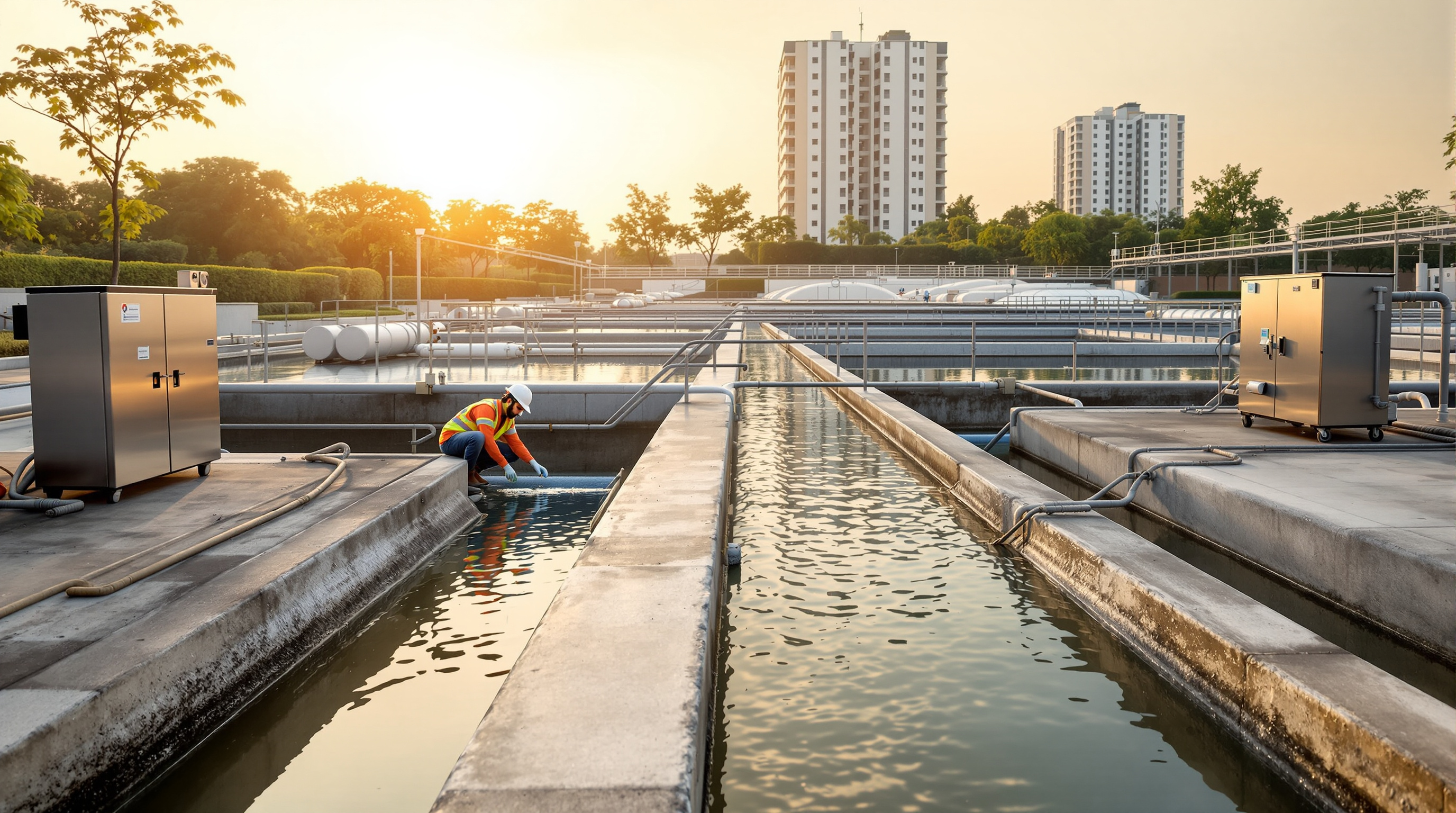
CPCB Guidelines for STPs Explained: Discharge Standards & the 2017/2019 History
What the Central Pollution Control Board actually prescribes for sewage treatment plants — the effluent parameters, the contested 2015–2017–2019 notification history, the NGT interventions, and which numbers your plant is really held to today.
Ask ten facility managers what the "CPCB norm" for their sewage treatment plant is and you will get several different numbers back — BOD of 30, or 20, or 10; fecal coliform of 1,000 or 100. They are not confused so much as caught in a genuinely messy piece of regulatory history. India's discharge standards for sewage treatment plants were relaxed in 2017, struck down by the National Green Tribunal in 2019, defended by the government in the Supreme Court, and are still applied unevenly from one state to the next.
This guide untangles that. It explains what the Central Pollution Control Board (CPCB) actually is, where STP standards legally come from, exactly what changed in the 2015–2017–2019 sequence, and which numbers your plant is realistically held to today.
The single most important thing to understand about "CPCB guidelines for STPs" is that they are a moving target. The values printed in a 2016 tender document may no longer be the ones your State Board will hold you to. Always confirm the current, state-specific limits on your Consent before you design, commission or audit a plant.
What the CPCB actually is — and isn't

The CPCB is a statutory body under the Ministry of Environment, Forest and Climate Change (MoEF&CC), created by the Water (Prevention and Control of Pollution) Act, 1974. Its job is to set national minimum standards, coordinate the states, and publish technical guidance. What it is not is your day-to-day regulator.
That role belongs to the State Pollution Control Board (SPCB) — KSPCB in Karnataka, MPCB in Maharashtra, and so on. The SPCB issues your Consent to Establish and Consent to Operate, inspects your plant, and can prescribe limits stricter than the national floor. So "the CPCB norm" is really the baseline; the number that binds you is the one written on your Consent by the state. Our guides on SPCB approvals for an STP and the MoEF rules that govern STPs unpack that division of labour in detail.
Where STP standards legally come from
The enforceable authority is not a "CPCB guideline" at all — it is the Environment (Protection) Act, 1986 and the rules and notifications issued under it. Under this framework sit two layers relevant to sewage:
- General Standards (Environment Protection Rules, 1986, Schedule VI) — the default limits for discharging treated effluent into inland surface water, a public sewer, land or the sea. For inland surface water these have long been roughly BOD ≤ 30 mg/L, TSS ≤ 100 mg/L, COD ≤ 250 mg/L, pH 5.5–9.0. These apply when no sector-specific standard exists.
- Sector-specific standards for sewage treatment plants — the ones that have been repeatedly rewritten and are the real subject of this guide.
If the parameters themselves are unfamiliar, read wastewater characteristics: BOD, COD, TSS and pH first — every number below is one of those measurements.
The contested timeline: 2015 → 2017 → 2019
This is the part that trips everyone up, so here it is in sequence.
| Year | Event | What it did |
|---|---|---|
| 2015 | MoEF draft | Proposed dedicated STP standards, including a tight BOD ≤ 10 for metros — never finalised as drafted |
| Oct 2017 | MoEF&CC notification (G.S.R. 1265(E)) | Issued tiered, relaxed STP standards: different limits for metro cities/state capitals vs. the rest of the country |
| Dec 2018–Apr 2019 | NGT, Nitin Shankar Deshpande v. Union of India | Examined and then quashed the 2017 relaxation; ordered uniform, stricter norms nationwide |
| 2019 onward | MoEF challenge in Supreme Court | Government contested the NGT order; no stay was granted, leaving the stricter figures effectively in play but unevenly adopted |
The 2017 notification created two classes of plant:
- Metro cities and state capitals (with some exclusions): pH 6.5–9.0, BOD ≤ 20 mg/L, TSS ≤ 50 mg/L, fecal coliform ≤ 1,000 MPN/100 mL.
- All other areas: pH 6.5–9.0, BOD ≤ 30 mg/L, TSS ≤ 100 mg/L, fecal coliform ≤ 1,000.
Crucially, the 2017 rules set no limit for COD and no limit for total nitrogen, and gave existing plants up to five years to comply. That leniency is exactly what the NGT objected to.
In its April 2019 order, the NGT — acting on an expert committee drawn from IIT Kanpur, IIT Roorkee, NEERI and the CPCB — rejected the idea that a small town's river deserves less protection than a metro's. It prescribed uniform standards for the whole country and disallowed the seven-year phase-in the committee had suggested, requiring existing and under-construction plants to comply without delay. The widely reported NGT values were:
| Parameter | NGT 2019 (uniform) | 2017 notification |
|---|---|---|
| pH | 6.5–9.0 | 6.5–9.0 |
| BOD | ≤ 10 mg/L | 20 (metro) / 30 (other) |
| COD | ≤ 50 mg/L* | not specified |
| TSS | ≤ 50 mg/L* | 50 / 100 mg/L |
| Total Nitrogen | ≤ 10 mg/L | not specified |
| Fecal coliform | < 100 MPN/100 mL | 1,000 MPN/100 mL |
\Read the asterisks carefully. This is where secondary sources diverge, and you should treat the exact COD and TSS figures as contested*. Reputable outlets reporting the same 2019 order cite COD variously as 20 or 50 mg/L, and TSS as anywhere from <10 to <50 mg/L. BOD ≤ 10, total nitrogen ≤ 10, and fecal coliform < 100 are the figures cited most consistently. Do not hard-code a COD or TSS number from a blog into a design basis — pull it from the current CPCB standard or your SPCB Consent.
What your plant is actually held to today
Here is the honest practical position, several years on:
- The stringent direction is real. Whatever the precise COD figure, the regulatory trend is firmly toward BOD ≤ 10 mg/L, low COD, tight TSS, added nitrogen control, and fecal coliform < 100 — far beyond the old 30/100 baseline. Design and procure for the strict end, not the lenient one.
- Your state, not a national circular, is the source of truth. Boards such as KSPCB have for years issued Consents to apartment STPs at roughly BOD < 10, COD < 50, TSS < 10–30, plus reuse conditions. Maharashtra, Tamil Nadu and others each publish their own Consent conditions. The number that matters is the one on your paper.
- Reuse standards are separate and stricter. If you flush toilets or irrigate with treated water, additional quality criteria apply on top of discharge limits. See treated-water quality standards and treated-water reuse standards.
For the full statutory picture across notifications, our STP regulations in India overview is the companion to this page.
Beyond the numbers: what CPCB also requires
Discharge values are only half the compliance story. CPCB direction also drives:
- Online monitoring. CPCB has pushed Online Continuous Effluent Monitoring Systems (OCEMS) — real-time sensors for pH, BOD/COD surrogates, TSS and flow, telemetered to the Board — for larger STPs and industrial effluent plants. Whether yours needs one is capacity- and state-dependent; confirm the current threshold with your SPCB. See STP environmental monitoring.
- Consent conditions and validity. Your Consent to Establish and Consent to Operate carry the binding limits, sampling frequency and renewal terms. Operating outside them — or without a valid Consent — is the most common enforcement trigger.
- Periodic testing and audits. Third-party sampling, STP performance testing and, for many properties, a formal STP audit demonstrate that the numbers on paper are met in practice.
- Zero Liquid Discharge in some contexts. Water-stressed states and certain project categories push toward Zero Liquid Discharge, where effectively nothing leaves the site at all.
What this means for your building

If you run or advise a residential or commercial property:
- Size and design for the strict regime. A plant engineered only to hit BOD 30 is a liability. Use our how to size an STP guide and the STP capacity calculator, and specify tertiary treatment (filtration plus disinfection) as standard so BOD ≤ 10 and low fecal coliform are achievable.
- Read your Consent before you argue about norms. The values, monitoring and reporting duties that a court can act on are the ones in your SPCB Consent — not a number remembered from a vendor's brochure.
- Keep an audit trail. Apartment associations in particular carry personal liability for compliance; STP compliance for apartment associations explains why logs, test reports and a maintained plant matter.
The bottom line
The "CPCB guidelines for STPs" are best understood as a statutory floor set nationally, tightened by the NGT, and enforced locally by your State Board. The 2017 relaxation is gone; the direction since 2019 is unambiguously stricter — BOD ≤ 10, nitrogen control, fecal coliform < 100 — even as the exact COD and TSS figures remain genuinely contested across sources. Design for the strict end, treat your SPCB Consent as the binding document, and confirm every specific number against the current CPCB standard before you commit it to a drawing.
Because these norms have changed twice in a decade and may change again, treat the values here as an accurate map of the landscape, not a substitute for the live figures — always verify the current requirement with the CPCB and your SPCB before designing, tendering or certifying a plant.
Continue with the Sewage Treatment Plants guide library for the neighbouring topics on approvals, monitoring and reuse.
Sources: CPCB effluent & emission standards · CPCB general discharge standards (PDF) · NGT order on STP effluent standards, 30/04/2019 · Business Standard: NGT orders stricter STP norms · Down To Earth: after NGT's stringent norms, a new dilemma · India Water Portal: the uniform-standards debate
Export this guide
Related Guides — Deep-dive reading
Apartment Association STP Compliance Guide: CTO, Monitoring, Records & Penalties
A practical, honest compliance playbook for RWAs and facility managers running a sewage treatment plant — how to keep your Consent to Operate valid, what to monitor and record, the notices that catch associations out, and how to stay on the right side of the CPCB, your SPCB and the NGT.
Sewage Treatment PlantsSPCB Approvals for STPs: The State Pollution Control Board Consent Regime Explained
How State Pollution Control Boards actually administer STP approvals in India — their role versus the CPCB, the Consent to Establish and Consent to Operate regime, inspections and monitoring, and why the rules differ from one state to the next.
Sewage Treatment PlantsState-Wise STP Approval Process Comparison: How Consent Rules Differ Across India
Every Indian state runs the same national CTE/CTO consent framework under the Water Act — but the board names, portals, thresholds and effluent limits change as you cross state lines. Here is how the STP approval process actually compares, state by state, and how to find the rule that binds your project.
Sewage Treatment PlantsRelated Tools — Try Free
STP Compliance Checklist Tool
Interactive self-audit that ticks off STP consents, discharge norms, reuse metering, online monitoring and O&M records to give a live compliance readiness score.
ChecklistCPCB Compliance Checklist for STPs
Tick off CPCB/SPCB outlet standards, monitoring duties and record-keeping to score your sewage treatment plant's compliance readiness.
ChecklistApartment STP Planner
Plan an apartment complex sewage treatment plant from flats and occupancy — get population load, sewage flow, recommended STP capacity in KLD, treatment technology and approximate space.
Planner