
Norman Foster's Façade Signature: The High-Tech Glass Diagrid and the Engineered Skin
How Norman Foster turned the building envelope into structure, climate machine and civic statement — the diagrid crystal, the breathing double-skin, the glazed gridshell — and what his glass towers really demand in Indian heat.
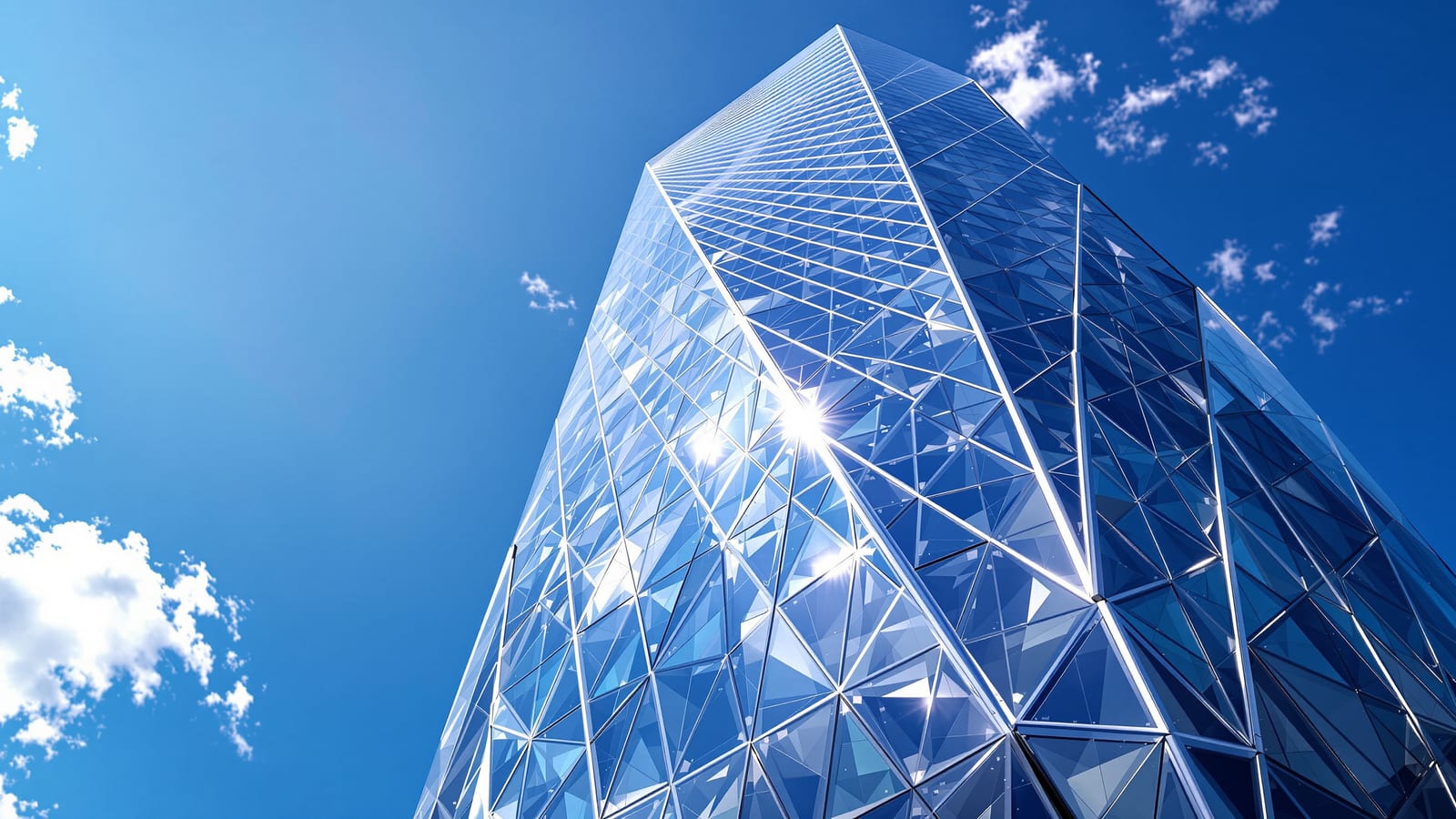
Stand at the foot of 30 St Mary Axe in the City of London — the building everyone calls the Gherkin — and look up. There are no columns interrupting the glass. The skin itself is a net of diagonal steel triangles climbing in a gentle spiral, each cell filled with a faceted pane, the whole thing tapering to a single glazed lens at the crown. It does not look like a wall hung on a frame. It looks like a crystal that grew its own structure. That is the Norman Foster move in one image: the façade is not a coat the building wears. The façade is the building.
For half a century Foster and his practice, Foster + Partners, have argued that the most advanced engineering and the most beautiful surface are the same problem. Where most architects treat the skin as decoration draped over a hidden steel skeleton, Foster pulls the structure out to the edge, makes it visible, makes it carry the load, and lets the glass become honest about what holds the building up. This is high-tech architecture — a movement, also called structural expressionism, that treats the structure, the services and the engineering of a building as the architecture itself, openly displayed rather than concealed. Foster won the Pritzker Prize, architecture's highest honour, in 1999, cited by the jury "for his contributions in defining an architecture with high technological standards."
But here is the catch that matters most to anyone building in Hyderabad or Gurugram: Foster's glass towers are not glass boxes. Every one of them is a climate machine in disguise — a double skin that breathes, an atrium that ventilates, a coating that filters the sun. The look has been copied across India a thousand times. The discipline almost never has. This guide is about the difference.
This is part of our Building Façades series — specifically our Masters of the Façade set, where we study how one great architect designed façades rather than how they lived. For Foster's life and full body of work, see his biography at Norman Foster. Because his signature is the engineered glass envelope, you should read this alongside our guides on glass curtain-wall façades (essential background), double-skin and ventilated façades, and energy-efficient façades.
1. High-tech: the structure is the ornament
To understand a Foster façade you first have to unlearn a habit. Most buildings hide their bones. A concrete frame or a steel skeleton stands inside, and the façade — brick, render, stone, glass — is a separate non-structural skin clipped onto the front. Foster's high-tech architecture refuses that separation. The trusses, the nodes, the cables, the bracing, the very logic of how loads travel to the ground are exposed and celebrated as the visible character of the building.
That means a Foster façade reads as engineering. You can trace, with your eye, where the forces go. The beauty is not applied; it is the by-product of solving the structural problem elegantly and then refusing to cover it up. A curtain wall — the lightweight, non-load-bearing outer skin of glass and metal that hangs off a building's frame like a curtain off a rail — is, in Foster's hands, often not a curtain at all. He frequently makes the perimeter skin do structural work, which is where the diagrid comes in.
2. The all-glass envelope and the minimal mullion
The dream behind the modern glass tower is total transparency: a building dissolved into light and reflection, its occupants connected to the city and the sky. Achieving that means shrinking everything that interrupts the glass. The vertical bars that hold panes in a curtain wall are mullions; the horizontal bars are transoms. Foster's detailing obsession is to make these as slender, as quiet and as few as possible.
His practice pioneered structural glazing (panes bonded with high-performance silicone so the glass face is uninterrupted by clips or frames) and unitised glazing (large façade panels prefabricated complete with glass, frame, gasket and insulation in a factory, then craned into place and locked together on site). Both come from the same instinct: a façade should be assembled from precise, repeatable components made to aircraft tolerances, not wet-trowelled on site. The result is a skin that looks effortless precisely because enormous effort went into the joint you never notice.
3. The energy agenda is in the skin
Here is the part the copyists miss. Foster did not chase transparency for its own sake — he chased it while solving the heat problem that all-glass buildings create. From the 1990s his façades carry an explicit environmental brief: capture daylight, reject solar heat, drive natural ventilation, and slash the energy a sealed glass tower would otherwise burn.
The tools are specific. Low-E glass (low-emissivity glass, coated with a microscopically thin metallic layer that lets daylight through but reflects infra-red heat) and solar-control glazing filter the sun before it cooks the interior. A double-skin façade wraps the building in two layers of glass with a ventilated air gap between them, so heat is intercepted in the cavity and carried away rather than dumped into the offices. An atrium or light-well stack — a tall vertical void rising through the building — works like a chimney: warm air rises and escapes at the top, pulling fresh air in low down, ventilating the building with almost no fans. None of this is visible as ornament. All of it lives inside the skin.
The diagrid: structure becomes the skin
The single idea that most defines a Foster tower façade is the diagrid — short for "diagonal grid." Instead of vertical columns and horizontal beams, the building's perimeter is wrapped in a triangulated lattice of diagonal steel members. Triangles are the only rigid polygon: they cannot deform without changing the length of a side. So a skin of triangles is enormously stiff and strong, and it carries both the vertical weight of the floors and the horizontal push of the wind — all on the outer edge of the building.
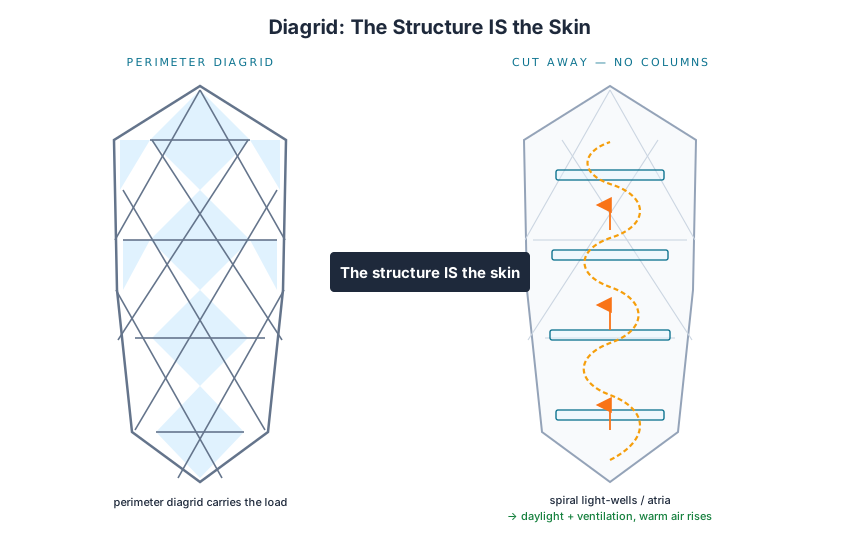
The payoff is twofold. Structurally, because the perimeter does the work, the interior can be cleared of columns — you get a wide, flexible, column-free floor flooded with daylight from a fully glazed edge. Architecturally, the diagrid gives the building its faceted, crystalline look: the glass is broken into hundreds of small triangular or diamond panes that catch light at different angles, so the tower shimmers rather than mirrors flatly. The skin is the structure, and the structure is the ornament.
At 30 St Mary Axe the diagrid does even more. Each floor plate is rotated five degrees from the one below, and triangular wedges are cut out of the plan and stacked so they form six spiralling atria — light-wells that wind up the full height of the tower. Those spiral voids flood the deep floors with daylight and, crucially, act as the building's lungs: the shape and the spiralling stacks drive natural ventilation, allowing the offices to run without mechanical ventilation for a large part of the year. The double-glazed outer skin with shading blinds inside its cavity delivers up to about 85 per cent solar protection. The Gherkin is famous for its shape; its real genius is that the shape is a ventilation strategy wearing a glass coat.
4. The breathing double-skin façade
The second great Foster envelope idea is the double-skin breathing façade, and its landmark is the Commerzbank Headquarters in Frankfurt, completed in 1997 and described at the time as the world's first ecological office skyscraper.
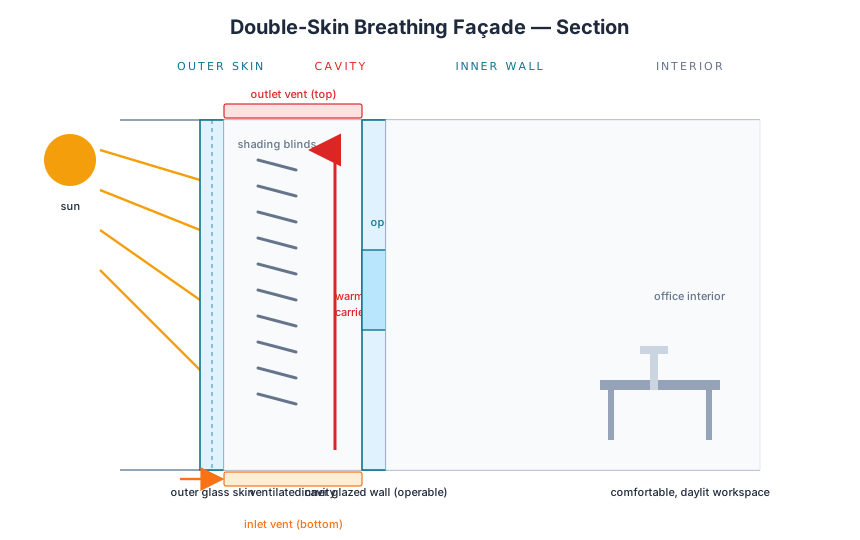
A double skin puts two layers of glass around the building with a ventilated cavity between them. Shading blinds sit protected inside that cavity, out of the weather. In summer, sun striking the outer glass heats the air in the gap; that hot air rises and vents away before it reaches the occupied space, so the building stays cool. In milder weather, occupants can open the inner windows and draw fresh air straight through the cavity — natural ventilation in a high-rise, which a single sealed curtain wall can never offer. Commerzbank's offices are naturally ventilated for roughly 85 per cent of the year and the tower uses meaningfully less energy than a conventional sealed high-rise of its size.
Foster paired the breathing skin with sky gardens: nine four-storey planted gardens spiralling up around a central atrium, each planted from a different world region — North America, Asia, the Mediterranean — depending on its orientation. The gardens are not decoration. They are part of the ventilation engine and the daylight strategy, bringing green outlook and fresh air deep into the plan. The façade and the section work as one breathing system.
5. The glazed gridshell roof
Foster's envelope thinking is not only vertical. Some of his most loved work is the gridshell — a structure where a fine grid of steel members, curved in two directions, becomes a self-supporting shell, then glazed to make a vast transparent roof over an old courtyard or hall.
The Queen Elizabeth II Great Court at the British Museum (2000) is the masterpiece. Foster + Partners, with engineers Buro Happold, roofed the museum's hidden inner courtyard — two acres, the largest covered square in Europe — with a glazed gridshell of 3,312 glass panels, no two the same shape, carried on a lattice of nearly 5,000 steel rods meeting at 1,566 nodes. The geometry was computed to absorb every irregularity of the surrounding historic façades to a tolerance of three millimetres. The same family of thinking roofs the Smithsonian's Kogod Courtyard in Washington. A gridshell is the diagrid logic laid flat: a thin triangulated or quadrilateral net doing structural work while almost disappearing into glass.
6. Transparency as a civic value
The Reichstag in Berlin (1999) shows the Foster envelope carrying meaning beyond climate. Atop Germany's restored parliament, Foster placed a 40-metre glass dome that the public can physically enter and climb, walking up a pair of spiralling ramps to a viewing platform — directly above the debating chamber, so citizens look down on their elected politicians at work. Foster's stated intent was the literal transparency of government: democracy made visible through glass.
The dome is also a working environmental device. A mirrored cone at its centre reflects daylight down into the chamber, cutting artificial lighting, while the dome acts as a chimney — drawing stale air up and out of the parliament below. It is the rare façade element that is simultaneously a symbol, a skylight and a ventilation flue. Transparency here is not a thermal trick; it is a political argument made in glass.
7. Precision, prefabrication and the resolved node
Underneath every Foster façade is a craft obsession: the joint. He came of age admiring aircraft engineering and never lost the belief that a building component should be designed and made with the same precision as an aircraft part. The recurring detail to look for is the node — the point where members meet — resolved so cleanly that it reads as a single sculpted piece rather than a clutter of bolts and brackets.
This is why so much of his façade is prefabricated: cast or machined nodes, unitised panels, repeatable components assembled dry on site. Prefabrication is not just speed; it is quality control. A factory-made unit is more precise, better sealed and more weatherproof than anything trowelled together in the rain — which is exactly what an all-glass skin, with its zero tolerance for leaks and its visible everything, demands.
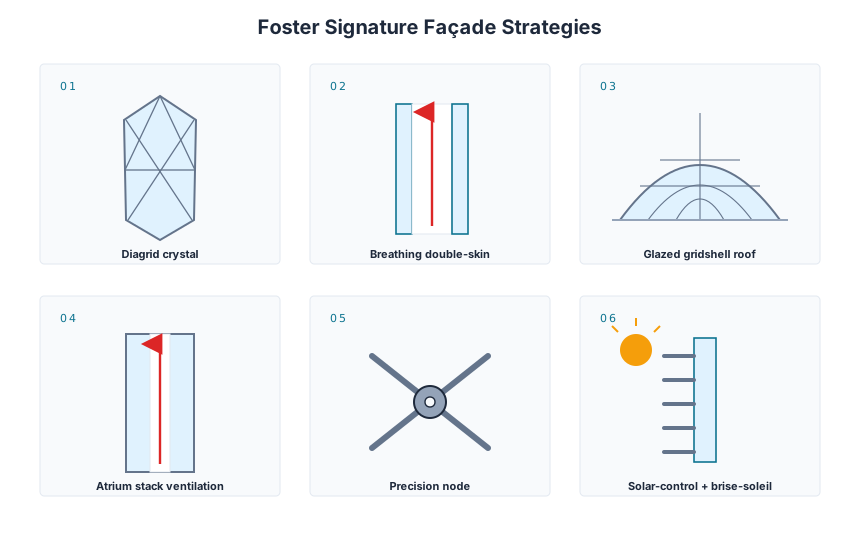
Signature façade strategies at a glance
| Strategy | What it is | Building | Why it matters | India relevance |
|---|---|---|---|---|
| Diagrid skin | Perimeter triangulated steel grid carries the load; interior goes column-free | 30 St Mary Axe; Hearst Tower | Structure becomes the façade; faceted crystalline look; less steel | The look most copied in Indian CBDs; rarely the column-free daylight logic behind it |
| Breathing double-skin | Two glass layers with a ventilated, blind-filled cavity | Commerzbank, Frankfurt | Natural ventilation in a high-rise; heat intercepted before it enters | The single missing ingredient that would make Indian glass towers liveable |
| Atrium / stack ventilation | Tall internal void vents warm air like a chimney | Gherkin spiral light-wells; Commerzbank sky gardens | Cuts mechanical cooling; daylights deep floors | Directly answers India's AC-load problem — almost never used |
| Solar-control / low-E glazing | Coated glass that passes light, blocks heat | Across the portfolio | Lets you glaze widely without cooking the interior | Non-negotiable minimum for any glass façade in Indian sun |
| Glazed gridshell | Thin steel net glazed into a transparent roof | British Museum Great Court | Vast daylit public space over old fabric | Atrium and courtyard roofs for malls, campuses, transit |
| Public glass envelope | Walkable transparent dome / skin | Reichstag dome | Transparency as civic and democratic meaning | A non-climate lesson: glass can mean openness, not just spectacle |
Real buildings, not renders
30 St Mary Axe — the Gherkin, London (2004). A 41-storey diagrid tower clad in a double-glazed faceted skin. Six triangular light-wells spiral up the building, formed by rotating each floor five degrees from the one below; they daylight the deep plan and drive natural ventilation, so the offices can run without mechanical ventilation for much of the year. The cavity blinds and double glazing give up to roughly 85 per cent solar protection. The shape is not styling — it is the ventilation diagram.
Hearst Tower, New York (2006). Forty-six storeys of diagrid glass-and-steel rising out of a six-storey 1920s Art Deco stone base, which Foster + Partners retained as a landmark and built the new tower inside. The diagrid uses about 21 per cent less steel than a conventional frame of the same size. Its distinctive faceted edge — sloping panels that lean in below and out above, nicknamed the "bird's-mouth" — required a bespoke window-cleaning rig that took years to develop.
Commerzbank Tower, Frankfurt (1997). Billed as the world's first ecological tall office building. A triangular plan with a central atrium and nine spiralling four-storey sky gardens, wrapped in a double-skin breathing façade. Naturally ventilated about 85 per cent of the year, with significantly lower energy use than a sealed equivalent. This is the fullest statement of the Foster idea that a tall building's skin and section are one climate system.
Reichstag Dome, Berlin (1999). A public glass dome over Germany's parliament, climbable by spiralling ramps, with a central mirrored cone that throws daylight into the chamber below and helps vent it. Transparency as both environmental device and democratic statement.
British Museum Great Court, London (2000). A glazed gridshell of 3,312 unique glass panels on a steel net of nearly 5,000 rods and 1,566 nodes, computed to a three-millimetre tolerance, roofing the largest covered courtyard in Europe. The same gridshell language reappears at the Smithsonian's Kogod Courtyard. Proof that the Foster envelope is as much about light as about height.
What it teaches India
Walk through any new business district in Gurugram, Bengaluru, Hyderabad or Mumbai and you will see the Foster look everywhere: the all-glass tower, the curtain wall, the reflective crystalline skin. It has become the default image of a "modern, world-class" office building. And most of the time it is a mistake.
Here is the honest engineering. Foster's glass towers work in Frankfurt and London because the glass is the smallest part of the system. Behind the transparency sit the double skin, the breathing cavity, the spiral atria, the stack ventilation, the solar-control and low-E coatings, the daylight modelling — the full kit that intercepts heat and moves air before the interior ever feels it. Strip that kit away and a glass tower is simply a greenhouse. In Indian solar conditions, a single-skin clear-glass façade traps radiant heat, drives indoor temperatures up, and forces the air-conditioning to run flat out all day — enormous energy bills, a heavy carbon load, and often a building that is still uncomfortable near the glass.
So the lesson from Foster is the opposite of what the copyists took. The all-glass façade is only honest in our climate if it carries the whole discipline:
- Solar-control or low-E glazing as the non-negotiable minimum, never plain clear glass on a sun-facing elevation;
- External shading or a double-skin/ventilated cavity so heat is stopped or carried away outside the occupied space — see our double-skin and ventilated façades guide;
- Natural ventilation and atrium stacks wherever the plan allows, to cut the cooling load the way the Gherkin and Commerzbank do;
- Daylight design so the glass earns its heat penalty by removing artificial lighting.
If a project cannot afford that full kit, the answer is not a cheaper glass tower — it is a different façade. A more shaded, more opaque skin with punched windows, deep reveals and brise-soleil (fixed external sun-shading louvres, a Foster device at Masdar and elsewhere) will outperform a naked glass box every day of the Indian year. Read our glass curtain-wall façades and energy-efficient façades guides for the detail. And do not lose the Reichstag's lesson either: glass can mean openness and public trust, not only spectacle — a beautiful, non-climate reason to use it well.
What this means for you
If you are commissioning, designing or simply admiring a glass building in India, judge it by Foster's standard, not Foster's image. Ask three questions. First: where does the load go — and could the structure have become the skin, freeing the interior and earning the glass? Second: what is the glass actually made of, and what stops the sun — coatings, a double skin, external shading, an atrium that breathes? Third: does the transparency mean something, or is it just shine? A Foster façade always has an answer to all three. A copy usually has none.
The takeaway is simple and a little uncomfortable. The all-glass high-tech tower is one of the great achievements of modern engineering — and one of the most abused. In our heat it is honest only when it carries the full environmental kit that made it possible. If you can build that, build the crystal. If you cannot, build the shade. Either way, make the façade do real work — that is the whole of Norman Foster's lesson.
Sources
- The Pritzker Architecture Prize — Norman Foster, 1999 Laureate and jury citation (pritzkerprize.com).
- Foster + Partners project pages: 30 St Mary Axe, Commerzbank Headquarters, Hearst Tower, Reichstag, Great Court at the British Museum (fosterandpartners.com).
- 30 St Mary Axe — diagrid, six spiralling light-wells, natural ventilation and ~85% solar protection (Archello; WikiArquitectura).
- Commerzbank Tower — double-skin breathing façade, nine spiralling sky gardens, ~85% naturally ventilated, world's first ecological skyscraper (Foster + Partners; City of Frankfurt).
- Reichstag dome — glass dome, public spiral ramps, mirrored cone, chimney ventilation, transparency of government (Foster + Partners; visitBerlin).
- Hearst Tower — diagrid using ~21% less steel, retained 1920s stone base, "bird's-mouth" façade (Archello; Permasteelisa).
- British Museum Great Court — 3,312 unique glass panels, ~5,000 rods, 1,566 nodes, Foster + Partners with Buro Happold (British Museum; Queen Elizabeth II Great Court records).
- Studio Matrx in-house: Norman Foster biography, glass curtain-wall façades, double-skin and ventilated façades, energy-efficient façades.
Export this guide
Related Guides — Deep-dive reading
Energy-Efficient Facades in India: How the Building Skin Cuts Your Cooling, Heating & Lighting Bills
How a building facade drives cooling, heating and lighting energy in India, the three levers of solar-heat-gain control, insulation and daylighting, U-value, SHGC, VLT and WWR in plain terms, ECBC and Eco-Niwas expectations, and real Indian green buildings.
Building FacadesCharles Correa's Façade Signature: How India's Master Made the Climate-Correct Wall
How Charles Correa eroded the flat sealed wall into deep, shaded, porous layers — verandahs, terraces, pergolas and open-to-sky courts — so the Indian façade filters sun and drives air instead of sealing it out.
Building FacadesBloomberg European HQ: The Office That Learned to Breathe
Foster + Partners' £1bn City of London headquarters folds ventilation, cooling, lighting, acoustics and even a Roman temple into a single integrated system — the most complete argument yet that the future workplace is not a sealed glass box but a low-energy, city-stitching organism. A study of its bronze gills, its 2.5-million-petal ceiling, its load-bearing stone, and the awkward question of whether a bespoke palace can really be a model.
The Future of ArchitectureRelated Tools — Try Free
Brise-Soleil Visualizer
Interactive horizontal-louvre cut-off angle calculator — sun altitude, louvre depth, and spacing inputs with a live shadow preview. Computes θ = arctan(spacing/depth) for façade shading, ECBC envelope compliance, hospital daylight design, and tropical sun-control detailing.
Sun Shading ToolCross-Ventilation Analyzer
Estimate airflow and air changes per hour (ACH) from room size, window areas, layout, and local wind — with NBC 2016 Part 8 compliance check.
Ventilation CalculatorFuture Home Comfort Score
Score your home 0 to 100 on daylight, ventilation, thermal and acoustic comfort and find the weak link.
Window Tool