
Norman Foster
The high-tech master who made structure, daylight and energy the visible art of the building
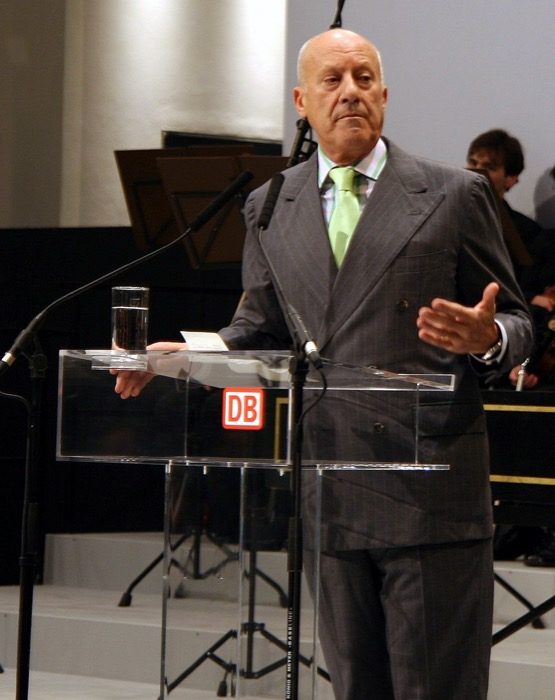
Photo: bigbug21, CC BY-SA 2.5, via Wikimedia Commons
Movements
Signature works
- Willis Faber & Dumas HQ, Ipswich (1975)
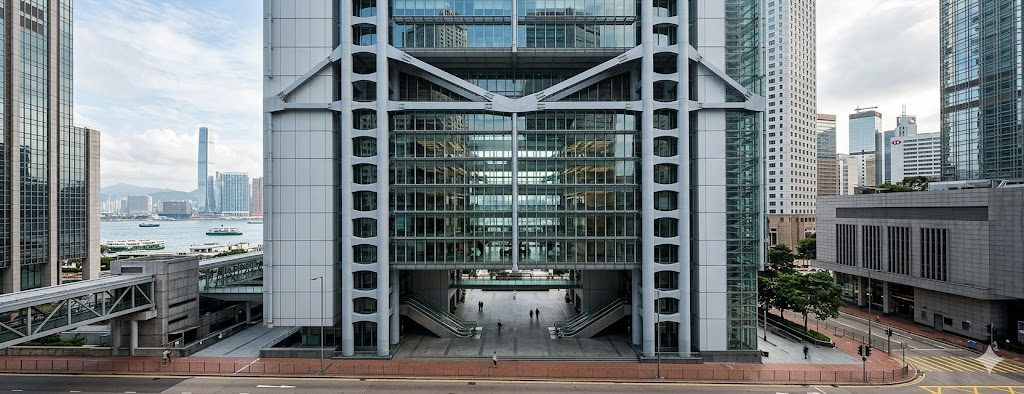
- HSBC Headquarters, Hong Kong (1985)
- Stansted Airport (1991)
- Commerzbank Tower, Frankfurt (1997)
- Reichstag Dome, Berlin (1999)
Walk into the banking hall of the Hongkong and Shanghai Bank in Hong Kong and look up. There is no ceiling in the ordinary sense, no thicket of columns marching across the floor. Instead the building seems to be hung from the sky: great steel masts climb the outer edges, paired trusses bridge between them, and from those trusses the floors are suspended on hangers like trays on a rack. High above, a bank of computer-driven mirrors — a "sunscoop" — catches the Hong Kong sun and throws it down through a ten-storey glass atrium onto the public plaza beneath. The building stands on its own legs and gives the ground back to the city. Nothing is hidden. The engineering is the architecture.
That building was the work of Norman Foster, born in Manchester in 1935, and one of the defining architects of the late twentieth and early twenty-first centuries — the man who, more than any other, turned the language of structure and machinery into a serene, luminous, deeply considered art.
Foster's central contribution is high-tech architecture at its most disciplined: the conviction that a building's structure and services should be expressed honestly, built light and precise like a fine machine, flooded with daylight, and tuned to work with its climate rather than against it. He took the bones and the plumbing of a building — the things others bury behind plaster — and made them the visible, beautiful, performing heart of the design. (For a close reading of his building skins — the structural diagrid, the breathing double-skin and the engineered glass envelope — see our Norman Foster facade signature guide.)
The idea: the building as a precise, honest, performing machine
Most buildings are a kind of polite fiction. The structure that holds them up is hidden inside walls; the ducts, pipes, lifts and wiring that keep them alive are tucked away above ceilings and behind risers; and the finished surface pretends none of this exists. High-tech architecture rejected that fiction. It argued that the engineering of a modern building is not something to be ashamed of but the most truthful and expressive thing about it — and that, shown clearly and made beautifully, it could move us as much as any column or cornice ever had.
Foster is the most refined practitioner of this idea. Where some of his contemporaries reveled in the raw machinery, Foster pursued a kind of weightless precision. His buildings are assembled from components made to fine tolerances in factories and bolted together on site, so the result has the crispness of an aircraft or a yacht rather than the roughness of a building site. Glass and steel, lightness and transparency, the long clear span and the deep flood of daylight — these are his materials.
But the deeper point, and the one that has only grown more important, is performance. From early in his career Foster treated a building as an environmental instrument: something to be oriented, shaded, naturally ventilated and daylit so that it consumes less energy and serves the people inside better. The high-tech surface is not decoration. It is the visible expression of a building that has been thought through, from its structure to its airflow, as a single integrated system.
As an architect you design for the present, with an awareness of the past, for a future which is essentially unknown.
That long horizon — designing for a future we cannot fully see — runs through everything he has built. It is why his best buildings feel less like fixed monuments than like flexible, adaptable frameworks made to outlast their first purpose.
Life and path
Norman Foster was born on 1 June 1935 in Manchester, into a working-class family in an industrial city. There was no money for a smooth, conventional path into the professions; he left school and worked — in a local office, then through national service in the Royal Air Force, where he encountered the precise, performance-driven world of aircraft that would echo through his architecture for the rest of his life. He came to architecture late and on his own initiative, winning a place at the Manchester School of Architecture and putting himself through it.
He was clearly exceptional, and it carried him across the Atlantic. He won a scholarship to the Yale School of Architecture, where he took a master's degree — and where he met a fellow young Englishman, Richard Rogers. The friendship would prove one of the most consequential in modern architecture. At Yale the two absorbed the optimism of post-war American technology and the lessons of the great modernists, and returned to Britain determined to build a new kind of architecture.
In 1963 they founded a small practice, Team 4, together with their wives, Wendy Cheesman and Su Brumwell — both architects in their own right, and Wendy Cheesman in particular a crucial early partner to Foster. Team 4's work, like the Reliance Controls factory, already showed the seeds of what was coming: a clean, light, exposed-steel architecture that treated an industrial shed with the seriousness usually reserved for a civic monument.
Team 4 dissolved after a few years, and in 1967 Foster founded Foster Associates — the practice that, as it grew into Foster + Partners, would become one of the largest and most influential architecture firms in the world, based in London but building across every continent. Across the following decades came the run of buildings that defined high-tech: the dark-glass headquarters in Ipswich, the art gallery in Norwich, the bank in Hong Kong, the airport at Stansted, the ecological tower in Frankfurt, the parliament dome in Berlin, the tower in the City of London that London nicknamed the Gherkin.
The honours followed the buildings. He received the Pritzker Prize in 1999, architecture's highest award, along with RIBA and Stirling honours, and he was made a life peer as Lord Foster of Thames Bank. But the more telling measure of the man is that, well into his ninth decade, he has kept the practice — and his own restless curiosity about structure, energy and the future — fully in motion.
The signature works
A handful of buildings trace the whole arc of Foster's thinking — from the sleek early statements to the great environmental machines.
| Building | Place & date | Why it matters |
|---|---|---|
| Willis Faber & Dumas HQ | Ipswich, England, 1975 | A dark, mirror-glass curtain wall that curves to follow its medieval street, with a grass roof garden on top. A radical, humane office that broke every rule of the corporate box. |
| Sainsbury Centre for Visual Arts | UEA, Norwich, 1978 | A single great shed of a gallery, its structure and services wrapped into the thickness of the walls and roof, leaving a calm, flexible, daylit hall for the art. |
| HSBC Headquarters | Hong Kong, 1985 | The masterpiece of high-tech: floors hung from edge masts and suspension trusses, a column-free interior, a sunscoop dropping daylight into a public atrium. At the time, the most expensive building in the world. |
| Stansted Airport | England, 1991 | The terminal reinvented — services pushed underground, the roof carried on branching structural "trees," and a single daylit concourse where passengers can see from entrance to aircraft. The template for the modern airport. |
| Commerzbank Tower | Frankfurt, 1997 | Described as the world's first ecological tall office building — spiralling sky gardens, a central atrium acting as a natural ventilation chimney, daylight reaching deep into every floor. |
| Reichstag dome | Berlin, 1999 | The new German parliament crowned with a public glass cupola: citizens spiral up a ramp above the debating chamber, a luminous symbol of transparent democracy — and an environmental device that ventilates and lights the hall below. |
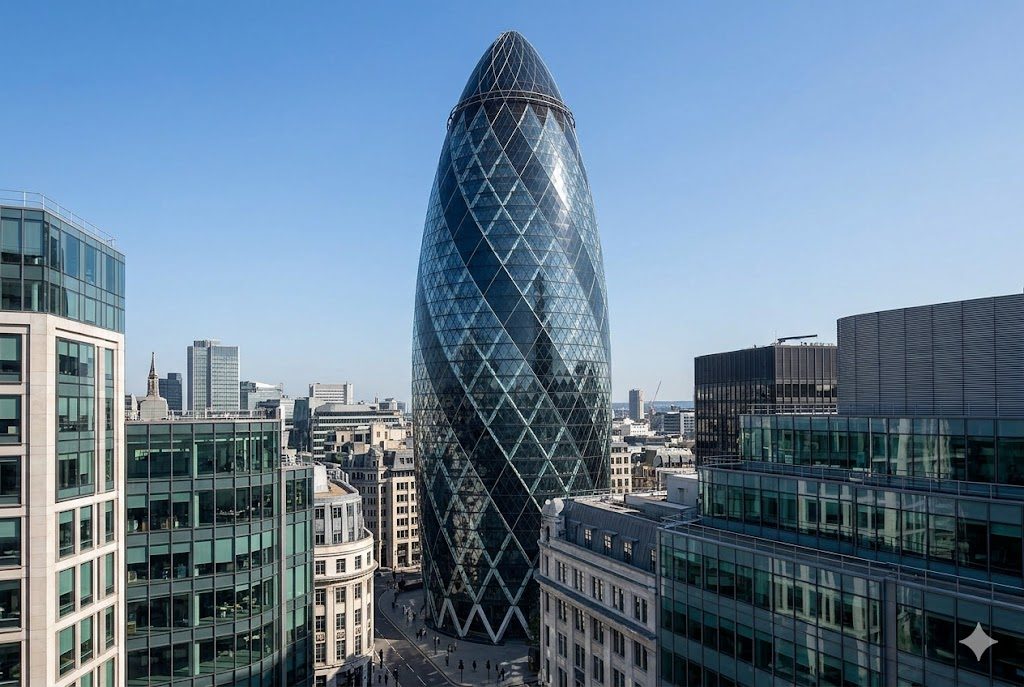
Beyond these stand a series of works that pushed the same ideas to new extremes: the Carre d'Art in Nimes, a glass-and-steel arts centre set in dialogue with a Roman temple; 30 St Mary Axe, the City of London tower universally known as the Gherkin (2004), whose curved aerodynamic form and spiralling light-wells are an environmental strategy made into an icon; the Millau Viaduct in France (2004), designed with the engineer Michel Virlogeux — the tallest bridge in the world, a cable-stayed road deck threading through the clouds; Beijing Capital International Airport Terminal 3 (2008), one of the largest buildings on earth; and Apple Park in Cupertino (2017), the vast glass ring set in a restored landscape.
The thread through all of them is integration. In a Foster building the structure, the skin, the daylighting and the air are not separate problems solved one after another — they are a single idea worked out together. Stansted is the clearest lesson: by deciding that the heavy mechanical plant should go beneath the floor rather than above the ceiling, Foster freed the roof to become a light, daylit canopy on slender "trees," and in one move changed how airports the world over would be built.
The philosophy: high-tech, refined into environmental architecture
Foster, with Richard Rogers, Renzo Piano and the engineer-architects around them, gave shape to high-tech architecture — the movement that took the exposed structure, the prefabricated component, the served-and-servant logic and the flexible open plan, and made them the very language of the building. It grew out of British engineering tradition and American technological optimism, and it answered the question modernism had left open: if ornament is gone, what does a building show? High-tech answered: it shows how it is made and how it works.
What distinguishes Foster within this movement is the steady migration of his work from expression toward performance. The early buildings celebrate technology as image; the mature ones deploy it in the service of light, comfort and energy. The Commerzbank's sky gardens are not a styling flourish — they are lungs that let the tower breathe. The Reichstag dome is not just a beautiful symbol — it draws stale air out of the chamber and bounces daylight in. By the time of the Gherkin, the spiralling form that reads as a logo is in fact a careful piece of environmental engineering, channelling natural ventilation and light through the tower.
To understand the ideas Foster did so much to define — the expressed structure, the served and servant spaces, the building as a tuned environmental instrument — read our guide to what high-tech architecture is. It is the philosophy this profile sits closest to, and Foster is among its greatest exponents.
The HSBC headquarters is the purest demonstration of the whole logic. By hanging the floors from masts at the edges, Foster cleared the centre of columns, pushed the lifts and services to the sides as "servant" zones, and left the working floors as open, flexible "served" space. The schematic below unpacks how the structure does its work — and why the building could lift itself off the ground and hand a covered public plaza back to Hong Kong.

India: high-tech thinking for the Indian commercial city
Foster's most direct mark on India is the work of Foster + Partners on major commercial and mixed-use developments — most prominently the Jio World development at the Bandra Kurla Complex in Mumbai, a large business-district scheme of towers, retail, cultural and convention space at the heart of the city's new financial centre. It is exactly the kind of programme — dense, glassy, climate-stressed, intensely used — where the high-tech toolkit of clear structure, integrated services and daylit public space has the most to offer.
But Foster's deeper influence on India runs through ideas more than through any single building. Two of his innovations in particular have shaped how Indian high-tech commercial architecture thinks.
The first is the airport. Stansted rewrote the rules for terminals worldwide — the single legible daylit concourse, the structure as a clean canopy, the services tucked out of sight — and that template lies behind the wave of large, light-filled airport terminals India has built over the past two decades as it modernised its aviation infrastructure. The ambition of an Indian terminal to feel open, daylit and easy to read owes a great deal to the standard Foster set.
The second is the environmental tower. India's commercial capitals build vertically, in some of the most demanding heat and humidity on earth, and the lesson of buildings like the Commerzbank and the Gherkin — that a tall office can be shaped to admit daylight, encourage natural ventilation and cut its energy load rather than relying brute-force on air-conditioning — speaks directly to the Indian climate. The marriage of glass-tower ambition with genuine environmental performance is one of the central challenges of contemporary Indian commercial architecture, and Foster's work is a primary reference point for it.
That challenge connects naturally to the older, climate-first wisdom of Indian building. The high-tech tower and the courtyard house are answering the same question — how do you keep a building cool, lit and alive in a hot land? — by different means. Our guides to passive design for India's climate zones and what defines contemporary Indian architecture trace how imported high-tech ambition and local climate logic are learning to meet on Indian ground.
Legacy and what we can learn
Foster's influence is vast and still unfolding. He helped invent a movement, then quietly led it from spectacle toward sustainability — and in doing so he changed the everyday experience of modern life. The airport you pass through, the glass office tower you work in, the transparent public dome you climb: these owe their form, in large part, to ideas he refined.
His closest peers carried the same banner in their own directions. Richard Rogers, his old friend and Team 4 partner, made the exposed-structure idea louder and more colourful, turning services into vivid external sculpture. Renzo Piano — Rogers's collaborator on the Pompidou Centre — took high-tech toward a lighter, more crafted, more humane register. Together with Foster they form the great trio that defined the movement, each pulling its shared language in a distinct direction. And a generation of younger practices, in Europe, China, the Gulf and India, now build in the integrated, performance-driven idiom Foster did so much to establish.
The practical lesson for anyone designing today — at any scale — is that how a building works should shape how it looks, not the other way round. Foster never started with a shape and then made it stand up. He started with the problem: how to carry the load, move the air, catch the light, use the least energy, give space back to people — and let the honest answer to those questions become the architecture. A column-free floor, a daylit room, a tower that breathes — these are not styling decisions. They are the visible result of solving real problems well.
That order of priorities — climate and structure first, image second — is as relevant to a single home as to a Hong Kong skyscraper. It is the same logic our tools put in your hands: see where the light and heat fall before you fix the form. Try the sun-path analyzer to understand a site the way Foster understands a building — as something to be tuned to its sky.
His principles — lightness, daylight, honesty and performance — live on in how thoughtful spaces get designed today. Explore them in your own rooms with DesignAI.
References
- Norman Foster & David Jenkins (ed.), Norman Foster: Works (multi-volume), Prestel.
- Deyan Sudjic, Norman Foster: A Life in Architecture, Weidenfeld & Nicolson.
- Chris Abel, Architecture and Identity and writings on Foster's high-tech method.
- The Pritzker Architecture Prize, 1999 Laureate citation, Norman Foster.
- Kenneth Frampton, Modern Architecture: A Critical History, Thames & Hudson.
- William J. R. Curtis, Modern Architecture Since 1900, Phaidon.
- Foster + Partners, project archive and practice monographs.
Trace the movement he helped define in what is high-tech architecture, and explore his fellow high-tech masters Richard Rogers and Renzo Piano.
Philosophies they championed