

Richard Rogers
The architect who turned buildings inside-out — and championed the public city
Photo: Andrew Zuckerman, CC BY 2.0, via Wikimedia Commons
Movements
Signature works
- Centre Pompidou, Paris (with Renzo Piano, 1971–77)
- Lloyd's of London (1986)
- Millennium Dome, London (2000)
- Madrid–Barajas Airport Terminal 4 (2005)
- Senedd, Cardiff (2006)
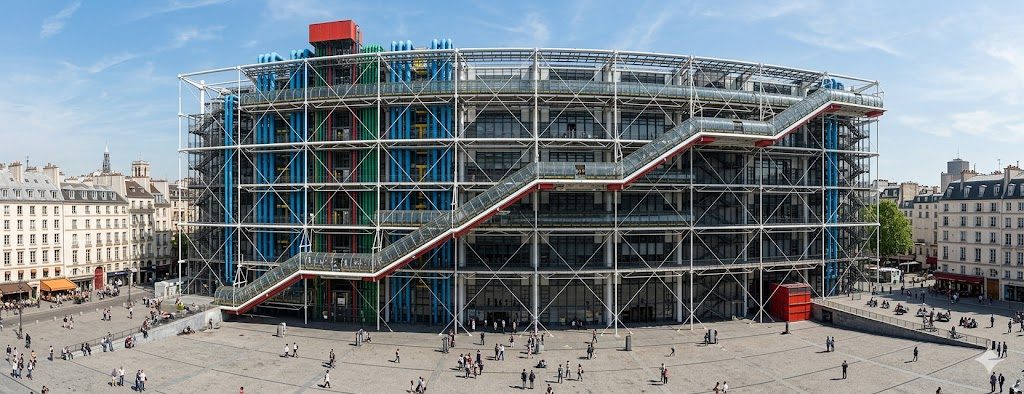
Stand in the great sloping piazza in front of the Centre Pompidou in Paris and look up at a building that seems to have been turned inside out. The structure is on the outside — a clear steel exoskeleton of columns and cross-braces. The services are on the outside too, and colour-coded like a diagram you can read from the street: blue for air, green for water, yellow for electricity, red for movement. A glazed caterpillar of an escalator climbs the front diagonally, carrying people up across the facade with the city spreading out behind them. Everything that a normal building hides — its bones, its ducts, its lifts — has been pulled out, celebrated, and painted bright. Behind that busy, mechanical skin lie vast, utterly empty floors, free of a single internal column, ready to be anything.
That building was the work of two young, almost unknown architects who won an open competition against the world — and one of them was Richard Rogers.
His central conviction was radical and simple: pull the structure and the services to the outside of a building, and you free the inside completely. Make those external systems legible and even beautiful, and the building becomes honest, flexible and alive. This is the heart of High-Tech architecture — and Rogers, more than almost anyone, gave it both its engineering daring and its social purpose.
The idea: the building turned inside-out
There is a long tradition in architecture of "served" and "servant" spaces — the rooms where life happens, and the supporting zones of stairs, ducts, lifts and plant that serve them. Louis Kahn made that distinction monumental, wrapping his servant spaces into thick masonry towers. Rogers took the same idea and pushed it to its logical, exhilarating extreme: if the servant systems are the things that clutter and constrain a floor, then banish them entirely — to the outside.
Once structure and services are externalised, the interior is liberated. A Rogers floor plate is famously open, long-span, column-free, capable of being reconfigured again and again over a building's life. A trading floor today, offices tomorrow, a gallery the year after. The building stops being a fixed object and becomes a flexible frame for whatever its users need — what he liked to call a building that can change as easily as life does.
But Rogers refused to treat this as mere engineering. The externalised systems are not hidden in shame; they are expressed, articulated, and often painted in vivid colour so anyone can read the building like a machine — here the air goes in, there the water rises, this is how you move up. He called this making a building "legible." A Rogers building wears its workings on its sleeve, and in doing so it tells the truth about how it is made and how it runs. Honesty, flexibility, legibility, and a frank delight in the poetry of structure and services — that is the Rogers formula.
Life and path
Richard Rogers was born on 23 July 1933 in Florence, Italy, into an Anglo-Italian family; the household soon moved to England. He was dyslexic at a time when the condition was barely understood, and school was, by his own later account, often a misery — he struggled to read, was assumed to be slow, and carried that sense of being an outsider for years. It is worth dwelling on, because the architect who would later make buildings of dazzling clarity and openness began as a child who felt shut out.
He found his footing at the Architectural Association in London, the freewheeling school that has incubated so many British modernists, and then crossed the Atlantic for a master's degree at Yale. There, in the early 1960s, he met a fellow student who would become his closest collaborator and lifelong sparring partner: Norman Foster. The two returned to England and, in 1963, founded a practice called Team 4 together with Wendy Cheesman and Su Brumwell (whom Rogers married). Team 4 was short-lived but precocious; its sleek, machine-made buildings already hinted at the High-Tech language both men would spend their careers refining.
When Team 4 dissolved, Foster and Rogers went their separate ways — and Rogers soon formed a new and momentous partnership with the Italian architect Renzo Piano. It was as Piano and Rogers that, in 1971, the two won the international competition for a new cultural centre in the heart of Paris. Neither had built anything remotely on that scale. They were in their thirties. What they built changed architecture.
After Pompidou, Rogers built his own practice in London — the Richard Rogers Partnership, later renamed Rogers Stirk Harbour + Partners as a new generation of partners took the lead. Across half a century he was showered with honours: the RIBA Royal Gold Medal in 1985, the Pritzker Prize in 2007, a knighthood, and a life peerage as Baron Rogers of Riverside, which took him into the House of Lords. He died on 18 December 2021, at eighty-eight, having shaped not only a string of landmark buildings but the way Britain thinks about its cities.
The signature works
A handful of buildings carry the whole arc of his thinking — from the joyful machine of Pompidou to the sleek towers of his last years.
| Building | Place & dates | Why it matters |
|---|---|---|
| Centre Pompidou | Paris, won 1971, opened 1977 | The manifesto. With Renzo Piano: a steel exoskeleton, colour-coded external services, the diagonal escalator tube, and column-free floors — all sitting above a public piazza that gives half the site back to the city. |
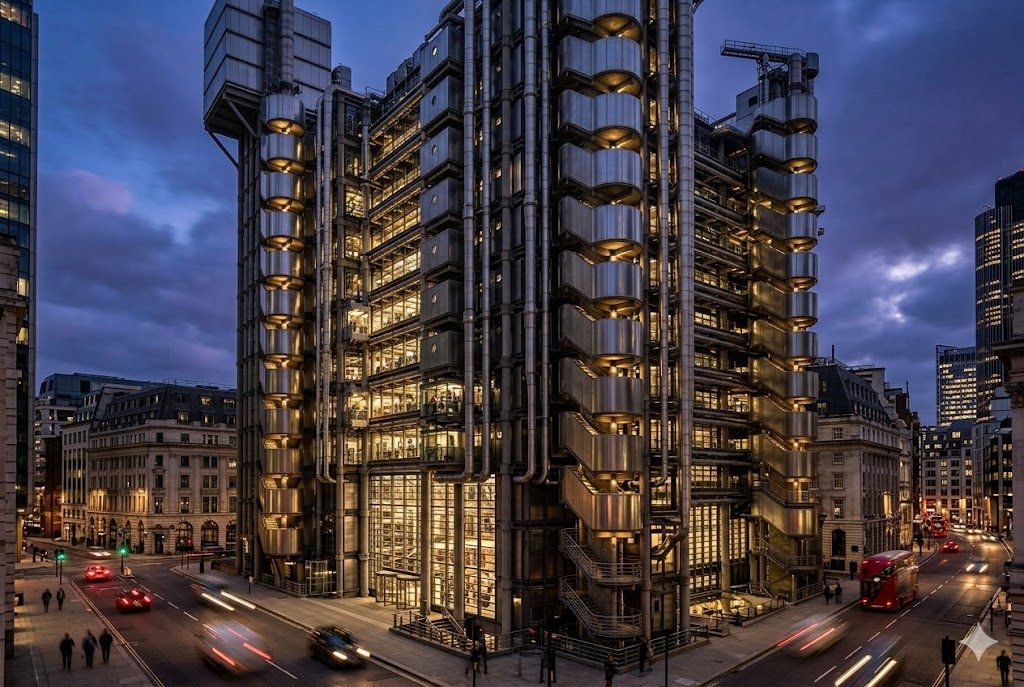
| Lloyd's of London | London, 1986 | The English masterpiece of "inside-out." Lifts, stairs, ducts and toilet pods are clustered into service towers on the outside, leaving a soaring atrium and uninterrupted trading floors within. Sometimes nicknamed "Bowellism." |
| Millennium Dome | London, 2000 | A vast, lightweight tensile canopy slung from a ring of yellow masts — a single dramatic roof, now The O2, covering a flexible interior. |
| Madrid–Barajas Airport, Terminal 4 | Madrid, 2005 | A great undulating roof lined with bamboo, washed in daylight through rooflights and supported on colour-graduated "trees" — proof that High-Tech could be warm, calm and humane. Won the Stirling Prize. |
| Senedd (National Assembly for Wales) | Cardiff, 2006 | A democratic building under a sweeping timber roof and a glass skin, putting the public above and the politicians visibly below — transparency made literal. |
| Leadenhall Building ("the Cheesegrater") | London, 2014 | A wedge-shaped tower that slopes back to protect a protected view of St Paul's, with its bracing and services expressed on the outside — High-Tech grown into the City skyline. |
Two more belong on any list: the Bordeaux Law Courts in France, where the courtrooms become a row of timber-clad pods raised on legs beneath a great copper roof; and 3 World Trade Center in New York, his practice's contribution to the rebuilt downtown skyline. The thread through all of them is unmistakable — structure and services pulled outward, the interior set free, and the whole thing made legible and often joyful.

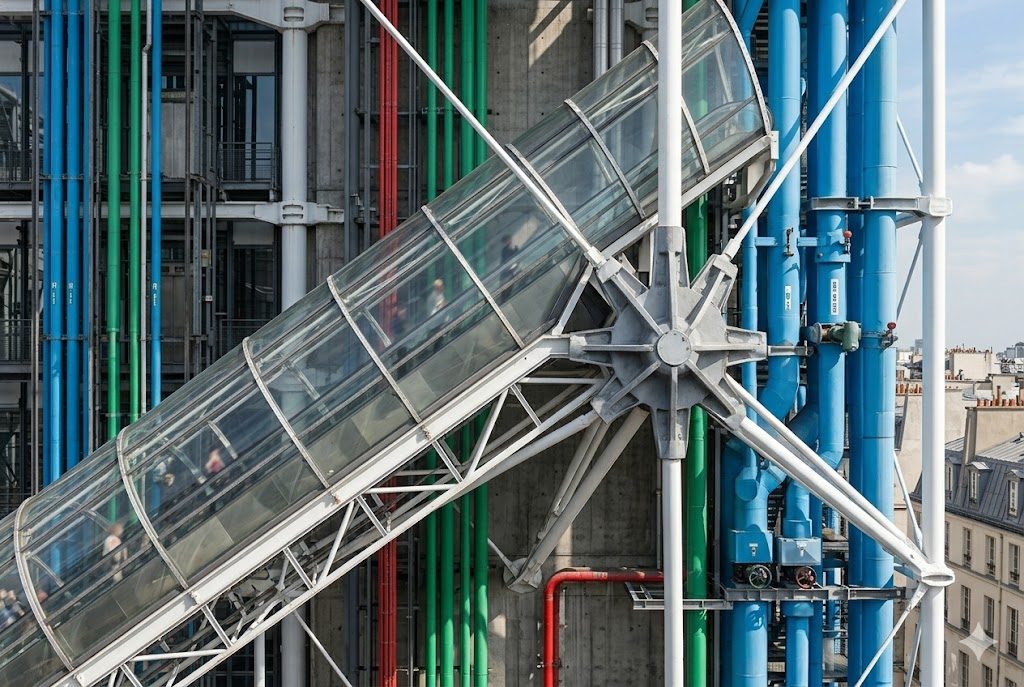
The Pompidou itself repays a closer look, because every later Rogers building grows from it. Its steel skeleton is held off the glass by a clever cast-steel cantilever — the "gerberette" — that lets the floors span the full width with no internal support. The escalators and circulation hang on the west front, facing the piazza, so that moving through the building becomes a public spectacle. The east front carries the ducts and pipes, frankly displayed and colour-coded. And nearly half the site was deliberately left empty as a sloping public square, because Rogers and Piano believed a cultural building owed the city a place to gather as much as it owed it a gallery.
The philosophy: High-Tech, and a building that serves the city
Rogers is one of the two or three architects most responsible for the movement we call High-Tech — the strand of late-twentieth-century architecture that took the components of industry and engineering (steel, glass, tension cables, prefabricated parts, exposed services) and made them the very language of the building. Where modernism had often hidden its technology behind smooth skins, High-Tech put it proudly on show. To understand the full lineage — from the Crystal Palace through the oil-rig aesthetic to the glass towers of today — read our guide to what High-Tech architecture is, the movement Rogers championed.
But it would be a mistake to read Rogers as merely a connoisseur of beautiful machines. For him, the point of all that flexibility and lightness was social. A flexible building lasts longer and wastes less, because it can adapt instead of being torn down. A legible building treats its users as adults who deserve to understand the world they inhabit. And a building that gives ground back to the city — a piazza, a public route, an open lobby — is keeping faith with the people who paid for it. His was a fundamentally generous and democratic idea of architecture.
The only thing that is permanent is change. A building should be able to grow and adapt — and it should give something back to the street.
That generosity scaled up into a passion for cities. Rogers became one of the most influential urbanists of his generation. He wrote the widely read "Cities for a Small Planet," delivered the BBC Reith Lectures on the future of the city, and chaired the British government's Urban Task Force, whose report shaped a generation of UK regeneration policy. His message was consistent: the future belongs to the compact, dense, walkable, mixed-use, public-transport city — a city of lively streets and public squares — not to the sprawling, car-dependent suburb. He argued for building on brownfield land, reviving abandoned riverfronts, putting people back into city centres, and treating the public realm as the most important room of all.
India: the urbanist's lesson for a fast-urbanising nation
Richard Rogers did not build a landmark in India, and the honest thing is to say so plainly rather than invent one. His importance to India lies elsewhere — in his ideas, which speak directly to the central drama of the Indian present: the explosive, often chaotic urbanisation of a country adding tens of millions of city-dwellers a decade.
Rogers spent his life arguing against exactly the kind of city that unplanned growth tends to produce — the low-density sprawl that eats farmland, the car-first road network that strands the poor, the privatised enclave that turns its back on the street. His prescription reads almost like a checklist for India's urban planners: build compact and dense rather than sprawling; mix homes, work and shops so people can walk; pour investment into public transport and the public realm; reclaim degraded land and waterfronts; and above all, protect and create great public space, because in a hot, crowded country the shared street and square are where civic life actually happens. The arguments of "Cities for a Small Planet" map onto Indian metros — Mumbai's density, Delhi's sprawl, Bengaluru's traffic — with uncomfortable precision.
There is a deeper resonance too. The traditional Indian city was already compact, mixed-use and walkable — the dense bazaar street, the shaded gully, the temple tank as public space. Rogers' modern, technocratic argument arrives, by a different route, at conclusions the old Indian town knew instinctively. Indian architects working on climate-responsive, dense urban housing are, in effect, pursuing a Rogers-shaped goal with Indian means. His thinking dovetails with the search for a genuinely Indian urban modernity that our guide on what defines contemporary Indian architecture explores, and with the sustainability imperative at the centre of sustainable home design for India.
His High-Tech buildings carry a quieter Indian lesson as well. Terminal 4 at Madrid is, at its core, a daylight-and-shade machine — a deep roof that floods a vast hall with soft, filtered light while keeping the sun's heat at bay. That is precisely the problem every large Indian public building must solve, and Rogers' answer — express the structure, harvest the daylight, move the air — is one that designers of airports, stations and institutions across India have learned from, whether or not his name is attached.
Legacy and what we can learn
Rogers' influence runs in two directions. As one half of the partnership that built the Pompidou, and through his long rivalry-and-friendship with Norman Foster, he helped make High-Tech the defining British contribution to late-modern architecture — a language now spoken in glass-and-steel towers, airports and stations the world over. The young architects who passed through his practice carried the inside-out logic into the next generation; his sometime partner Renzo Piano went on to a Pritzker of his own and a body of work that softened and matured the High-Tech idea.
But the more durable legacy may be the urban one. Long before "fifteen-minute cities" and walkability became planning slogans, Rogers was making the case — in lectures, in books, in his chairmanship of the Urban Task Force — that the way to a humane future was the compact, public, mixed city. Every regenerated waterfront, every car-tamed high street, every argument for density over sprawl owes something to his advocacy.
For anyone designing in India today, two lessons stand out. The first is about buildings: design for change. A building that can be reconfigured, re-serviced and reused will outlive one built rigidly for a single purpose — and in a fast-changing economy that adaptability is not a luxury but a kind of sustainability. Pull the fixed services to the edges, keep the usable space open and flexible, and let the building grow with its occupants.
The second lesson is about cities, and it is the one India most needs to hear. The quality of a place is set not by its towers but by the public space between them — the street, the square, the shaded walk, the riverfront. Rogers spent a career insisting that this shared realm is the real measure of a civilisation. In a country building the equivalent of new cities every decade, that conviction is less a piece of imported theory than an urgent practical instruction.
His belief that great architecture should be flexible, honest and generous to the city still shapes how thoughtful spaces get planned — explore openness, light and adaptable layouts in your own rooms with DesignAI.
References
- Richard Rogers, Cities for a Small Planet, Faber & Faber, 1997.
- Richard Rogers (with Richard Brown), A Place for All People: Life, Architecture and the Fair Society, Canongate, 2017.
- The Pritzker Architecture Prize, 2007 Laureate citation and jury statement, Richard Rogers.
- Urban Task Force (chaired by Richard Rogers), Towards an Urban Renaissance, 1999.
- Kenneth Powell, Richard Rogers: Complete Works (three volumes), Phaidon.
- William J. R. Curtis, Modern Architecture Since 1900, Phaidon.
- Centre Pompidou and Lloyd's of London project archives, Rogers Stirk Harbour + Partners.
Explore the movement he gave both its daring and its conscience in what is High-Tech architecture, and trace the story alongside his collaborators Norman Foster and Renzo Piano, and his fellow master of served-and-servant space Louis Kahn.
Philosophies they championed