
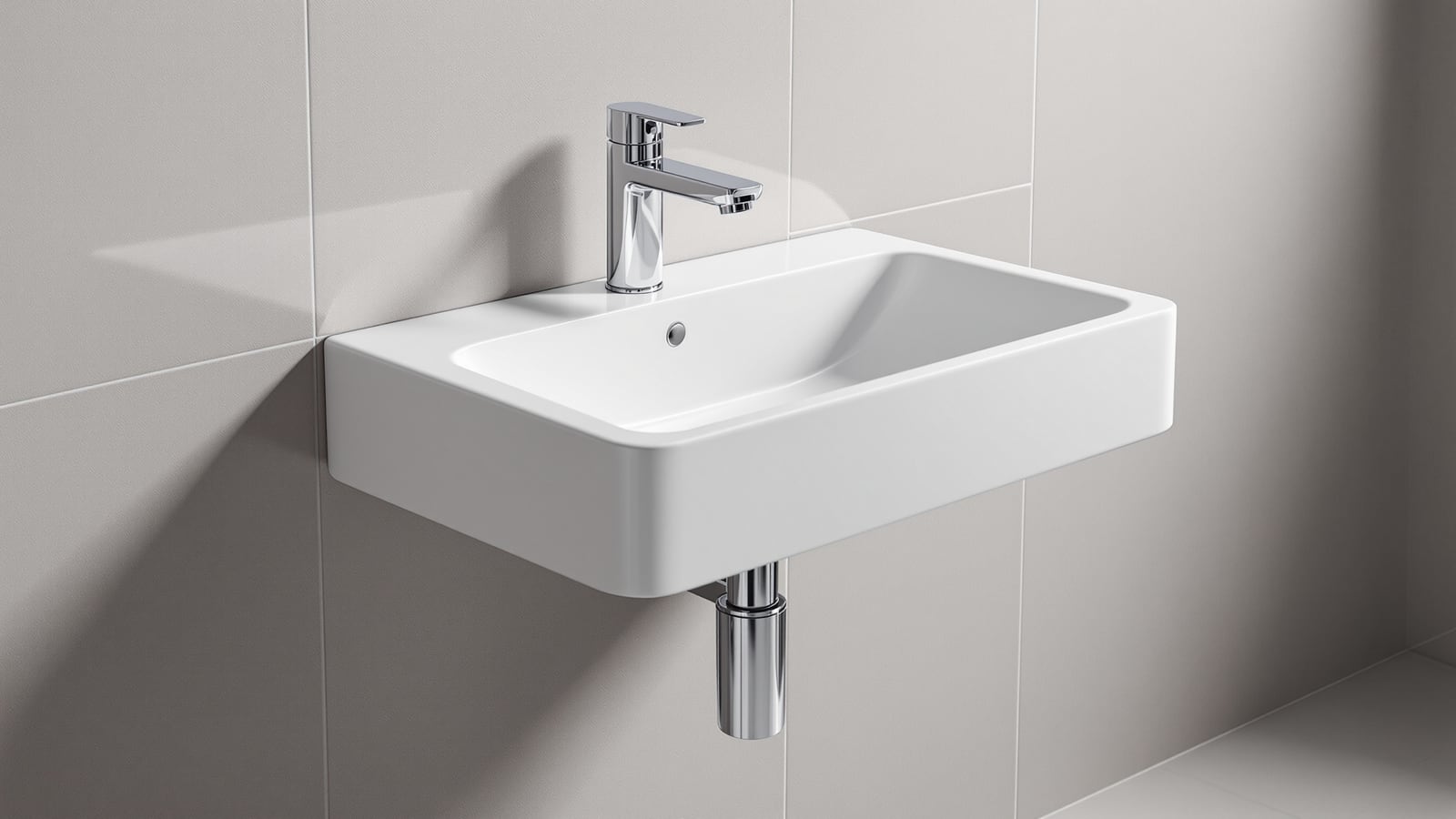
Wall Hung Wash Basin India: Fixing, Bracket Frames, Height & Cost (2026)
The floating basin that makes a small Indian bathroom feel bigger — how the concealed bracket or frame anchors into masonry, concealed vs exposed bottle trap, half-pedestal cover options, the right rim height, and honest pros, cons and rupee ranges.
A wall hung wash basin does one thing that no pedestal or countertop can: it lifts the whole fixture off the floor, so you see tiles running clean underneath. In a compact Indian bathroom that single move buys visual space, makes the floor faster to mop, and gives the room the pared-back, hotel-like look that defines a modern bath. But a basin bolted to nothing but a wall is only as safe as its fixing — and this is exactly where cheap installs fail. This guide is India-first and fixing-first: how the bracket or frame actually anchors into your masonry, where the plumbing hides, the right height off the finished floor, and the honest trade-offs against a pedestal.
Read it alongside the main bathroom wash basin guide for India, which sets out every basin type; then weigh a wall-hung against a pedestal wash basin if you want the plumbing fully covered, or a countertop basin if you want storage below. For the room around it, the small bathroom layout guide and the apartment bathroom design guide show where a floating basin earns its keep.
A wall hung basin is a structural fixing first and a fixture second. Get the anchorage into solid masonry right and it lasts decades; skip it and the basin cracks the wall — or your knuckles — the first time someone leans on the rim.
What "wall hung" actually means
A wall hung (or wall mounted) basin has no leg touching the floor. Its entire weight — the ceramic, plus water, plus a person leaning on it — transfers into the wall through two hidden fixings. There are two systems, and knowing which one your wall can take is the first decision.
- Concealed bracket / bolt fixing. A pair of heavy galvanised or stainless bolts (studs) are anchored into the masonry; the basin hangs on them and the nuts pull up tight behind the ceramic, hidden by the bowl. This is the common, economical route and works only in solid masonry — brick, solid block or RCC — where the bolts get real grip.
- Concealed frame / carrier (installation system). A steel frame stands inside the wall cavity or in front of the blockwork, carries the load down to the floor slab, and presents threaded studs at the face. This is essential for hollow, drywall or lightweight partition walls and is the same family of carrier used behind wall-hung WCs. It costs more but takes the guesswork out of anchorage.
The trap — the U or bottle that seals sewer gas out — then either shows as a slim chrome tube (exposed) or vanishes behind a half-pedestal or into the wall (concealed). More on that below.
Fixing into masonry: weight, anchorage and the wall it needs
This is the section installers rush and homeowners regret. A ceramic wall hung basin weighs roughly 12–20 kg dry; add water and a person resting both forearms on the front rim and the fixing must safely hold a downward and outward pull of well over 100 kg. The bracket bolts sit only 150–200 mm apart, so they work as a lever — the lower edge of the basin tries to pull the bolts straight out of the wall.
- Solid wall, please. Bolt-fixed basins belong on 115 mm (half-brick) minimum, ideally 230 mm full-brick, solid block or RCC. On a hollow block or a light AAC-block partition the bolt spins in the void and the fixing is worthless.
- Chemical anchors beat plastic plugs. For a bolt fixing, drill oversize, blow the hole clean, and set the studs in a chemical/resin anchor (epoxy or polyester injection). Ordinary nylon wall plugs are the single most common cause of a sagging or fallen basin.
- Frame it when in doubt. On drywall, brick-veneer partitions or any wall you cannot trust, fit a concealed carrier frame bolted to the floor slab. The wall then only carries the finish, not the load.
- Backing and blocking. In a stud/drywall wall without a frame, a marine-ply or steel backer plate spanning two studs is the minimum — never hang a basin on plasterboard alone.
- Seal the wall. The fixing points pierce your waterproofing; re-seal each penetration. The bathroom waterproofing guide explains why a bolt hole through a tanked wall is a leak waiting to happen.
Hiding the plumbing: bottle trap, half-pedestal or concealed
Lift a basin off the floor and you expose the drain and supply pipes. How you handle that is largely an aesthetic and budget call.
- Exposed bottle trap. A neat chrome or matt-black bottle trap on show, angled supply pipes with clean escutcheon plates. This is the deliberately modern look — but it demands tidy, plumb pipework, because everything is visible. Choose a metal (not white plastic) trap for a wall hung basin on display.
- Half-pedestal (semi-pedestal). A short ceramic shroud clips to the wall under the basin and hides the trap and pipe stubs without touching the floor — so you keep the floating look and clean-under-mopping while covering the messy bits. The most popular Indian compromise.
- Concealed / in-wall trap. The trap sits inside the wall behind the basin, with only the waste showing. Cleanest of all, but it must be planned before tiling and works best with a carrier frame.
| Trap / cover option | Look | Plumbing hidden | When to choose |
|---|---|---|---|
| Exposed bottle trap | Sharp, modern, minimal | No — on show | New pipework, plumb walls, design-led bath |
| Half-pedestal cover | Clean, floating | Mostly | Retrofit over untidy stubs, family bath |
| Concealed in-wall trap | Seamless | Yes | Planned new build, carrier frame fitted |
Whichever you pick, use a P-trap or bottle trap with a proper water seal so drain smells stay out, and keep the health-faucet spray in mind — India's wet-use bathrooms mean the wall and pipe covers get splashed constantly, so metal and ceramic beat cheap plastic here.
The right height — and why it matters more than usual
Because there is no floor leg to reference, you set the height, and you set it in the wall before tiling — get it wrong and the fix is ugly. The standard finished rim height is 800–850 mm above finished floor level (FFL) for adults; the bracket studs sit a little below the rim, so mark them off the FFL, not the rough slab.
- General adult use: 800–850 mm to the rim is comfortable for most Indian users.
- Children's or family bathroom: drop to 650–750 mm, or fit a wall-hung basin low and add a step stool; see the children's bathroom design guide.
- Accessible / wheelchair use: a wall hung basin is the natural choice because knees slide under it. Set the rim near 750–800 mm with clear knee space and no pedestal — detailed in the accessible bathroom design guide.
- Coordinate the mirror and tap: decide basin height first, then mirror and wall-mounted tap heights follow.
Pros, cons and where it wins
| Factor | Wall hung basin | Full pedestal basin |
|---|---|---|
| Look | Floating, modern, minimal | Traditional, grounded |
| Floor space | Frees floor, feels bigger | Occupies floor footprint |
| Cleaning under it | Easy — mop straight through | Awkward around the leg |
| Plumbing cover | Half-pedestal or exposed trap | Fully hidden in the leg |
| Height flexibility | You choose it | Fixed by the pedestal |
| Wall requirement | Solid masonry or a frame | Any wall — load goes to floor |
| Install skill | High — fixing is critical | Forgiving |
| Cost (fixture + install) | Higher | Lower |
| Accessible / knee space | Excellent | Poor |
Best for: small and modern bathrooms, powder rooms, en-suites and accessible baths — anywhere the floating look and clear floor pay off. See the powder room design guide and ensuite bathroom guide for tight spaces where it shines.
Think twice if: your wall is hollow block or drywall and a carrier frame is not in the budget; you have young children who hang off fixtures; or you specifically want the pipework fully covered without a frame — in which case a pedestal or a countertop basin over a vanity is calmer.
Cost in India (2026)
| Item | Typical India range (2026) | Note |
|---|---|---|
| Ceramic wall hung basin (bowl only) | ₹1,800–₹6,000 | Standard sizes, brand-neutral |
| Designer / large wall hung basin | ₹6,000–₹20,000+ | Slim-rim, matt, oversized |
| Half-pedestal (semi-pedestal) cover | ₹800–₹3,000 | Ceramic shroud for the trap |
| Concealed carrier frame | ₹4,000–₹12,000 | For hollow / drywall walls |
| Metal bottle trap + angle valves | ₹700–₹2,500 | Chrome or matt-black for exposed use |
| Chemical/resin anchor + heavy studs | ₹300–₹900 | Do not substitute plastic plugs |
| Fixing labour (mark, drill, anchor, seal) | ₹800–₹2,000 | The step that makes or breaks it |
Buying and installation checklist
- Confirm the wall is solid masonry, or budget a carrier frame — decide before tiling.
- Insist on chemical/resin anchors and heavy studs, never nylon plugs.
- Fix the rim at 800–850 mm off FFL (lower for children / accessible use).
- Choose a metal bottle trap for exposed use, or a half-pedestal to hide stubs.
- Re-seal every fixing penetration through the waterproofing.
- Match to a wall-mounted or short-spout tap and coordinate mirror height.
- Ask the plumber to load-test the fixing before you tile over anything.
References
- IS 2556 — Vitreous sanitary appliances (vitreous china): specification for wash basins, dimensions and quality.
- National Building Code of India (NBC 2016) — Part 9 (Plumbing services) and accessibility provisions for basin mounting height and clear space.
- IS 1172 — Basic requirements for water supply, drainage and sanitation, relevant to trap and waste connections.
- CPHEEO Manual on Water Supply and Sanitation — Ministry guidance on sanitary fixtures and traps.
- Manufacturer fixing instructions (Jaquar, Hindware, Cera, Kohler as examples) — always follow the stud spacing, anchor type and load rating specified for the specific basin.
Export this guide
Related Guides — Deep-dive reading
How to Choose a Wash Basin in India: Mount Type, Size, Tap Holes & Budget (2026 Buyer's Guide)
A buyer's decision guide to picking the right wash basin — matching the mount type to your vanity and space, sizing it to the room, getting the tap-hole config right for your faucet, judging material and durability, checking what's in the box, good/better/best rupee tiers, the IS 2556 vitreous-china mark, and how to spot seconds, hairline cracks and warranty traps.
BathroomsBathroom Wash Basin India: Types, Sizes, Height, Materials & Cost (2026)
The complete India-first guide to choosing a bathroom wash basin — wall-hung, countertop, under-counter, pedestal and semi-recessed mounting; ceramic, stone, solid-surface and glass materials under IS 2556; ergonomic heights, tap-hole options, waste and bottle-trap fittings, rupee costs and how to match a basin to your bathroom.
BathroomsFreestanding Bathtub India: Materials, Floor Load, Concealed Plumbing & Cost (2026)
The statement centrepiece tub that stands free of every wall — how acrylic, stone-resin and cast-iron differ, the floor load a filled tub imposes, the concealed rough-in you must set out before the flooring goes down, the clear space it needs all around, drainage, and honest 2026 rupee costs.
BathroomsRelated Tools — Try Free
Plumbing Pressure-Test & Leak Checklist
Pre-closure pressure and leak test — 9 categories, 60+ checkpoints across water supply, drainage, fixtures, waterproofing, hot water, tanks.
Pre-Closure TestMonsoon-Readiness Checklist
Pre-rain home audit across 9 categories — terrace, drains, waterproofing, electrical, HVAC, pest, vehicles, documents.
Seasonal AuditApartment Video Door System Planner
Enter flats, entrances, floors and guard desk for a first-pass building intercom plan — door stations, indoor monitors, guard station, the right architecture and an indicative cost band.
Building Planner