
Countertop Wash Basin India: Vessel & Table-Top Basins, Tap Height & Cost (2026)
How a countertop (vessel / table-top) basin actually sits on a vanity, why it raises your working height by 120–150 mm and forces a tall or wall-spout tap, the shapes and materials that survive Indian hard water, splashing and rim-cleaning realities, an honest pros-and-cons, and 2026 rupee costs.
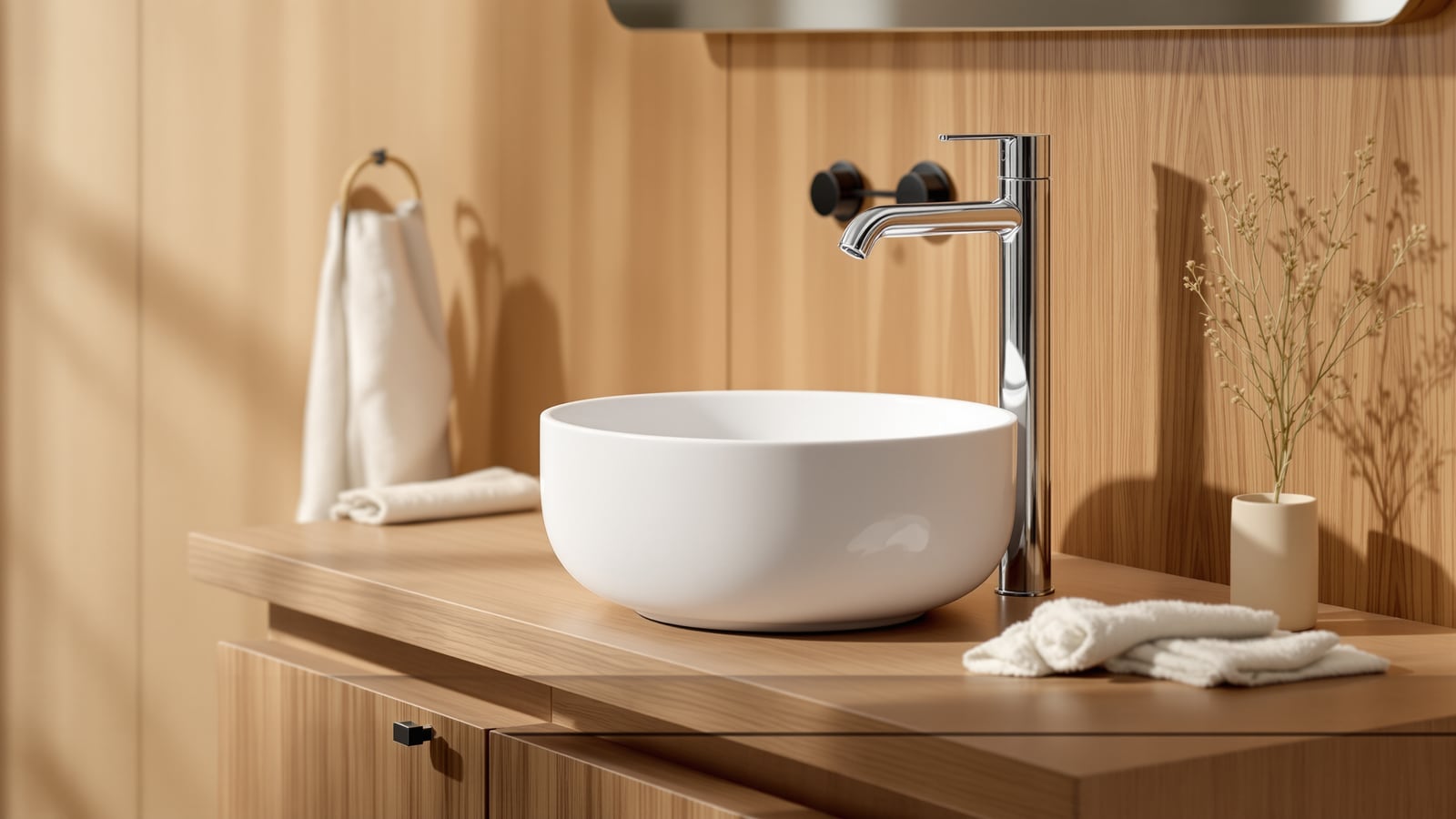
A countertop basin — the showroom calls it a table-top basin, an above-counter basin, a vessel basin or, when it is sculptural, an art basin — is the bowl that sits fully on top of the vanity counter rather than being sunk into it. It is the single most photographed basin type in Indian bathroom design, and for good reason: it turns a plain slab of granite or quartz into a display plinth and lets a designer place a piece of ceramic, stone or glass as an object. But it is also the basin type most often bought on looks and regretted on ergonomics, because the one thing every glossy image hides is that the bowl adds its own height on top of the counter.
This guide is India-first. It assumes hard water that films every glossy rim, a health-faucet WC that keeps splashes flying, and a mason who will set the counter height off a habit rather than off your basin. It sits under the bathroom wash basin guide for India, which frames the whole basin decision; here we go deep on just the countertop option. For the flush-mounted alternative read under-counter basins for India, and for the tap that a raised bowl usually demands see wall-mounted faucets for India.
A countertop basin is not a basin choice — it is a height choice. Fix the finished rim height first, then work the counter height backwards from it. Everything else is styling.
What a countertop basin is — and the height it adds
An under-counter or drop-in basin hides most of its depth inside the vanity, so the counter you designed is the height you use. A countertop basin does the opposite: the whole bowl stands proud of the counter, so its full external height stacks on top of the slab.
- A typical table-top ceramic bowl is 120–150 mm tall externally (art basins and tall cylinders run to 180 mm).
- The comfortable finished rim height for washing hands and face is 800–850 mm from floor — the same target you would set for any basin.
- Therefore the counter (slab top) must sit lower: around 680–730 mm from floor, so that counter + bowl lands the rim in the comfort band.
Get this wrong and you build the classic Indian mistake: a standard 800–820 mm counter with a 140 mm bowl on top, putting the rim at 940–960 mm — shoulder-high for a short adult and unusable for a child. The correction is not a smaller bowl; it is a lower counter, decided before the vanity is fabricated.
Shapes — round, rectangular and art basins
The bowl standing on show is the whole point, so the shape carries the design.
- Round bowls. The default table-top. Soft, forgiving, easy to clean around, and they need the least counter depth. A 400–420 mm diameter suits most vanities.
- Rectangular / oval bowls. More surface for a wider vanity, a crisper modern look, and a flatter internal base that stacks less water. Corners collect grime, so the internal radius matters.
- Art basins. Sculptural pieces — hammered metal, faceted stone, hand-glazed ceramic, coloured or thin-walled forms. Stunning as a powder-room centrepiece (see powder room design); often shallow, so they splash more, and the specials cost far more to replace.
- Thin-rim vs thick-rim. A thin (5–8 mm) rim reads contemporary but chips; a thicker rolled rim is far more forgiving of a dropped tumbler and everyday knocks.
Whatever the shape, confirm the outlet is a standard 32 mm / 40 mm waste and that the bowl comes without a tap hole (most table-tops do), because a countertop basin is almost always paired with a tall deck tap set behind it or a wall spout — not a tap mounted in the bowl.
Materials that survive Indian bathrooms
| Material | Look & feel | Hard-water behaviour | Care | Relative cost |
|---|---|---|---|---|
| Glazed ceramic / vitreous china (IS 2556) | Classic, widest choice | Films but wipes clean; glaze resists stain | Easy — mild cleaner, no acid | ₹ (lowest) |
| Natural stone (marble, granite, sandstone) | Premium, solid, tactile | Etches with acid; hard water leaves a ring | Seal periodically; pH-neutral cleaner only | ₹₹₹ |
| Engineered / terrazzo / quartz-composite | Speckled, contemporary, consistent | More stain-resistant than natural stone | Low; avoid abrasives | ₹₹ |
| Tempered / fused glass | Light, transparent, jewel-like | Shows every water spot and toothpaste splash | Daily squeegee/wipe or it looks dirty | ₹₹ |
| Stainless steel / brass / copper (art) | Industrial or artisan | Water-spots; copper patinas | Frequent polishing | ₹₹–₹₹₹ |
For most Indian homes, glazed ceramic to IS 2556 (sanitary appliances of vitreous china) is the honest default — it is the cheapest to buy and replace, the most stain-tolerant against hard water, and available in every shape. Reserve stone, terrazzo and glass for a powder room or a low-use guest basin where the wow factor earns its extra care, because in a hard-water city a glass or polished-stone bowl needs wiping after almost every use to stay looking new.
The tap problem — why you need a tall or wall-spout mixer
Because the bowl sits high, an ordinary basin pillar tap or short deck mixer will not clear the rim, and even if it does, the spout will be too low to get your hands under. A countertop basin forces one of two tap choices:
- A tall single-lever basin mixer (often sold as a "table-top" or "tall" mixer) with a spout height of 250–320 mm, mounted on the counter behind the bowl. Check the spout clears the rim by 60–100 mm and that its reach delivers water into the centre of the bowl, not onto the rim.
- A wall-mounted spout / concealed mixer, set in the wall above the bowl. This keeps the counter clear, is the easiest surface to keep clean, and looks the crispest — but the plumbing must be roughed into the wall before tiling, so it is a decision for the bathroom planning stage. Full detail in wall-mounted faucets for India.
Getting the tap wrong is the second-most-common countertop regret after height. Match the spout height and reach to the specific bowl — a tall bowl needs a taller tap, and a wide bowl needs more reach.
Splashing and cleaning the rim
The two everyday complaints about countertop basins both come from the same fact: the bowl is shallow and raised.
- Splashing. A tall tap dropping water into a shallow art bowl splashes more than a deep drop-in basin. Fix it by choosing a deeper bowl (110 mm+ internal), an aerated tap that softens the stream, and by aiming the spout at the bowl centre. Keep the tap's flow modest.
- The counter–bowl joint. Where the bowl meets the slab is a silicone-sealed seam that collects water, soap and grime and can grow black mould if neglected. Run a neat bead of anti-fungal sanitary silicone and wipe the joint dry — this is the single spot that ages a countertop installation.
- Around the rim. A raised bowl leaves a ring of counter around it that catches splashes and toothpaste; a thin rim is fussier to wipe than a rolled one. Glass and polished stone need a daily wipe in hard-water cities to avoid a permanent cloudy ring.
- Behind the bowl. Leave enough clear counter behind for the tap and for a hand to reach — cramming a big bowl onto a narrow counter makes the back corners impossible to clean.
Pros and cons — the honest trade-off
| Countertop / vessel basin | Under-counter basin | |
|---|---|---|
| Look | Statement piece, on display | Clean, minimal, hidden |
| Counter height | Must drop counter ~100–150 mm | Standard 800–850 mm |
| Tap | Needs tall or wall spout | Standard deck tap |
| Splashing | More (shallow, raised) | Less (deep, recessed) |
| Cleaning | Rim + silicone seam on show | One easy wipe over the edge |
| Counter usable area | Bowl eats the surface | Full counter usable |
| Replacement | Easy — just lift and swap | Must lift/refix under slab |
| Best for | Powder rooms, feature vanities | Family & high-use bathrooms |
The takeaway is not that one is better — it is where each belongs. A countertop basin is the right call for a powder room, a guest bathroom or a low-use feature vanity where the object earns its keep. For a busy family bathroom where splashing and cleaning dominate, an under-counter basin is usually the calmer choice. Whichever you pick, coordinate it with the bathroom vanity design and the overall scheme in the bathroom design guide for India.
What it costs in India (2026)
Ball-park 2026 retail rates for the basin alone, before tap, waste, counter and plumbing labour. Brand, material and finish move these a lot.
| Item | Typical rate |
|---|---|
| Basic glazed-ceramic round/rectangular table-top basin | ₹1,800–4,500 |
| Premium designer ceramic / matte-finish art basin | ₹5,000–15,000 |
| Natural stone / terrazzo countertop basin | ₹6,000–25,000+ |
| Tempered-glass wash basin | ₹3,500–12,000 |
| Tall single-lever basin mixer | ₹3,500–14,000 |
| Concealed wall mixer + spout | ₹6,000–20,000 |
| Basin waste + bottle trap (health-faucet friendly) | ₹800–3,500 |
Add the counter slab, its cut-out for the waste, and plumbing labour, and a complete countertop basin installation commonly lands in the ₹9,000–40,000 band depending on how much of the budget goes into the bowl and tap. Brands you will see as examples across these ranges — Jaquar, Hindware, Cera, Kohler, Parryware, Roca — are brand-neutral illustrations; buy to the IS 2556 sanitaryware standard and the height maths above, not the showroom lighting.
One rule saves most countertop-basin regrets: decide the finished rim height (800–850 mm) and the tap first, then have the vanity built to suit. Never buy the bowl and hope the standard counter fits it.
References
- IS 2556: Vitreous Sanitary Appliances (Vitreous China) (BIS) — the specification family covering wash basins, dimensions, quality and glaze requirements.
- National Building Code of India (NBC) 2016, Part 9 (Plumbing Services) — water supply, sanitary appliance fixing and drainage practice for wash basins.
- IS 1172: Code of Basic Requirements for Water Supply, Drainage and Sanitation (BIS) — appliance provision and plumbing basics.
- IS 774 / IS 2963 — flushing cisterns and copper-alloy sanitary fittings (waste, trap and fitting references).
- CPHEEO Manual on Water Supply and Sanitation (Ministry of Housing & Urban Affairs) — public-health engineering benchmarks for sanitary fittings.
- CPWD Specifications — government workmanship benchmarks for sanitaryware fixing and vanity work.
Export this guide
Related Guides — Deep-dive reading
How to Choose a Wash Basin in India: Mount Type, Size, Tap Holes & Budget (2026 Buyer's Guide)
A buyer's decision guide to picking the right wash basin — matching the mount type to your vanity and space, sizing it to the room, getting the tap-hole config right for your faucet, judging material and durability, checking what's in the box, good/better/best rupee tiers, the IS 2556 vitreous-china mark, and how to spot seconds, hairline cracks and warranty traps.
BathroomsBathroom Wash Basin India: Types, Sizes, Height, Materials & Cost (2026)
The complete India-first guide to choosing a bathroom wash basin — wall-hung, countertop, under-counter, pedestal and semi-recessed mounting; ceramic, stone, solid-surface and glass materials under IS 2556; ergonomic heights, tap-hole options, waste and bottle-trap fittings, rupee costs and how to match a basin to your bathroom.
BathroomsWall Mounted Basin Tap India: Spout Projection, Concealed Plumbing, Height & Cost
A practical, India-first guide to wall-mounted basin faucets — where the spout emerges from the wall above a countertop or vessel basin, plumbing hidden in the wall. Spout projection and height over the basin, why it must be planned before tiling, pros and cons versus deck-mounted taps, servicing, and rupee costs.
BathroomsRelated Tools — Try Free
Cross-Ventilation Analyzer
Estimate airflow and air changes per hour (ACH) from room size, window areas, layout, and local wind — with NBC 2016 Part 8 compliance check.
Ventilation CalculatorMaterial Compare — Side by Side
Compare materials side-by-side: granite vs quartz vs marble, laminate vs acrylic vs PU, and more.
ComparisonBathroom Vanity Size Calculator
Recommended vanity width, counter depth and height, how many basins fit, and indicative counter cost — fit to your wall run.
Bathroom Planner