
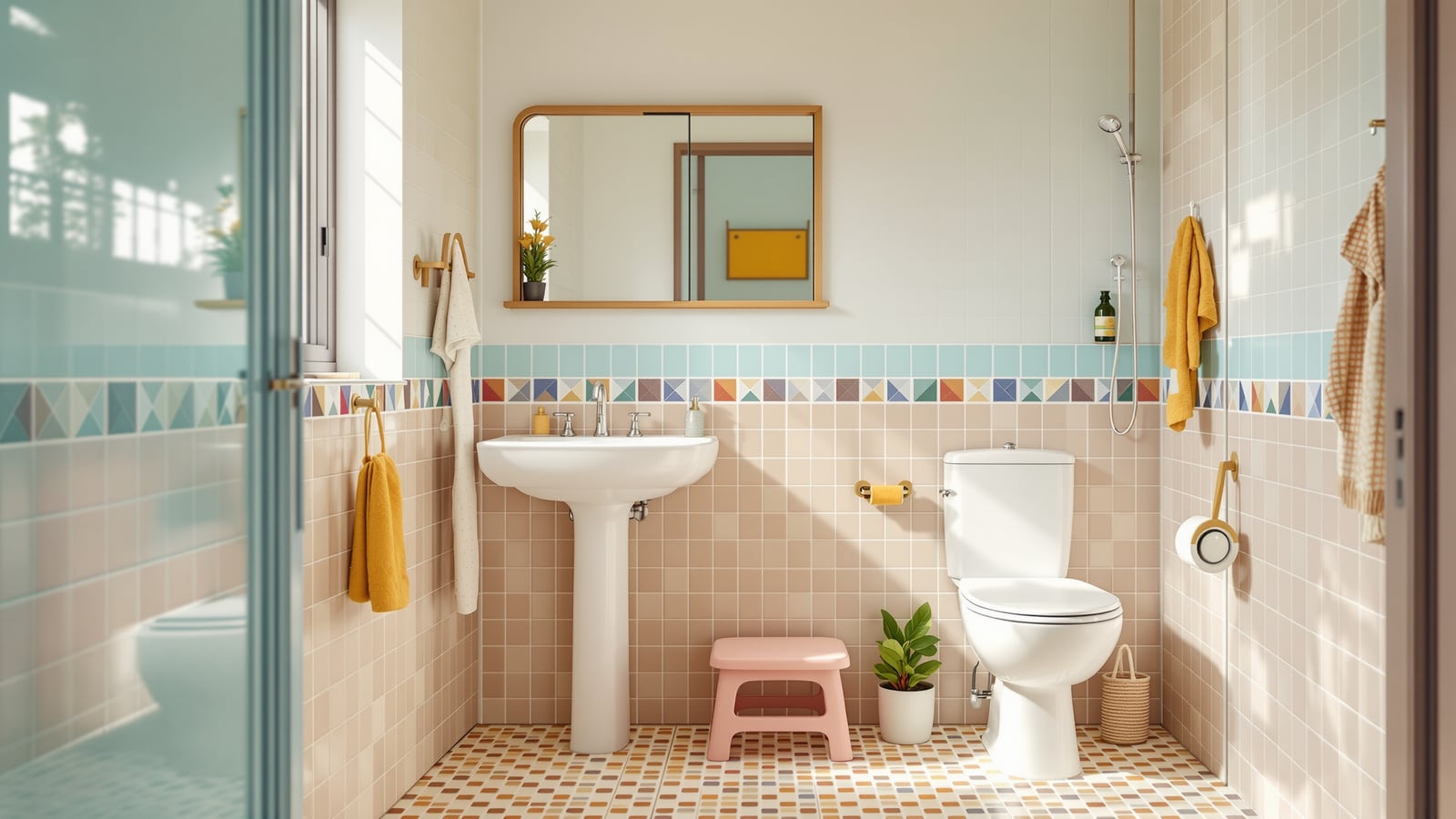
Kids Bathroom Design India: Child-Safe, Fun & Future-Proof
How to design a children's bathroom in India that is genuinely safe — anti-scald water, anti-slip floors, reachable fixtures and rounded edges — while staying playful today and easy to grow up tomorrow.
A children's bathroom has one job that outranks every other: it must be safe for a small person who is wet, in a hurry, and not yet cautious. Everything else — the cheerful tiles, the animal hooks, the colourful stool — is welcome, but it comes second. The best kids bathroom in India is the one where a five-year-old can wash their hands, use the WC and rinse off without ever meeting scalding water, a slippery floor or a sharp corner. Get the safety and the ergonomics right and the fun takes care of itself.
This guide sits inside the Studio Matrx bathroom hub. Read it alongside the complete bathroom design guide for India for codes and fundamentals, and the bathroom layout planning guide for how the room fits your floor plan. It also pairs naturally with the family bathroom guide and the common bathroom guide, because in most Indian homes the children's bathroom is a shared bathroom that simply has to work harder for smaller users.
Design a kids bathroom safety-first, then decorate. Anti-scald water, an anti-slip floor and reachable fixtures matter far more than the theme on the wall — and unlike the theme, you cannot repaint them.
What makes a children's bathroom different
Small children are not small adults. They reach less, balance worse, feel temperature more slowly, and treat every surface as optional to hold on to. A bathroom designed for grown-ups quietly stacks the odds against them: the geyser runs hot enough to scald, the basin is too high to use without climbing, the floor is polished, and the WC seat is a leap of faith. A well-designed children's bathroom removes each of those hazards without turning the room into a plastic playpen you will hate in five years.
Three principles carry the whole design:
- Safety is non-negotiable. Water temperature, floor grip, edges and electrical safety come first and are never value-engineered out.
- Ergonomics for the actual user. Fixtures, hooks and switches placed where a child can reach them independently — because independence is what makes a child use the bathroom safely rather than improvise.
- Future-proofing. Children grow fast. Build the room so it adapts from toddler to teenager by swapping accessories, not by demolishing tiles.
Anti-scald: the single most important decision
Scalds are the most common serious bathroom injury for young children, and Indian geysers make it easy: a storage water heater often holds water at 55–65 degrees Celsius, hot enough to injure skin in seconds. The fix is to control the temperature the child can actually receive at the outlet.
- Thermostatic mixing. A thermostatic shower valve or a point-of-use thermostatic mixing valve holds the delivered water to a safe, pre-set temperature — typically capped around 38–43 degrees Celsius — and shuts off if the cold supply fails. This is the gold-standard control for a kids bathroom.
- Set the geyser lower. Where a thermostatic valve is not fitted, set the geyser thermostat to a lower temperature and add an anti-scald limiter on the tap. This is a budget fallback, not a substitute for a mixing valve.
- Pressure stability. In homes where opening a tap elsewhere makes the shower run suddenly hot, a pressure-balanced or thermostatic valve prevents the surprise scald that catches children most.
- The health-faucet trap. The jet spray beside the WC often runs straight off the cold line, but where it is teed off a mixed or hot supply it can deliver scalding water. Check it, and prefer a cold-fed or temperature-limited health faucet.
Fit a thermostatic mixing valve and cap the outlet temperature. It is the one upgrade that turns an ordinary bathroom into a genuinely child-safe one, and it costs far less than a hospital visit.
Sizing and heights for small users
The ergonomics of a children's bathroom are about reach and reassurance. A child who can do things independently is safer than one who has to climb, stretch or wait. The heights below are child-friendly targets; where the room is shared with adults, use standard heights plus a sturdy step stool and lower accessories, so the same room serves both.
| Fixture | Standard adult | Child-friendly | Shared-room approach |
|---|---|---|---|
| WC seat height | 380–400 mm | 250–300 mm | Standard WC + a stable step + child seat reducer |
| Basin rim height | 800–850 mm | 550–600 mm | Standard basin + broad anti-slip step stool |
| Mirror bottom edge | 1000 mm | 800–900 mm | Full-height or tilt mirror covers both |
| Towel hooks / robe | 1500 mm | 900–1100 mm | Add a second low rail at 900–1000 mm |
| Light switch | 1200 mm | 900–1000 mm | Rocker switch at a reachable 1000 mm |
| Shower / mixer control | 1000–1100 mm | 800–900 mm | Hand shower on a slide bar, adjustable height |
A broad, stable step stool with an anti-slip top and feet is the cheapest future-proofing tool in the room: it lifts a toddler to an adult-height basin today and disappears when they outgrow it, meaning you never have to install and later replace a too-low basin.
Anti-slip, rounded edges and hard-surface safety
Wet feet on a smooth Indian bathroom floor are the second big hazard after hot water. The whole room should be planned so a running, wet child does not fall — and if they do, meets nothing sharp.
- Anti-slip flooring. Choose matt, textured floor tiles with a high slip rating (look for R10–R11 or a wet-barefoot rating) rather than glossy tiles that look pristine and behave like ice. IS 15622 covers ceramic tile classification; the anti-slip surface finish is the property that matters here. A small anti-slip bath mat with suction adds grip in the wet zone.
- Rounded edges. Prefer basins, WCs and vanity tops with soft, rounded profiles. Where sharp corners are unavoidable — counter edges, window sills — fit clear corner guards. Avoid glass shower screens at child height; a curtain or a fixed low screen is safer, and toughened glass to the relevant safety standard if glass is used.
- Soft-close everywhere. Soft-close WC seats and drawers prevent slammed lids and trapped little fingers.
- Electrical safety. Keep switches and sockets outside the wet zones per IS 732 and NBC guidance, protect circuits with an RCD/RCCB, and use IP-rated fittings near water. No loose extension boards in a children's bathroom, ever.
- Door that cannot trap. Use a privacy lock that an adult can release from outside, and consider a door that opens outward or a lock a child cannot jam themselves behind.
Storage, colour and fun that lasts
Once the room is safe, personality is easy — and cheap to change, which is exactly the point. Children's tastes turn over every couple of years, so put the theme in the swappable layer and keep the permanent surfaces calm.
- Reachable, open storage. Low open shelves, hooks and a labelled bin for bath toys let a child put things away themselves. Keep medicines, cleaning chemicals and sharp grooming items in a high, latched cabinet.
- Put the fun in soft goods. Colourful towels, a shower curtain, a stool, wall decals and a step stool carry the theme. When the dinosaur phase ends, you replace a curtain, not the tiles.
- Neutral permanent surfaces. White or pale sanitaryware and a calm floor and wall tile future-proof the room. Add one bright accent wall or a band of colour if you want energy, chosen so it still reads fine when the child is fourteen.
- Good, glare-free light. Bright, even lighting helps a nervous child feel comfortable and helps you supervise; a soft night light makes late trips to the WC safe and independent.
The table below sorts the choices into what to build in permanently versus what to keep swappable — the core of future-proofing.
| Keep permanent (calm, safe) | Keep swappable (fun, dated fast) |
|---|---|
| White/pale sanitaryware, rounded edges | Themed towels, robes, bath mats |
| Anti-slip matt floor tile | Shower curtain and rings |
| Neutral wall tile, one accent band | Wall decals and removable stickers |
| Thermostatic valve, RCD, hooks | Step stool, storage baskets, toy bins |
| Full-height or tilt mirror | Colourful accessories and night light |
Ventilation, hard water and easy cleaning — the India layer
Indian conditions add their own demands, and a children's bathroom is used and abused more than most. Monsoon humidity and daily bathing mean real ventilation matters: an exhaust fan sized to the room, ideally humidity-sensing, plus an openable window keeps mould off grout and toys. Hard water leaves scale on fittings and roughens surfaces, so choose quality CP or PVD-coated taps and consider softening at source; it also protects the thermostatic cartridge that keeps the water safe. Finally, design for easy cleaning — wall-hung or easy-clean-rim WCs, minimal joints, wipeable surfaces and a floor drain that clears quickly — because a hygienic children's bathroom is one a busy household can actually keep clean. For the wider shared-use planning, the family bathroom guide and common bathroom guide go deeper; for accessible and multi-generational homes, see the elderly-friendly bathroom guide, whose grab-bar and anti-slip logic overlaps neatly with child safety.
Bringing it together
A children's bathroom in India succeeds when it is boringly safe and quietly clever: water that cannot scald, a floor that grips, fixtures a child can reach, edges that forgive a fall, and a personality that lives in things you can swap for a few hundred rupees. Build the safety and ergonomics into the permanent room, keep the fun in the soft layer, and design once so the space carries a child from toddler to teenager. Start with the fundamentals in the complete bathroom design guide, fit it to your plan with the layout planning guide, and coordinate shared use through the family and common bathroom guides.
References
- National Building Code of India (NBC 2016), Bureau of Indian Standards — Part 9 Plumbing Services and Part 3 space, ventilation and safety provisions for bathrooms.
- IS 2556: Vitreous China Sanitary Appliances — specification and quality for WCs and basins, Bureau of Indian Standards.
- IS 15622: Pressed Ceramic Tiles — classification, specification and surface/slip properties for anti-slip flooring, Bureau of Indian Standards.
- IS 1172: Code of Basic Requirements for Water Supply, Drainage and Sanitation, Bureau of Indian Standards.
- IS 732: Code of Practice for Electrical Wiring Installations — safe placement of switches, sockets and RCD/RCCB protection in wet areas, Bureau of Indian Standards.
- CPWD Harmonised Guidelines and CPHEEO plumbing guidance — fixture placement, accessibility and water-safety references relevant to multi-user and family bathrooms.
Export this guide
Related Guides — Deep-dive reading
Family Bathroom Design India: Layout, Storage & Safety (2026)
How to design the main shared family bathroom in an Indian home — a hard-working room that a toddler, a teenager and a grandparent all use on the same busy morning: storage for many, child and elderly safety, durable easy-clean finishes, and a layout planned for quick turnaround.
BathroomsBathroom Safety Accessories India: The Fall-Safe Kit (Grab Bars, Anti-Slip, Seats & SOS) (2026)
The full retrofit kit that turns a slippery Indian bathroom into a fall-safe one — anti-slip mats and strips, a shower stool, grab bars, an anti-scald thermostatic control, a raised toilet seat, an SOS button, corner guards, non-slip footwear and night lighting — with mm sizes, rupee costs and a room-by-room checklist.
BathroomsBathroom Planning for New Homes in India: Get It Right Before You Build
The bathroom decisions you cannot undo once the slab is cast — location and stacking, sunken vs non-sunken slabs, waterproofing, and the plumbing, electrical and ventilation you must coordinate with the civil work, stage by stage.
BathroomsRelated Tools — Try Free
Cross-Ventilation Analyzer
Estimate airflow and air changes per hour (ACH) from room size, window areas, layout, and local wind — with NBC 2016 Part 8 compliance check.
Ventilation CalculatorElectrical Safety & Load Audit
Home electrical audit — 10 categories, 65+ checkpoints across earthing, RCCB, MCB, wiring, switchboards, appliance circuits, DG/inverter backup.
Safety AuditWindow Cleaning Cost Calculator
Estimate professional window cleaning cost per visit and per year by access and frequency.
Window Calculator