
Pedestal Wash Basin India: Full vs Half Pedestal, Fixing, Height & Cost (2026)
The classic Indian budget basin explained — how the pedestal hides the pipes and carries the load, full vs half pedestal, wall-plus-floor fixing, the right rim height, where it still beats a vanity, and honest rupee ranges.
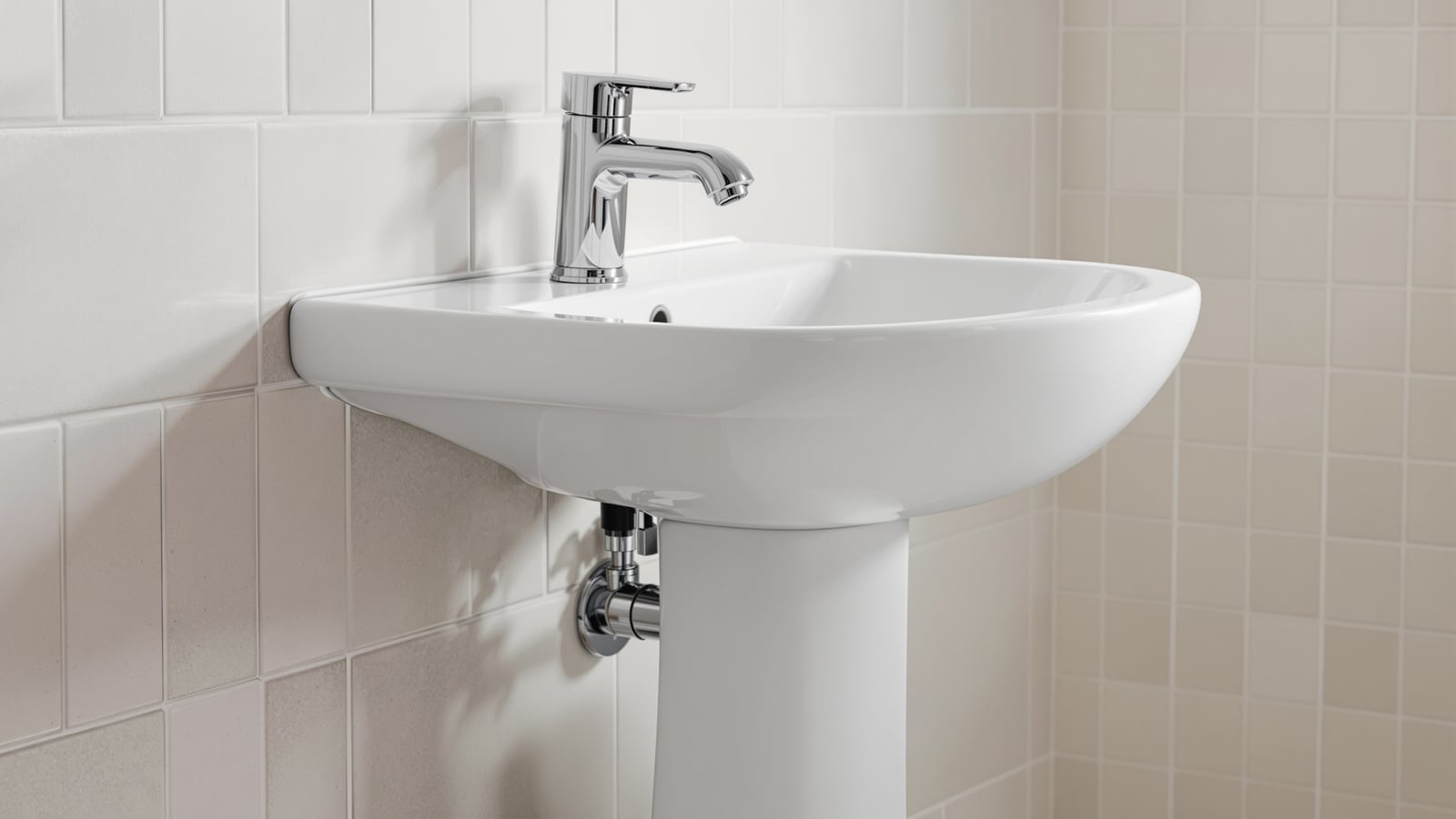
Walk into almost any Indian flat, rental, school, office toilet or middle-budget home and you will meet the same fixture: a white ceramic bowl on a matching column, screwed to the wall with a tapering pedestal reaching the floor. The pedestal wash basin is the default sanitaryware of the subcontinent for one very practical reason — it is the cheapest respectable way to get a basin that hides its own plumbing. No cabinet, no counter, no carpentry; a bowl, a column, four screws and a plumber for an afternoon.
That simplicity is exactly why it survives despite fashionable wall-hung and vanity units taking over showrooms. This guide is India-first: what full and half pedestals actually do, how they are fixed to wall and floor, the height that suits Indian users, where the pedestal basin still wins, where it loses, and honest rupee ranges. Read it alongside the bathroom wash basin guide for India for the full menu of basin types, and compare it against the wall-hung basin guide before you decide.
The pedestal is not decoration. It is a pipe cover that also shares the load — remove it and you expose the trap, and you put the entire weight of a leaning adult on the wall bolts alone.
What the pedestal is actually for
A wall basin has two problems the pedestal quietly solves. First, the bowl is heavy porcelain and people lean on it, so the fixing must resist a strong downward and outward pull. Second, the waste pipe and its P-trap, plus the two water-supply connections, hang visibly under the bowl and look untidy.
The pedestal answers both:
- It hides the plumbing. The hollow column sleeves down over the bottle trap and the supply lines, so all you see is a clean ceramic form. This is the single biggest reason to choose it over a plain wall basin.
- It shares the load. The column transfers part of the basin's weight — and the extra force when someone leans — down to the floor, taking strain off the wall bolts. It does not do the whole job (see fixing below), but it turns a cantilever into a propped support.
- It sets a repeatable height. A full pedestal lands the rim near the standard 800–850 mm without measuring, which is why plumbers like it.
Full pedestal vs half (semi) pedestal
There are two families, and picking the wrong one is a common site mistake.
| Type | Reaches | Hides pipes | Load help | Best for |
|---|---|---|---|---|
| Full pedestal | Floor to bowl | Fully — trap and supply | Real — column props the bowl | Common, family & rental bathrooms; nervous fixings |
| Half / semi pedestal | Short shroud, stops mid-air | Partly — hides the trap only | None — purely cosmetic | A cleaner floor, tidy look, when the wall is strong |
A full pedestal runs bowl-to-floor and is the classic budget basin. It hides everything and genuinely helps carry weight, so it forgives a weaker wall. Its downside is the footprint on the floor — you cannot mop cleanly around a fat column, and hair and grime collect at its base.
A half pedestal (also called semi-pedestal) is a short decorative shroud that clings under the bowl and stops in mid-air, covering only the trap. It looks lighter, frees the floor for easy cleaning, and reads more modern — but it carries no load at all. Every kilo, and every lean, goes into the wall brackets, so a half pedestal is only safe on a solid brick or RCC wall with proper anchors, never on a hollow partition. Think of it as a wall-hung basin wearing a modesty skirt.
Fixing: it is wall and floor, never one alone
The commonest cause of a cracked or fallen pedestal basin is treating the pedestal as the support and skipping the wall bolts — or the reverse. A pedestal basin is a two-point fixing.
- The bowl bolts to the wall. Two horizontal bolts through the rear of the bowl into rawl plugs / expansion anchors set in brick or RCC. On a solid wall use M8–M10 anchors; on a hollow block or drywall you must fix into a hidden batten or steel bracket, because block infill will not hold a leaning adult.
- The pedestal locates to the floor. The column sits on the finished floor and is usually screwed down through a foot hole (or bedded on a thin silicone pad). It does not just rest there decoratively — that floor screw stops the column kicking out.
- The two act together. Wall bolts resist the outward pull-off; the pedestal resists the downward push. Rely on either alone and the basin loosens, the trap leaks, and the ceramic eventually cracks at the bolt holes.
A practical detail for India: get the plumbing rough-in right before tiling. The waste outlet and both angle valves must sit behind the pedestal footprint so the column hides them. If the plumber sets the point too high or off-centre, the pedestal will not sleeve over the trap and you are left with an ugly gap — a frequent site failure. The common bathroom design guide covers coordinating these points in shared and rental bathrooms.
Height: get the rim right
The pedestal fixes most of the height for you, but confirm it. In Indian homes the basin rim is normally set at 800–850 mm from finished floor level (FFL) for adults. Lower it toward 650–700 mm in a children's or school bathroom, and for a wheelchair user follow accessible guidance (rim around 800 mm max with knee clearance) — though note a full pedestal blocks knee space, so an accessible basin is usually wall-hung, covered in the accessible bathroom design guide.
Where the pedestal basin still wins — and where it loses
The pedestal basin is not old-fashioned so much as specialised: it is the value option. It shines in exactly the places most Indian basins live.
It still suits:
- Common and shared bathrooms where cost per unit matters and there is no storage to give up.
- Rental flats and PGs — cheap, standard, easy for any plumber to replace, and society-friendly.
- Tight budgets and quick renovations — no cabinet to buy or build, minimal carpentry, fast install.
- Small bathrooms where a bulky vanity would crowd the room but you still want the pipes hidden.
- Heritage / traditional looks — a good pedestal has a classic, timeless profile.
It loses when you need:
- Storage. A pedestal offers zero. If you want to stash cleaning bottles, spare soap and toiletries, a vanity unit wins outright.
- A floating, easy-to-mop look. The column sits on the floor and collects grime at its base; a wall-hung basin leaves the floor clear.
- Counter space. No landing space for a soap dish, tap of tumblers or a phone — a vanity or a counter-top basin gives you a shelf.
- True accessibility. The column blocks wheelchair knee clearance.
| Basin type | Hides pipes | Storage | Floor cleaning | Cost | Storage/knee space |
|---|---|---|---|---|---|
| Full pedestal | Yes, fully | None | Hard (column base) | Lowest | None |
| Half pedestal | Trap only | None | Easy (floor clear) | Low–mid | None |
| Wall-hung | Needs bottle trap/skirt | None | Easiest | Mid | Good knee space |
| Vanity unit | Yes, in cabinet | Plenty | Moderate | Highest | Storage, no knee space |
Living with it: care and common failures
A pedestal basin is low-maintenance, but a few Indian realities catch people out. Hard water leaves a white scale ring on the bowl and at the tap base — wipe with a mild acidic bathroom cleaner, never a metal scourer that scratches the glaze. Check the pedestal-to-bowl and bolt joints twice a year: a loose wall bolt lets the bowl rock, and a rocking bowl cracks at the fixing holes and starts a slow leak into the trap. Do not stand or sit on the bowl, and do not let anyone use the pedestal as a step — the column is a pipe cover, not a stool. If you see a hairline crack radiating from a bolt, replace the ware; ceramic cracks only grow. Keeping the substrate dry underneath matters too, so pair good fixing with sound bathroom waterproofing around the wet zone.
Cost in India (2026)
Prices are for the ceramic ware only unless noted; add a plumber's labour of roughly ₹500–₹1,200 for a straightforward wall-and-floor fixing, plus tap, waste and angle valves.
| Item | Typical India range (2026) | Note |
|---|---|---|
| Basic full pedestal set (bowl + pedestal) | ₹1,500–₹3,500 | Standard white ceramic, common brands |
| Mid-range / designer full pedestal | ₹3,500–₹8,000 | Better glaze, slimmer form |
| Half / semi-pedestal set | ₹2,500–₹9,000 | Look premium; needs a strong wall |
| Premium branded pedestal basin | ₹9,000–₹20,000+ | Imported / designer ranges |
| Fixing labour (wall + floor) | ₹500–₹1,200 | Excludes tap, waste, angle valves |
| Angle valves + bottle trap + waste | ₹600–₹1,800 | Buy metal, not plastic, for durability |
Choose IS-marked sanitaryware, insist on two proper wall anchors plus the floor screw, and buy a metal bottle trap and angle valves rather than the flimsy plastic ones that often come bundled — they are what leak first under Indian hard water. If you later want storage or a floating look, the wash basin guide walks through upgrading to a vanity or wall-hung unit.
References
- IS 2556 (Part 1 onwards) — Vitreous sanitary appliances (vitreous china): specification for wash basins and pedestals.
- IS 774 — Flushing cisterns and allied sanitary fittings; general sanitaryware requirements referenced for basin installations.
- National Building Code of India (NBC 2016), Part 9 — Plumbing services: water supply, drainage and sanitary fittings, including basin waste and trap requirements.
- IS 1172 — Code of basic requirements for water supply, drainage and sanitation.
- CPHEEO Manual on Water Supply and Sanitation — public and shared-toilet fixture guidance relevant to common bathrooms.
- Harmonized Guidelines and Standards for Universal Accessibility in India — basin height and knee-clearance provisions for accessible washrooms.
Export this guide
Related Guides — Deep-dive reading
How to Choose a Wash Basin in India: Mount Type, Size, Tap Holes & Budget (2026 Buyer's Guide)
A buyer's decision guide to picking the right wash basin — matching the mount type to your vanity and space, sizing it to the room, getting the tap-hole config right for your faucet, judging material and durability, checking what's in the box, good/better/best rupee tiers, the IS 2556 vitreous-china mark, and how to spot seconds, hairline cracks and warranty traps.
BathroomsWall Hung Wash Basin India: Fixing, Bracket Frames, Height & Cost (2026)
The floating basin that makes a small Indian bathroom feel bigger — how the concealed bracket or frame anchors into masonry, concealed vs exposed bottle trap, half-pedestal cover options, the right rim height, and honest pros, cons and rupee ranges.
BathroomsBathroom Wash Basin India: Types, Sizes, Height, Materials & Cost (2026)
The complete India-first guide to choosing a bathroom wash basin — wall-hung, countertop, under-counter, pedestal and semi-recessed mounting; ceramic, stone, solid-surface and glass materials under IS 2556; ergonomic heights, tap-hole options, waste and bottle-trap fittings, rupee costs and how to match a basin to your bathroom.
BathroomsRelated Tools — Try Free
Bathroom Renovation Cost Calculator
Cost to renovate an existing bathroom with a replace-vs-keep model — demolition, re-waterproofing, tiles, fittings and the money saved by keeping items.
Bathroom CalculatorMonsoon-Readiness Checklist
Pre-rain home audit across 9 categories — terrace, drains, waterproofing, electrical, HVAC, pest, vehicles, documents.
Seasonal AuditBathroom Cost Calculator
Estimate the all-in cost of building or renovating a bathroom — by size, quality tier and city, with a category-wise breakdown.
Bathroom Calculator