
Bathroom Wash Basin India: Types, Sizes, Height, Materials & Cost (2026)
The complete India-first guide to choosing a bathroom wash basin — wall-hung, countertop, under-counter, pedestal and semi-recessed mounting; ceramic, stone, solid-surface and glass materials under IS 2556; ergonomic heights, tap-hole options, waste and bottle-trap fittings, rupee costs and how to match a basin to your bathroom.
The wash basin is the fitting your household touches most — every hand-wash, every brush, every shave and face-wash runs through it, several times a day, for twenty years. Yet it is usually the last thing chosen and the first thing regretted: a beautiful table-top bowl mounted at the wrong height, a pedestal that hides ugly pipework but wastes the cabinet space you needed, a glass basin that films white within a month of hard water. Getting the basin right is less about the shape on the showroom shelf and more about three decisions taken together — how it mounts, what it is made of, and how tall it sits — matched honestly to your plumbing, your storage and the people who use it.
This guide is India-first. It assumes hard water that scales every surface, a health-faucet WC that keeps the room humid, small-to-medium bathrooms where every centimetre counts, and a mason who will set the basin height off memory unless you write it down. It sits under the bathroom design guide for India, which frames the whole room; here we go deep on the basin alone. Once you have settled on a mounting type, the dedicated deep-dives cover each one: wall-hung basins, countertop basins, under-counter basins and pedestal basins. For the tap that sits on it, read the basin mixer taps guide for India.
A basin is chosen in three moves — mount, material, height. Get those right and the shape is just taste; get them wrong and no shape will save it.
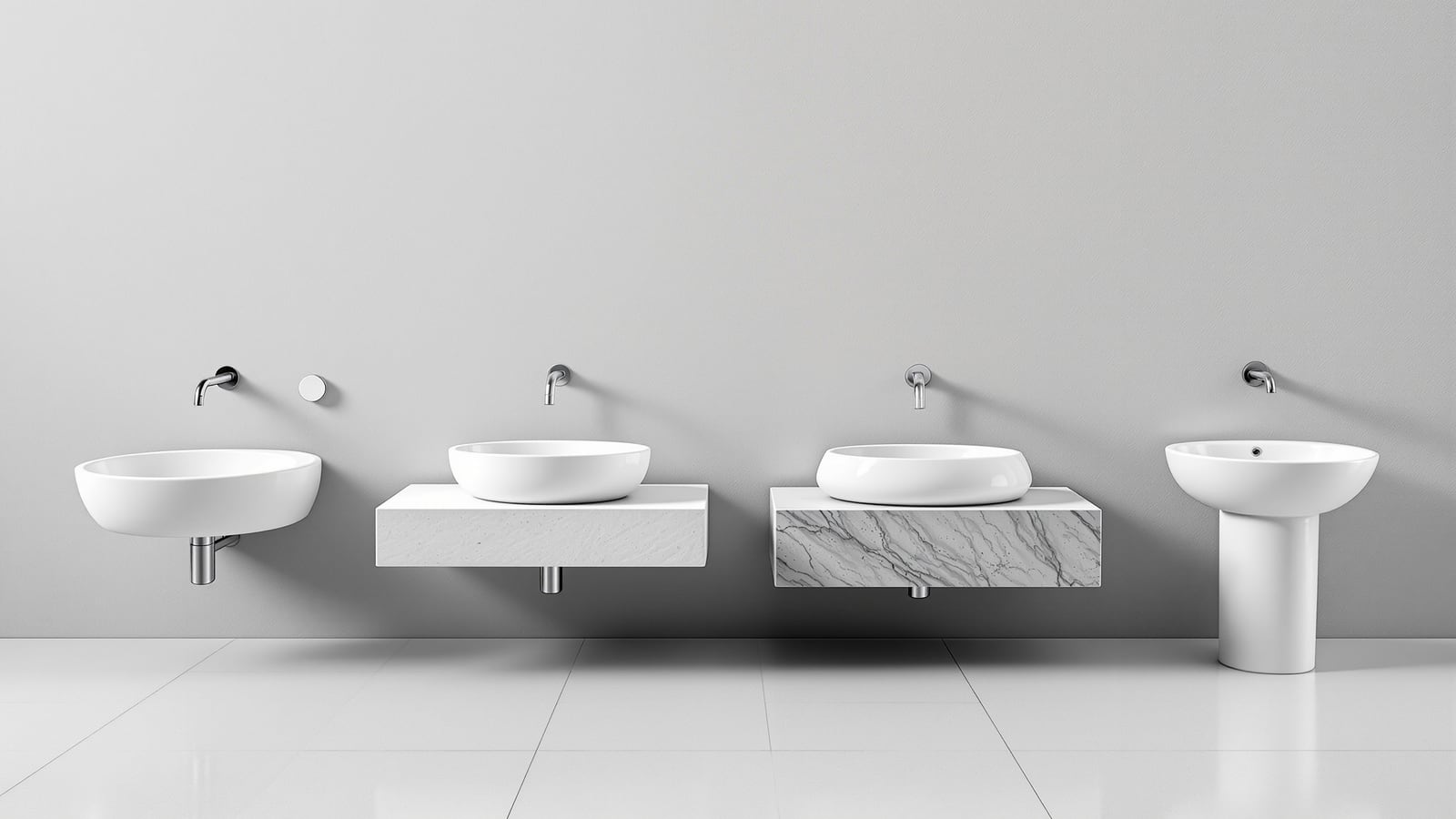
The five mounting types
How a basin attaches to the wall or counter is the decision that drives everything else — the plumbing rough-in, the storage you keep or lose, the cleaning effort, and the cost. Indian bathrooms use five common mounts.
- Wall-hung — the basin bolts to the wall on concealed brackets, with the waste pipe and (ideally) a bottle trap left exposed or half-hidden below. Floor stays clear, so the room reads bigger and mopping is easy. It needs a solid wall or an in-wall frame to carry the load, and the wall plumbing must be roughed in at the right height before tiling.
- Countertop / vessel (table-top) — a bowl sits fully on top of a counter or vanity, like a mixing bowl on a table. The most fashionable look, and the easiest to swap later, but it raises the effective rim height, so the counter below it must be set lower (see the height section). Cleaning around the base and the exposed tap is fiddly.
- Under-counter — the bowl is fixed below a stone or solid-surface counter, with the counter overhanging the rim. The cleanest wipe-down surface of all — you sweep water straight into the bowl — and the most premium feel, but it needs an accurate cut-out and a fabricated counter, so it costs more to install.
- Pedestal — a floor-standing ceramic column supports the basin and hides the trap and supply pipes. Traditional, forgiving of rough wall plumbing, and cheap — but the pedestal eats floor space and gives you no storage. The half-pedestal (wall-mounted, stops short of the floor) is a neat compromise.
- Semi-recessed — the basin sits half into and half proud of a narrow counter, so the bowl overhangs the front edge. Designed for shallow vanities in tight bathrooms where a full counter-depth basin will not fit.
Which mount for which bathroom
| Bathroom / need | Best mount | Why |
|---|---|---|
| Small bathroom, want floor clear | Wall-hung or half-pedestal | Open floor reads bigger, easy to mop |
| Family bathroom, need storage | Under-counter on a vanity | Cabinet below, cleanest counter |
| Powder room, statement look | Countertop / vessel | Sculptural bowl on show, low water use |
| Budget bathroom, rough wall plumbing | Full pedestal | Cheapest, hides pipework, tolerant |
| Narrow / shallow space | Semi-recessed | Bowl projects past a slim counter |
Materials — what basins are made of
Most Indian basins are vitreous china (a dense, glazed ceramic), and for good reason. But stone, solid surface and glass all have a place. Sanitaryware sold in India is governed by IS 2556 (the ceramic sanitary appliances standard), which sets out dimensions, warpage limits and the crazing/staining tests a glaze must pass — a BIS-marked basin is worth insisting on.
| Material | Feel | Hard-water behaviour | Care | Indicative ₹ (basin only) |
|---|---|---|---|---|
| Vitreous china / ceramic (IS 2556) | Standard, robust, glossy | Films but wipes clean; glaze resists staining | Low — mild cleaner | ₹1,500 – ₹8,000 |
| Natural stone (marble, granite) | Solid, luxurious, heavy | Etches with acidic cleaners; needs sealing | High — pH-neutral only, re-seal yearly | ₹8,000 – ₹40,000+ |
| Solid surface (acrylic/mineral composite) | Warm, seamless, repairable | Non-porous, hides scale well | Low — sandable if scratched | ₹10,000 – ₹35,000 |
| Tempered glass | Light, transparent, modern | Shows every water spot and scale mark | High — squeegee after each use | ₹3,000 – ₹12,000 |
In plain terms: for a bathroom used hard by a family in a hard-water city, vitreous china wins on durability, price and low maintenance. Reserve stone and glass for low-traffic powder rooms or luxury master baths where someone will actually maintain them. Solid surface is the sleeper pick — seamless with the counter, forgiving, and repairable — if the budget allows.
Sizes and the height that matters most
A basin that is the wrong height is a daily nuisance no material can fix. The single most useful number to write on your drawing is the rim height — the finished top edge of the bowl above the floor.
- Rim height: 800 – 850 mm is the comfortable adult range in India, with 820 – 840 mm a safe default. Too low and tall users stoop and splash their backs; too high and shorter users and children reach up into the bowl.
- This is a rim figure, so the mounting type changes the maths. For a countertop / vessel basin, the bowl adds 100 – 150 mm on top of the counter — so the counter must drop to roughly 700 – 720 mm to keep the rim near 820 mm. This single point catches out more homeowners than any other.
- Children's / accessible basins sit lower, around 650 – 750 mm rim. See the accessible bathroom design guide for knee-clearance and reach.
- Basin footprint: compact basins run 450 – 500 mm wide; standard 550 – 600 mm; a comfortable double-user or master basin 650 mm+. Depth (front to back) is typically 400 – 500 mm. In a narrow bathroom a semi-recessed or corner basin buys back walking space.
Tap-holes, waste and the bottle trap
Two fittings decide whether your basin looks finished and drains cleanly — the tap-hole configuration and the waste-plus-trap below.
Tap-hole configuration
Basins are pre-drilled (or left blank) for the tap you plan to use. Choose the tap first, then the basin.
- Single tap-hole — one central hole for a basin mixer (one spout, one or two handles for hot and cold). The most common modern choice.
- Three tap-holes — separate hot tap, cold tap and spout, spaced at a standard centre distance, for a traditional pillar-tap set.
- No tap-hole (blank) — for a wall-mounted tap or a deck-mounted tap on the counter behind a vessel basin. The basin body stays clean; plumbing must be roughed into the wall accurately.
Match this to the basin mixer taps guide before you buy — a single-hole basin cannot take a three-piece set, and a wall tap needs its rough-in fixed before tiling.
Waste and trap
- Waste coupling — the drain fitting in the basin bottom. A pop-up waste (opens and closes with a lever) suits a plugged basin; a simpler slotted/free-flow waste (no plug, always open) suits Indian washing habits where a running basin is normal and it self-drains an overflow.
- Overflow — most ceramic basins include a moulded overflow slot; if your basin has one, use a slotted waste so the overflow can drain.
- Bottle trap — the P- or bottle-shaped trap below the waste holds a water seal that blocks drain gas and smell from rising into the room. On a wall-hung or vessel basin the trap shows, so a chrome bottle trap is worth the extra over a plastic one. A basin without a working trap will smell — this is not optional.
How to choose — a quick path
Walk the decision in order and the basin picks itself:
1. Start with the room. Small and want it open? Wall-hung. Need storage? Under-counter vanity. Powder-room show-piece? Vessel. Tight budget, rough plumbing? Pedestal.
2. Set the plumbing. Wall-hung and wall-tap basins need the rough-in and load-bearing fixed before tiling — decide early. Pedestals forgive late decisions.
3. Pick the material for who uses it. Hard-water family bathroom → vitreous china. Low-use luxury → stone, glass or solid surface.
4. Lock the rim at 820 – 840 mm — and if it is a vessel basin, drop the counter to ~700 mm so the finished rim still lands there.
5. Match tap-hole to tap, and insist on a working trap (chrome if it shows).
A few honest don'ts drawn from what fails in Indian bathrooms:
- Don't put a glass or polished-stone basin in a hard-water family bathroom unless someone will squeegee it daily — it will look permanently spotted.
- Don't let the mason set basin height by eye; write 820–840 mm to rim on the drawing.
- Don't buy a beautiful vessel bowl and mount it on a standard 800 mm counter — the rim ends up near a metre and everyone splashes.
- Don't skip the bottle trap or accept a bare plastic P-trap on a wall-hung basin — it will smell and look unfinished.
Sort these and the basin becomes what it should be — the quiet, reliable fitting you never think about, twelve times a day, for the next twenty years.
References
- IS 2556 (Bureau of Indian Standards) — Vitreous sanitary appliances (vitreous china): dimensions, quality and test requirements for wash basins and other sanitaryware.
- NBC 2016 (National Building Code of India), Part 9 Plumbing Services — sanitary fixtures, traps, water seals and drainage provisions.
- IS 1172 — Basic requirements for water supply, drainage and sanitation.
- IS 774 / IS 771 — Vitreous / fireclay sanitary appliances and flushing/waste fittings, referenced for trap and waste seals.
- CPHEEO Manual on Water Supply and Sanitation (Ministry of Housing and Urban Affairs) — fixture and drainage design guidance for Indian buildings.
Export this guide
Related Guides — Deep-dive reading
How to Choose a Wash Basin in India: Mount Type, Size, Tap Holes & Budget (2026 Buyer's Guide)
A buyer's decision guide to picking the right wash basin — matching the mount type to your vanity and space, sizing it to the room, getting the tap-hole config right for your faucet, judging material and durability, checking what's in the box, good/better/best rupee tiers, the IS 2556 vitreous-china mark, and how to spot seconds, hairline cracks and warranty traps.
BathroomsFreestanding Bathtub India: Materials, Floor Load, Concealed Plumbing & Cost (2026)
The statement centrepiece tub that stands free of every wall — how acrylic, stone-resin and cast-iron differ, the floor load a filled tub imposes, the concealed rough-in you must set out before the flooring goes down, the clear space it needs all around, drainage, and honest 2026 rupee costs.
BathroomsCountertop Wash Basin India: Vessel & Table-Top Basins, Tap Height & Cost (2026)
How a countertop (vessel / table-top) basin actually sits on a vanity, why it raises your working height by 120–150 mm and forces a tall or wall-spout tap, the shapes and materials that survive Indian hard water, splashing and rim-cleaning realities, an honest pros-and-cons, and 2026 rupee costs.
BathroomsRelated Tools — Try Free
Window Cleaning Cost Calculator
Estimate professional window cleaning cost per visit and per year by access and frequency.
Window CalculatorBathroom Drainage Pipe Calculator
Recommended drain and waste pipe sizes, slopes and stack size for a bathroom's fixtures — indicative IS 1172 / NBC plumbing practice.
Bathroom CalculatorMaterial Decision Framework (M-Score)
Score 30+ Indian construction materials across cost, durability, climate fit, maintenance, and sustainability.
Materials