
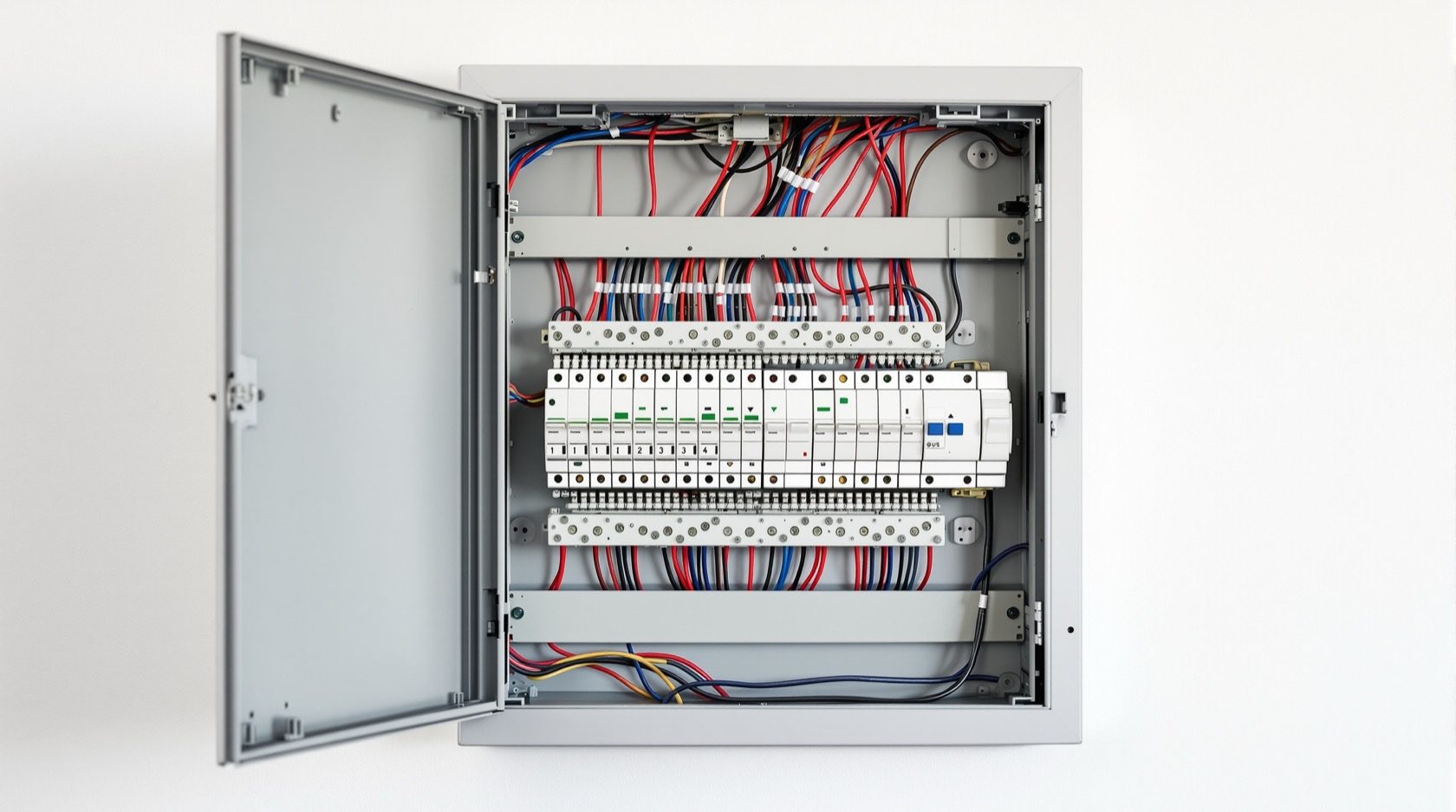
Residential Electrical Systems: The Complete Guide for Indian Homes
How the electricity in an Indian home actually works — from the utility supply and meter through the distribution board, circuits, wiring, earthing and protection, to lighting, safety, energy efficiency, smart controls, solar and backup — written so a homeowner can understand, plan and judge it, and know exactly where a licensed electrician must take over.
Electricity is the one building service a homeowner both depends on completely and understands least. You flick a switch and light appears; you plug in a geyser and hot water follows. But behind that wall sits a system every bit as designed as the structure or the plumbing — a chain that carries power from the street to the socket, splits it safely among rooms, and is watched over by devices whose only job is to cut the power in the fraction of a second before it can hurt someone.
This is the pillar guide to that system. It explains, in plain language, how the electricity in an Indian home actually works — the supply, the meter, the distribution board, the circuits, the wiring, the earthing, the protection devices, and the modern layers on top: energy efficiency, smart controls, solar and backup. The goal is not to turn you into an electrician. It is to make you an informed client — someone who can plan a home's electrical system, ask the right questions, judge whether a job was done well, and know exactly where the line is that only a licensed professional may cross.
Read this first — the safety line, stated once and meant throughout. Electricity is the one home system that can kill you in an instant and burn the house down overnight. This guide helps you understand, plan, specify, buy and judge — it is a literacy guide, not a how-to-wire manual. Every hands-on task involving live wiring, the distribution board, or the supply must be done by a licensed, competent electrician, and in India connection to the grid is legally the domain of licensed persons under the electricity rules. Wherever this guide describes what happens inside a live installation, read it as what a good electrician should do — not an instruction for you to do it.
How to read this guide
An electrical system is a chain, and the guide follows that chain from the street inward:
1. The supply and the meter — where power enters and is measured.
2. The distribution board — where it is split into circuits and protected.
3. Circuits and wiring — how it reaches each room.
4. Earthing and protection — the safety net that makes it survivable.
5. Load and capacity — how much power the home actually needs.
6. The modern layers — energy efficiency, smart controls, solar and backup.
7. Living with it — maintenance and knowing when to call a professional.
Each stage links to a deeper guide where one exists. Start here to see the whole; branch out where you need detail.
1. The supply: where power enters the home
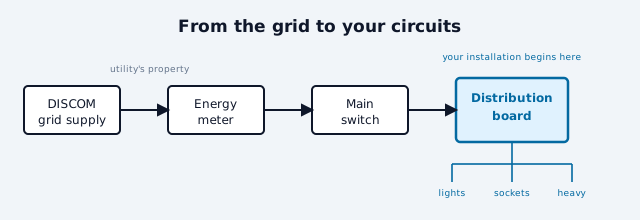
Electricity reaches your home from the local distribution company (DISCOM) — your state's utility. For most Indian homes the supply is single-phase, 230 volts; larger homes, homes with heavy loads (multiple air-conditioners, a large geyser bank, an EV charger), or villas often take a three-phase, 415-volt connection, which delivers more power and balances heavy appliances across three lines.
The supply enters through a service cable to an energy meter — the DISCOM's property — which records how many units (kilowatt-hours) you consume. From the meter, a cable runs to your main switch and then to the distribution board, which is where your installation begins and your responsibility starts.
A few things worth understanding as an owner:
- Sanctioned load. Your connection has an approved maximum load in kilowatts, agreed with the DISCOM. Exceed it consistently and you risk penalties or a tripped supply; plan an EV charger or a solar system and you may need to apply to enhance it.
- Single vs three phase. Three-phase is not "more dangerous" — it is a way to carry more power and run heavy or three-phase appliances (large pumps, some ACs) smoothly. The choice is a load-and-future-planning decision, covered in the home electrical planning guide.
- The meter is not yours to touch. Tampering with it is an offence under the Electricity Act, 2003.
2. The distribution board: the heart of the home
If the home's electrical system has a heart, it is the distribution board (DB) — also called the consumer unit or, loosely, "the fuse box". This is the panel, usually near the entrance or in a utility area, where the incoming supply is divided into circuits and where the protective devices live.
Inside a well-designed DB you will find:
- A main switch (or main isolator / RCCB) that cuts all power to the home.
- A residual current device — an RCCB (residual current circuit breaker) — that watches for current leaking to earth and trips in milliseconds. This is the single most important life-safety device in the house.
- A row of miniature circuit breakers (MCBs), one per circuit, each sized to protect its cable from overload and short circuit.
- Busbars distributing the incoming power to each MCB, and a neutral and earth bar.
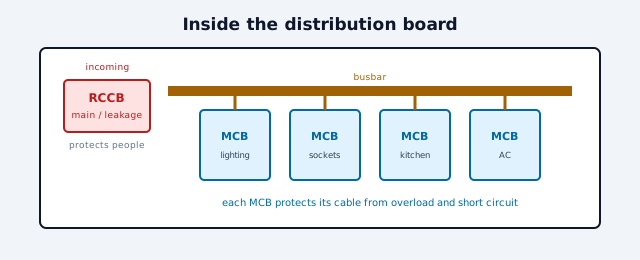
The DB is where good and bad electrical work most clearly diverge. A quality board has clearly separated circuits, a correctly rated RCCB, MCBs sized to their cables (not oversized to "stop nuisance tripping"), and a legible circuit chart on the inside of the door so anyone can tell which breaker feeds what. The distribution board planning guide covers how to size and lay one out; here, the point is simply to recognise the DB as the command centre and the RCCB as its guardian.
A breaker that trips is not a fault to be silenced — it is a safety device doing its job. The wrong response to frequent tripping is a bigger breaker; the right response is to find out why.
3. Circuits and wiring: how power reaches each room
From the DB, power travels along circuits — separate cabled paths, each protected by its own MCB, feeding a defined set of points. Good practice, reflected in the National Electrical Code of India (SP 30 : 2023) and IS 732 : 2019 (Code of Practice for Electrical Wiring Installations), is to divide a home into several circuits rather than run everything on one:
- Lighting circuits — low current, many points, kept separate so a socket fault never darkens the house.
- General socket (power) circuits — for everyday plug loads, grouped by area.
- Dedicated circuits for heavy or critical appliances — the geyser, the air-conditioners, the kitchen (which draws hard from microwaves, ovens and induction hobs), a pump, and increasingly an EV charger.
Separating circuits does three things: it contains faults (a problem on one circuit trips only that circuit), it matches cable size to load (a 16 A geyser needs heavier wire than a 6 A light point), and it makes the home serviceable (you can isolate the kitchen without killing the bedrooms).
The wiring itself is almost always concealed in modern Indian homes — insulated copper conductors drawn through PVC conduits buried in wall and slab. The conductor of choice for home wiring is copper, sized by the current it must carry: typically 1.0–1.5 sq mm for lighting, 2.5 sq mm for general sockets, and 4–6 sq mm for heavy points like geysers and ACs. Undersized wire is a fire risk that hides behind the plaster for years — which is exactly why wire sizing is a job for a competent electrician working to code, not a place to save money.
| Circuit type | Typical use | Indicative wire size (copper) | Typical MCB |
|---|---|---|---|
| Lighting | Lights, fans, small points | 1.0 – 1.5 sq mm | 6 A |
| General sockets | 5–6 A plug points | 2.5 sq mm | 16 A |
| Kitchen / power | Microwave, hob, mixer | 4 sq mm | 20 A |
| Geyser / AC | 15–16 A dedicated points | 4 – 6 sq mm | 20 – 32 A |
| EV charger | Home AC charger | 4 – 6 sq mm (per charger spec) | Per manufacturer |
Sizes are indicative for typical Indian homes and must be confirmed by a licensed electrician against the actual load, cable length (voltage drop) and the current code. See the wire and cable choices discussion in the planning guide.
4. Earthing and protection: the safety net
This is the part of a home's electrical system that never announces itself and matters most. Earthing and protective devices together form the safety net that turns a potentially lethal fault into a harmless trip.
Earthing gives fault current a deliberate, low-resistance path back to earth. Every metal appliance body, every socket's earth pin, and the DB itself connect to an earth electrode buried in the ground. If a live wire ever touches the metal casing of a geyser or a fridge, earthing carries that current safely away and lets the protective device trip — instead of leaving the casing live and waiting for a person to touch it. India's earthing practice is codified in IS 3043 : 2018 (Code of Practice for Earthing).
Protective devices each guard against a different danger:
- MCB (Miniature Circuit Breaker) — trips on overload (too much current for too long) and short circuit (a sudden massive current). It protects the cable from overheating and catching fire.
- RCCB (Residual Current Circuit Breaker) — trips on earth leakage: it compares the current flowing out on the live with the current returning on the neutral, and if even a small amount (typically 30 mA for a home) is leaking — for instance, through a person — it cuts power in milliseconds. It protects people from electric shock.
- RCBO — combines both functions (overload/short-circuit and earth leakage) in one device.
- Surge protection (SPD) — clamps voltage spikes from lightning or grid switching before they destroy electronics.
- Lightning protection — for exposed or tall structures, a separate system per IS/IEC 62305 carries a strike safely to ground.
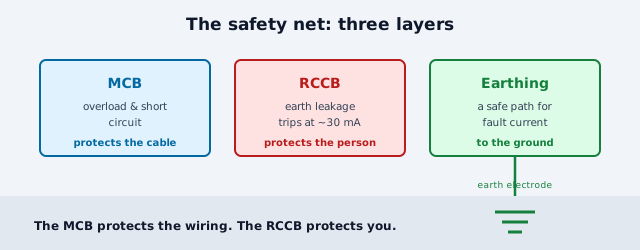
The distinction to carry away: the MCB protects the wiring; the RCCB protects the person. A home with MCBs but no RCCB is protected against fire but not against a fatal shock. A correctly installed 30 mA RCCB with proper earthing is the combination that saves lives — and verifying that your home has both, correctly wired, is one of the most valuable things an owner can ask an electrician to confirm.
Of every rupee spent on a home's electrics, the ones spent on earthing and an RCCB buy the most safety. They are invisible, they are boring, and they are the difference between a fault that trips a breaker and a fault that kills.
5. Load and capacity: how much power the home needs
An electrical system must be sized to the load — the total power the home's lights and appliances draw. Underestimate it and you get nuisance tripping, overheating and an installation you outgrow in a year; overestimate it wildly and you pay for capacity you never use.
The load is estimated by adding up the wattage of every appliance, then applying a diversity factor (because you never run everything at once) to arrive at the realistic maximum demand. That demand drives the sanctioned load you request from the DISCOM, the size of the main switch and cables, and the number of circuits.
This is important enough — and forward-looking enough, given ACs, EV chargers and induction cooking keep pushing home loads up — that it has its own tools and guide. Use the electrical load calculator for a first estimate, and read the home electrical planning guide for how load flows into circuit design and future-proofing.
6. The modern layers: efficiency, smart, solar and backup
A home's electrical system is no longer just "wires and switches". Four modern layers sit on top of the core, and a well-planned home makes room for them from the start.
- Energy efficiency. The single biggest lever is the appliances themselves: the Bureau of Energy Efficiency (BEE) star rating tells you how much power a fan, AC or fridge draws for the same work, and a 5-star AC can use a third less energy than a 1-star one over its life. LED lighting, efficient fans (including BLDC motors), and simply right-sizing appliances cut the bill and the load together.
- Smart controls. Smart switches, dimmers, sensors and energy monitors let a home schedule, automate and measure its electricity. The wiring decisions that make this easy — a neutral at every switch, conduit spare capacity — are cheap to plan and expensive to retrofit, which is why smart-readiness belongs in the design stage, not after.
- Renewable integration. Rooftop solar — governed by MNRE guidelines and your DISCOM's net-metering rules — can offset a large share of a home's consumption, and increasingly pairs with battery storage. A solar-ready home leaves roof access, conduit routes and DB space for it in advance.
- Backup power. Grid reliability varies across India, so inverters with batteries (for lights, fans and electronics) and generators (for whole-home or heavy backup) remain common. The choice, sizing and wiring — including an automatic transfer switch so backup engages cleanly — is a planning decision, not an afterthought.
Each of these is a cluster of its own on Studio Matrx; this pillar simply places them in the whole. The principle across all four is the same: the cheapest time to make a home efficient, smart, solar-ready and backup-ready is while the conduits are still open.
7. Living with it: maintenance and knowing when to call a professional
A home's electrical system is low-maintenance but not no-maintenance. A few habits keep it safe:
- Watch for warning signs: warm switch plates, a burning smell, flickering lights, sockets that spark, breakers that trip repeatedly, or a mild tingle from an appliance body. Any of these means stop using that point and call an electrician — they are the early symptoms of loose connections, earth faults or overload.
- Test the RCCB periodically using its test button (it should trip instantly); if it does not, it is not protecting you.
- Have the installation inspected by a licensed electrician on a sensible cycle — and always before buying an older home or after any water damage.
- Keep the DB accessible and labelled, and never store things against it or paint over it.
And the boundary, stated plainly one last time: replacing a fused lamp, resetting a tripped breaker, or unplugging a faulty appliance are ordinary homeowner acts. Opening the distribution board, altering wiring, adding circuits, or working on anything live are not. Those belong to a licensed, competent electrician — both because the risk is lethal and because, under India's electricity rules, that work is legally theirs to do. Knowing where that line sits is the mark of a genuinely informed homeowner.
The one-line answer
A home's electricity flows from the DISCOM supply through a meter to a distribution board, which splits it into protected circuits that reach every room through sized copper wiring; earthing and an RCCB form the safety net that makes it survivable; the load determines the whole design; and efficiency, smart controls, solar and backup are the modern layers best planned in from the start. Understand this chain and you can plan and judge your home's electrics — and know exactly where to hand over to a licensed electrician.
Where to go next
- Plan a new or existing home's electrics: Complete Guide to Home Electrical Planning.
- Building from scratch: Electrical Design Guide for New Homes.
- Fixing an old home: Electrical Renovation & Rewiring Guide.
- Beyond the home: Building Electrical Services Guide.
- Estimate your demand: Electrical Load Calculator.
References
- National Electrical Code of India, SP 30 : 2023 (Active), Bureau of Indian Standards: https://www.bis.gov.in/
- IS 732 : 2019, Code of Practice for Electrical Wiring Installations (Fourth Revision), BIS.
- IS 3043 : 2018, Code of Practice for Earthing (Second Revision), BIS.
- IS/IEC 62305 : 2010 (Parts 1–4), Protection Against Lightning, BIS.
- The Electricity Act, 2003, Ministry of Power, Government of India: https://powermin.gov.in/
- Central Electricity Authority (Measures relating to Safety and Electric Supply) Regulations, CEA: https://cea.nic.in/
- Bureau of Energy Efficiency (Standards & Labelling / star rating programme): https://beeindia.gov.in/
- Rooftop solar and net metering framework, Ministry of New and Renewable Energy (MNRE): https://mnre.gov.in/
This guide is written for homeowner literacy and planning. It is not a substitute for design or installation by a licensed electrician. Figures, wire sizes and ratings are indicative for typical Indian homes and must be verified against the current code and your actual installation by a competent professional. Verify any standard's current status via the BIS catalogue before relying on it.
Export this guide
Related Guides — Deep-dive reading
Future-Proof Wiring Systems for Indian Homes
Build electrical headroom now so tomorrow's loads are plug-and-play, not demolition.
Future-Ready HomesElectrical Safety for Security Systems in India (2026): Powering It Without Peril
A homeowner's guide to the power side of home and RWA security systems, CCTV, alarms, gates, access control and NVRs, done so it protects you instead of quietly becoming a shock or fire hazard. What makes a supply safe, what to insist on, and why the mains work belongs to a licensed electrician.
SecurityElectrical Fire Safety in India (2026): Overloads, Wiring and the Right Protection
Why electrical faults cause so many Indian building fires, and the fix: correct cable sizing and a properly designed board by a licensed electrician, MCB plus RCCB protection, no overloading, and never water on a live fire.
SecurityRelated Tools — Try Free
Electrical Safety & Load Audit
Home electrical audit — 10 categories, 65+ checkpoints across earthing, RCCB, MCB, wiring, switchboards, appliance circuits, DG/inverter backup.
Safety AuditElectrical Load Calculator
Estimate a home's connected load and realistic maximum demand from its appliances, whether it needs single or three-phase supply, and a suggested main switch rating.
ElectricalRainwater Tank Sizer
How big should your rainwater tank be? Computes annual harvest, recommended tank capacity in litres, water-bill savings, and payback — for 10 Indian cities.
RWH Calculator