
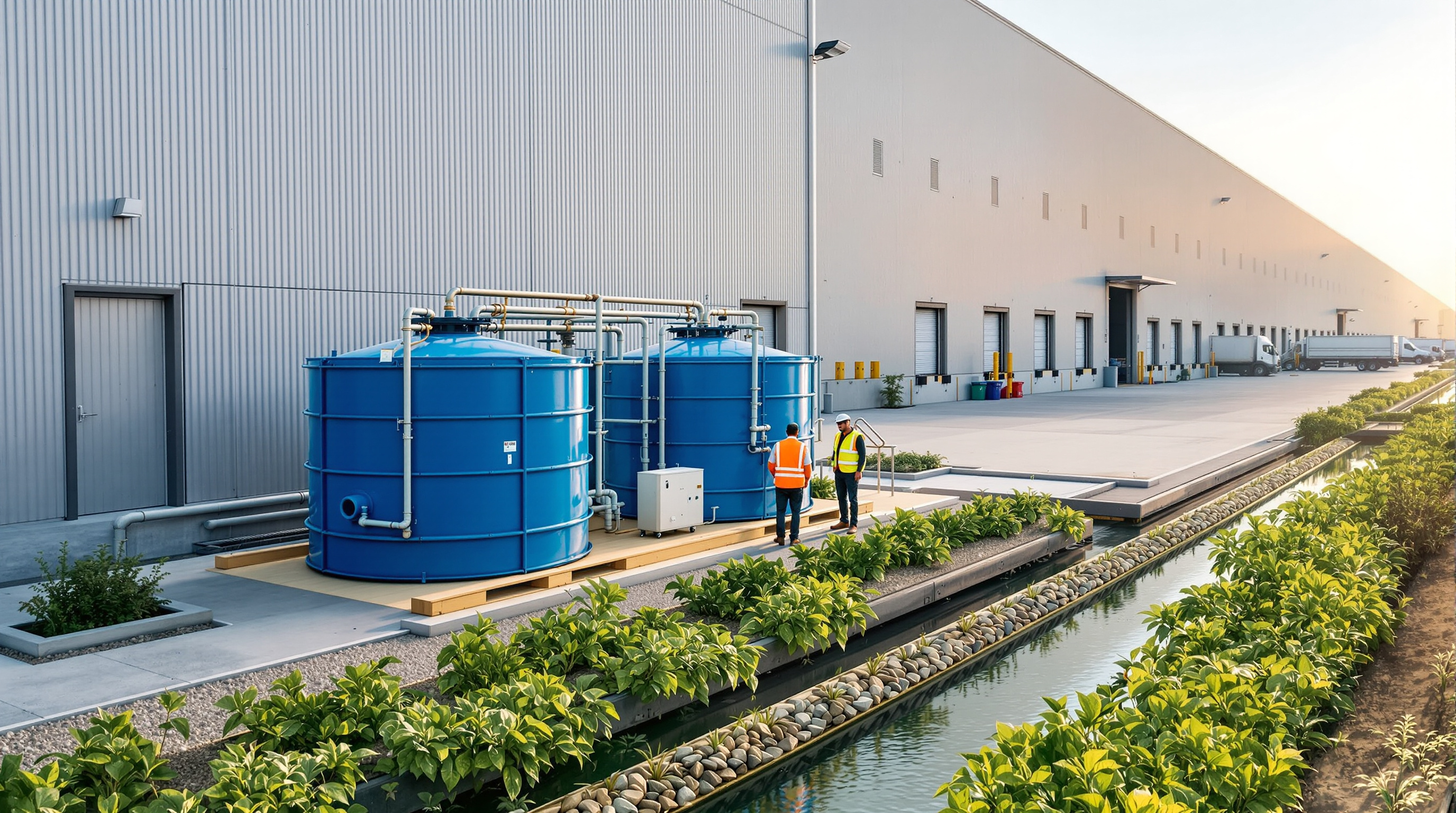
STP for Warehouses & Logistics Parks: Sizing, Packaged Plants & Reuse
Warehouses cover huge plots but hold very few people — so the sewage is small, spiky and easy to mishandle. Here is how to size an STP for a logistics park, when a packaged compact plant beats a septic system, and how to reuse every drop for dust suppression and landscape.
A warehouse is a strange building for a sewage engineer. It can cover four or five acres under one roof, carry a project cost in the tens of crores, and yet, on a normal shift, hold fewer people than a mid-sized villa. All that floor is for pallets, racking and forklifts — not for occupants. So the wastewater problem is almost the opposite of an apartment tower: a huge footprint producing a very small, very spiky flow of sewage.
That mismatch is exactly where warehouse STPs go wrong. Teams either over-build a plant sized for a factory that never fills up, or they wave the whole thing away with a septic tank that quietly fails its first pollution-board inspection. This guide is about getting it right for low-occupancy, large-footprint logistics — how much sewage a warehouse really makes, which technology fits, when a packaged compact STP beats a septic system, and how to put every treated litre back to work on dust and landscape.
A warehouse's sewage load is driven by its people, not its plot. Ten thousand square metres of storage with forty staff produces less sewage than a twelve-flat apartment building — but it still has to meet the same treated-water standard before that water leaves site.
The warehouse wastewater profile
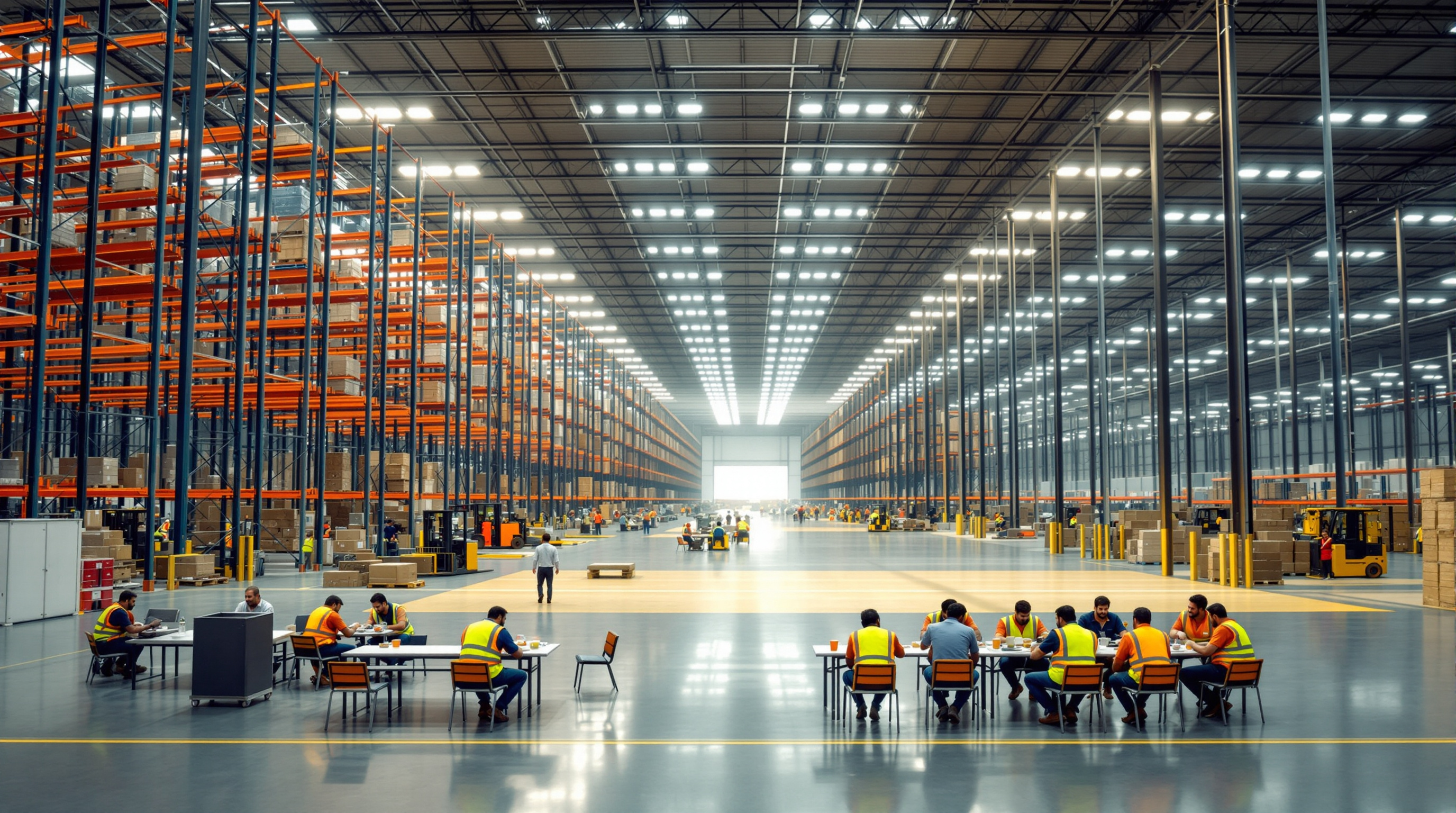
Before sizing anything, understand what makes this building type distinct. Three features shape every decision.
Low, headcount-driven volume. Sewage in a warehouse comes almost entirely from toilets, washbasins and a canteen or pantry — the domestic needs of the staff on shift. A distribution centre might run 30–80 people per shift across office, security, loading and housekeeping. At a domestic demand of roughly 45 LPCD for a workplace with canteen use, even 80 staff generate only in the region of 3–5 KLD of sewage — a fraction of what the same plot would make as housing. The sewage generation calculator will convert your exact headcount and shift pattern into a design flow.
A spiky, shift-driven flow pattern. The flow is not just small — it is lumpy. Break times, shift changes and the canteen lunch rush concentrate the day's sewage into a few sharp peaks, with long quiet stretches in between. A biological plant hates that. The microbes need a steady diet; feast-and-famine starves and then shocks them. This is why an equalisation tank is non-negotiable for a warehouse STP, even a tiny one — it is the buffer that turns three violent peaks into a calm, even trickle the biology can actually digest.
Special contaminants to watch. Domestic warehouse sewage is ordinary strength, but two things sneak in. A canteen or pantry adds oils and grease that will blind a biological plant if not intercepted — so a proper grease trap ahead of the STP matters more than the modest flow suggests. And if the site washes vehicles, floors or handles anything that drains hydrocarbons or chemicals, that stream is not domestic sewage and must never enter the STP — it needs its own oil-water separator or effluent handling. Mixing the two is the fastest way to kill an STP designed for sewage. For a refresher on the numbers that define sewage strength, see wastewater characteristics: BOD, COD, TSS, pH.
Septic tank or STP? The real decision
For a genuinely tiny warehouse — a single shed, a handful of staff, a couple of toilets — a septic tank with a soak pit can still be the honest answer, exactly as it is for a remote farmhouse. But most modern logistics parks cannot rely on one, for three reasons:
- Regulation. Above a threshold plot area or built-up size, pollution-control consent requires proper treatment to a defined discharge standard, not the passive settling a septic tank offers. A logistics park with multiple tenants almost always crosses that line.
- No safe discharge. A septic tank still produces an effluent that has to go somewhere. On a paved, high-water-table or space-tight industrial plot, there is often nowhere legal for it to soak away.
- Water value. A septic tank throws the water away. An STP recovers it — and on a hot, dusty logistics yard, treated water is genuinely useful.
The honest comparison, building type by building type, is laid out in STP vs septic tank. For most warehouses the conclusion is the same: install a small STP, not a septic system.
| Factor | Septic tank | Packaged STP |
|---|---|---|
| Treats water to reusable standard | No — settles only | Yes — meets discharge norms |
| Suits a multi-tenant logistics park | Rarely (consent limits) | Yes |
| Produces water for dust/landscape reuse | No | Yes, 80%+ recovered |
| Footprint on a paved plot | Needs soak field | Compact skid, minimal land |
| Handles spiky shift flow | Poorly | Yes, with equalisation |
Which STP technology fits a warehouse
The winning answer for low, variable flows is almost always a packaged, factory-built compact STP — a skid- or container-mounted unit delivered largely pre-assembled, rather than a civil-tank plant built up on site. It suits a warehouse for concrete reasons: it needs little land, installs fast alongside the main shed programme, and is sized for exactly the small flows we are dealing with.
On the biological process inside that package, the standout choice for this duty is MBBR (Moving Bed Biofilm Reactor). Its carrier media hold a robust, attached film of microbes that survives the feast-and-famine of shift work far better than a conventional suspended-growth plant — it tolerates the intermittent load and the periods when the site is quiet, then recovers quickly when the lunch peak hits. Read how it works in the MBBR guide.
Two alternatives are worth knowing:
- SBR (Sequential Batch Reactor) treats sewage in timed batches, which naturally matches a plant that fills up in surges — handy where flow is very intermittent. See SBR.
- MBR (Membrane Bioreactor) gives the highest, cleanest reuse-grade output, but it is usually over-specified and over-priced for a warehouse's modest needs unless the treated water has a demanding reuse (see MBR). For most sites it is more plant than the job requires.
Whatever the process, the four-stage journey — screen and equalise, treat biologically, settle, then filter and disinfect — is the same one every plant follows; the sewage treatment process flow walks through it end to end.
Sizing without over-building
The single most common mistake is sizing a warehouse STP off the plot or off some notional "future factory" load. Size it off people on shift, not square metres of racking. The steps:
1. Count realistic peak occupancy — office, warehouse, security and housekeeping staff on the busiest shift, plus any canteen diners.
2. Apply a workplace demand of roughly 45 LPCD (higher if there are showers or a full kitchen), and take sewage as about 80% of water supplied.
3. Add a modest design margin — say 10–20% — for phased tenant fill-up, not a 3x factor "to be safe."
4. Round to the nearest sensible packaged size — many warehouses land in the 5–15 KLD band.
Run your numbers through the STP capacity calculator and cross-check demand with the water consumption calculator. Two design cautions specific to warehouses: do not undersize the equalisation tank (the buffer is what makes a small plant behave), and beware the turndown problem — a plant sized for a fully leased park will run at a trickle on day one, so choose a technology and controls that tolerate running well below design flow during the lease-up years.
Where the treated water goes

This is the happy part of a warehouse STP, because the reuse demand on a logistics site is almost perfectly matched to the small volume produced:
- Dust suppression — the biggest win. Truck yards, unpaved margins and construction phases throw up dust constantly; treated water sprayed on roads and yards keeps it down without touching fresh supply.
- Landscape irrigation — the green buffer strips and frontage that industrial approvals increasingly mandate.
- Toilet flushing — piped back in a separate line, the standard reuse for the staff blocks.
- Truck and floor washing (non-potable areas) and groundwater recharge of the surplus.
Because the flow is small and the yard is thirsty, a warehouse can often reuse close to 100% of its treated water on site — dust and landscape alone will absorb it in the dry months. That turns the STP from a compliance cost into a genuine water source, exactly the logic behind why every modern building needs an STP.
Common mistakes on warehouse projects
- Sizing off the footprint, not the headcount — leads to a plant three times too big that runs starved and unstable.
- Skipping equalisation — the spiky shift flow then shocks the biology and the effluent fails.
- Letting canteen grease or vehicle-wash water into the STP — the first blinds the plant, the second poisons it; both need their own interception.
- Defaulting to a septic tank on a plot that has no legal soak-away or that crosses the consent threshold.
- No plan for the lease-up years — a multi-tenant park fills gradually, so the plant must run happily at a small fraction of design flow for a long time.
- Forgetting the operator — even a small packaged plant needs routine attention; an unmanned logistics site must budget for an AMC or trained caretaker.
Warehouses and logistics parks are, in the end, one of the easier building types to treat well if you respect the low-flow, high-spike character of the load and resist the urge to over-build. Get the equalisation right, pick a forgiving packaged process, and put the water on the dust — and the STP quietly earns its place. For the wider picture, browse the Sewage Treatment Plants guide library, or compare notes with the closely related STP for industrial parks and STP for office buildings.
Export this guide
Related Guides — Deep-dive reading
STP for IT Parks & Campuses: Central-Plant Design, Reuse & Redundancy Guide
How to plan a campus-scale sewage treatment plant for a multi-building IT park in India — the daytime flow pattern, the right technology, sizing for a central plant, and a reuse network feeding landscape, flushing and cooling towers.
Sewage Treatment PlantsSTP for Office Buildings & IT Offices: Sizing, Reuse & Design Guide
Why office STPs need lower per-person LPCD, a weekday-only flow strategy and a generous equalisation tank — plus which technology suits, how to size it, and where flushing and cooling-tower reuse pay for themselves.
Sewage Treatment PlantsSTP for Hotels: High Per-Guest Loads, FOG & Water Reuse Explained
Why hotel wastewater is heavier and swingier than an apartment's, which STP technology (MBBR vs MBR) actually fits, how to size for peak occupancy, and where the treated water pays for itself — in laundry, cooling and landscape.
Sewage Treatment PlantsRelated Tools — Try Free
Sewage Generation Calculator
Estimate the daily sewage a building generates and its peak flow in KLD from occupancy, LPCD, sewage return factor and peak factor.
STP CalculatorApartment STP Planner
Plan an apartment complex sewage treatment plant from flats and occupancy — get population load, sewage flow, recommended STP capacity in KLD, treatment technology and approximate space.
PlannerRainwater Tank Sizer
How big should your rainwater tank be? Computes annual harvest, recommended tank capacity in litres, water-bill savings, and payback — for 10 Indian cities.
RWH Calculator