
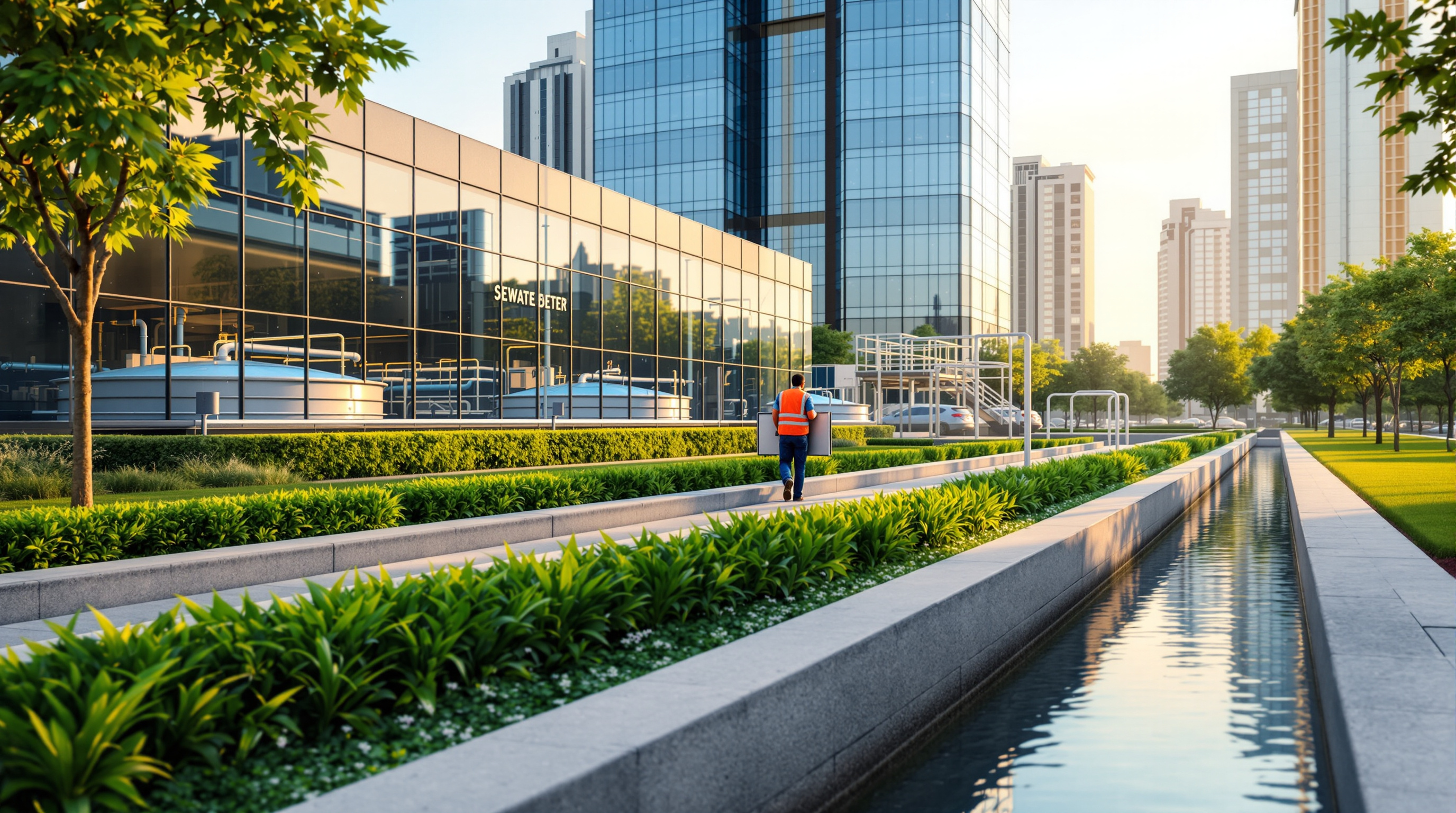
STP for Office Buildings & IT Offices: Sizing, Reuse & Design Guide
Why office STPs need lower per-person LPCD, a weekday-only flow strategy and a generous equalisation tank — plus which technology suits, how to size it, and where flushing and cooling-tower reuse pay for themselves.
An office building looks nothing like an apartment block from a wastewater point of view — and yet developers and consultants routinely size office STPs as if people lived there. They do not. Nobody bathes at their desk, nobody cooks dinner, and on Saturday evening the whole tower goes quiet. Get those differences right and an office sewage treatment plant is one of the easiest, cheapest and most reuse-friendly STPs you will ever build. Get them wrong and you end up with an oversized, half-starved plant that smells, trips its blowers and never quite meets norms.
This guide walks through the wastewater profile of offices and IT campuses, the technology that suits them, how to size for a weekday-only flow, and where the treated water actually pays for itself.
An office STP is defined by two numbers most designers get wrong: a low per-person LPCD because there are no baths or kitchens, and a spiky weekday-only flow that idles every weekend. Design for those two facts and everything else follows.
The wastewater profile of an office

In a home, water is consumed for bathing, cooking, washing clothes and flushing. In an office, almost all of it is flushing, hand-washing and a pantry. That single fact changes every number in the design.
- Low LPCD. A residential design assumes roughly 135 litres per person per day. An office occupant generates far less — commonly taken at around 45 LPCD (sometimes 25–50 depending on whether a canteen and showers are provided). Use the residential figure and you will double your tank sizes.
- Weekday-only, daytime flow. Sewage arrives in a sharp 9-to-7 band, five (or six) days a week, then drops to almost nothing on weekends and public holidays. There is no gentle overnight trickle to keep the biology fed.
- Concentrated, low-volume load. Because there is little grey water diluting it, office sewage can be relatively strong per litre — decent BOD and TSS in a small daily volume — while the total organic load stays modest.
- Special contaminants. Pantry and canteen discharges bring oil and grease; large IT campuses with full food courts behave more like a restaurant or mall and need serious grease interception. Cleaning chemicals and the occasional detergent slug can knock pH around.
If you want to convert your headcount into a design flow before reading further, the sewage generation calculator and the water consumption calculator will get you a defensible KLD figure in a minute.
Why equalisation is the whole game
Here is the trap. An office's flow is not just spiky through the day — it is spiky through the week. Monday to Friday the plant is hammered for ten hours; then it sits idle for 60+ hours. A biological STP is a living culture of microbes, and those microbes need to be fed. Starve them all weekend and Monday morning's slug hits a weakened, sluggish biomass.
The answer is a generously sized equalisation (EQ) tank — the buffer that catches the daytime surge and lets you feed the biology at a steady, controlled rate around the clock, including a trickle over the weekend to keep the culture alive.
- Size EQ for the peak-hour and peak-day pattern, not the daily average. Offices often need EQ volume equal to a large fraction of the day's flow — noticeably more than a residential plant of the same nameplate capacity.
- Keep the EQ tank aerated or mixed so it does not turn septic during the long idle periods.
- Use the EQ pumps to meter flow into the aeration tank so the biology sees a near-constant load even though people don't.
This is the single most important design decision for an office STP, and the one most often shortchanged. Read more on why in the equalisation and aeration fundamentals.
Which STP technology suits an office
The intermittent, weekend-off load pushes you toward technologies that tolerate variable flow and recover gracefully after idle periods.
| Technology | Fit for offices | Notes |
|---|---|---|
| MBBR | Excellent | Biofilm on carriers survives idle weekends better than suspended growth; compact, low-fuss. A common default for offices. |
| SBR | Very good | Batch operation naturally suits a start-stop, day-only flow; excellent effluent, good nutrient removal. |
| MBR | Good, premium | Smallest footprint and the cleanest effluent (ideal where reuse quality matters), but higher cost and O&M attention. |
| Conventional ASP | Workable | Reliable but larger footprint and more sensitive to being starved over weekends. |
For a basement plant in a tight IT tower where footprint is scarce and reuse quality is prized, an MBBR or MBR usually wins. For a campus with room to breathe, an SBR handles the weekly rhythm elegantly. Compare the mechanisms in the how an STP works guide before you commit.
Sizing considerations
Sizing an office STP is where the low LPCD and the spiky flow have to be reconciled.
1. Start from occupancy, not built-up area. Count desks and seats — including a realistic peak with visitors and shift overlap — then apply the office LPCD (~45). The STP capacity calculator does this conversion cleanly.
2. Add a diversity/peak factor, then buffer it in EQ. Do not oversize the biological reactor to swallow the peak; instead size the reactor for the averaged load and let a large EQ tank absorb the swing. This keeps the plant small, efficient and stable.
3. Plan for shifts and phasing. IT parks often fill up floor by floor over a year or two. A modular plant — commissioned in stages, or with MBBR media added as load grows — avoids running a half-empty plant that cannot sustain its biology in year one.
4. Right-size the blowers with turndown. Variable-speed or staged aeration lets you throttle down on weekends and up on Monday, saving power and protecting the culture.
A properly sized office plant is often surprisingly small relative to a residential building with the same headcount — the low LPCD is doing that for you.
Where the treated water pays for itself
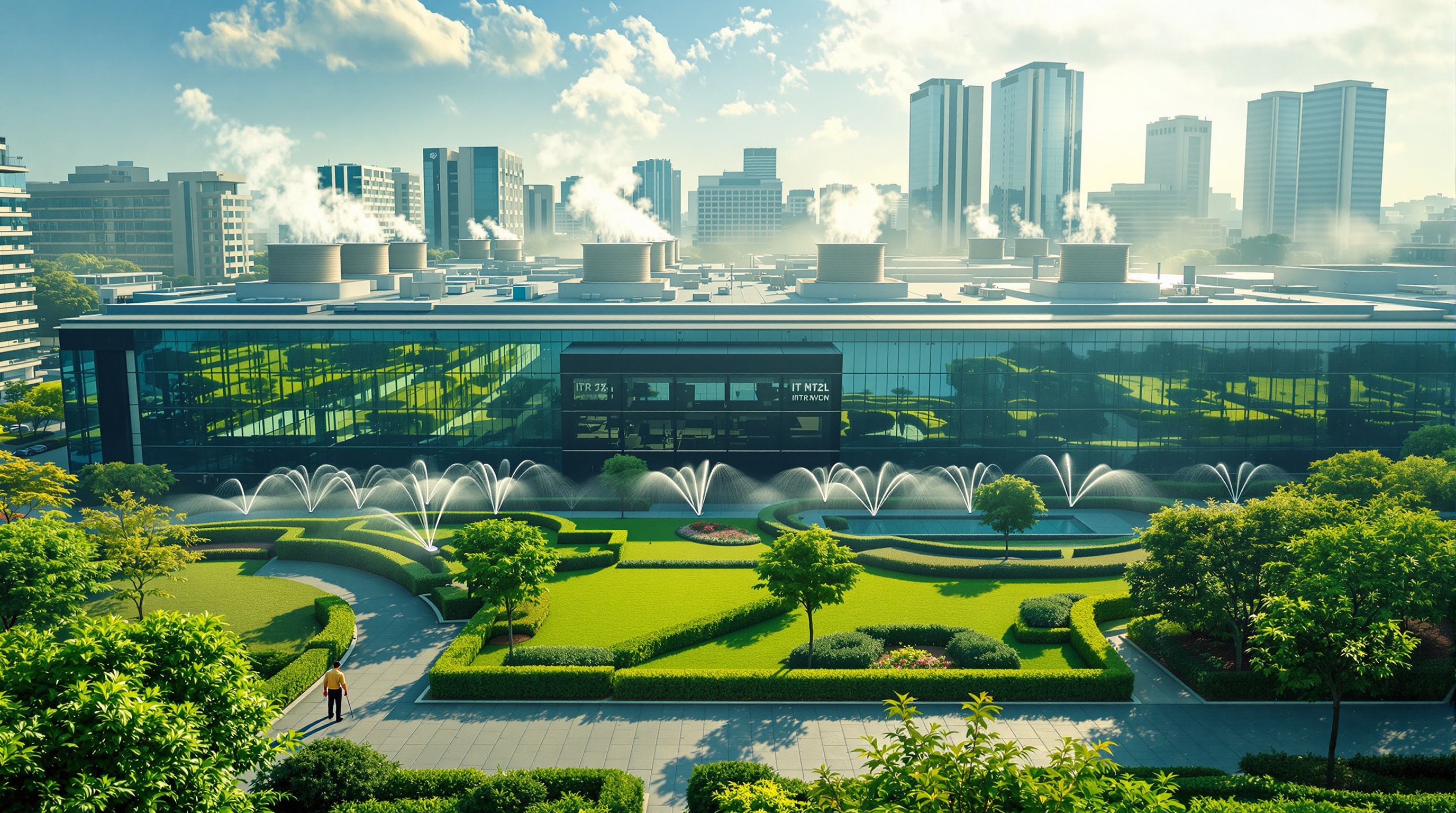
This is where offices shine. An air-conditioned commercial building has two enormous, thirsty reuse sinks that residential buildings mostly lack.
- Flushing. In an office, flushing is the dominant water use, so treated water goes straight back into the biggest demand on site — a near-perfect closed loop.
- Cooling-tower make-up. Central HVAC in an IT tower evaporates large volumes of water every day. Feeding cooling towers with treated (and suitably polished) STP water is one of the highest-value reuse routes in any building type — provided you control TDS, hardness and biological fouling first.
- Landscape irrigation for campus lawns and green buffers.
- Groundwater recharge for the surplus, tying into any rooftop and site water-recycling scheme.
Because flushing and cooling together can absorb most of what the plant produces, office STPs routinely achieve very high reuse rates — which is also why they earn strong green-building credits. IGBC and GRIHA ratings reward on-site treatment, water reuse and reduced freshwater draw; a well-integrated office STP contributes directly to a platinum-chasing scorecard. If you are treating cooling-tower reuse seriously, aim for the tighter effluent quality that MBR or a polished MBBR/SBR train delivers.
Compliance notes
- On-site treatment is expected for commercial developments above the applicable thresholds under state pollution-control board rules (aligned with CPCB direction and NBC provisions). Treated effluent must meet the prescribed BOD, COD, TSS and pH limits before reuse or discharge — see the wastewater characteristics primer for what those numbers mean.
- Dual plumbing (a separate flushing line) is effectively mandatory to realise the reuse the approval assumes.
- Provide monitoring, and where required online metering, so you can demonstrate compliance during the long idle weekends when a struggling plant is most likely to slip.
Common mistakes and challenges
- Sizing at residential LPCD. The number-one error — it produces a plant twice as large as needed, which then runs starved and underloaded.
- Undersizing equalisation. Ignoring the weekday-only, daytime-only pattern leaves the biology lurching between feast and famine. EQ is not optional here.
- Letting the plant go septic over weekends. No feed, no aeration, and by Monday you have odour and a knocked-back culture. Keep a weekend maintenance feed and keep EQ mixed.
- Forgetting pantry grease. A food court on an IT campus needs grease traps sized like a restaurant's, not an afterthought.
- Cooling-tower reuse without polishing. Dumping secondary effluent into cooling towers invites scaling and biofouling — polish and dose it properly.
- Not planning for phased occupancy. A single large plant serving a slowly filling tower cannot hold its biology; go modular.
The bottom line
An office STP rewards designers who respect two facts: people at desks use little water, and they use it only on weekdays. Size from occupancy at office LPCD, invest in a generous equalisation tank, pick a resilient technology like MBBR or SBR, and route the clean water back into flushing and cooling towers where the demand is biggest. Do that and you get a compact, cheap-to-run plant that quietly earns its green-building credits.
Start with your numbers in the STP capacity calculator, then browse the full sewage treatment plants guide library for the technology deep-dives. If your project is really an IT park or a mixed campus, read that companion guide next.
Export this guide
Related Guides — Deep-dive reading
STP for IT Parks & Campuses: Central-Plant Design, Reuse & Redundancy Guide
How to plan a campus-scale sewage treatment plant for a multi-building IT park in India — the daytime flow pattern, the right technology, sizing for a central plant, and a reuse network feeding landscape, flushing and cooling towers.
Sewage Treatment PlantsSTP for High-Rise Buildings: Solving the Vertical Challenges
Why an STP in a tower is a different animal from one in a low-rise block — sharp peak flows, a basement site starved of air and light, treated water that has to be pumped forty floors up, and odour and fire clearances that decide whether the plant gets signed off at all.
Sewage Treatment PlantsSTP for Shopping Malls: Mixed Loads, Big Reuse
Why a mall's wastewater is unlike any other building's — a punishing mix of food-court grease, washroom peaks and huge cooling-tower thirst — and how to size, site and choose an STP that turns all of it back into usable water in the basement.
Sewage Treatment PlantsRelated Tools — Try Free
Rainwater Tank Sizer
How big should your rainwater tank be? Computes annual harvest, recommended tank capacity in litres, water-bill savings, and payback — for 10 Indian cities.
RWH CalculatorSewage Generation Calculator
Estimate the daily sewage a building generates and its peak flow in KLD from occupancy, LPCD, sewage return factor and peak factor.
STP CalculatorApartment STP Planner
Plan an apartment complex sewage treatment plant from flats and occupancy — get population load, sewage flow, recommended STP capacity in KLD, treatment technology and approximate space.
Planner