
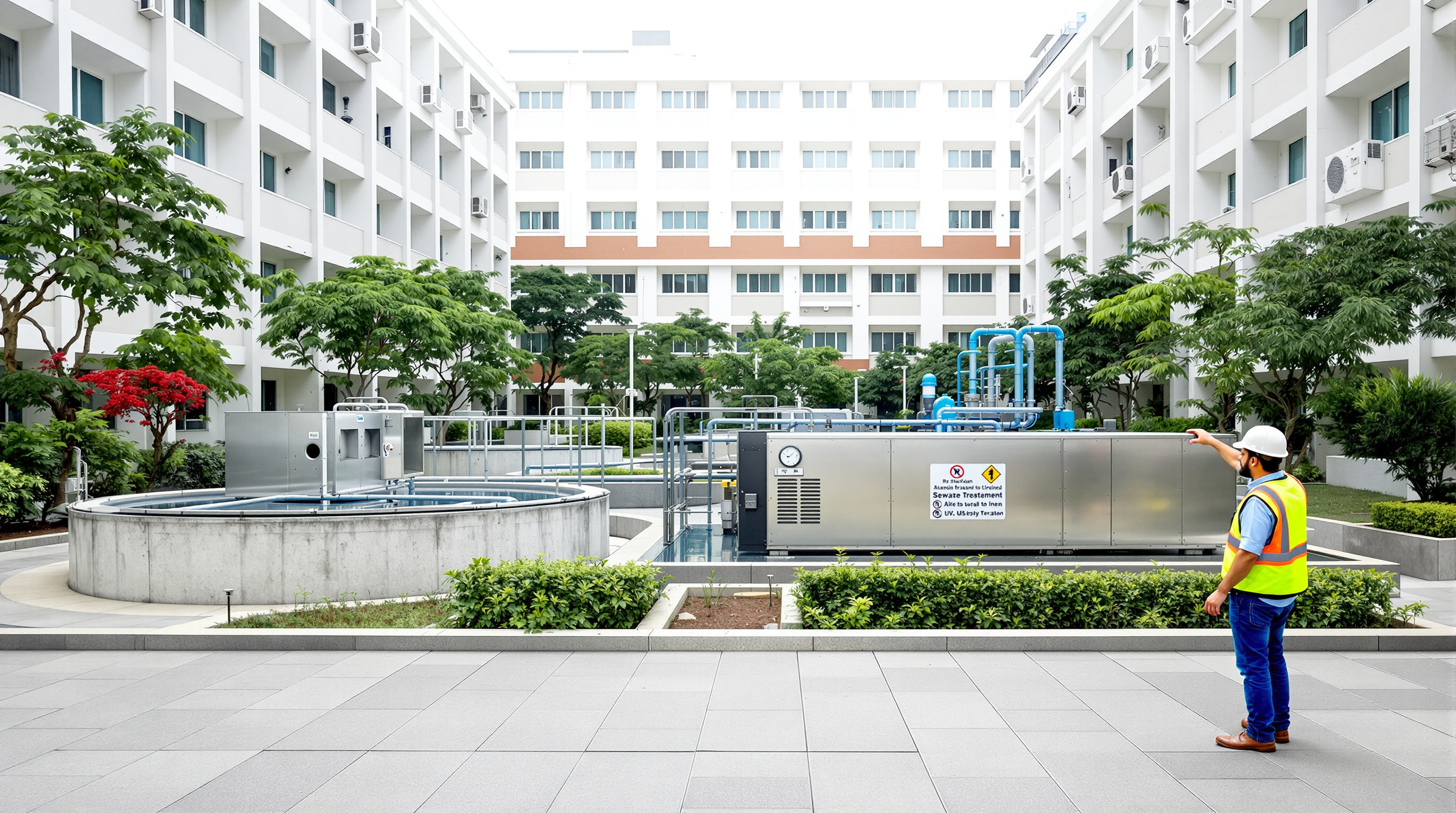
STP for Hospitals: Higher Standards, Disinfection & Compliance
Hospital wastewater carries a heavier pathogen load — and sometimes pharmaceutical and chemical traces — than any ordinary building. This guide explains why a hospital STP needs stricter disinfection, higher reliability, and where it starts to edge into ETP territory.
A hospital never sleeps. Operating theatres, wards, laboratories, dialysis units, canteens, laundries and hundreds of toilets all drain into the same pipes, round the clock. And unlike an apartment block or an office, a hospital's wastewater is not just used water — it is water that has washed over wounds, instruments, soiled linen, laboratory samples and medicines. That single fact changes everything about how its STP for hospitals must be designed, operated and disinfected.
If you have read what an STP actually is, the core principle is unchanged: microbes eat the organic waste, solids settle, and the water is filtered and disinfected. But a hospital raises the stakes on the last step, tightens the reliability requirement to near-absolute, and — depending on what the facility does — can start to blur the line between a sewage plant and an effluent plant. This guide walks through what makes hospital sewage different and how a competent design answers it.
Ordinary sewage is dangerous because it rots. Hospital sewage is dangerous because it can infect. The whole design brief shifts from "clean the water" to "clean the water and guarantee no live pathogens leave the gate."
What makes hospital wastewater different
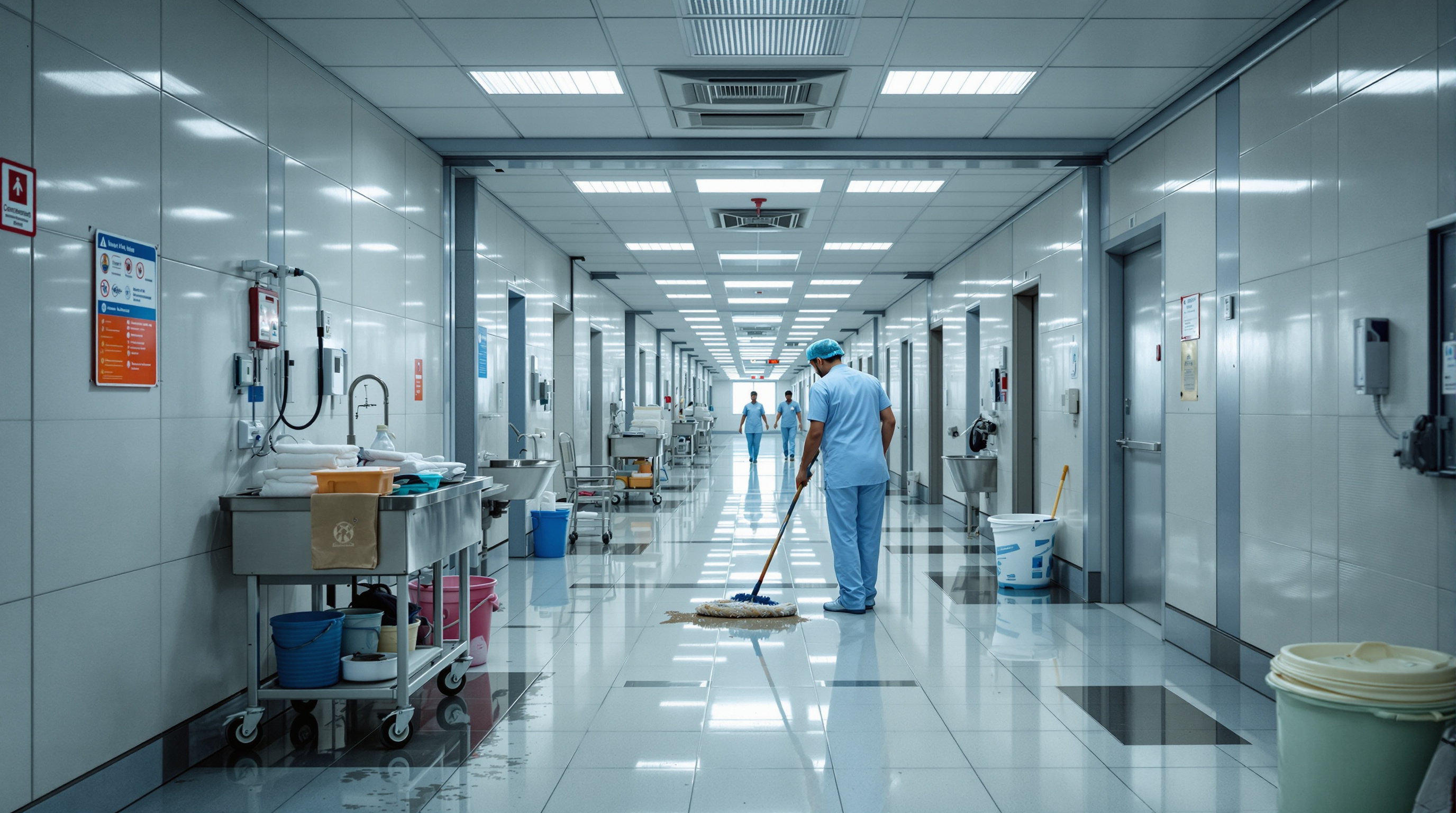
Domestic sewage from homes is more than 99% water, with organic matter, solids, nutrients and some pathogens. Hospital sewage carries that same base load — plus a set of contaminants that most building STPs never have to think about:
- A far higher and more virulent pathogen load. Bacteria, viruses and drug-resistant organisms shed by patients concentrate in ward and toilet waste. This is the defining hazard.
- Pharmaceutical residues. Antibiotics, cytotoxic (chemotherapy) drugs, hormones and their metabolites pass through patients into the drains. These are not removed by ordinary biological treatment and, worse, antibiotics can suppress the very microbes the STP relies on.
- Chemicals and disinfectants. Phenols, chlorine-based cleaners, formaldehyde, laboratory reagents and radiology contrast media. Heavy slugs of disinfectant can shock and kill the biological culture.
- Higher, spikier organic strength. Kitchens, canteens and laundries push BOD, COD, oil and grease well above a residential profile.
Because of these traces, hospital effluent sits in an awkward middle ground. Most general-ward and administrative sewage is genuine domestic sewage and belongs in an STP. But wastewater from certain streams — pathology and research labs, radiology, and any on-site handling of cytotoxic drugs — carries chemical loads closer to industrial effluent, which is ETP territory. The correct answer is almost always segregation: keep the genuinely hazardous chemical streams out of the main STP and treat or collect them separately, so the biological plant receives sewage it can actually digest.
Which STP technology suits a hospital — and why
The technology choice is driven by three demands: a stable biology that shrugs off shock loads, a consistently high-quality effluent the disinfection stage can finish reliably, and a compact, low-odour footprint that fits on a constrained hospital campus. In practice two technologies dominate.
| Technology | Why it fits a hospital | Watch-outs |
|---|---|---|
| MBBR (Moving Bed Biofilm Reactor) | Biofilm on carriers is robust against shock loads and toxic slugs; compact; low sludge; tolerant of variable flow | Effluent still needs strong tertiary + disinfection to hit pathogen limits |
| MBR (Membrane Bioreactor) | Membrane physically filters out solids and most bacteria, giving the cleanest, most reliable effluent — ideal where reuse and pathogen safety are paramount | Higher capex and power; membranes foul faster on greasy/chemical-laden waste; needs skilled O&M |
For many mid-sized hospitals, a well-designed MBBR followed by a rigorous tertiary and dual-disinfection train is the pragmatic choice. Larger, newer or reuse-focused hospitals increasingly specify MBR, because the membrane itself acts as a barrier to bacteria — a huge advantage when the whole point is to stop pathogens leaving. The older Activated Sludge Process and SBR are used too, but their sensitivity to shock loads makes them a weaker fit unless equalisation is generous. Whatever the core reactor, it is the aeration tank biology that must be protected, because a hospital STP that loses its microbes at 2 a.m. cannot simply stop accepting sewage.
Disinfection: the non-negotiable step
In an ordinary building STP, disinfection is the polite finishing touch. In a hospital it is the main event. Best practice is dual-barrier disinfection — do not rely on a single method:
- Chlorination — dosing sodium hypochlorite (or equivalent) with adequate contact time in a chlorine contact tank. Chlorine is proven, cheap and leaves a residual that keeps killing bacteria in the reuse pipework. But it must be dosed correctly: too little fails, too much creates harmful chlorinated by-products and corrodes fittings.
- UV (ultraviolet) disinfection — passing the clear treated water past UV lamps to destroy bacterial and viral DNA. UV is fast, chemical-free and highly effective against many pathogens, including some chlorine-resistant organisms — but it leaves no residual, and it only works on genuinely clear water (turbidity shields microbes from the light).
The two are complementary, which is why serious hospital designs use both: UV for a broad, chemical-free kill, chlorination for the residual protection downstream. The target is a treated effluent with faecal coliform driven down to the low levels regulators require and, ideally, a measurable chlorine residual in any water sent to reuse. Getting there depends on the water reaching the disinfection stage being clear — which is why the tertiary filtration stage (pressure sand and activated carbon filters) is not optional in a hospital: cloudy water cannot be reliably disinfected.
Sizing and reliability considerations
Sizing starts the same way as any plant — headcount and per-capita flow — but a hospital's number is measured per bed, not per person, and it runs high because of laundries, kitchens, labs and constant cleaning. As a rough planning figure, engineers often reckon on the order of 400–600+ litres per bed per day for a full-service hospital (far above a residential LPCD), and more where laundry and central sterile services are large. Translate your bed count into a design flow with the sewage generation calculator, then convert that to plant capacity in KLD using the STP capacity calculator; cross-check demand with the water consumption calculator.
Beyond raw capacity, a hospital STP is judged on reliability, and that drives several design decisions ordinary buildings can skip:
- Generous equalisation. A large equalisation tank absorbs the spikes — a shift changeover, a laundry discharge, a slug of disinfectant — and feeds the biology a steady diet.
- Redundancy (N+1). Standby blowers, duty/standby pumps and, ideally, the ability to keep treating during maintenance. A hospital cannot afford an STP that is "down for repairs."
- Backup power. The STP must ride through outages on the hospital's DG supply — untreated hospital sewage backing up is a public-health event, not an inconvenience.
- Continuous monitoring. Online sensors and alarms so a failing disinfection dose or a crashed biology is caught immediately, not at the next monthly test.
Reuse opportunities — with a safety caveat
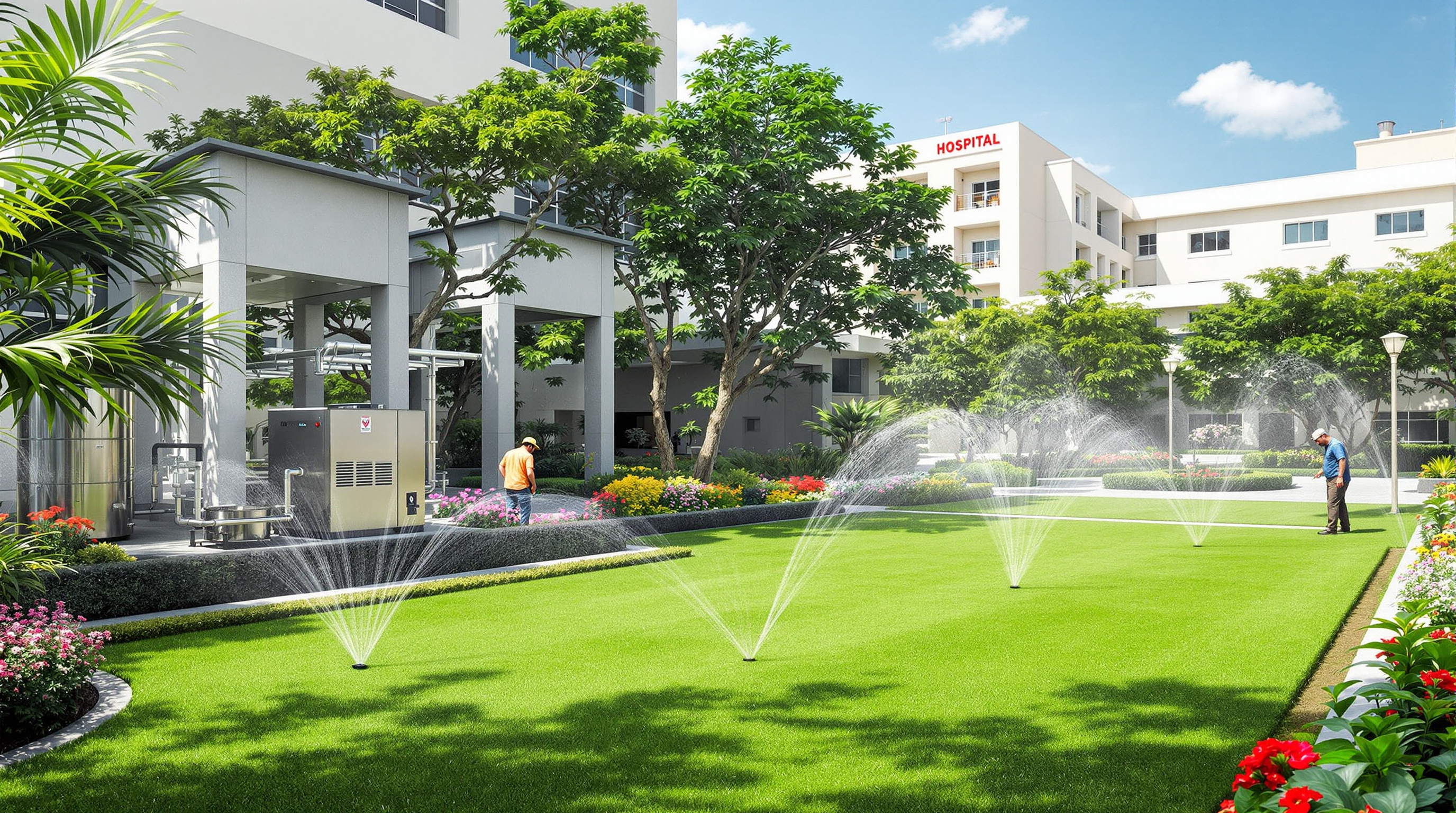
A hospital consumes enormous quantities of water and can productively reuse its treated effluent, cutting both freshwater bills and discharge volumes. Sensible, safe reuse includes:
- Toilet and urinal flushing via a separate dual-plumbing line.
- Landscape and garden irrigation across the campus.
- Cooling-tower make-up for large HVAC/chiller plants.
- Groundwater recharge of the surplus.
The caveat is important: because of the pathogen and pharmaceutical concern, hospital reuse water should be held to a higher bar than a housing society's, kept well away from any patient-contact or potable use, and disinfected to a verified standard before it re-enters the building. When in doubt, restrict reuse to flushing, landscaping and cooling — never anything a patient or their food might touch.
Common mistakes and challenges
The failures on hospital projects repeat themselves, and every one is avoidable:
- Treating hospital sewage like apartment sewage. Under-sized disinfection and no dual barrier is the single most common — and most dangerous — mistake.
- Not segregating hazardous streams. Letting lab reagents, cytotoxic waste and heavy disinfectant slugs into the main STP shocks the biology and lands the effluent in ETP-grade territory the plant was never built for.
- Skimping on equalisation and redundancy. A hospital plant with no buffer and no standby fails exactly when it is needed most.
- Undersized or poorly maintained filtration. Cloudy water defeats both UV and chlorine — the pathogens sail straight through.
- Weak O&M. Antibiotic-laden influent, membrane fouling and precise chlorine dosing all demand a trained operator, not a part-time caretaker. Hospital STPs punish neglect.
The bottom line
A hospital STP does the same fundamental job as any other — collect, digest, settle, filter, disinfect, reuse — but with the volume turned up on the two things that matter most: disinfection and reliability. Choose a shock-tolerant biology (MBBR or MBR), protect it by segregating chemical and cytotoxic streams, build in redundancy and backup power, and finish with dual-barrier chlorination plus UV on genuinely clear water. Do that, and the plant reliably turns one of the most hazardous wastewaters any building produces into a safe, reusable resource. To go deeper on the technology and the norms, browse the Sewage Treatment Plants guide library, and compare notes with the closely related demands of an STP for hotels.
Export this guide
Related Guides — Deep-dive reading
STP for Hotels: High Per-Guest Loads, FOG & Water Reuse Explained
Why hotel wastewater is heavier and swingier than an apartment's, which STP technology (MBBR vs MBR) actually fits, how to size for peak occupancy, and where the treated water pays for itself — in laundry, cooling and landscape.
Sewage Treatment PlantsSTP for IT Parks & Campuses: Central-Plant Design, Reuse & Redundancy Guide
How to plan a campus-scale sewage treatment plant for a multi-building IT park in India — the daytime flow pattern, the right technology, sizing for a central plant, and a reuse network feeding landscape, flushing and cooling towers.
Sewage Treatment PlantsPharmaceutical Wastewater Treatment: Why It Needs an ETP, Not an STP
Pharma effluent carries high COD, toxic and refractory compounds, swinging pH and traces of active drug ingredients — a load that overwhelms a domestic STP. Here is what makes it so hard to treat, and the ETP train engineers build to handle it in India.
Sewage Treatment PlantsRelated Tools — Try Free
Sewage Generation Calculator
Estimate the daily sewage a building generates and its peak flow in KLD from occupancy, LPCD, sewage return factor and peak factor.
STP CalculatorRainwater Tank Sizer
How big should your rainwater tank be? Computes annual harvest, recommended tank capacity in litres, water-bill savings, and payback — for 10 Indian cities.
RWH CalculatorApartment STP Planner
Plan an apartment complex sewage treatment plant from flats and occupancy — get population load, sewage flow, recommended STP capacity in KLD, treatment technology and approximate space.
Planner