
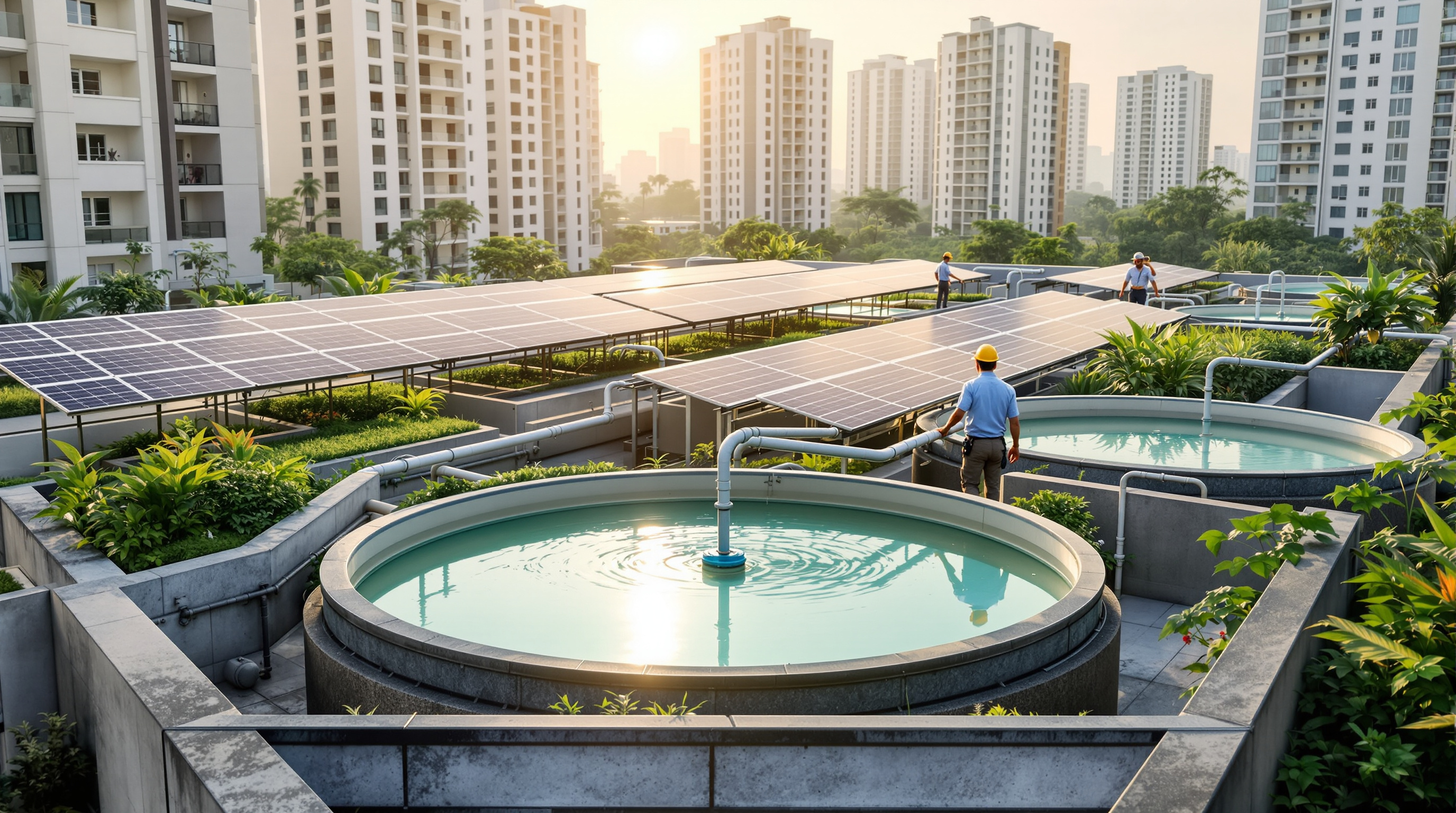
Reducing an STP's Carbon Footprint: The Net-Emissions Guide
An STP burns power around the clock — but the treated water it produces displaces tankered and pumped freshwater. This guide shows how to weigh the two, then shrink the net carbon footprint with efficient aeration, solar and biogas.
An STP is one of the few pieces of building equipment that runs twenty-four hours a day, every day, for its entire life. Blowers push air, pumps lift water, and the meter never stops turning. On a carbon ledger that looks like a liability — a plant that quietly burns grid electricity, and with it coal, from the moment it is commissioned.
But that is only half the entry. Every kilolitre of treated water the STP produces is a kilolitre of freshwater a building does not have to buy, pump from a deep borewell, or receive by diesel tanker. Those avoided activities carry emissions of their own. The honest question for a developer, RWA or consultant is not "how much carbon does the STP emit?" but "what is its net footprint once the water savings are counted?" — and then, how do you push that number down.
An STP is not simply a carbon cost. It is a carbon trade: grid power spent on treatment against the pumping, tankering and freshwater extraction that recycled water displaces. Managed well, the trade can come out close to even — and with solar and biogas, in your favour.
The two sides of the ledger
Start by naming the flows honestly. On the cost side sits the plant's operating energy; on the credit side sits everything the reused water avoids.
| Carbon COST (emissions the STP creates) | Carbon CREDIT (emissions the STP avoids) |
|---|---|
| Grid electricity for blowers, pumps, filters, UV | Diesel tanker water trips displaced |
| Direct methane and nitrous oxide from the process | Deep borewell / municipal pumping energy saved |
| Sludge hauling and disposal transport | Freshwater treatment and long-distance conveyance |
| Embodied carbon of concrete, steel and membranes | Reduced load on the municipal sewer and its plant |
The single biggest number on the cost side is electricity, and within electricity the single biggest consumer is aeration — the blowers that keep the biological culture supplied with oxygen. Aeration alone typically accounts for 50–65% of an STP's total power draw. If you want to reduce an STP's carbon footprint, you reduce aeration energy first; everything else is a rounding error by comparison. Our companion guide on reducing STP electricity consumption drills into the specific-power numbers.
Measuring the footprint honestly
Two figures let you convert an STP into carbon. The first is specific power consumption — the kilowatt-hours the plant spends per kilolitre treated. A well-run conventional plant lands around 0.6–1.0 kWh/KL; a tired, oversized or badly controlled one can drift well past 1.5. The second is the grid emission factor — how much CO₂ each unit of Indian grid electricity carries. India's grid is still coal-heavy, so roughly 0.7 kg CO₂ per kWh is a reasonable working figure, though it improves each year as renewables grow.
Multiply the two and you have the operating carbon per kilolitre. A 500 KLD plant at 0.9 kWh/KL is drawing about 450 units a day — a genuine, ongoing emission that shows up on the electricity bill and, increasingly, in green-building disclosures.
Against that, size the credit. Water arriving by diesel tanker in a stressed city is remarkably carbon-heavy per litre because of the transport; borewell water pumped from great depth is energy-heavy too. When treated water displaces those sources for flushing, landscaping and cooling towers, the avoided emissions are real. The carbon-savings calculator lets you enter your reuse volume and local water source to estimate the net position rather than guess at it.
Lever 1 — Make aeration efficient
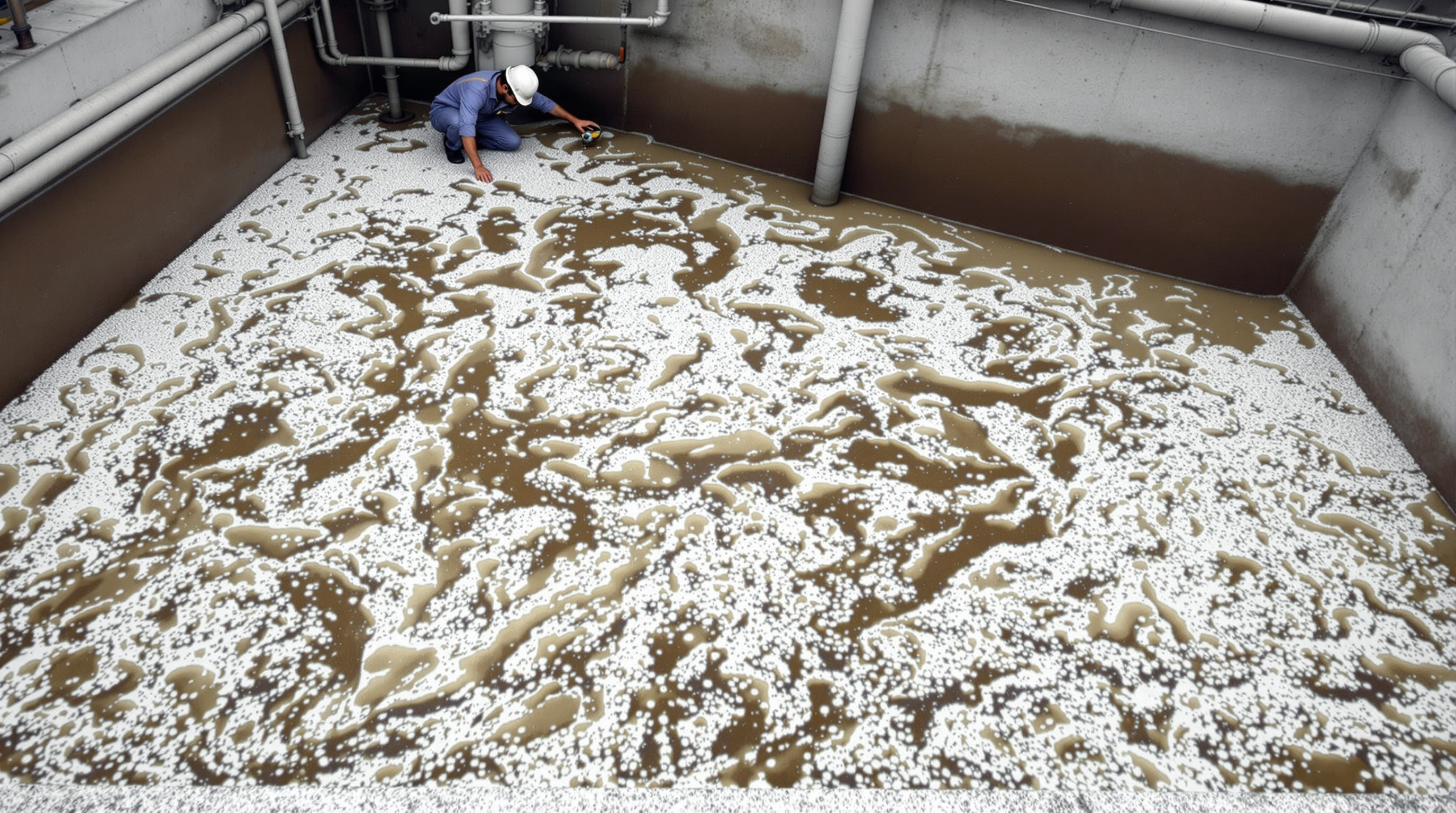
Because aeration dominates, small efficiency gains here beat heroic savings anywhere else.
- Fine-bubble diffusers transfer far more oxygen per unit of air than coarse-bubble or surface aerators. Retrofitting them is one of the highest-return carbon moves on an older plant.
- Dissolved-oxygen (DO) control — a DO probe feeding a VFD on the blower — stops the plant over-aerating at night and during low flow. Most fixed-speed plants run their blowers flat out regardless of load, wasting a third of aeration energy.
- Right-sizing matters at design stage: an STP sized for a full occupancy that never arrives spends years running half-empty and inefficient. Get the demand right with the water balance calculator before locking the blower selection.
Technology choice interacts here too. An MBBR or SBR plant with good controls can be leaner than an old extended-aeration basin, while an MBR buys superb effluent quality at the price of higher energy for membrane scouring — a trade worth making with eyes open.
Lever 2 — Put solar on it
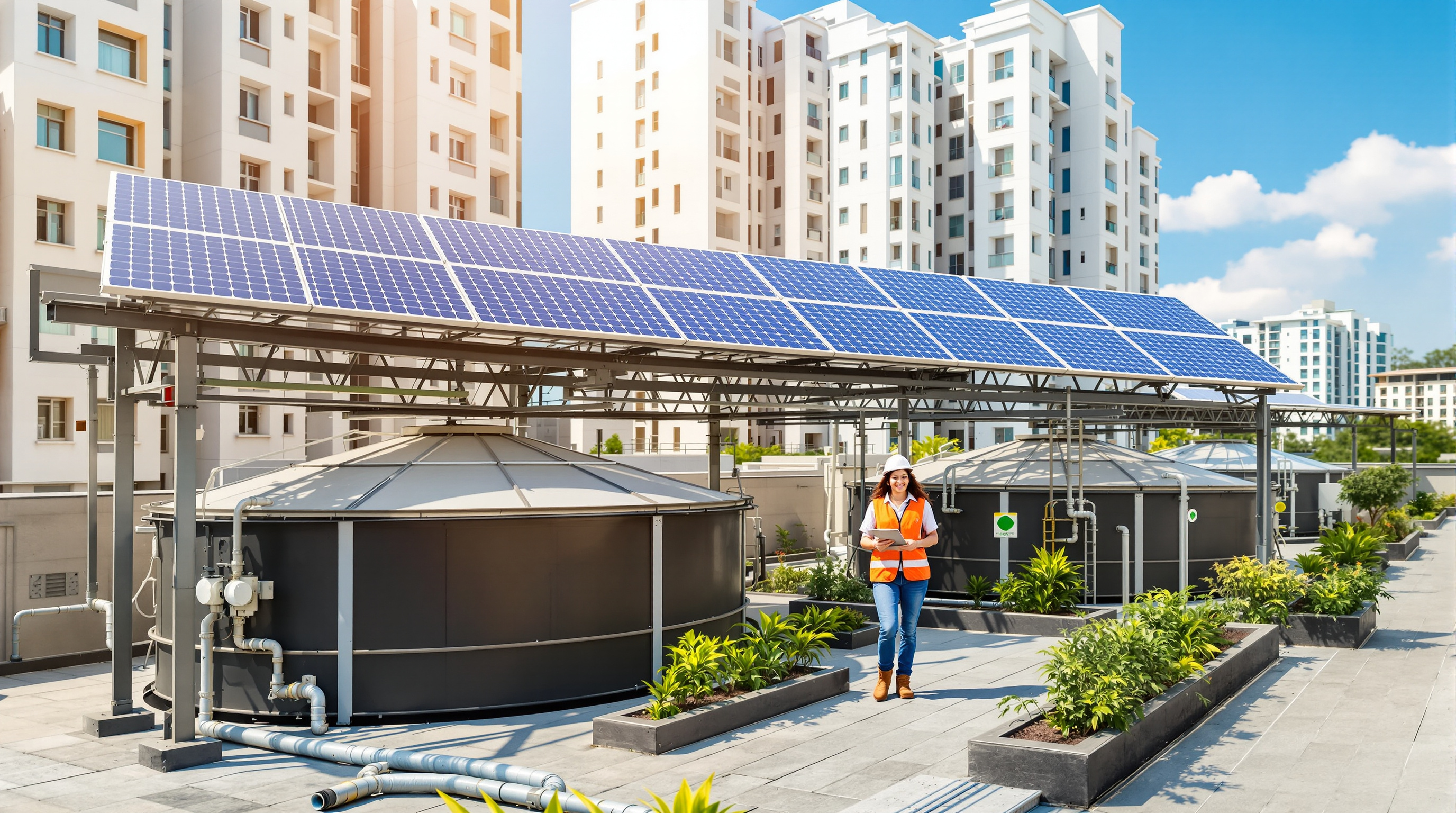
An STP has a rare quality among building loads: it runs during the day, every day, with a large, predictable base demand. That is an almost ideal match for rooftop or ground-mount solar. Covering even the daytime aeration load with on-site PV directly swaps coal-grid electrons for zero-carbon ones, and in most Indian tariff bands it pays back in a handful of years.
Solar rarely covers the full 24-hour draw without storage, but it does not need to. Shifting the daytime blower and pump load onto solar can knock a large slice off the plant's grid emissions, and pairs naturally with the wider ambition of net-zero and water-positive buildings.
Lever 3 — Capture biogas where scale allows
Aerobic STPs — the common apartment and commercial type — spend energy adding oxygen. Anaerobic digestion does the opposite: it breaks down sludge and organic load without oxygen and releases biogas, a methane-rich fuel that can be burned to generate power or heat on site.
At smaller decentralised scale, full biogas capture is often not viable — the volumes are modest and the equipment adds complexity. But for large campuses, townships and clusters, anaerobic pre-treatment or sludge digestion turns a portion of the waste stream into energy and, crucially, captures methane that would otherwise leak. Methane is a far more potent greenhouse gas than CO₂, so preventing its escape is a double win.
The emerging tools — promising, not magic
There is real interest in AI-driven operation, IoT monitoring and digital twins to trim STP energy by tuning aeration in real time and catching drift before it wastes power. The logic is sound: better control of the DO setpoint is exactly where energy hides. Be clear-eyed, though — in the Indian decentralised market these are still early and unevenly proven. A reliable DO probe wired to a VFD delivers most of the benefit today at a fraction of the cost and complexity. Treat AI and digital twins as an optimisation layer on top of good fundamentals, not a substitute for them.
Bringing it together
- Measure first. Know your kWh/KL and your reuse volume; you cannot reduce a footprint you have not quantified.
- Attack aeration. Fine-bubble diffusers plus DO-based VFD control is the highest-return carbon move on almost any plant.
- Add solar to swap daytime grid power for clean power on a load that runs every day.
- Capture biogas where the scale justifies it, and prevent methane leakage.
- Count the credit. The reused water is displacing tankers and deep pumping — that avoided carbon is part of the true, net number.
Done together, these turn the STP from a standing carbon liability into something close to carbon-neutral — and a genuine contributor to green-building water credits under IGBC and GRIHA. To put numbers on your own plant, start with the carbon-savings calculator, then return to the Sewage Treatment Plants guide library to go deeper on the technology and cost choices behind each lever.
Export this guide
Related Guides — Deep-dive reading
Energy-Efficient STP Design: How to Build a Plant That Sips Power
Aeration eats 50-70% of an STP's electricity bill. This guide shows how right-sized blowers, fine-bubble diffusers, DO control with VFDs, gravity flow and the right technology cut running cost for the life of the plant.
Sewage Treatment PlantsMBR STP Cost Guide: What a Membrane Bioreactor Really Costs in India (2026)
Why MBR carries the highest capital and running cost of any sewage treatment technology in India — membranes, power and replacements — and exactly when that premium pays for itself through water reuse and a smaller footprint.
Sewage Treatment PlantsAeration Design Principles for STPs: Oxygen Demand, Diffusers & Blower Sizing
How engineers actually size the aeration system at the heart of a sewage treatment plant — from oxygen demand and alpha/beta factors to SOTE, fine versus coarse bubble diffusers, blower selection and the energy bill that follows for decades.
Sewage Treatment PlantsRelated Tools — Try Free
Green Building Water Score Calculator
Score a building's water efficiency 0–100 from treated-water reuse, rainwater harvesting, low-flow fixtures and metering, with an IGBC/GRIHA-style rating and your biggest improvement lever.
SustainabilityRainwater Tank Sizer
How big should your rainwater tank be? Computes annual harvest, recommended tank capacity in litres, water-bill savings, and payback — for 10 Indian cities.
RWH CalculatorSTP Technology Comparison Matrix
Compare Extended Aeration, MBBR, SBR, MBR and UASB across six criteria, set your priority, and see the best-fit STP technology instantly.
Comparator