
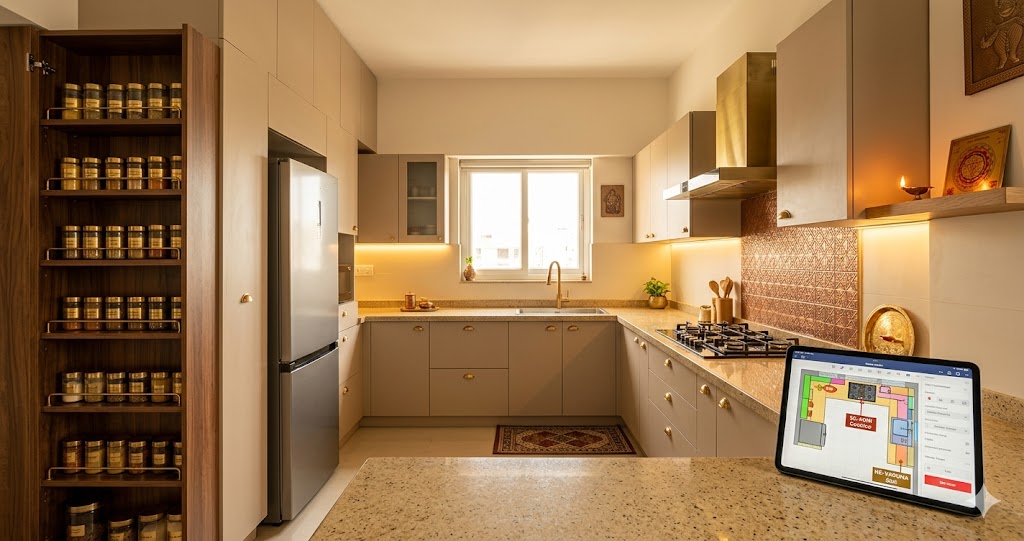
AI Modular Kitchen Planner — Cabinet, Appliance, Vastu AI for Indian Kitchens (2026)
L/U/parallel/island/peninsula · SE Agni · India counter heights · Hettich/Hafele/Blum
The Indian modular kitchen is a ₹26,000-crore market in 2026 — and the kitchen is the single most rule-bound room in a 3 BHK. Cabinet runs follow Vastu, counter heights follow Indian cooking ergonomics, hardware comes from three German oligopolies via India, and the pull-out larder has to swallow 40 masala jars and a 10 kg sack of basmati. Generic AI room planners pretend this room is the same as a Hamburg kitchen. It is not.
An AI modular kitchen planner is finally specialising for India — solving cabinet-layout optimisation, appliance placement, India-specific shapes (L, U, parallel, island, peninsula), Vastu alignment (SE Agni for the cooktop, NE for the sink), counter heights tuned to the 5'2"–5'6" Indian female cook, tall pull-out larder modules for masala/dal, and brand-aware quoting across Sleek, Wurfel, Veneta Cucine, Hacker, Bonito, and DIY ecosystems. Studio Matrx ships a kitchen-rulebook tool that bakes these constraints into the layout step itself — so a Whitefield homeowner gets a Vastu-clean, Hettich-quoted L-shape in twelve minutes, not twelve site visits.
The Indian kitchen is the only room in a 3 BHK where Vastu, ergonomics, hardware, brand, and budget collide in 110 square feet. Every other room forgives mistakes. The kitchen does not — you live with that hood, that drawer slide, that counter height for fifteen years.
For the broader context, pair this with AI interior design, AI room planner, AI-powered interiors, Indian kitchen design, modular kitchen India buyer's guide, and the non-negotiable Vastu for kitchen playbook. This guide refreshes every 12 months. Last verified: May 2026 · Next verify: May 2027.
What AI Modular Kitchen Planner Actually Means (and What It Doesn't)
An AI modular kitchen planner is a domain-specialised design system that, given a kitchen footprint (length × width, door/window/duct positions), occupant data (cook height, family size, vegetarian/non-veg mix, frequency of large-vessel cooking), and brand budget, generates one or more cabinet layouts with:
- a shape decision (L, U, parallel/galley, island, peninsula) justified by footprint and workflow;
- module-level placement of base units, wall units, tall units, corner solutions, appliance housings;
- hardware specification (drawer slides, hinges, lift-ups, pull-outs) keyed to Hettich India / Hafele India / Blum India catalogues;
- counter and shutter material call-outs (Indian-grain teak, BWR ply carcass, acrylic / laminate / membrane / lacquer shutters);
- a Vastu overlay that respects the SE Agni cooktop, NE sink, NW refrigerator conventions where the homeowner asks for it;
- an itemised quote that maps modules to vendor SKUs and prices in ₹.
In one paragraph: it is the first AI tool that treats the kitchen as a constraint problem (Vastu × ergonomics × hardware catalogue × budget × shape), not as a furniture-arrangement problem.
Five things AI modular kitchen planner is NOT:
1. It is not a generic room planner rotated 90 degrees. A planner that auto-places a sofa cannot place a wall-mounted RO unit, a 1200 mm cooktop with chimney CFM clearance, and a tall pull-out larder with 6 baskets — these are kitchen primitives.
2. It is not a CAD replacement for the carpenter's shop drawing. The planner gives you the layout, modules, and BoQ. The fabricator still produces the 1:1 cutting list, edge-banding sequence, and on-site adjustment.
3. It is not an appliance recommendation engine in disguise. It places the chimney, hob, oven, microwave, dishwasher, fridge correctly — it does not tell you to buy Faber over Elica.
4. It is not a Vastu app. Vastu is one overlay among many. If the homeowner doesn't want it, it is silent. If they do, it ranks layouts by Vastu-cleanliness and never invents pseudo-science.
5. It is not a substitute for a kitchen designer on site. The planner gets you 80% of the way; the designer handles dust extraction routing, gas-line approval, granite slab grain matching, and the inevitable wall that is 12 mm out of square.
Why AI Modular Kitchen Planner Matters in 2026 India
Five forces are colliding right now in Indian metros.
1. The market is at ₹26,000 crore and growing 16% CAGR. Modular kitchens are no longer aspirational — every new premium 3 BHK launched in Bengaluru Whitefield, Mumbai Powai, Delhi NCR Gurgaon Sector 79, Pune Hinjewadi, and Hyderabad Gachibowli ships with a modular kitchen quote in the brochure. KPMG India's 2025 home-interiors report pegs kitchens at 22–28% of the average Bengaluru 3 BHK interior spend (₹4.5–6.5 lakh on a ₹20 lakh total fit-out).
2. Vastu compliance has become a hard buyer requirement. A 2024 Anarock home-buyer survey across eight metros found 68% of homeowners under 45 explicitly ask for Vastu-compliant kitchen orientation when shortlisting flats. A planner that ignores SE-cooktop / NE-sink loses the brief in the first meeting.
3. The Hettich / Hafele / Blum hardware oligopoly is mature in India. Hettich India operates two plants (Vadodara, Jamshedpur) supplying every Tier-1 city. Hafele India has 50+ design studios. Blum India runs experience centres in Mumbai, Bengaluru, Delhi NCR. Any planner worth installing must speak these catalogues fluently — drawer-slide weight class, hinge crank angle, lift-up gas-strut sizing — because the carpenter will quote in these SKUs anyway.
4. The big-five Indian modular kitchen brands have standardised the conversation. Sleek Kitchens (Asian Paints), Hacker Kuchen (German, distributed by HomeLane and others), Veneta Cucine India, Bonito Designs, Wurfel Kuche — each has a price band, a shutter language, and a typical quote envelope. AI can compare them honestly.
5. India has unique kitchen primitives no foreign planner solves natively: the tall pull-out larder for 40 masala jars and 8 dal varieties; the wet-and-dry sink split; the dosa-tawa storage; the pressure-cooker shelf depth; the chapati platform at 750 mm not 850 mm; the rangoli space; the temple-shelf cut-in; the dedicated overhead unit for the dabbas of pickle and ghee that the previous generation handed down; the gas-cylinder cabinet sized for two 14.2 kg cylinders side-by-side (still the reality in 60% of Indian metro homes despite PNG rollout); the cabinet under the sink that has to accommodate an RO + water purifier + waste segregation bin, not a single dustbin; the chimney aesthetic that has to be visible (Indian families want to see they bought a chimney — a fully concealed European island hood reads as missing).
The seam Studio Matrx fills: every other AI planner today (Coohom, Foyr, Planner 5D, IKEA) treats the kitchen as a parametric furniture set. None of them check Vastu by default, none speak Hettich India catalogue numbers, none know that a 12'×10' Bengaluru kitchen needs a 2400 mm tall larder column or the homeowner will cry on day 30. Studio Matrx's kitchen-rulebook is the only India-first ruleset in production today. It is also the only planner that, by default, exports the BoQ in a format that Indian carpenters can read in 5 minutes — module name, internal width, hardware SKU, shutter material, edge band, qty — rather than a 40-page European-style technical drawing the carpenter will set aside and re-draw from scratch.
The 8 Capabilities That Matter
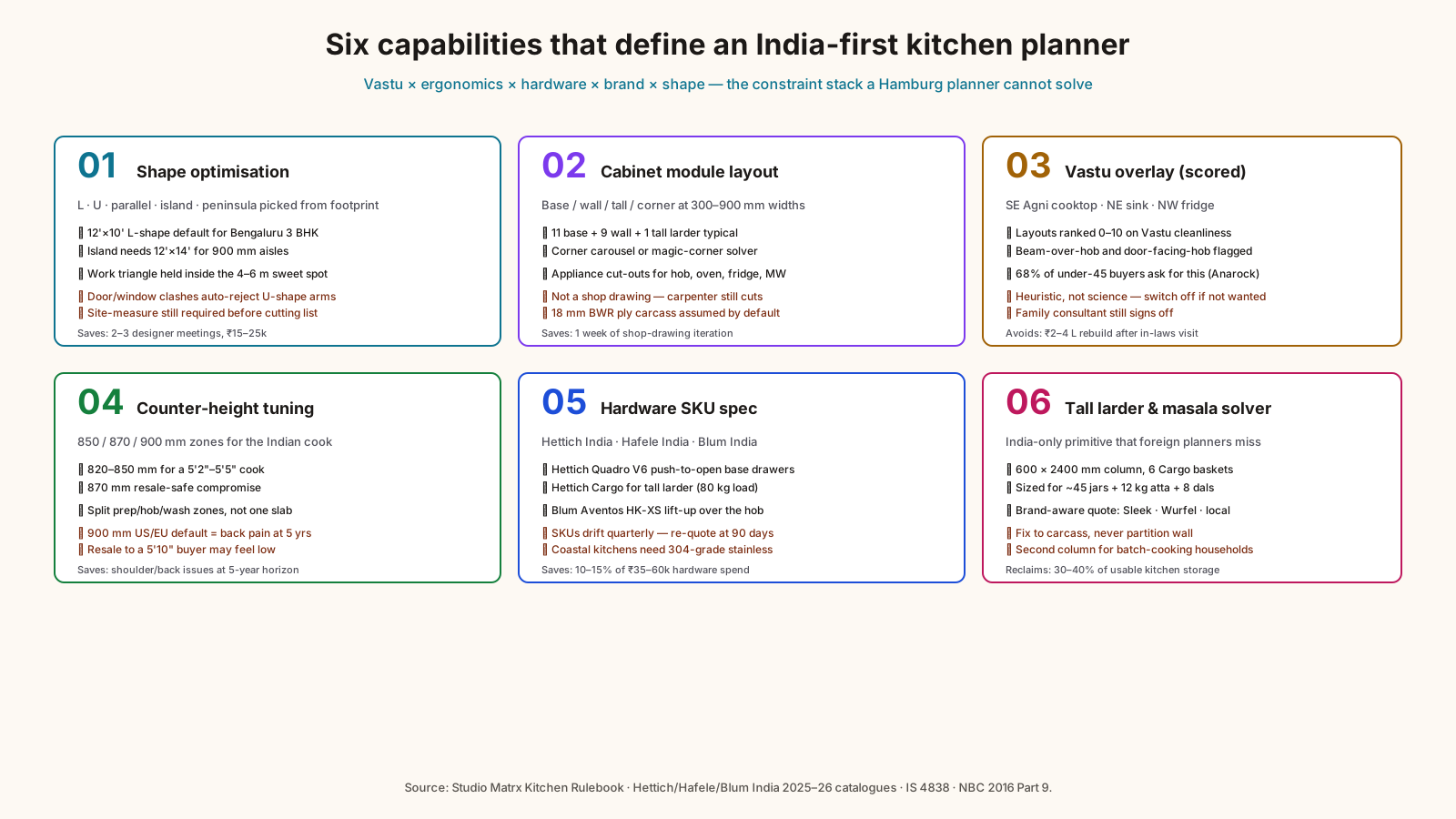
| Capability | What it does | Time / cost saved | Studio Matrx flow |
|---|---|---|---|
| Shape optimisation (L/U/parallel/island/peninsula) | Picks the right shape for the footprint, work-triangle and family size | 2-3 designer meetings (₹15-25k) | Kitchen-rulebook → shape decision step |
| Cabinet module layout | Places base, wall, tall, corner modules at standard 300/450/600/900 mm widths | 1 week of shop-drawing iteration | Furniture-planner + kitchen-rulebook |
| Vastu overlay (SE cooktop, NE sink, NW fridge) | Scores each layout for Vastu and re-orients where physically possible | Avoids a rebuild after the in-laws visit (₹2-4 lakh) | Vastu-for-kitchen cross-check |
| Counter-height tuning | Sets 850/870/900 mm zones for prep, cooking, washing based on cook's height | Eliminates back-pain at 5 years of use | Ergonomics-guide + dimension-handbook |
| Hardware spec (Hettich/Hafele/Blum) | Quotes specific drawer-slide / hinge / pull-out SKUs | 4-6 hours of carpenter back-and-forth | Material-rate-library + vendor-comparison |
| Appliance placement | Reserves and dimensions hob, chimney (CFM-sized), oven, microwave, dishwasher, fridge cut-outs | Avoids ₹40-60k of re-cutting | Kitchen-rulebook + dimension-handbook |
| Brand-aware quoting (Sleek/Wurfel/Veneta/Hacker/Bonito) | Maps the layout to each brand's price band | 3-4 brand walk-throughs (a Saturday each) | Cost-benchmark + quotation-generator |
| Tall larder / masala storage solver | Sizes the Indian-specific larder column for jar counts, dal sacks, atta tin | Reclaims 30-40% of usable storage | Kitchen-rulebook (Indian-storage rule) |
How Studio Matrx Does AI Modular Kitchen Planning — End-to-End Walkthrough
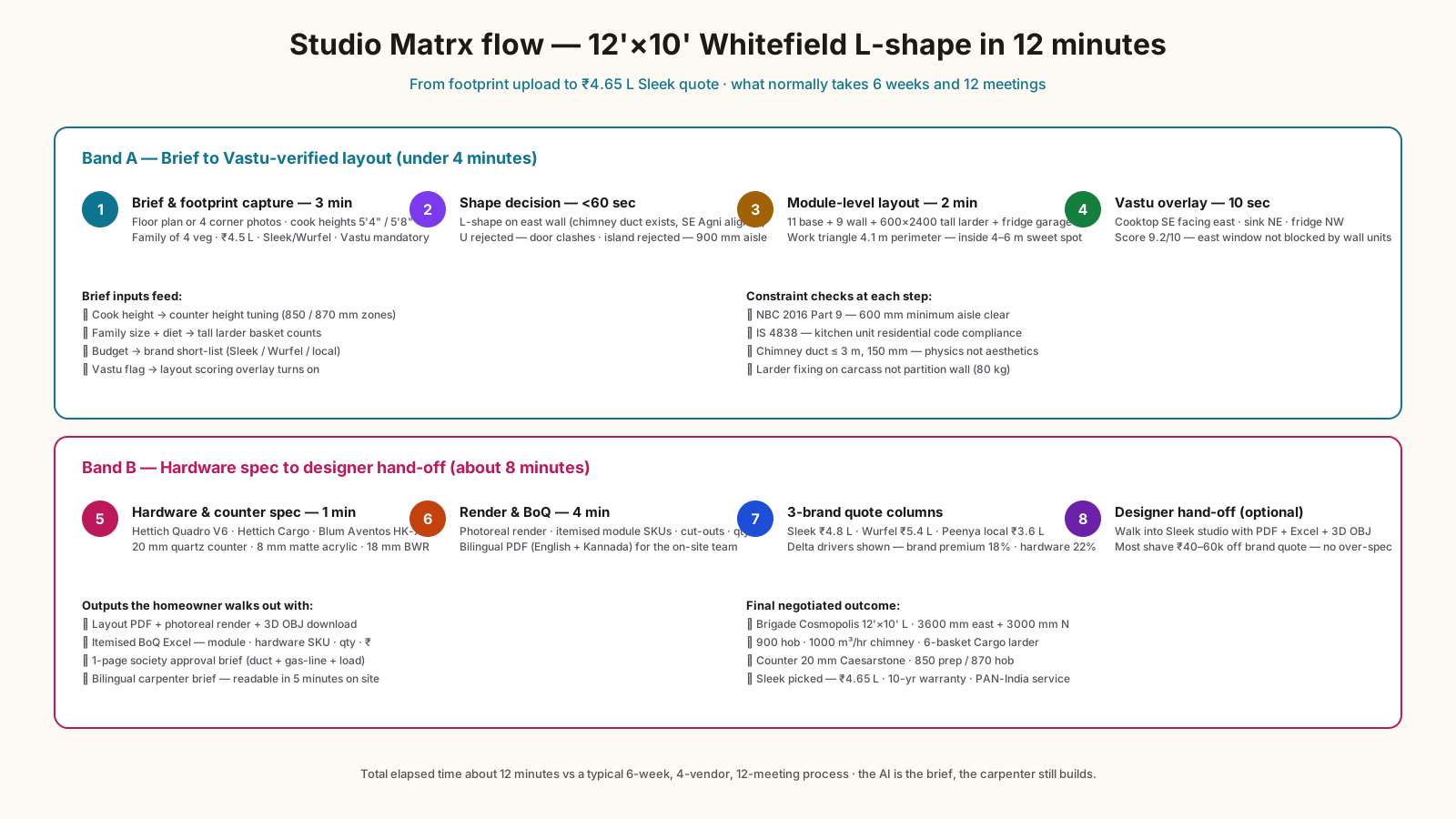
This is the actual flow a Whitefield homeowner runs today for a 12' × 10' L-shape kitchen in a Brigade 3 BHK.
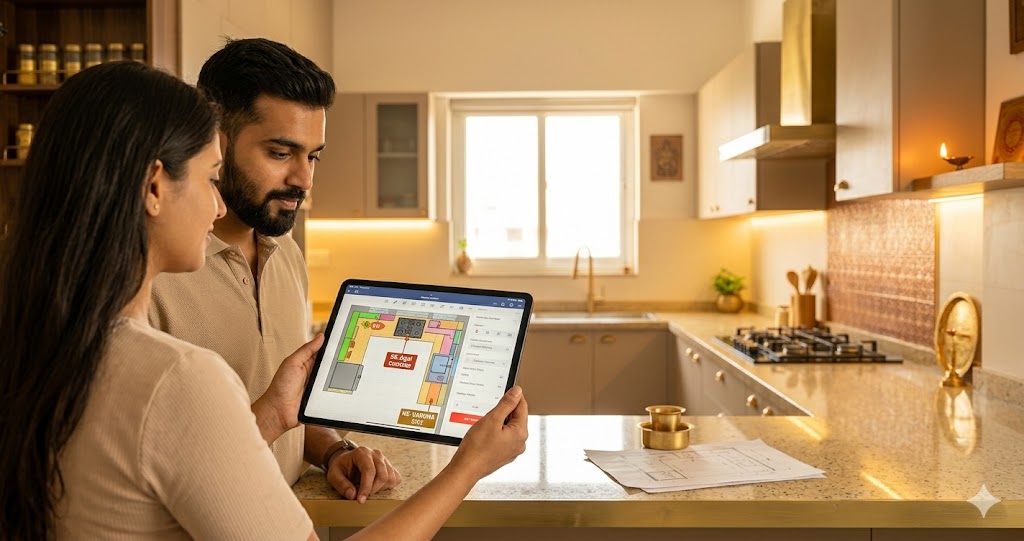
Step 1 — Brief and footprint capture (3 minutes). The homeowner uploads the kitchen floor plan (or takes 4 corner photos and the dimensions). They tell us: cook height (5'4" wife, 5'8" husband alternating), family of 4 vegetarian, daily Indian cooking, twice-a-month large-batch (festival, guests), budget ₹4.5 lakh, brand preference Sleek or Wurfel, Vastu mandatory, deadline 8 weeks. The AI onboarding and client discovery tools collect this.
Step 2 — Shape decision (under 60 seconds). Studio Matrx's kitchen-rulebook engine evaluates the 12' × 10' rectangle, the window on the east wall, the door on the north, the existing chimney duct above the east wall. It outputs: L-shape recommended (cooktop on east wall to align with SE Agni and existing chimney duct; sink on north wall near the NE corner; tall larder column on the west wall behind the door). U-shape rejected because the door would conflict with the third arm. Island rejected because 12' × 10' leaves less than 900 mm aisle.
Step 3 — Module-level layout (2 minutes). The planner places 11 base modules (600 + 900 sink + 900 hob + 450 + 600 + corner 900 carousel + 600 + 600 + 600 + 450), 9 wall modules with profile lift-ups for the lift-up cabinet over the hob, 1 tall larder column (600 × 2400 mm with 6 Hettich Cargo baskets), a 600 mm tall oven housing, and a 600 mm tall fridge garage. The work triangle (sink-cooktop-fridge) measures 4.1 m perimeter — inside the 4-6 m sweet spot.
Step 4 — Vastu overlay (10 seconds). Cooktop is in the SE quadrant facing east — Vastu-clean. Sink is in the NE quadrant — Vastu-clean. Fridge is in the NW — acceptable. Wall units do not block the east window. The layout scores 9.2/10 on the Vastu-for-kitchen rubric. The full check cross-links into Vastu for kitchen.
Step 5 — Hardware and counter spec (1 minute). Drawer slides: Hettich Quadro V6 push-to-open for base drawers, Hettich Cargo for the tall larder, Blum Aventos HK-XS for the lift-up over the hob. Hinges: Hettich Sensys soft-close. Counter: 20 mm quartz (Caesarstone or Indian equivalent) at 850 mm for prep zone, 870 mm for hob zone (Indian-cook ergonomics, not US 900 mm). Shutters: 8 mm acrylic in matte finish to match the homeowner's moodboard. Carcass: BWR ply, 18 mm.
Step 6 — Render and BoQ (4 minutes). Studio Matrx generates a photoreal render of the L-shape, then an itemised BoQ: each module SKU, each hardware SKU, each appliance cut-out, total carcass square-footage, shutter square-footage, counter running-foot, labour estimate. The quotation generator outputs three columns — Sleek (₹4.8 L), Wurfel (₹5.4 L), local fabricator (₹3.6 L) — with delta drivers (Sleek brand premium 18%, Wurfel German hardware 22%).
Step 7 — Designer hand-off (optional). The homeowner downloads the layout PDF, the BoQ Excel, and the 3D OBJ. They walk into a Sleek studio, hand it over, and negotiate. Most homeowners shave ₹40-60k off the brand quote because the salesperson can no longer up-sell modules they don't need — the AI already told them they don't.
Total elapsed time: about 12 minutes for what is normally a 6-week, 4-vendor, 12-meeting process.
A worked-example snapshot: 12' × 10' L-shape in Brigade Cosmopolis, Whitefield, Bengaluru. East wall: 3600 mm run. North wall: 3000 mm run after corner. Cooktop placed at 1800 mm from the SE corner (Vastu-aligned, Agni east-facing). 900 mm hob, 1000 m³/hr chimney ducted up through the existing 150 mm masonry shaft. Sink placed at 600 mm from the NE corner on the north wall (Vastu-aligned, water + east-light). Tall larder column (600 × 2400 mm) on the west wall behind the door entry — 6 Hettich Cargo baskets, sized 350 / 300 / 250 / 250 / 250 / 250 mm internal clear, taking ~45 jars + 12 kg atta tin + 8 dal canisters. Fridge garage in NW corner (Vastu-acceptable, separates fridge motor heat from cook). Microwave on a 600 mm wall-shelf above the prep zone at 1450 mm AFL (reachable for a 5'4" cook). Built-in oven optional — homeowner declined (Indian families bake rarely; the cabinet stays a tall pull-out). Counter: 20 mm Caesarstone Cloudburst Concrete at 850 mm prep / 870 mm hob. Shutters: 8 mm matte acrylic in stone grey. Carcass: 18 mm BWR ply, edge-banded 2 mm PVC. Total: 11 base modules, 9 wall modules, 1 tall larder, 1 tall fridge garage. Final negotiated quote: ₹4.65 L at Sleek, ₹5.22 L at Wurfel, ₹3.45 L at a Peenya fabricator. The homeowner picked Sleek for the 10-year warranty and PAN-India service.
AI Modular Kitchen Planning vs Traditional Carpenter / Showroom-Led Design
| Criteria | Studio Matrx AI flow | Traditional carpenter | Brand showroom (Sleek/Wurfel) | Winner |
|---|---|---|---|---|
| Time to first layout | 12 minutes | 3-5 days | 1-2 weeks (post site-visit) | AI (caveat: showroom layout is salesperson-verified) |
| Vastu check | Built-in, scored | Ad-hoc, depends on carpenter | Optional, often ignored | AI |
| Hardware specificity | SKU-level (Hettich Cargo, Blum Aventos HK-XS) | "Branded slides" (vague) | Brand-locked (Sleek uses captive Hettich) | AI ties with showroom |
| Indian ergonomics (counter heights) | 850/870 mm tuned | Default 900 mm (legacy) | Default 900 mm or homeowner-set | AI |
| Masala / dal / atta storage | Tall larder + Cargo basket sized for jar count | Custom shelves, often undersized | Standard tall column | AI |
| Price transparency | Itemised BoQ, 3 brand columns | Lump-sum quote | Showroom price (10-25% premium) | AI |
| Site dust / on-site adjustment | Not handled — needs designer | Native skill | Native skill | Carpenter / showroom |
| Granite slab grain matching | Not handled | Native skill | Designer-led | Carpenter / showroom |
| Risk of misalignment with walls | High without site verify | Low (they measure) | Low | Carpenter / showroom |
| Cost (kitchen-only, 12'×10', mid-range) | ₹3.5-5 L (BoQ baseline) | ₹2.8-4 L | ₹4.5-6 L | Carpenter cheapest, AI most informed |
The honest read: AI planning beats traditional on layout quality, Vastu, hardware specificity, and price transparency. Traditional carpenters and brand showrooms still own on-site adjustment and material sourcing. Studio Matrx is best treated as the upstream brief generator that you hand to either a brand or a carpenter — not a replacement for the install crew.
Tool Landscape 2026
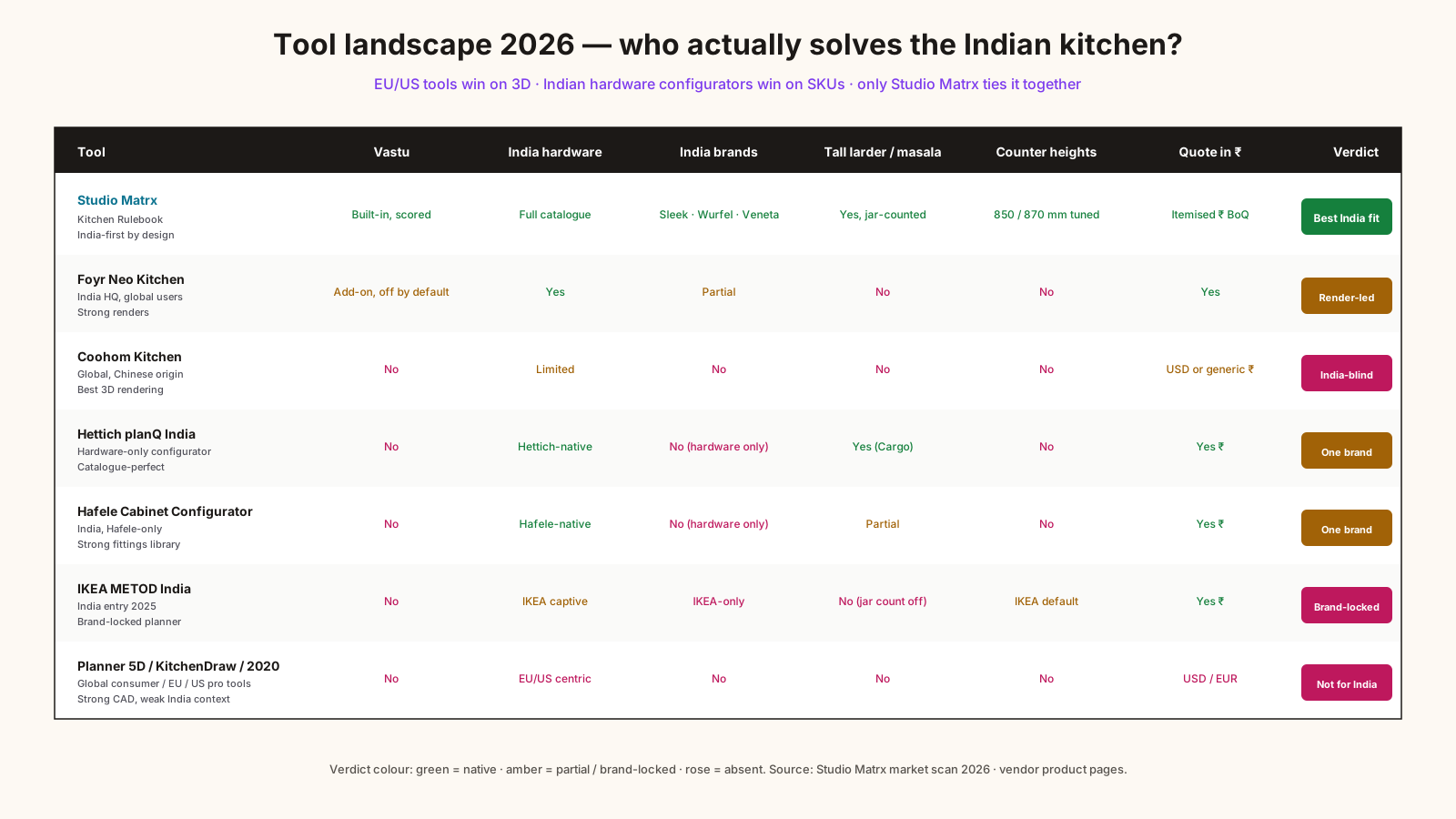
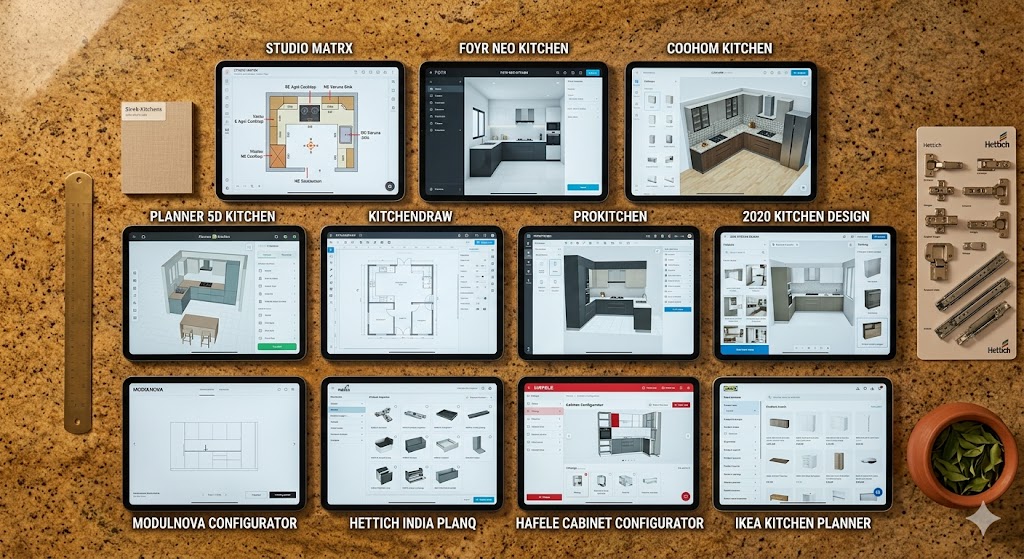
| Tool | India focus | Vastu | Indian hardware (Hettich/Hafele/Blum) | Indian brands (Sleek/Wurfel) | Tall larder / masala | Counter heights tuned | Quote in ₹ | Honest verdict |
|---|---|---|---|---|---|---|---|---|
| Studio Matrx Kitchen Rulebook | India-first | Built-in, scored | Full catalogue | Full catalogue | Yes, jar-counted | 850/870 mm | Yes, itemised | Best India answer in 2026 |
| Foyr Neo Kitchen | India HQ, global users | Add-on, not default | Yes | Partial | No | No | Yes | Strong renders, weak Indian-storage logic |
| Coohom Kitchen | Global (Chinese origin) | No | Limited | No | No | No | USD or generic ₹ | Best 3D rendering, India-blind |
| Planner 5D Kitchen | Global consumer | No | No | No | No | No | No | Hobbyist-grade, not pro |
| KitchenDraw | EU pro tool | No | EU-centric | No | No | No | EUR | Used by Indian distributors, not homeowners |
| ProKitchen Software | North America pro | No | NA-centric | No | No | No | USD | NA-only, irrelevant for India |
| 2020 Kitchen Design | Global enterprise (US) | No | EU/US hardware | No | No | No | USD | Enterprise dealer tool, not retail |
| Modulnova Configurator | Italian luxury brand | No | Brand-locked | No (Italian) | No | No | EUR | ₹50 L+ kitchens only |
| Hettich India Configurator (planQ) | India | No | Hettich-only (native) | No | Yes (Hettich Cargo) | No | ₹ | Hardware-only, not full kitchen |
| Hafele Cabinet Configurator | India | No | Hafele-only (native) | No | Partial | No | ₹ | Hardware-only, not full kitchen |
| IKEA Kitchen Planner (METOD) | India entry 2025 | No | IKEA captive | IKEA-only | No (jar count off) | Default IKEA height | ₹ | Brand-locked, IKEA-only |
Take-away: the EU/US tools are excellent at 3D and CAD but Vastu-blind and India-storage-blind. The Indian hardware configurators (Hettich planQ, Hafele) are catalogue-perfect but cover only one brand's modules. Studio Matrx is the only tool in 2026 that combines the India-first ruleset with brand-agnostic quoting.
Eight Risks, Pitfalls and Honest Limits
1. AI cannot see your wall actually leaning 12 mm out of plumb. Mitigation: site-measure before the final cutting list goes to the carpenter. The AI layout is the brief, not the shop drawing.
2. Vastu scoring is a heuristic, not a science. Mitigation: present Vastu as one of several scores; if the homeowner doesn't care, suppress it. If they do, get the family's preferred Vastu consultant to sign off (some are stricter than others).
3. Hardware SKUs change quarterly. Mitigation: kitchen-rulebook pulls from a versioned catalogue refreshed each quarter against Hettich India, Hafele India, Blum India price lists. Layouts older than 90 days flag a re-quote.
4. Counter-height tuning collides with resale. A 850 mm counter for a 5'4" cook may feel low to a 5'10" buyer in 5 years. Mitigation: recommend 870 mm as the resale-safe compromise; 850 mm only if the family commits.
5. Chimney CFM and duct routing are physics, not aesthetics. A 1000 m³/hr chimney needs a 150 mm duct ≤ 3 m. AI can flag the requirement but cannot route through someone else's flat. Mitigation: require duct-route confirmation before locking the cooktop position.
6. Brand quotes drift 8-15% from showroom-walk-in quotes. Mitigation: present the AI quote as a baseline negotiating reference, not a final price. Tell the homeowner: walk in with this BoQ, expect ±10%.
7. The tall pull-out larder is heavy. A 600 × 2400 mm Hettich Cargo loaded with 40 jars and 10 kg of atta hits 80 kg. Wall fixing must be on the carcass, not the partition wall. Mitigation: AI flags load-class requirement (Quadro V6 90 kg or Cargo HD).
8. Granite vs quartz vs Indian marble counter selection is regional and tactile. AI can suggest a category, but the slab must be picked physically. Mitigation: counter material is presented as a category (quartz / engineered stone / granite), with the slab selection deferred to a showroom visit.
AI gets you the brief in 12 minutes. The carpenter still gets you the kitchen. The trick is to treat the planner as the upstream conversation, not the downstream delivery — because in India, what gets fabricated is what the bhaiya in Peenya, Sakinaka, or Pimpri-Chinchwad chooses to fabricate, not what arrives in a German shipping container.
India-Specific Considerations
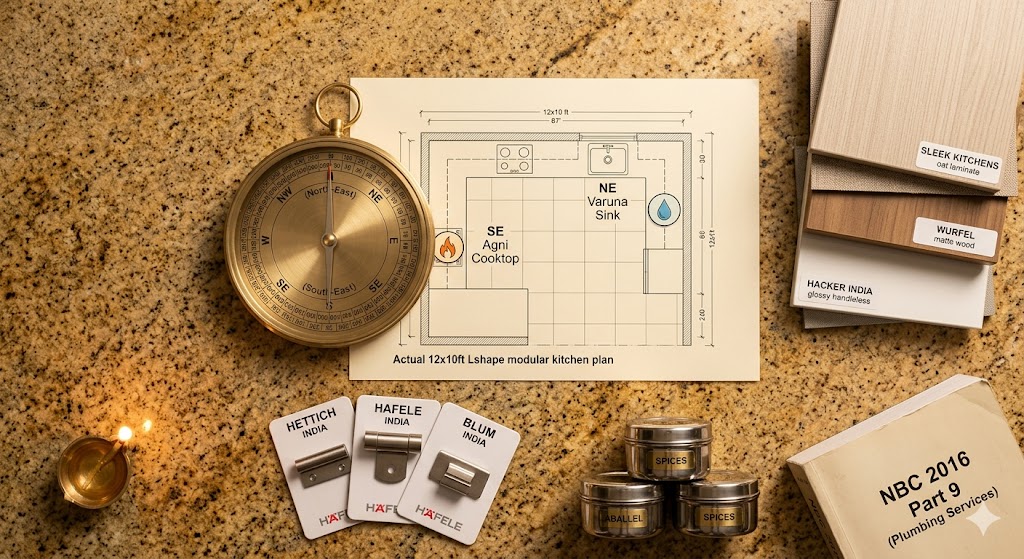
NBC 2016 and IS codes. The National Building Code Part 9 (Plumbing Services) sets minimum 600 mm aisle clear and 750 mm preferred between counter and opposing fixed surface. IS 2440 (Guide for daylighting of buildings) and IS 4838 (Code of practice for kitchen units in residential buildings) define minimum natural ventilation — most metro kitchens fail this by default, which is why chimney sizing matters. AI planners must respect 600 mm aisles even in compact 10' × 8' kitchens.
DPDP Act 2023. The kitchen brief captures personal data: cook height, family size, dietary preferences, budget. The Digital Personal Data Protection Act 2023 requires explicit consent and purpose limitation. Studio Matrx stores the brief encrypted, processes it for the planning task only, and offers a deletion path within 30 days. Foreign tools that host kitchen data on US/EU servers without an India data-residency option are a compliance red flag for any architect billing the homeowner under a written contract.
Vastu compatibility. The non-negotiables for the homeowner who asks are: cooktop in SE (Agni corner) facing east while cooking; sink in NE or N (water element away from fire); fridge in NW or SW (not NE); no cooktop directly under a beam; no door directly opposite the cooktop. AI planners that ignore this get rejected at the family-elder step. See Vastu for kitchen for the full ruleset.
Regional vendor reality. Bengaluru leans Sleek + Wurfel + local fabricators in Peenya. Mumbai leans Veneta Cucine + Hacker + Sleek, with strong local carpenters in Sakinaka. Delhi NCR is Hafele + Sleek + Bonito heavy. Pune is Sleek + Wurfel + local Pimpri-Chinchwad fabricators. Chennai is Sleek + locally-fabricated teak-shutter kitchens. Hyderabad is Bonito + Sleek dominant. AI must surface the right vendor short-list per city.
Language. A homeowner in a Bengaluru gated community may brief in English, but the carpenter on site speaks Kannada or Telugu. Studio Matrx exports the BoQ as a bilingual PDF (English + selected regional language) so the on-site team can read it. Hindi, Tamil, Telugu, Kannada, Marathi, Bengali, Malayalam are supported in 2026.
Climate zones. A kitchen in coastal Mumbai or Chennai needs 304-grade stainless hinges (salt-air corrosion); a Bengaluru kitchen can use standard chrome; a Delhi NCR kitchen needs to plan for summer heat soak (no laminate shutters on south-facing walls). NBC climate-zone overlays inform shutter and hardware spec. Hot-dry zones (Jaipur, Ahmedabad) need extra attention to shutter expansion gaps; warm-humid zones (Mumbai, Chennai, Kochi) need stainless drawer slides and anti-fungal carcass treatment; composite zones (Delhi NCR) need both summer-heat and winter-condensation thinking. Studio Matrx tags each city's default climate zone and switches the hardware/material library accordingly.
Gas, water, drainage realities. Indian metros have wildly varying utility realities. PNG (piped natural gas) is mainstream in Mumbai, Pune, Vadodara, Delhi NCR, Surat — the planner reserves a 100 × 100 mm regulator niche near the cooktop. LPG-cylinder remains the reality across most of Bengaluru, Hyderabad, Chennai, Kochi, smaller towns — the planner reserves an under-counter cabinet sized for two 14.2 kg cylinders (300 × 320 × 600 mm internal each, plus a swap-rotation gap). Water: most metro homes have municipal + bore-well dual supply needing a RO+UV+water-purifier stack under the sink (400 × 300 × 500 mm reserve). Drainage: kitchen waste-water lines in older buildings are 50 mm OD; the planner flags this when the sink module would otherwise specify a 75 mm bottle-trap that won't fit.
Society and building-owner approval. Most metro housing societies require chimney-duct routing approval before drilling through external walls. The planner exports a 1-page "society approval brief" with duct path, cooktop position, gas-line route, and structural-load impact — designed for the building manager's signature. This is a small detail that saves homeowners a 2-week delay.
The Studio Matrx Stack for Modular Kitchen Planning
The kitchen flow uses these specific tools:
- Kitchen Rulebook — the India-first kitchen ruleset (Vastu, ergonomics, larder sizing, work triangle).
- Furniture Planner — places base, wall, tall modules at standard widths.
- Dimension Handbook — counter, aisle, appliance clearances per NBC 2016 and IS 4838.
- Ergonomics Guide — counter-height tuning for the cook's height (850/870/900 mm).
- Material Palette — shutter/carcass/counter material selection.
- Material Rate Library — versioned Hettich/Hafele/Blum and shutter/counter rates.
- Vendor Comparison — Sleek vs Wurfel vs Veneta vs local fabricator quote-delta.
- Cost Benchmark — what a 12'×10' L-shape should cost in your city in 2026.
- Quotation Generator — itemised BoQ export for brand walk-in negotiation.
- Cross-Ventilation Analyzer — checks the kitchen window is doing real ventilation work, not decorative.
When NOT to Use AI Modular Kitchen Planning
1. You have a heritage Chettinad or Goan kitchen. The masonry counter, traditional storage in the wall niches, and wood-fired stove sit outside the modular grammar. Use a heritage-trained carpenter.
2. The kitchen is under 50 sq ft (studio apartments). At this size the planner over-engineers; a single L-run with 4 base units and a microwave shelf solves it without modular logic.
3. You are a chef-owner designing a commercial kitchen at home. Commercial kitchens (heavy 4-burner Indian range, exhaust hood with grease trap, separate dishwashing zone) follow FSSAI norms, not residential modular grammar.
4. You're spending under ₹1.5 lakh. Below this, a local carpenter with standard shutter material wins on price-per-square-foot. The AI quote will not save you money — it will just confirm what you already know.
5. The kitchen is being designed for an elderly parent with specific mobility needs. Universal-design kitchens (knee-clearance under hob, pull-out shelves at waist height, lever taps) need a designer + occupational-therapist input. AI is a starting point at best.
6. You're moving in 2 years. A full modular fit-out won't recover its cost on resale unless the building is in a hot pocket. Use the AI to plan a stripped-down version — base units + counter only, no tall larder — that recovers value.
The 5-Year Trajectory: AI Modular Kitchen Planning in 2030
By 2030, four shifts will reshape this space.
1. AR-on-phone install verification. Today the carpenter measures, fabricates, and hopes. By 2028-29, the homeowner will scan the empty kitchen with an iPhone LiDAR, the AI will overlay the planned layout in AR, and any clash (a 14 mm wall bulge, an unexpected duct) is flagged before fabrication starts. Studio Matrx's AR flow ships in 2026 H2 for residential rooms; kitchen-specific AR is on the 2027 roadmap.
2. Hardware catalogue API integration. Hettich India and Hafele India are both building B2B APIs. By 2027 the planner will query live SKU availability and price, eliminating the 90-day catalogue-drift problem. By 2030 the carpenter will place the order from inside the planner.
3. Voice-first kitchen briefs. A homeowner saying "main hindi mein bata raha hoon — 12 by 10 kitchen, L-shape, Vastu compulsory, budget 4.5 lakh, brand Sleek ya Wurfel" will get the same output the form-based flow gives today. Multilingual voice (Hindi, Kannada, Tamil) is on the Studio Matrx roadmap for 2026 H2.
4. Embedded sustainability scoring. EPD-graded counter materials, FSC ply carcasses, low-VOC shutters — by 2030 every BoQ will carry an embodied-carbon number alongside the rupee number. IGBC and GRIHA are already publishing kitchen-specific norms; the planner will score against these by default.
What does not change: Vastu, the cook's height, the masala jar count, the work triangle, the carpenter on site with a chisel. Those are India primitives. The AI gets faster and smarter around them.
Frequently Asked Questions
Q: Can AI design a modular kitchen for my Bengaluru 3 BHK?
Yes — this is the highest-volume use case for Studio Matrx kitchen-rulebook. A typical Bengaluru 3 BHK kitchen (12' × 10' to 14' × 12'), L or U shape, ₹3.5-6 lakh budget, Sleek/Wurfel/local fabricator, takes about 12 minutes to plan end-to-end. The output is layout + render + BoQ + brand-comparison quote.
Q: Does Studio Matrx kitchen planner check Vastu (SE cooktop, NE sink)?
Yes, by default — and it is the only AI planner in India that does. The Vastu overlay scores each layout for cooktop placement (SE Agni corner), sink placement (NE), fridge placement (NW preferred), and beam/door clashes. Score is shown alongside the ergonomics and budget scores. If you don't want Vastu, switch it off and it stops scoring. See Vastu for kitchen for the full ruleset.
Q: What's the right counter height for Indian cooking?
For a 5'2"–5'5" cook (most common Indian female cook height): 820–850 mm. For 5'5"–5'8": 850–870 mm. For 5'8"–6': 870–900 mm. The legacy 900 mm "default" inherited from US/EU planners is too tall for most Indian women cooking 90 minutes a day — it causes shoulder/back issues at 5-year horizons. Studio Matrx defaults to 850 mm prep / 870 mm cook for the median Indian household; you can override.
Q: How does AI handle the masala/dal/tall-larder problem?
The kitchen-rulebook has an Indian-storage rule that asks: jar count (small ≤30, medium 30-50, large 50+), dal varieties (4-8 typical), atta/rice/sugar tin volume (10-25 kg total), pressure cooker count (2-4). It sizes the tall larder column accordingly — for the median family, a 600 × 2400 mm Hettich Cargo with 6 baskets at 350/300/250/250/250/250 mm clear heights solves it. For larger families or batch-cooking households, it specifies a second tall column or a deeper pantry pull-out.
Q: Can AI quote Hettich vs Hafele vs Blum hardware for me?
Yes — the material rate library keeps a quarterly-refreshed catalogue across all three. The planner picks the appropriate slide class (drawer weight), hinge type (overlay/inset, soft-close, crank angle), and lift-up gas-strut (cabinet weight) for each module. You can lock to one brand if your fabricator has a preferred account, or let it pick the best price per spec. A typical 12'×10' kitchen has ₹35-60k of hardware alone; the spec-level quoting saves 10-15% of that.
Q: Sleek vs Wurfel vs Veneta Cucine — does AI compare?
Yes. The vendor comparison tool runs the same BoQ through Sleek (Asian Paints, India-manufactured), Wurfel (German-design India-manufactured), Veneta Cucine (Italian-import India-distributed), Hacker (German-import), Bonito (India-direct), and a local-fabricator baseline. Expect Sleek/Wurfel to come in 15-25% above local, Veneta/Hacker 35-60% above, Bonito on the local-fabricator end. The comparison shows the delta drivers (brand premium, hardware grade, shutter material, warranty) so you negotiate from data, not vibes.
Q: Will the AI design clash with my carpenter or designer?
Not if you frame it correctly. Hand the AI BoQ to the carpenter as a brief, not a contract. Most carpenters appreciate the layout and module-level spec; they will adjust dimensions for site reality. Most brand showrooms appreciate the clarity; they will negotiate against it. A few will push back ("we don't do that drawer slide") — that's useful information.
Q: Can I plan a U-shape or island kitchen with AI?
Yes for U-shape if the footprint supports it (typically 12' × 10' minimum, with no door clashing the third arm). Island kitchens need 12' × 14' minimum to maintain 900-1000 mm aisles on all four sides — most Indian flats can't do this. Peninsula kitchens (island connected to one wall) work in 10' × 14' and are increasingly popular in Mumbai sea-view 3 BHKs.
Q: How does AI handle gas-line and PNG approval?
It doesn't — gas-line approval is a regulatory step (society + PNG distributor in cities like Mumbai/Pune/Delhi NCR; LPG cylinder vendor elsewhere). AI flags the gas-source assumption (PNG / 2-cylinder LPG) and reserves the cabinet for the regulator. Approval is a separate site step.
Q: What about resale value of a custom-fit modular kitchen?
Honest answer: modular kitchens recover 40-60% of cost on resale in hot pockets (Whitefield, Powai, Gurgaon Sector 79), less elsewhere. Avoid hyper-personalised choices (custom counter colours, niche shutter materials) if you plan to sell within 5 years. AI flags resale-risk choices when you build the BoQ.
References
1. KPMG India — Home Interiors and Furniture Market Outlook 2025, KPMG India (2025). https://kpmg.com/in/en/home/insights.html
2. IBEF — Indian Real Estate Industry Report, India Brand Equity Foundation (2025). https://www.ibef.org/industry/real-estate-india
3. Anarock Research — Consumer Sentiment Survey: Indian Home Buyers H1 2024, Anarock Group (2024). https://www.anarock.com/research-reports
4. National Building Code of India 2016, Part 9 — Plumbing Services, Bureau of Indian Standards. https://bis.gov.in/
5. IS 4838 (Part 1 & 2): Code of practice for kitchen units in residential buildings, Bureau of Indian Standards.
6. IS 2440: Guide for daylighting of buildings, Bureau of Indian Standards.
7. Digital Personal Data Protection Act, 2023 — Government of India. https://www.meity.gov.in/data-protection-framework
8. Hettich India product catalogue 2025–26, Hettich India Pvt. Ltd. https://www.hettich.com/in/
9. Hafele India product catalogue and Cabinet Configurator, Hafele India Pvt. Ltd. https://www.hafeleindia.com/
10. Blum India hardware catalogue, Julius Blum India. https://www.blum.com/in/en/
11. Houzz India — Indian Home Renovation Trends 2024 Kitchen Study. https://www.houzz.in/
12. Statista — Furniture Market India 2025 (Kitchen segment). https://www.statista.com/outlook/cmo/furniture/india
13. IGBC — Green Homes Rating System v3.0 (kitchen criteria), Indian Green Building Council. https://igbc.in/
14. Asian Paints / Sleek Kitchens — Product handbook 2025. https://www.sleekworld.com/
15. Wurfel Kuche — Product and price band reference 2025. https://wurfel.in/
Related Guides
Export this guide
Related Guides — Deep-dive reading
Smart Storage Interiors — A 2026 Working Reference for Indian Homes
Inventory-driven · Floor-to-ceiling · Hardware-engineered · Zone-mapped
Room PlanningSpace-Efficient Homes — A 2026 Working Reference for Compact Indian Apartments
Five spatial multipliers · Floor plan tricks · Dual-purpose furniture
Room PlanningAI Interior Design — A 2026 Consumer Cornerstone for Indian Homes
Six capabilities · Studio Matrx walkthrough · India-native vs US tools · DPDP-safe
Design StylesRelated Tools — Try Free
Cross-Ventilation Analyzer
Estimate airflow and air changes per hour (ACH) from room size, window areas, layout, and local wind — with NBC 2016 Part 8 compliance check.
Ventilation CalculatorWindow Orientation Planner
Pick the best window type, glass and shading by wall direction — north, east, south and west.
Window ToolApartment Video Door System Planner
Enter flats, entrances, floors and guard desk for a first-pass building intercom plan — door stations, indoor monitors, guard station, the right architecture and an indicative cost band.
Building Planner