
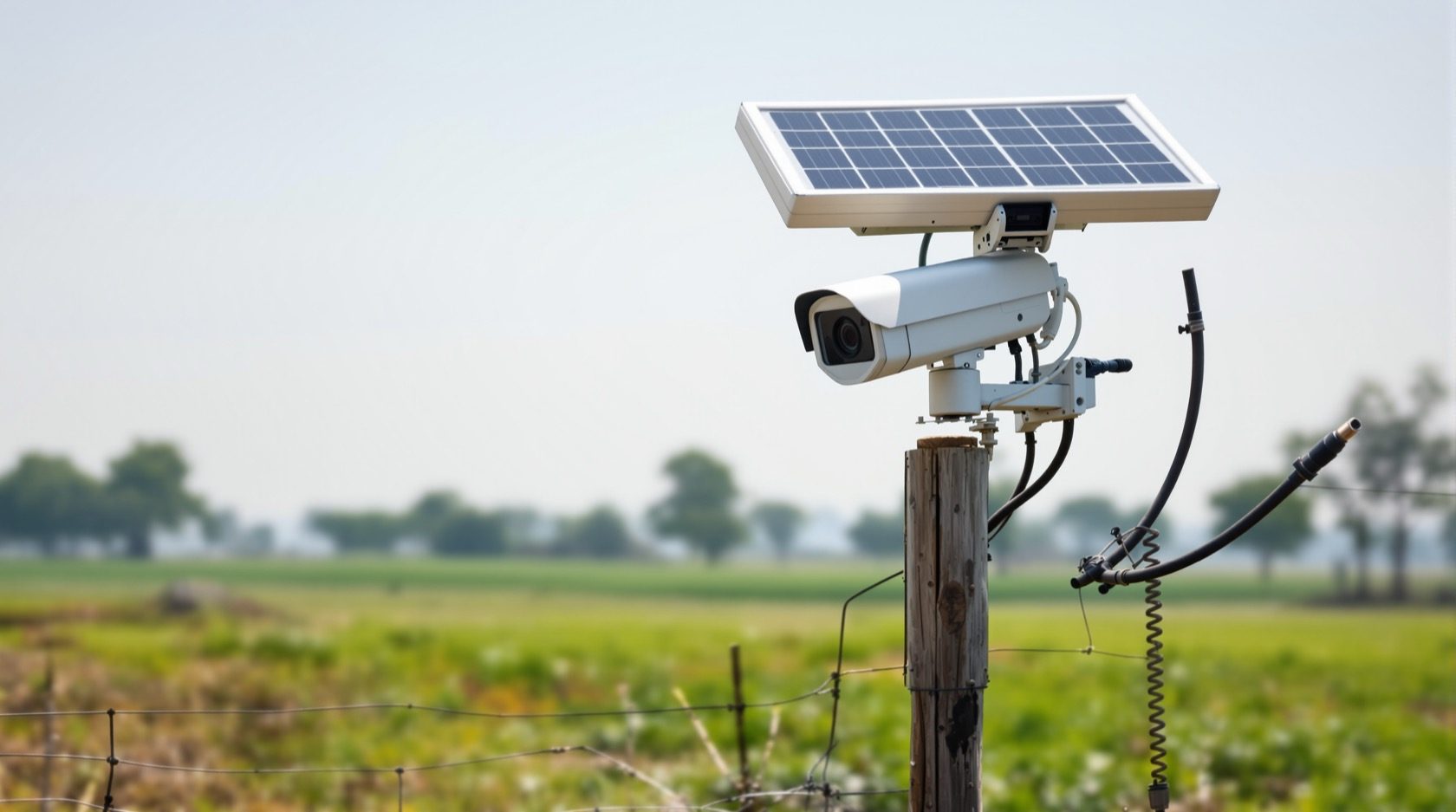
Solar-Powered CCTV Cameras in India: Off-Grid Security Sizing & Buying Guide
How a solar CCTV camera powers itself off-grid at a farm gate, plot boundary or society perimeter with no power line - panel, battery and camera sizing intuition, India sun-hours, monsoon derating, panel theft and maintenance.
A solar-powered CCTV camera is a security camera that makes its own electricity. A small photovoltaic panel charges a built-in battery through the day, and that battery runs the camera through the night and through the next cloudy stretch. There is no wire back to the meter, no trench, no mains point. For a farm gate, a plot boundary, an under-construction site or a stretch of society perimeter where the nearest socket is a hundred metres away, that self-sufficiency is the whole reason it exists.
This guide is the focused explainer on the solar power form factor in Studio Matrx's CCTV hub. It is not about the camera's shape or its resolution - a solar rig can wrap a bullet or a compact turret. It is about how the camera is powered and, just as important, where that off-grid trick genuinely pays and where it quietly disappoints. India's frequent power cuts and long unwired boundaries are exactly why solar earns a look here - but only if you size it honestly.
Scope & safety. This guide helps you plan and choose. Mounting a panel and camera at height, running any DC or solar wiring, and any work near the mains board belong to licensed professionals - decide the positions here, have them installed by a qualified installer. A camera or panel must never block a window, door or fire-escape route, and cameras belong only on your own property and shared areas - never bathrooms, bedrooms or changing areas, and positioned to respect neighbours and the spirit of the DPDP Act, 2023.
How a solar camera actually works
Strip away the marketing and a solar CCTV setup is a simple energy chain. Sunlight hits the panel, which produces DC electricity. A small charge controller feeds that into a battery without over-charging it. The battery then powers the camera, day and night. When the sun is out the panel both runs the camera and refills the battery; after dark the battery carries the load alone.
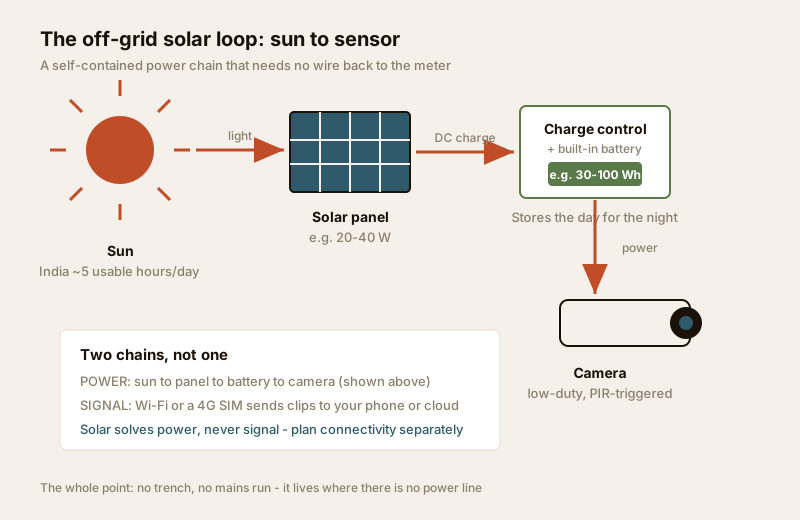
The single most important thing to understand up front: solar solves power, not signal. The panel keeps the camera alive, but the footage still has to reach you. On a remote plot that means either a Wi-Fi link back to a router (only if one is in range) or, far more often, a 4G/5G SIM inside the camera sending clips to the cloud. Plan the connectivity as a separate decision - a beautifully sized solar rig with no signal is just an expensive box on a pole.
Sizing intuition: match the day to the night
You do not need to be an electrician to get the sizing right in your head - you just need to respect three quantities and let a tool do the arithmetic. The relationship is simple: the panel must refill the battery faster than the camera drains it, averaged over grey days as well as bright ones.
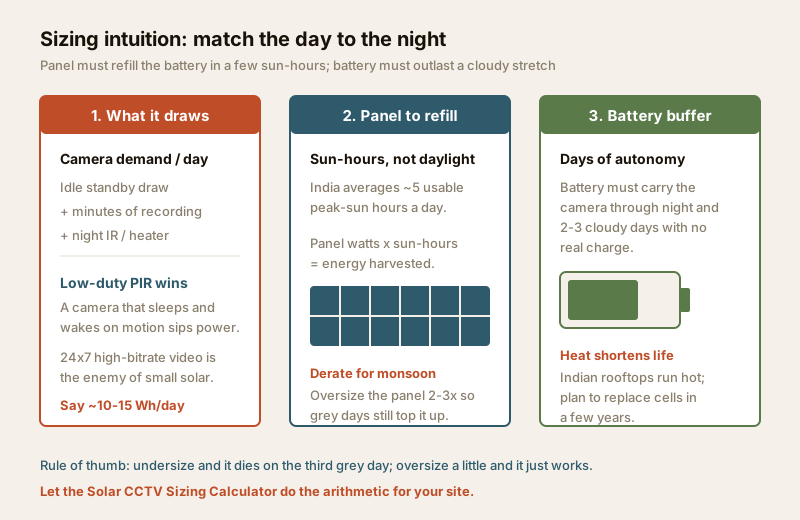
- What the camera draws (Wh per day). A camera that sleeps and wakes on motion sips power; one that streams high-bitrate video 24x7 gulps it. This single choice dominates everything downstream - which is why solar and low-duty recording go hand in hand (more below).
- What the panel harvests (sun-hours, not daylight). A panel does not make its rated wattage all day. It makes it during peak-sun hours - and across India that averages roughly five usable hours a day, less in a coastal monsoon month, more in a dry Rajasthan winter. Panel watts multiplied by sun-hours is the energy you actually collect.
- What the battery buffers (days of autonomy). The battery has to carry the camera through every night and through two or three consecutive overcast days when the panel barely charges. That "days of autonomy" number is your insurance against a wet week.
Rather than guess, feed your camera's draw, your location's sun-hours and your tolerance for grey days into the Solar CCTV Sizing Calculator. It returns a sensible panel wattage and battery capacity so you neither under-size (dead on the third cloudy day) nor massively over-pay.
A worked feel for the numbers
| Quantity | Modest PIR camera | 24x7 continuous camera |
|---|---|---|
| Typical daily energy | ~10-15 Wh | ~60-120+ Wh |
| Panel to refill (India ~5 sun-hrs) | ~20-40 W (oversized for grey days) | ~100 W or more |
| Battery for ~2-3 days autonomy | ~40-100 Wh | ~250 Wh or more |
| Monsoon comfort | Comfortable if oversized | Marginal; often fails |
| Verdict | The natural fit for solar | Fights the whole premise |
Treat these as feel, not spec - your camera, climate and recording mode set the real figures, which is exactly what the calculator computes.
Why solar suits low-duty PIR recording, not 24x7 video
This is the point most cheap-kit buyers miss, and the one that decides whether you are happy in six months. Small solar makes a modest, unreliable trickle of energy. It comfortably powers a camera that sleeps most of the time and wakes on a PIR (motion) trigger to record a short clip - a gate that swings open a dozen times a day, a boundary that sees the odd visitor.
It does not comfortably power a camera recording continuously at high bitrate on a busy scene, day and night, especially with power-hungry IR or a built-in heater running through a cold night. That workload wants a mains supply and a wired recorder - which is what a PoE camera gives you. If a spot genuinely needs constant, high-detail 24x7 coverage, run power to it and use PoE; do not stretch a solar panel to a job it will fail on the first cloudy week.
So the honest positioning: solar is for event-based watching in places with no power, not for busy, always-on surveillance.
Where a solar camera fits best
Play to the strength - places a mains cable cannot easily reach.
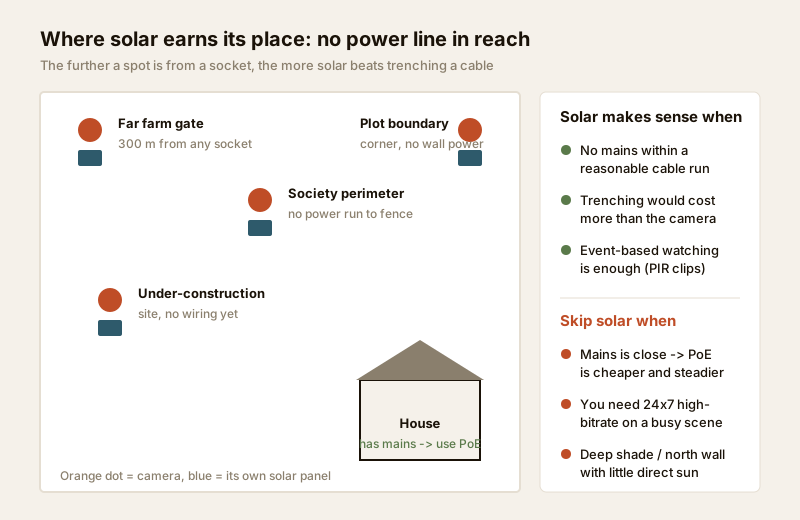
- The far farm gate or field. Hundreds of metres from the farmhouse, with no line to run - the classic solar case.
- A plot boundary you are watching before you build. Keep an eye on an empty plot or land parcel with nothing on it yet.
- An under-construction site. No permanent wiring exists yet; solar cameras watch materials and the compound until the mains is commissioned.
- A society or estate perimeter run. Stretches of boundary fence far from any power point, filling the gaps a gated-community scheme leaves at the edges.
Anywhere mains power is genuinely within a reasonable cable run, a wired PoE camera is cheaper, steadier and lower-maintenance - reach for solar only when the alternative is trenching a long, costly cable. For the wider logic of covering a boundary, see the perimeter vulnerability assessment and the outdoor CCTV guide.
The India-specific realities
Solar in India is not the same as solar in a brochure shot. Weight these before you commit.
- Monsoon derating. Weeks of thick cloud slash panel output. Size for the worst month, not the average - oversize the panel two to three times and give the battery a couple of days of autonomy so a wet spell does not black out the camera.
- Panel and camera theft. A shiny panel on an isolated pole is itself a target. Mount it high and out of easy reach, use anti-tamper fixings, and position the camera to keep its own panel in frame where possible. On a truly remote plot, the deterrent value of a visible camera helps protect the kit that powers it.
- Dust and cleaning. A film of dust or bird droppings on the glass can cut output sharply - and India's dust is relentless. A dusty panel that was fine in January can starve the camera by April. Plan a periodic wipe-down as routine maintenance, especially before and after the dusty pre-monsoon months.
- Heat and battery life. Rooftop and open-field heat is brutal on batteries. Expect the cells to age faster than a datasheet in a temperate climate suggests, and budget to replace the battery every few years rather than treating it as permanent.
- Shading kills it. A panel in the shade of a tree, a water tank or a north-facing wall for half the day will never keep up. Aim the panel at open sky, tilted roughly to your latitude and facing south, clear of shadows across the whole day.
Solar pros, cons and best-fit
| Aspect | What solar gives you |
|---|---|
| Best strength | Total off-grid independence - no mains, no trench, no cable run |
| Power source | Panel + battery; sun-hours (India ~5/day) drive the sizing |
| Ideal duty | Low-duty, PIR-triggered event clips - not 24x7 high-bitrate |
| Signal | Separate problem - usually a 4G SIM, sometimes Wi-Fi in range |
| Weather | Vulnerable to monsoon cloud; must be oversized and buffered |
| Maintenance | Wipe the panel, watch battery ageing, mind theft of the kit |
| Best-fit | Farm gates, plot boundaries, construction sites, far perimeters |
| Poor fit | Busy 24x7 scenes, deep shade, or anywhere mains is close (use PoE) |
Price bands in India (indicative)
Prices move with brand, panel size, battery capacity and whether a 4G module is built in - treat these as ballparks to sanity-check a quote, not fixed rates.
| Item | Typical range (₹) | Notes |
|---|---|---|
| Entry solar Wi-Fi camera + small panel | ₹4,000 - ₹8,000 | Light duty; needs a router in range |
| Solar 4G camera (SIM built in) | ₹7,000 - ₹15,000 | The remote-plot workhorse; add a data plan |
| Larger panel + higher-capacity battery kit | ₹3,000 - ₹9,000 extra | For real days-of-autonomy in monsoon regions |
| Anti-theft pole mount + tamper fixings | ₹500 - ₹2,000 | Worth it on an isolated site |
| 4G data plan (per month) | ₹150 - ₹500 | Ongoing cost - upload caps matter for video |
Remember the recurring cost: a 4G solar camera has a data plan every month, and video is data-hungry, so a low-duty PIR clip strategy also keeps your bill down. Size and cost the wider scheme with the security system cost estimator and check coverage with the camera coverage calculator.
Getting a solar install right
- Aim the panel at open sky. South-facing, tilted near your latitude, clear of shade across the whole day. This one thing decides whether the camera survives the monsoon.
- Oversize deliberately. A panel and battery that look generous on a sunny day are merely adequate on a wet week. Follow the calculator, then round up.
- Mount high, fix against tampering. Protect the camera and the panel both - the panel is worth stealing.
- Confirm the signal before you commit. Test 4G signal or Wi-Fi reach at the exact spot; no signal means no footage regardless of power.
- Keep a maintenance rhythm. A quarterly panel wipe and an annual battery health check keep it honest.
When to bring in a professional. Decide the positions, camera duty and coverage yourself - then hand the pole mounting at height, any DC or solar wiring, panel angling and secure fixing to a licensed installer. Anything at the mains board is a licensed electrician's job; see the electrical hub. If the site has a small on-grid supply nearby, an installer can also advise whether a wired PoE run would in fact be simpler and more reliable than going solar.
Key takeaways
- A solar-powered CCTV camera makes its own power from a panel and battery, so it can watch a spot with no mains line - a farm gate, plot boundary, construction site or far perimeter.
- Sizing is three numbers: camera daily draw, panel harvest (India ~5 sun-hours, derated for monsoon) and battery days-of-autonomy - let the Solar CCTV Sizing Calculator do the maths.
- Solar suits low-duty, PIR-triggered clips, not 24x7 high-bitrate video - for busy always-on scenes, run power and use a PoE camera instead.
- Solar solves power, not signal - plan connectivity separately, usually a 4G/5G SIM, sometimes Wi-Fi if a router is in range.
- Mind India's realities: monsoon derating, dust cleaning, heat-shortened batteries and theft of the panel - and route mounting, wiring and mains work to a licensed professional.
References
- Digital Personal Data Protection Act, 2023 - position cameras to cover only your own property and shared areas with a legitimate purpose; avoid capturing neighbours' private spaces.
- Ingress Protection (IP) ratings - verify a camera's and panel enclosure's weatherproofing on the manufacturer's specification sheet before ordering for outdoor and remote use.
- National Building Code of India (SP 7), Bureau of Indian Standards, and local municipal bye-laws for any structural, electrical or life-safety aspect of a solar or camera install; verify the current edition via the BIS catalogue: https://www.services.bis.gov.in/
This is an educational overview. Mounting at height, solar and DC wiring, and any electrical work are qualified professional tasks - engage licensed installers and verify any standard's current status via the BIS catalogue before relying on it.
Export this guide
Related Guides — Deep-dive reading
How to Choose a CCTV Camera (2026): The Homeowner's Decision Guide for India
Cut through the spec-sheet noise and choose the right CCTV camera for each spot around an Indian home. What actually matters — sensor and low-light performance, lens and field of view, form factor, IP and IK ratings, honest smart features — and the marketing claims to ignore.
SecuritySolar Security Lighting in India (2026): Where It Genuinely Works, and the Honest Reasons It Fades in the Monsoon
An all-in-one solar security light needs no cabling to a far gate and no running cost, which is exactly why it is oversold. This guide shows a homeowner where solar lighting is genuinely the right answer, where wired dusk-to-dawn is safer, and how to buy one that does not die at 2am in July.
SecurityData Storage Cost for CCTV in India (2026): Local Disks vs Cloud, and How to Size It
The running cost people forget when they buy cameras. Where the footage actually lives — a one-time surveillance hard disk in the recorder, or a recurring per-camera cloud plan — and how camera count, resolution, frame rate, recording mode and retention days decide how many terabytes, and how much money, you really need.
SecurityRelated Tools — Try Free
Solar CCTV Sizing Calculator
Enter cameras, sun-hours and backup days to get the solar panel wattage, battery Ah and an indicative kit cost for an off-grid camera.
Solar SizingCCTV Camera Coverage & Count Calculator
Estimate how many CCTV cameras you need, the NVR channels, storage in TB for your retention period, and an indicative all-in cost with GST.
CCTV CalculatorCross-Ventilation Analyzer
Estimate airflow and air changes per hour (ACH) from room size, window areas, layout, and local wind — with NBC 2016 Part 8 compliance check.
Ventilation Calculator