
Smart Residential Layouts
The smart community, honestly — what digital infrastructure genuinely adds at layout scale, the foundations-first rule, designing a smart-ready layout, and useful systems versus gimmicks
The WhatsApp group for a 600-flat township on the edge of Hyderabad has 580 members and roughly forty messages before breakfast. A leaking overhead tank on Tower C. A car parked across the ramp. A dog without a leash. The water tanker is late again. Buried in the noise is a genuinely useful pattern: the residents already run their neighbourhood through software. They have just done it with the worst possible tool — a chat app that forgets, blames and never closes a complaint. A kilometre away, a newer "smart" gated community sells the same residents a different promise: facial-recognition gates, an app that opens the boom barrier, sensors everywhere, a glossy dashboard in the clubhouse. Two years in, half the sensors are dead, the camera feed nobody watches fills a hard disk, and the families still argue about water on WhatsApp.
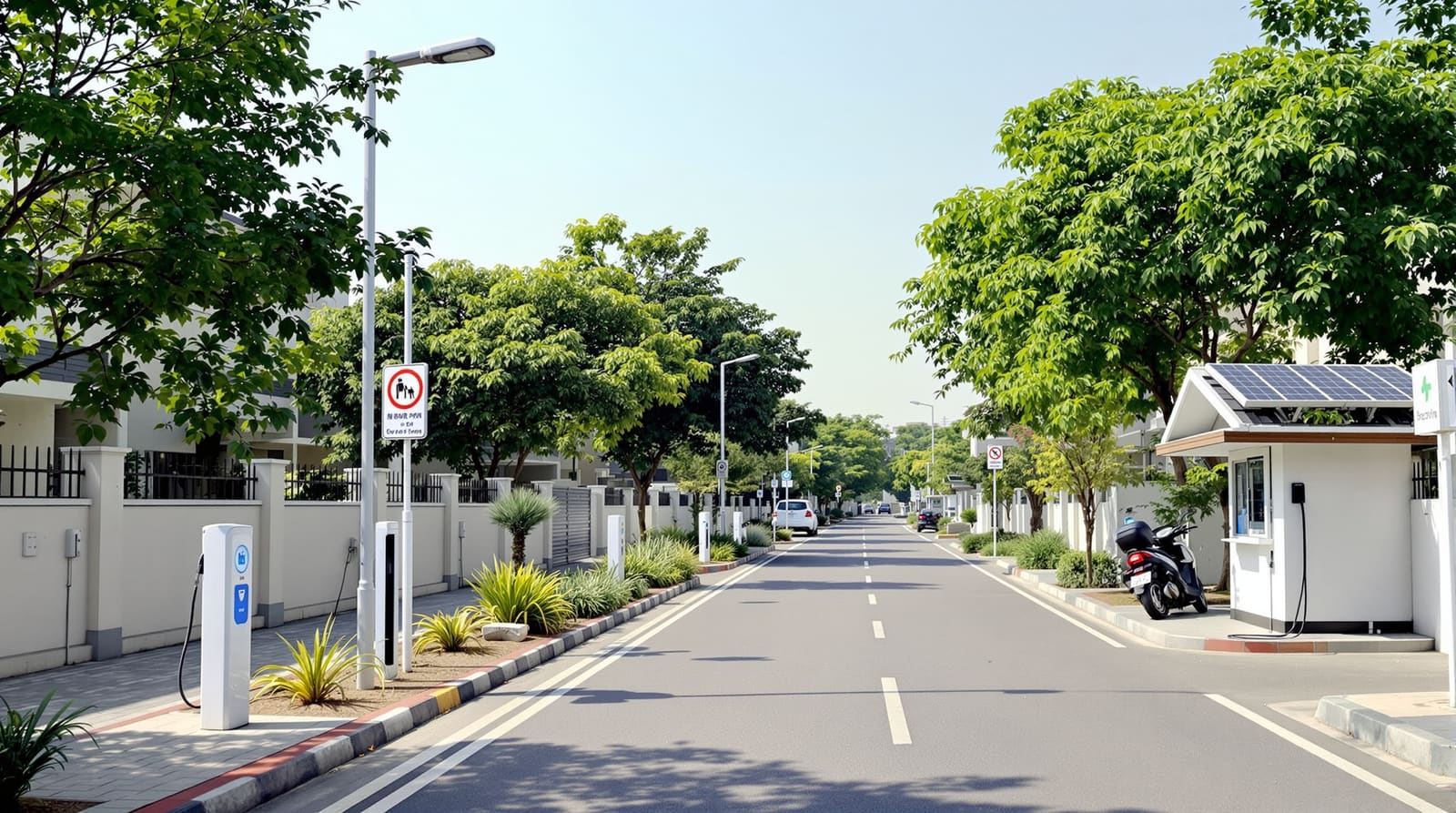
Between these two failures sits the actual opportunity. A residential layout can be made genuinely smarter — not a billboard of gadgets, but a neighbourhood where the water doesn't leak unnoticed for a week, the EV chargers work, the streetlights are bright where people walk, and the complaint about the broken ramp is logged, ticketed and closed. A smart residential layout is not a community studded with technology; it is a well-built neighbourhood whose physical foundations come first and whose modest digital layer quietly removes friction from daily life.
What "smart" actually means at the layout scale
Strip away the smart-city marketing and the idea is narrow and useful. At the scale of a neighbourhood or township, "smart" means a thin layer of sensing, connectivity and software laid over good urban design, so that the community's utilities, mobility, safety and governance run with less waste, less guesswork and less human friction. It is the difference between discovering a burst water main from the monthly bill and being alerted the night it starts; between a security guard's paper register and an audited, searchable access log; between a maintenance complaint lost in a chat thread and a ticket that someone owns until it closes.
This is deliberately not the smart-city dream of a central command centre running a metropolis. That vision — the screens, the predictive policing, the integrated everything — has a poor track record. India's Smart Cities Mission, launched in 2015 across 100 cities, delivered its most durable value not through marquee control centres but through unglamorous basics: better roads, drains that work, public lighting, sensible public spaces. The "smart" command centres that proved useful were the ones repurposed for genuine coordination during the monsoon and the pandemic; many others became expensive video walls. The lesson scales down cleanly. At the residential layout, smartness is worth pursuing only where it solves a problem residents actually have.
It is also not home-scale smart living. A flat full of voice assistants, app-controlled lights and a smart fridge is a private consumer choice, covered well in future-proof home design for Indian families. The smart layout is about the shared infrastructure between the front doors — the streets, the grid, the water network, the gates and the commons. And it differs from its temporal cousin: future-ready residential layouts treat digital-readiness as one adaptability move among many — flexible plots, climate hedging, demographic change. This guide is the smart-and-digital model in full. The rural counterpart, smart villages, shares the philosophy but inverts the context entirely: there the binding constraints are first-mile connectivity, off-grid power and agricultural livelihoods, not parking apps and EV chargers.
Foundations before gadgets
The single most important rule of the smart layout is also the least exciting: the physical neighbourhood must be good first. No sensor improves a layout that is car-choked, unwalkable and badly drained. A smart water meter on a network that floods every monsoon is a thermometer on a patient nobody will treat.
So the order is fixed. Build the well-graded roads with proper stormwater drains. Lay a reliable, ringed water supply and a sewerage network that actually connects. Provide robust power with sensible redundancy. Make the streets walkable — footpaths, shade trees, the human-scale blocks described in walkable neighbourhood design and the street hierarchy. Get the open space, density and mix right. Only on top of that foundation does the digital layer earn its place. A neighbourhood that nails the basics and adds nothing smart will outperform a gadget-laden one that skimped on drains.
There is exactly one piece of digital infrastructure that belongs in the foundation itself, because it is ruinous to retrofit: the conduit. Empty ducting and fibre pathways, laid in the same trench as the water and power, cost almost nothing during construction and a fortune later. A layout that runs spare conduit to every pole, gate, pump house and substation has bought the option to be smart for decades, whether or not the first owner ever installs a single sensor. This is the cheapest, highest-leverage smart decision a developer makes, and it is invisible on the brochure.
The genuinely useful smart layers
With foundations and conduit in place, a handful of digital layers repay their cost. The honest list is shorter than any vendor's.
Smart utilities and metering. The clearest win. District water metering with leak detection turns the township's biggest silent loss — water vanishing through underground breaks — into a same-day alert. Per-flat smart energy and water metering ends the unfair flat-rate split, lets demand management shave peak loads, and makes consumption visible enough that people use less. For communities pursuing net-zero residential communities, metering is the nervous system that makes a target measurable.
Smart mobility. A planned EV-charging network — adequate feeder capacity, conduit to parking bays, a mix of slow overnight and a few fast chargers — is now a baseline expectation, not a luxury. App-based shared and e-mobility (cycles, scooters at the gate and the transit stop) extends the reach of the transit connections the layout should already be built around. "Smart parking" earns its name only when it genuinely reduces hunting and double-parking; mostly it is a dashboard nobody needs.
Safety and security, without overreach. Good lighting where people actually walk does more for safety than any camera. Sensible CCTV at gates, perimeters and parking — recorded, access-controlled, retained briefly, watched only when something happens — is reasonable. App-based visitor and access management beats the paper register. The line to refuse is facial recognition on residents, always-on internal surveillance, and feeds that flow to a vendor's cloud forever. Security should protect residents, not catalogue them.
Community apps and e-governance. This is where most residents' actual smartness lives. A single RWA platform that handles maintenance billing, amenity bookings, complaints-as-tickets, notices, visitor passes and transparent accounts replaces the chaos of WhatsApp, paper and the treasurer's spreadsheet. The governance challenge of running a community at all is the subject of community-centric housing; the app is its administrative spine, not its soul.
Environmental sensing and the microgrid. A few well-placed sensors — air quality, sump and tank levels, the STP's performance, rainfall and the recharge pits described in water-sensitive urban design — give the community real feedback on its own health. The smart solar microgrid, balancing rooftop generation, storage and EV load across the layout, is the most ambitious of these and the most genuinely transformative where it is maintained.
The data layer — and its quiet danger
Every layer above produces data, and the data is where smartness either compounds or curdles. Used well, it closes loops: the metering data finds the leak, the access log resolves the dispute, the air-quality trend justifies more trees. Used carelessly, it becomes a liability — a honeypot of residents' movements, vehicle numbers, faces and habits, sitting on a vendor's server with nobody accountable for it.
The principles are not complicated, and India's Digital Personal Data Protection Act, 2023 now gives them legal weight. Collect the minimum. Keep recordings briefly and delete by default. Make the RWA, not the vendor, the legal custodian of resident data. Avoid building the integrated profile of who comes and goes and when, however technically easy it has become. A smart layout should be able to answer "is the water leaking?" without being able to answer "where was Mrs Rao at 9pm last Tuesday?"
Designing the layout to be smart-ready
Most of the cost and almost all of the regret in smart neighbourhoods comes from retrofitting. The discipline is to design for smartness during master planning, then install gadgets slowly, only as they prove useful.
Smart-readiness means four things laid in early. Ducts and conduits to every place a future sensor, camera, charger or access point might live. Electrical and data capacity sized with headroom — feeder capacity for a parking deck that will one day be mostly electric, not the trickle that suits today's two cars. Open, interoperable standards written into procurement, so that no single vendor's proprietary protocol can hold the community hostage. And, for larger townships, a simple digital twin — an accurate as-built model of the networks, updated as things change — so the community actually knows what it owns and where it runs. None of this requires buying a single sensor on day one. It buys the right to add them cheaply for thirty years.

Useful versus gimmick — an honest table

The fastest way to spend money badly is to buy the gimmick version of a good idea. For nearly every smart layer there is a genuinely useful form and a costlier, fragile imitation that photographs well and breaks quietly.
| Smart layer | The genuinely useful version | The gimmick to avoid |
|---|---|---|
| Utilities & metering | District leak detection & per-flat smart meters that cut bills & waste | A glossy "consumption dashboard" nobody opens after week two |
| Mobility | Adequate EV charging with real feeder capacity; gate-to-transit e-cycles | "Smart parking" sensors on a lot that was never actually full |
| Safety & security | Good lighting on walked routes; recorded CCTV at gates; app visitor passes | Facial recognition on residents; always-on internal surveillance |
| Governance | One RWA app: billing, bookings, ticketed complaints, transparent accounts | A "command centre" video wall in the clubhouse with no operator |
| Environmental sensing | Tank levels, STP performance, a few air-quality & rain sensors | A wall of live graphs disconnected from any decision or action |
| The microgrid | Solar plus storage balancing real rooftop generation & EV load | A token panel array & a screen, sized for the brochure not the load |
Does it actually work in India?
The honest answer is: rarely, so far — and the failures are instructive rather than disqualifying. The recurring traps are predictable.
Tech that breaks and isn't maintained. This is the dominant failure. The gates, sensors and apps are installed by the developer, handed to an RWA with no budget line for upkeep, and decay. A smart layer is an operating commitment, not a capital purchase; if the community cannot fund and staff maintenance, it should buy less and build it better. Vendor lock-in. Proprietary systems that cannot be serviced by anyone but the original supplier become extortionate or abandoned. Open standards and the right to data portability, written into the original contract, are the only defence. Privacy and surveillance overreach. The gated society already over-collects; bolting on smart tech without restraint turns a home into a monitored campus. The gimmick over the genuinely useful, as the table shows. Cost versus benefit — every smart rupee competes with shade trees, footpaths and a sinking fund, and often loses on merit. And the digital divide: an app-only RWA disenfranchises the elderly resident, the domestic worker, the security guard. Every smart system needs a working non-digital fallback, or it quietly excludes the people who keep the community running.
The positive Indian lessons come from communities that got the basics right first and digitised modestly. The townships that work — Magarpatta in Pune, Aranya in Indore at the affordable end — earned their reputation through walkability, mix and management long before any sensor. The Smart Cities Mission's durable gains were infrastructure, not dashboards. The pattern holds: in the fuller vision of the future Indian township, the smart layer is the last thing added and the first thing to keep modest. Build the neighbourhood. Lay the conduit. Add the few digital systems that residents would actually miss — and stop there.
References
1. Carlos Moreno, The 15-Minute City: A Solution to Saving Our Time and Our Planet (2024) — proximity and the role of digital coordination in neighbourhood life.
2. Ministry of Housing & Urban Affairs, Government of India — Smart Cities Mission guidelines and outcome evaluations (2015 onward).
3. Town & Country Planning Organisation, URDPFI Guidelines, 2014 — utility, mobility and service-infrastructure norms for Indian settlements.
4. The Digital Personal Data Protection Act, 2023 (India) — consent, data minimisation and custodianship obligations.
5. Indian Green Building Council — IGBC Green Townships rating, on resource metering and monitoring for communities.
6. Jan Gehl, Cities for People (2010) — the primacy of human-scale, walkable public space over technological add-ons.
7. Bureau of Energy Efficiency / Central Electricity Authority — smart metering and EV-charging infrastructure guidance for residential developments.
For the wider picture, read the future Indian township and the net-zero residential communities whose microgrid this model powers — and let DesignAI help you plan a neighbourhood that earns its smartness from the foundations up.
Export this guide
Related Guides — Deep-dive reading
Smart Water Monitoring India: Track Bathroom Usage, Catch a Running Toilet, Cut the Bill (2026)
A clamp-on or inline flow sensor turns your water line into a dashboard — litres per shower, a toilet that never stops filling, a hidden drip you would never hear. This is the honest India-first guide to smart water monitoring: how sensors meter each fixture, the apps and alerts, tie-ins with auto shut-off valves, and the real rupee cost against the bill it saves.
BathroomsSecurity Guide for Gated Communities
Community-scale security for Indian gated layouts and apartment complexes — perimeter and gate integrity, RFID and app-based visitor management, boundary CCTV, guard SOPs, and the tailgating and insider-access problem that makes gated NOT the same as safe. Written for residents and RWA or management committees.
SecurityDigital Twins in Residential Design: A Living Model of Your Home
What a digital twin really is, and how a data-connected model of your house could help you design, build and run it
Future-Ready HomesRelated Tools — Try Free
Rainwater Tank Sizer
How big should your rainwater tank be? Computes annual harvest, recommended tank capacity in litres, water-bill savings, and payback — for 10 Indian cities.
RWH CalculatorCCTV Camera Coverage & Count Calculator
Estimate how many CCTV cameras you need, the NVR channels, storage in TB for your retention period, and an indicative all-in cost with GST.
CCTV CalculatorMonsoon-Readiness Checklist
Pre-rain home audit across 9 categories — terrace, drains, waterproofing, electrical, HVAC, pest, vehicles, documents.
Seasonal Audit