
The Future Indian Township
What the next-generation Indian township should be — integrated, mixed-use, walkable, sustainable, smart and resilient — and the honest lessons of real attempts from GIFT City to Magarpatta
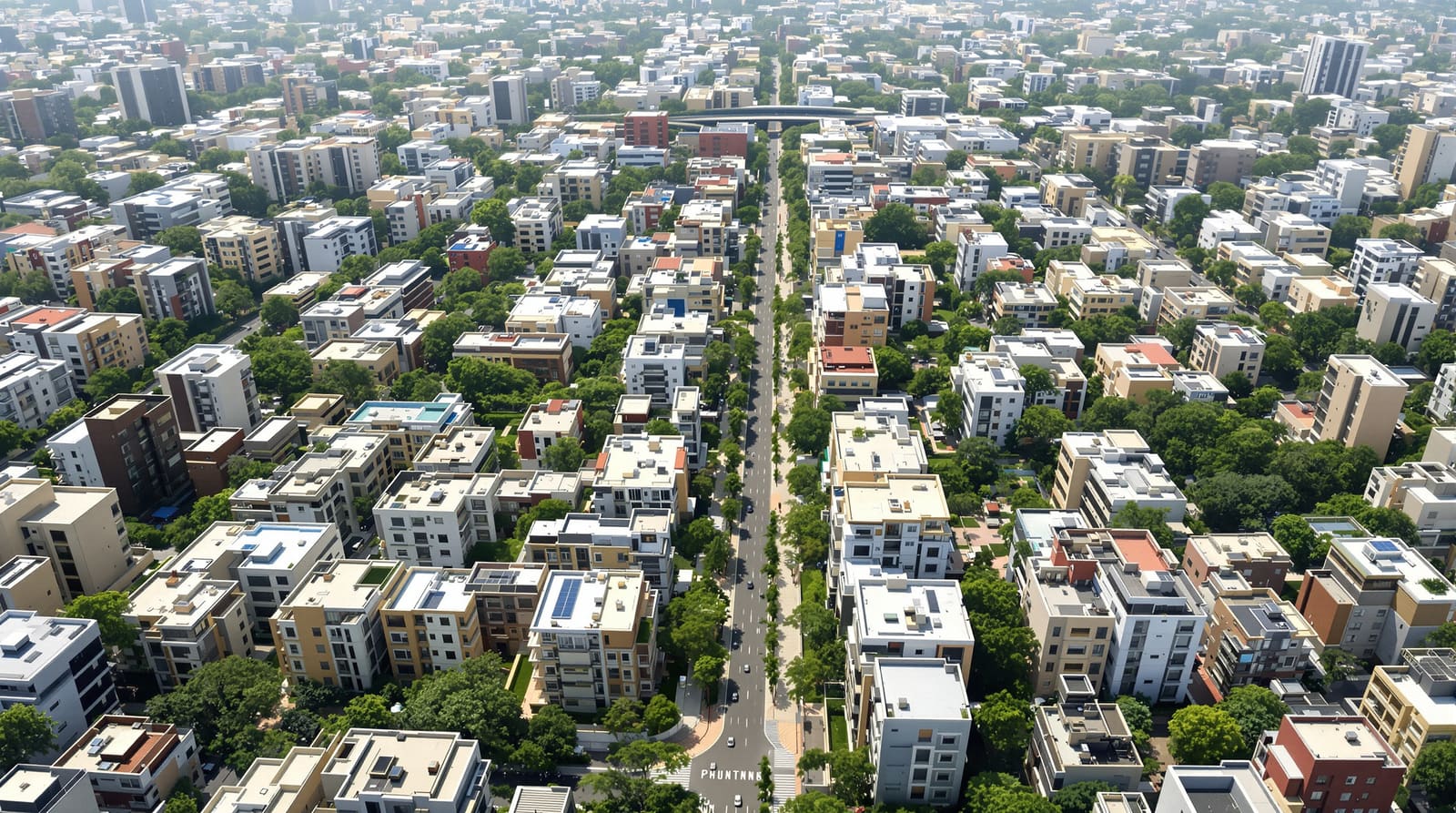
On a Tuesday morning in a township on the edge of an Indian metro, a woman walks her daughter to a school that sits three minutes from her front door, past a vegetable vendor she has known for years, under a row of rain trees heavy from the night's first monsoon shower. Her husband has already cycled to an office block at the other end of the same neighbourhood; he will be home for lunch. The car they own sits unused in a shared basement most weekdays, because almost everything they need is inside a walkable, knitted-together piece of city. The water that fell last night is not racing into a choked drain — it is soaking into a swale and topping up a recharge well. This is not a brochure render. Some of it already exists, in fragments, in places like Magarpatta in Pune.
A short drive away tells the other, more familiar story. A gated enclave of identical towers rises behind a boom barrier, its lawns watered by tankers, its only shop a kilometre away across a six-lane road no child can cross alone. Every errand is a car trip. The "amenities" are private and locked to outsiders, the streets outside are an afterthought, and the residents' association spends its meetings arguing about parking. The two places are separated by ten kilometres and an entire philosophy of how Indians should live together. The future Indian township is not a bigger, glossier gated enclave — it is the deliberate undoing of that model: an integrated, mixed-use, walkable, dense-but-liveable, sustainable and resilient piece of real city, rooted in Indian climate, culture and affordability.
Why the default is failing
For two decades, the dominant new-housing product in urban India has been the gated enclave: a walled cluster of towers or villas, single-use (homes only), reached almost exclusively by private car, with a privatised "club" of amenities and a public street it turns its back on. It sold a real promise — security, predictable maintenance, an escape from the chaos outside. But at scale it has produced a city that does not work.
The car-dependence is structural, not incidental. When homes are zoned far from jobs, schools and shops, every daily need becomes a vehicle trip, and the arterial roads between enclaves fill with traffic that no flyover can outrun. The privatised commons hollows out public life: parks, courts and pools sit behind boom barriers while the actual street — the thing a city is made of — gets no footpath, no shade, no eyes. And the social sorting is quiet but real, as gates separate people by income into parallel worlds that never meet. Add the Indian monsoon to acres of impervious paving and you get the flooding that now visits Bengaluru, Chennai and Gurugram every year. The enclave optimised for the individual buyer and disinvested from everything between the buyers.
The integrated township is the answer to all of that at once. It is the idea — old in human settlement, newly urgent here — that you can live, work, learn and play within reach, because jobs and homes are planned together rather than in separate zones an hour apart. It is, in the global vocabulary, the 15-minute city (the framework articulated by Carlos Moreno) applied honestly to Indian density, climate and incomes: most of daily life accessible by foot or cycle in a quarter of an hour, and the rest by a transit spine rather than a private engine.
What the future township actually is
Strip away the slogans and the model rests on a few load-bearing principles, most of which predate the marketing.
Mixed use, finely grained. Homes, workplaces, schools, clinics, markets and worship are interleaved — vertically within blocks and horizontally across the layout — so that proximity, not the car, does the connecting. This is the core of New Urbanism and Traditional Neighbourhood Development: a walkable centre, a defined edge, and a mix of uses and incomes within it.
A walkable, shaded public realm. The street, not the gated lawn, is the township's living room. That means continuous footpaths, tree canopy sized for a 40-degree afternoon, short blocks, and a street hierarchy that slows cars instead of worshipping them. The Barcelona superblock and Jan Gehl's people-first street are the references; the Indian application is the shaded bazaar street that has worked here for centuries. We treat the mechanics of this in walkable neighborhood design.
Density that is liveable, not punishing. The future township is dense — sprawl is unaffordable in land and unsustainable in carbon — but it pairs density with light, air, courtyards and green so it reads as generous rather than crammed. Done well, this is the difference between a vibrant mohalla and a slum-by-tower.
A transit and mobility spine. Transit-Oriented Development (TOD) puts the highest density next to a metro, BRT or rail station, so that the dense core has a way out that is not a car. Within the township, walking and cycling come first.
Sustainability and resilience as defaults. Rooftop solar, water-sensitive design that lets the monsoon recharge groundwater instead of flooding the street, on-site waste processing, and a layout built to take the heatwaves, floods and shocks the next decades will bring.
This is a vision, not a recipe. For the actual step-by-step of how you draw such a layout — block sizes, road widths, plotting — that is the job of the urban how to design a residential layout, the mechanics guide this pillar sits above. And for how to make a layout robust over time rather than spatially integrated today, see the temporal methodology in future-ready residential layouts. This pillar is about the what and the why; those are the how.
The eight facets — one vision, many lenses
The future township is too big to design as a single move, so this cluster breaks the vision into eight facets. Each is a complete idea on its own, and each is a different lens on the same integrated place.

- Community-centric — designing for belonging and shared life rather than isolated units; the social heart of the township. See community-centric housing.
- Co-housing — the Danish bofællesskab model of private homes plus deliberately shared kitchens, gardens and governance, adapted to Indian extended-family and neighbourly norms. See co-housing models.
- Cluster — courtyard and cluster housing that groups dwellings around shared semi-private space, an old Indian and Mediterranean idea that delivers density with intimacy. See cluster housing explained.
- Car-free — low-car and car-free districts, on the Vauban (Freiburg) pattern, where parking is peripheral and the interior belongs to people. See car-free neighborhood design.
- Sustainable — the whole-neighbourhood green agenda, in the language of IGBC Green Townships and LEED-ND. See sustainable neighborhood design.
- Net-zero — communities that balance their own energy, water and waste, not just one efficient home at a time. See net-zero residential communities.
- Smart — sensors, district systems and app-managed mobility and services, used to serve residents rather than to surveil them. See smart residential layouts.
- Resilient — planning for floods, heat and shocks, drawing on the sponge-city idea and the social-plus-climate resilience agenda. See resilient community planning.
No single facet is the whole answer. A car-free district that excludes the poor has failed; a "smart" township that floods every July has failed; a net-zero community nobody can afford has failed. The vision is the integration of all eight.
Old default versus future township
| Dimension | The gated-enclave default | The future township |
|---|---|---|
| Land use | Single-use, homes only | Mixed — homes, jobs, schools & shops woven together |
| Getting around | Car-dependent; the car is mandatory | Walk, cycle & transit first; car optional |
| The commons | Privatised & gated club amenities | Shared public realm — streets, parks & squares |
| Density | Sprawl or punishing towers | Dense-but-liveable, with light & courtyards |
| Water & monsoon | Impervious paving; floods downstream | Water-sensitive; recharge & sponge layout |
| Energy & waste | Grid-only; waste trucked out | On-site solar, net-zero ambition & local processing |
| Social mix | Sorted by income behind gates | Mixed incomes & ages by design |
| Governance | RWA fighting over parking | Township management as civic stewardship |
Does it work in India? Honest lessons
India has been building "townships" for years; the results are a mixed, instructive map rather than a triumph.
The greenfield mega-projects are a cautionary tale. GIFT City in Gujarat built world-class district infrastructure — automated waste, district cooling, a clean spine — but for years it struggled to attract the residents and life that turn infrastructure into a place; it risked becoming a beautifully serviced ghost town. Amaravati, Andhra Pradesh's from-scratch capital, has been repeatedly stalled by politics and land disputes, a reminder that land assembly and governance, not design, are the binding constraints. Naya Raipur (now Atal Nagar) is generously planned and green but criticised for low occupancy and a scale built for cars, not feet. Lavasa, the privately-built hill city, collapsed under debt and environmental-clearance failures — a warning about both ecology and the private-township financial model.
The quieter successes are more useful. Magarpatta City in Pune, built by a cooperative of landowning farmers who pooled their land rather than selling it, delivered a genuinely mixed-use, walkable, IT-jobs-plus-homes township with the original community still owning a stake — a model for land assembly and shared upside. Aranya low-cost housing in Indore (B.V. Doshi's incremental-housing scheme) showed that affordability, incremental growth and human-scale clustering can coexist, and it earned global recognition. Auroville near Puducherry, an intentional community rather than a market product, has tested communal living, on-site sustainability and a non-conventional governance for over fifty years — imperfect, but a long-running experiment in living differently.
Three honest constraints run through all of this:
- Affordability and land. Integration is worthless if only the rich can buy in. The Indian challenge is delivering walkable, mixed townships at prices ordinary families can reach — which is as much a land-assembly and finance problem (Magarpatta's pooling, the affordable-housing schemes, RERA-regulated delivery) as a design one.
- Governance. The Indian integrated-township schemes and state policies grant FSI and incentives, but the long-run question is who runs the place. The RWA model, designed for one gated cluster, buckles at township scale; the future needs township management as genuine civic stewardship of shared infrastructure, not a parking committee.
- Climate truth. A township that ignores the monsoon, the heatwave and the water table will not survive its own success. Resilience and water-sensitivity are not green garnish; they are structural.
The future Indian township, then, is neither a foreign import nor a finished product. It is the patient assembly of eight proven ideas onto Indian land, at Indian prices, in the Indian climate — and the honest reading of why our first attempts half-worked. The tools to design it well already exist; what is missing is the resolve to stop building the enclave. DesignAI exists to help architects, planners and developers visualise and stress-test these integrated communities before the first brick is laid.
References
- Carlos Moreno, The 15-Minute City — the proximity-based urban framework.
- Congress for the New Urbanism, Charter of the New Urbanism.
- Indian Green Building Council (IGBC), Green Townships Rating System; USGBC, LEED for Neighborhood Development (LEED-ND).
- Ministry of Urban Development (Govt. of India), URDPFI Guidelines, 2014.
- State integrated-township policies (e.g. Maharashtra, Gujarat & Haryana integrated-township schemes).
- Jan Gehl, Cities for People (Island Press).
- Institute for Transportation & Development Policy (ITDP), TOD Standard.
For the next layer of the vision, read sustainable neighborhood design and resilient community planning — and use DesignAI to bring an integrated township to life.
Export this guide
Related Guides — Deep-dive reading
Amaravati: Can You Still Draw a Capital City on a Blank Sheet?
Foster + Partners' masterplan for Andhra Pradesh's new capital proposes an entire city from scratch on the banks of the Krishna — a green-spined grid crowned by a 250-metre assembly rising from a lake. It is one of the last great tabula-rasa capitals of the twenty-first century, and a live test of whether that idea should survive at all.
The Future of ArchitectureSustainable Neighborhood Design
Sustainability at the neighbourhood scale — shared energy, water, waste, mobility and ecology systems a single home cannot achieve, the green-township ratings, and social sustainability
Urban Housing ModelsCar-Free Neighborhood Design
Designing a neighbourhood where the car is a guest — the car-free-to-car-light spectrum, parking at the edge, the land that comes back, and an honest take on Indian feasibility
Urban Housing ModelsRelated Tools — Try Free
Rainwater Tank Sizer
How big should your rainwater tank be? Computes annual harvest, recommended tank capacity in litres, water-bill savings, and payback — for 10 Indian cities.
RWH CalculatorInterior Layout Planner — Printable Graph Grid
Printable graph grid to sketch room layouts to scale before committing to furniture placement.
Layout ToolHome Building & Interior Cost Calculator — 20 Cities
Construction + interior costs for 20 Indian cities across kitchen, wardrobes, flooring, painting, ceiling.
Cost Calculator