
Community-Centric Housing
Designing housing around shared life — the public-to-private gradient, the courtyard and common spaces, social infrastructure, and homes that serve every age, not the isolated unit
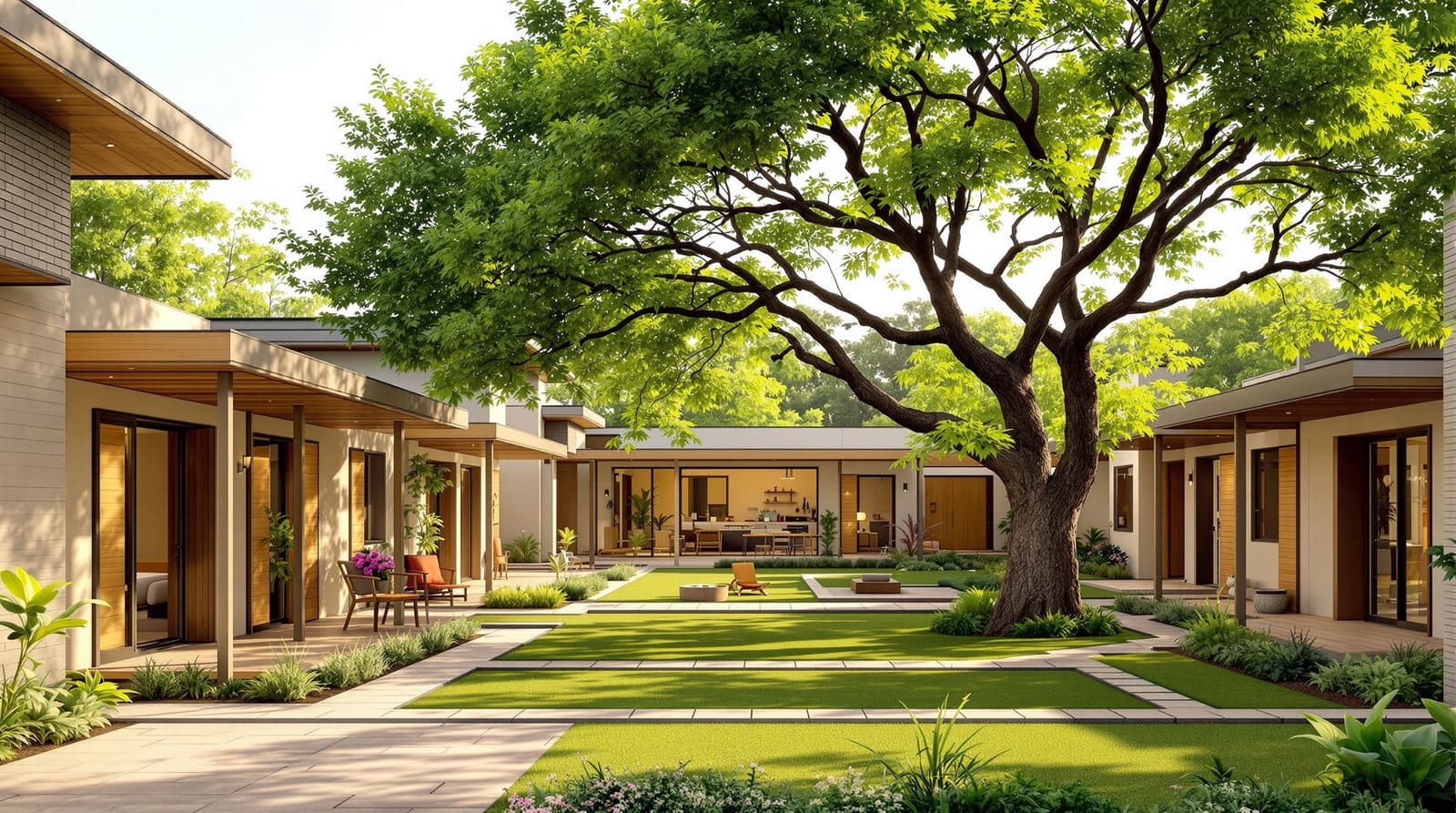
It is half past six on a Pune evening, and the courtyard at the centre of the housing cluster is doing what it was built to do. A clutch of seven- and eight-year-olds chase a half-deflated football across the shared green while their grandparents watch from a shaded plinth, trading the day's news. A delivery rider leaves a parcel with the woman tending the common herb bed because everyone knows whose flat it belongs to. Two doors stand open to the evening air. The lift in the tower across the road, by contrast, carries strangers up and down in silence; its lobby is a place to pass through, never to be.
This is not nostalgia. It is a design choice, and increasingly a deliberate one. Across India a generation of architects, developers and homebuyers is asking why the dominant model — the anonymous apartment tower ringed by a compound wall — leaves so many people lonely inside their own neighbourhoods, and what it would take to build housing that puts shared life back at the centre of the plan. Community-centric housing is the design philosophy that treats the in-between spaces — the courtyards, thresholds, shared streets and semi-private edges — as carefully as the homes themselves, because that is where belonging is actually made.
What community-centric housing actually means
The conventional logic of Indian residential development optimises the unit. Maximise the saleable carpet area, stack the units efficiently, wrap them in a wall, add a name with the word "Greens" or "Heights" in it, and sell. Everything outside the front door is treated as residual — leftover space, driveway, setback, the bit you mow. Community-centric housing inverts that priority. It designs the in-between first, then arranges the homes to serve and overlook it.
The intellectual roots are deep and global. New Urbanism and Traditional Neighbourhood Development argued in the 1990s that the post-war suburb had engineered social isolation, and that walkable, mixed, finely grained neighbourhoods rebuild community. Jan Gehl spent a career documenting how the design of the space between buildings determines whether people linger or flee. Carlos Moreno's fifteen-minute city reframed proximity itself as the unit of a good life. But the most important precedents for India are not foreign at all — they are the traditional settlement forms that the country quietly demolished in its rush to verticality.
The mohalla, the Maharashtrian wada with its central courtyard, the Tamil agraharam street where homes shared a continuous verandah edge, the Gujarati pol with its gated lane and shared water tank and bird-feeder — these were not picturesque accidents. They were sophisticated social technologies. They graduated space from the public street to the semi-private lane to the threshold to the private home, so that a child could play within sight of a dozen watchful adults, an elder was never far from company, and a festival flowed naturally from house to street. They built what planners now call passive surveillance and social capital, and they did it without a single CCTV camera or WhatsApp group. Community-centric housing is, in large part, the project of translating that intelligence into contemporary, dense, code-compliant form.
Designing the in-between: the gradient from public to private
The single most useful idea in this whole field is the spatial gradient. Belonging does not happen in spaces that are either fully public (where you are anonymous) or fully private (where you are alone). It happens in the graded thresholds between them — the stoop, the shared landing, the courtyard you half-own, the lane you recognise. A community erodes when that gradient collapses into a binary: the locked flat and the impersonal lobby, with nothing in between.
Designing the gradient means deliberate moves at every scale. At the home, a deep verandah, a window seat that overlooks the lane, a front door that opens onto a shared edge rather than a double-loaded corridor. At the cluster, a courtyard of eight to thirty homes that is collectively owned and naturally surveilled — the form explored in detail in cluster housing explained. At the neighbourhood, shared streets where the car is a guest, not the master, and where the carriageway doubles as play space and festival ground. None of this is exotic; it is the difference between a plan that asks "where do the cars go?" first and one that asks "where do people meet?" first.
The tower is not the villain by virtue of its height — Singapore and Hong Kong build sociable high-rise. The villain is the anonymous tower: the configuration where the only shared space is a transactional lift lobby, where no flat overlooks a common ground, and where the compound wall privatises the commons for residents while turning a blank, dead face to the city.
The spectrum, from a stoop to full co-housing
Community-centric housing is not a single product. It is a spectrum of intensity, and a developer or a homebuyer can sit anywhere along it.
At the lightest end is simply good edge design: a stoop, a bench, a shaded threshold, a front door that faces a neighbour's. Add a genuine shared courtyard and you have the cluster model. Add managed common facilities — a hall, a play area, a guest room — and you have what most thoughtful Indian gated communities already gesture at, usually half-heartedly. Further along is the intentional sharing of daily life: shared meals, collective childcare, jointly run amenities. At the far end is full co-housing — the Danish bofællesskab model where residents co-design the scheme, own their private homes but deliberately share a common house with a kitchen and dining hall, and run the community by consensus. That most intentional end of the spectrum has its own dedicated treatment in co-housing models; the point here is that almost any project can move a notch or two up the ladder without going all the way.
The social infrastructure that makes community real
A courtyard alone does not make a community; it makes a pretty void. What activates the in-between is social infrastructure — the small, shared, programmed places that give people a reason to be there at the same time.
The list is short and ancient. A common room that can be a study, a meeting, a yoga class or a children's party. A safe, overlooked play area within shouting distance of homes. A shared kitchen and covered dining space that comes alive for festivals, weddings and the monthly community meal — the single highest-return shared facility in the Indian context, because so much of Indian social life is organised around food. A maidan or generous green that holds cricket, garba, a wedding mandap and a morning walk. A few benches and a chaupal-like shaded sitting place where elders naturally gather. Each device does specific social work, and it is worth being explicit about which.
| Community device | What it enables (when designed and overlooked well) |
|---|---|
| Shared courtyard | Daily unplanned encounter; children's play within sight of homes; the social heart of the cluster |
| Common room / hall | Meetings, classes, celebrations & remote work; a neutral space that builds weak ties |
| Festival kitchen & dining | Collective meals, weddings & festivals; the strongest belonging-builder in Indian life |
| Overlooked play area | Children's freedom & independence; passive surveillance by surrounding homes |
| Maidan / shared green | Cricket, garba, walking, gathering; flexible space for the whole age range |
| Shaded plinth / chaupal | Elders' company & "eyes on the street"; intergenerational contact |
| Threshold & verandah edge | The public-to-private gradient; casual neighbourly contact without intrusion |
The deeper logic of how these public open spaces fit a layout is covered in anatomy of a good neighborhood; the point to hold here is that social infrastructure is housing infrastructure, not an amenity bolted on to sell flats.
Designing for all ages
The clearest test of whether housing is genuinely community-centric is whether it works for the very young and the very old — the two groups that most need a community and are most failed by the anonymous tower.

Children need the freedom to roam a little — to step out of the door, find a friend and play, all within a safe, car-free, overlooked territory. That single capacity, normal a generation ago and nearly extinct in the gated high-rise where a child cannot leave the flat unaccompanied, is one of the strongest reasons families seek out community housing. Elders need the opposite movement: a reason and a place to be present in shared life, a shaded seat with a view of the comings and goings, company within reach. And those elders, simply by being present, provide the "eyes on the street" that make children's freedom safe — Jane Jacobs' insight, alive in every functioning mohalla.
Intergenerational living is the third strand: layouts and unit mixes that let an extended family, or simply different generations, live close without living on top of one another — a separate-but-near flat, a granny annexe, a cluster where parents and married children take two homes around the same courtyard. This is where community-centric design meets the Indian family structure honestly, and where it diverges from the single-household assumptions baked into most flat plans.
Privacy, security and the honest Indian reality
It would be dishonest to pretend this is easy in India, or that more sharing is always better. The genuine tension is real: Indian buyers, especially women and families, value security and privacy intensely, and the gated community sells precisely that. Any community-centric scheme that ignores the security anxiety will not sell, and should not pretend the anxiety is irrational.
The resolution is not to choose between community and privacy but to design the gradient so that residents control their own exposure. A home on a courtyard should be able to retreat fully — a private terrace, a screen, a door that closes — and also open up when wanted. Defensible space and passive surveillance, properly done, deliver more real safety than a wall and a guard, because a hundred watchful neighbours beat one bored security guard at midnight. The gated-versus-open tension is genuine; the best Indian projects manage it with a controlled edge to the city and a generous, shared, surveilled interior, rather than a fortress with a dead heart.
Then there is governance and maintenance — the place where Indian community ambitions most often die. A shared courtyard and a festival kitchen are liabilities without a functioning Resident Welfare Association to clean, fund and program them, and RWAs are notoriously prone to apathy, capture and conflict. Magarpatta City in Pune and B V Doshi's Aranya housing in Indore are studied precisely because they got the social and management dimension partly right; Lavasa is studied as a warning about what happens when the financing and governance model fails under a beautiful master plan. RERA has improved buyer protection, but it does not legislate community. The honest rule is this: the maintenance and governance model must be designed with the same seriousness as the courtyard, or the courtyard becomes a weedy, contested, locked void within five years.
Affordability is the last hard truth. Generous shared space costs land, and land is the scarcest, costliest input in urban India. The answer is not luxury commons for the few; it is to recognise that shared infrastructure can let private units be smaller and cheaper while the household's effective living space grows — a small flat opening onto a real courtyard and a shared dining hall lives larger than a slightly bigger flat opening onto a corridor. That trade is the core economic argument for community-centric housing at scale, and it is what connects this approach to the broader vision of the future Indian township.
References
- Carlos Moreno, The 15-Minute City: A Solution to Saving Our Time and Our Planet (2024); and the founding "15-minute city" framing, 2016 onward.
- Congress for the New Urbanism, Charter of the New Urbanism (2nd ed., 2013).
- Jan Gehl, Cities for People (Island Press, 2010); and Life Between Buildings.
- Jane Jacobs, The Death and Life of Great American Cities (1961) — passive surveillance and "eyes on the street".
- Charles Durrett & Kathryn McCamant, Creating Cohousing: Building Sustainable Communities (2011).
- Town and Country Planning Organisation, Government of India, URDPFI Guidelines (2014) — norms for residential community facilities and open space.
- B V Doshi / Vastu Shilpa Foundation, Aranya Low-Cost Housing, Indore (Aga Khan Award, 1995) — graded public-to-private space at scale.
For the bigger picture this housing model serves, read the future Indian township and the most intentional version of shared life in co-housing models — then bring your own site and family to DesignAI to see how a community-centric layout could take shape.
Export this guide
Related Guides — Deep-dive reading
How to Plan a Home for Multi-Generational Living
Designing for grandparents, parents and children under one roof — privacy, accessibility and harmony
Home PlanningThe Street, Mathura: How Sanjay Puri Turned a Corridor into a Community
At GLA University near Mathura, Sanjay Puri Architects folded 800 hostel rooms into five snaking, four-storey blocks so that the leftover space between them became a genuine pedestrian street — a low-cost, climate-tuned answer to the question of how young people should live together, drawn from the winding lanes of an old Indian city.
The Future of ArchitectureACROS Fukuoka: Emilio Ambasz and the Building That Gave Its Park Back
Two decades before the vertical forest, Emilio Ambasz hid a million square feet of concert hall and offices under a fifteen-storey climbing garden — turning the oldest argument in cities, land value versus open space, into a single terraced hill in the heart of Fukuoka.
The Future of ArchitectureRelated Tools — Try Free
Cross-Ventilation Analyzer
Estimate airflow and air changes per hour (ACH) from room size, window areas, layout, and local wind — with NBC 2016 Part 8 compliance check.
Ventilation CalculatorRainwater Tank Sizer
How big should your rainwater tank be? Computes annual harvest, recommended tank capacity in litres, water-bill savings, and payback — for 10 Indian cities.
RWH CalculatorRoom Programming Worksheet
Add every space, size it to feel right and rank it A/B/C — then generate an architect-ready design brief.
Design Tool