
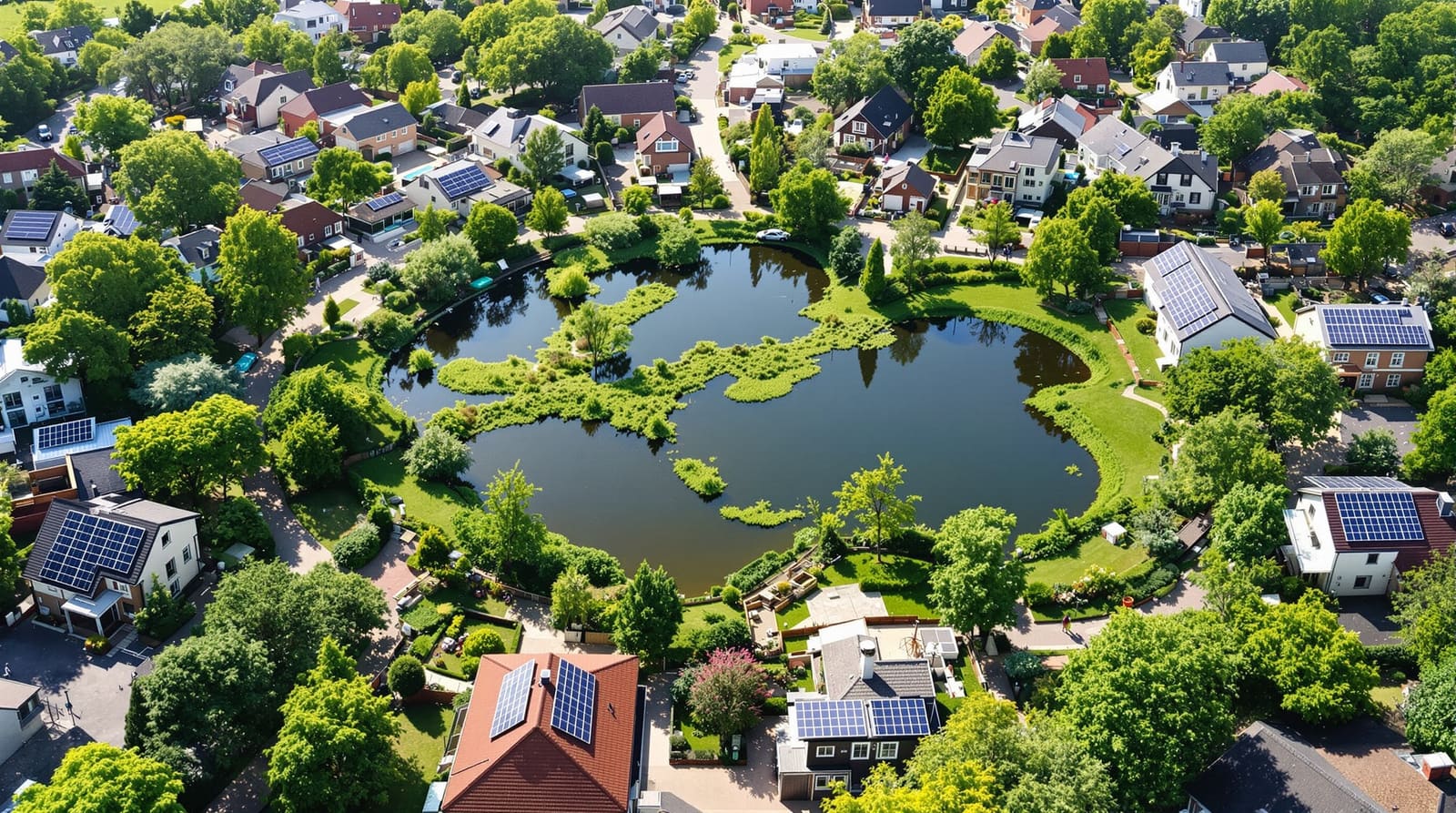
Net-Zero Residential Communities
Net-zero at community scale — the four net-zeros (energy, water, waste, carbon), shared generation and microgrids, the demand-first principle, and honest annual accounting
On the outskirts of Bengaluru, a 14-acre residential community runs a small ritual every evening at dusk. As the rooftop solar tapers off and the air-conditioners come on, a bank of batteries in a corner shed quietly takes over, discharging the day's surplus into the lanes of two-storey row houses and a low apartment block. A screen in the clubhouse shows two lines for the day — kilowatt-hours generated, kilowatt-hours consumed — and on most clear-sky days from October to March the green line sits comfortably above the orange one. The community sells the difference back to the grid. The residents call it net-zero. On a grey, drenched July afternoon, the same screen tells a humbler story: the orange line wins, the batteries empty by nine, and the grid carries the rest.
That gap between the dry-season triumph and the monsoon shortfall is the whole subject of this guide. Net-zero is not a steady state you occupy every minute; it is an annual ledger that must balance across all twelve months, the bright ones subsidising the dark. And the honest truth most brochures omit is that a single home struggles to close that ledger, while a community of a few hundred homes — pooling roofs, sharing a battery, treating its own water and digesting its own waste — has a genuine shot. Net-zero is most achievable not at the scale of the house but at the scale of the neighbourhood, where shared generation, a common microgrid, and district-scale water and waste systems can balance what no individual dwelling can.
What "net-zero" actually means — and why "net" matters
Net-zero is a balance struck over time, usually a calendar year, between what a community draws and what it produces or offsets. The word "net" is doing heavy lifting: it does not mean the community is self-sufficient every hour of every day, nor that it never touches the grid, the municipal water main, or the landfill. It means that, summed across the year, production and offset equal or exceed consumption. A community can pull power from the grid at 8 p.m. in August and still be net-zero-energy if it exported enough surplus on clear March afternoons to cancel that draw.
This matters because "net-zero" is one of the most greenwashed phrases in Indian real estate. There are four distinct net-zeros, and a project that achieves one is often marketed as if it has achieved all four.

- Net-zero energy — renewable generation over the year equals or exceeds operational energy use.
- Net-zero water — the community sources, harvests and reuses enough that its net draw on external freshwater is nil; rainwater capture plus treated greywater and blackwater reuse meet demand.
- Net-zero waste — organic and recyclable streams are composted, digested or recovered so that what goes to landfill approaches zero.
- Net-zero carbon — the trickiest, because it must account not just for operational energy but for the embodied carbon locked into the concrete, steel and brick of construction itself.
Each is a separate accounting exercise. A community can be net-zero-water and nowhere near net-zero-carbon. Honest projects say which one they mean.
Why the community scale unlocks what a home cannot
A single rooftop in an Indian city is shaded by water tanks, neighbours and trees, oriented however the plot fell, and sized to one family's wallet. It can offset a meaningful fraction of a home's energy, but a fully net-zero home — as discussed in our guide on net-zero energy homes — needs an unusually good roof, an unusually efficient house, and often a battery that one household struggles to justify. Step up to the community and the arithmetic transforms.
A community can aggregate every viable rooftop and add a small ground-mounted solar farm on common land, sizing total generation against total demand rather than house by house. It can run a microgrid — an internal distribution network with its own controls — so that a surplus on one roof flows to a deficit on another in real time. It can install a single community battery far cheaper per kilowatt-hour than two hundred individual ones, smoothing the daily peak and carrying the evening load. On the water side, it can build collective rainwater harvesting into a central pond or recharge field, run one decentralised sewage treatment plant, and recycle treated water back for flushing and landscape — the path to net-zero water. On waste, a shared composting yard and a biogas digester can turn the community's wet waste into cooking gas or electricity, approaching net-zero waste. District cooling — one efficient central chilled-water plant instead of hundreds of split units — can cut cooling energy substantially in the right climate. None of these are available to the lone household. This is the energy-and-carbon extreme of the broader model laid out in sustainable neighborhood design; net-zero is what that design aims at when it pushes the dial all the way.
Demand first — reduce before you generate
The most expensive kilowatt-hour is the one you have to generate; the cheapest is the one you never needed. Every credible net-zero community is built demand-first: it drives consumption down through design before it spends a rupee on solar panels. A community that has not done this is simply buying a very large array to feed an inefficient settlement, and the embodied carbon of all that hardware undermines the whole exercise.

Demand reduction begins with the layout itself — orientation for prevailing breeze and shaded streets, building depths shallow enough for cross-ventilation, massing that shades west walls. It continues through the passive design of each home: insulation, reflective roofs, shaded glazing, so that the cooling load shrinks before any mechanical system switches on. It includes efficient appliances, LED lighting, efficient pumps and lifts on the common services, and a layout that lets people walk rather than drive, cutting transport energy too. Only once demand is as low as design can sensibly push it does generation get sized against it. The rule of thumb across serious net-zero practice is roughly: efficiency first can halve the load, and then renewables only have to cover the smaller half.
The honest accounting — where net-zero claims live and die
Here is where most marketing collapses. Honest net-zero accounting confronts four uncomfortable facts.

First, grid-tied versus off-grid. The honest, achievable, and frankly sensible target for an Indian community is net-zero while staying grid-connected. The grid acts as a giant virtual battery: the community exports surplus by day and imports at night, settling to zero over the year through net-metering. Going fully off-grid would require oversizing both panels and batteries enormously to survive the monsoon, multiplying cost and embodied carbon for little real benefit. Grid-tied net-zero is the credible model; "off-grid net-zero" in a city is usually theatre.
Second, the monsoon and cloudy-season storage gap. Solar output in much of India can fall by half or more during a long monsoon spell. No reasonably sized battery bridges weeks of low sun. This is precisely why the annual-ledger definition matters and why grid balancing is essential — the bright dry season has to bank enough surplus to cover the wet one.
Third, embodied carbon. A community can run net-zero-energy for forty years and still have a large carbon debt from the concrete and steel poured to build it. Net-zero-carbon, honestly accounted, must include this embodied burden — which pushes serious projects toward lower-carbon materials, less concrete, and retrofitting existing stock rather than always building new.
Fourth, what counts as offset. Buying carbon credits or RECs to "reach" net-zero is weaker than actually generating clean energy on site. The honest hierarchy is: reduce demand, then generate and reuse on site, and only then offset the residual — never offset-first.
| The four net-zeros | What it means at community scale | The community move |
|---|---|---|
| Net-zero energy | Annual renewable generation & offset equals annual operational energy use | Aggregated rooftop & ground solar, a microgrid, a shared community battery, district cooling, net-metering with the grid as the annual balancer |
| Net-zero water | Net draw on external freshwater approaches nil over the year | Collective rainwater harvesting & recharge, one decentralised STP, treated greywater & blackwater reuse for flushing & landscape |
| Net-zero waste | Waste sent to landfill approaches zero | Community composting of wet waste, a biogas digester, segregation & recovery of dry recyclables, near-zero residual |
| Net-zero carbon | Operational & embodied carbon net to zero | Demand-first passive design, on-site renewables, low-carbon materials & less concrete, retrofit over rebuild, offsets only for the residual |
The path — net-zero-ready, then net-zero, new build versus retrofit
Net-zero is rarely switched on at handover; it is approached in stages. A pragmatic developer builds net-zero-ready first: the demand is minimised, the roofs and common land are structured and reserved for arrays, the conduits and microgrid switchgear are pre-installed, and the water and waste plants are sized for full reuse — even if generation is phased in as the community fills up and as finance allows. The community then closes the ledger to true net-zero as occupancy and load stabilise.
New build has the obvious advantage: orientation, passive design, the microgrid and the district systems can all be designed in from day one, which is why net-zero pilots are almost always greenfield. Retrofit is harder — you cannot reorient finished buildings — but it matters far more for India's carbon total, because most of the homes that will exist in 2050 are already built. Retrofit focuses on what is reachable: rooftop solar on existing roofs, efficiency upgrades, a bolt-on STP and composting, and aggregating an existing RWA's roofs onto a shared meter. The deeper community-scale ambition belongs to the township-scale vision set out in the future Indian township.
Does it work in India? The honest reckoning
The Indian fundamentals are unusually favourable on one axis and stubborn on others. The sun is the gift: most of the country receives strong, year-round solar irradiation, and solar tariffs have fallen to among the cheapest electricity ever recorded, which makes community generation economically rational, not merely virtuous. Net-metering policy exists in most states, allowing communities to bank surplus with the grid — though the rules are set by each state's DISCOM, caps on system size and gross-versus-net-metering disputes are real, and the financially stressed DISCOMs have at times resisted rooftop solar because it erodes their most profitable customers. Any net-zero claim rests on a net-metering arrangement that the local DISCOM must honour, and that is a policy risk, not a technical one.
Real Indian attempts give honest lessons. IGBC's Green Townships rating and the international LEED-ND framework have certified several large communities on energy, water and waste criteria, proving the systems work at scale here. Magarpatta City in Pune is often cited for its in-built water recycling and waste management; Aranya in Indore and Auroville near Puducherry show what intentional, resource-conscious community can look like over decades. But the cautionary tales are louder: many "green township" claims rest on one net-zero (usually water) while the project remains car-dependent and carbon-heavy; several flagship integrated townships stalled on land, finance and governance long before any sustainability target mattered. Net-zero water without net-zero carbon is still progress, but it is not the whole claim.
The hard constraints are affordability and governance. The premium for a genuine net-zero community — battery, STP, biogas, low-carbon materials — adds real upfront cost, and unless the lifetime energy and water savings are made legible to buyers, the market discounts them. And the systems only stay net-zero if they are run: a battery, an STP and a digester demand competent, funded operation, which falls to the same Resident Welfare Association that often struggles to maintain a lift. The most durable net-zero communities pair the hardware with a maintenance corpus and professional facility management from the outset. Tools like DesignAI can help a developer or planner model demand-first layouts and visualise how passive design, shared generation and reuse stack up before a single panel is bought — turning the net-zero ambition from a brochure line into a buildable, honestly accounted plan.
References
- Carlos Moreno et al., "Introducing the 15-Minute City: Sustainability, Resilience and Place Identity in Future Post-Pandemic Cities," Smart Cities, 2021.
- Indian Green Building Council (IGBC), Green Townships Rating System & Net Zero ratings, igbc.in.
- U.S. Green Building Council, LEED for Neighborhood Development (LEED-ND) rating system.
- Bureau of Energy Efficiency & Ministry of New and Renewable Energy, rooftop solar and net-metering framework (DISCOM-administered), India.
- URDPFI Guidelines 2014, Ministry of Urban Development, Government of India.
- TERI, "Net-Zero Energy Buildings and Communities in India" (research and pilots), The Energy and Resources Institute.
- Jan Gehl, Cities for People, Island Press, 2010.
For the household-scale version of this ambition see net-zero energy homes, and for the water side of community net-zero see water-sensitive urban design — then explore how it all comes together with DesignAI.
Export this guide
Related Guides — Deep-dive reading
Designing a Naturally Energy-Efficient Indian Home
Comfort first, gadgets last — passive design, orientation, insulation, ventilation and the climate wisdom that cuts Indian energy bills
SustainabilityWhy Sustainable Buildings Cost Less Over Time
The lifecycle-cost case for green homes in India, explained in plain money for ordinary homeowners
SustainabilityEmbodied Carbon in Construction: Cutting the Carbon Locked Into Your Indian Home
The CO2 baked into your cement, steel and bricks is paid up front and can never be undone. Here is where it hides in an Indian home, and the low-cost choices that cut it by roughly a quarter.
SustainabilityRelated Tools — Try Free
Rainwater Tank Sizer
How big should your rainwater tank be? Computes annual harvest, recommended tank capacity in litres, water-bill savings, and payback — for 10 Indian cities.
RWH CalculatorCross-Ventilation Analyzer
Estimate airflow and air changes per hour (ACH) from room size, window areas, layout, and local wind — with NBC 2016 Part 8 compliance check.
Ventilation CalculatorApartment Video Door System Planner
Enter flats, entrances, floors and guard desk for a first-pass building intercom plan — door stations, indoor monitors, guard station, the right architecture and an indicative cost band.
Building Planner