
Digital Twins in Residential Design: A Living Model of Your Home
What a digital twin really is, and how a data-connected model of your house could help you design, build and run it
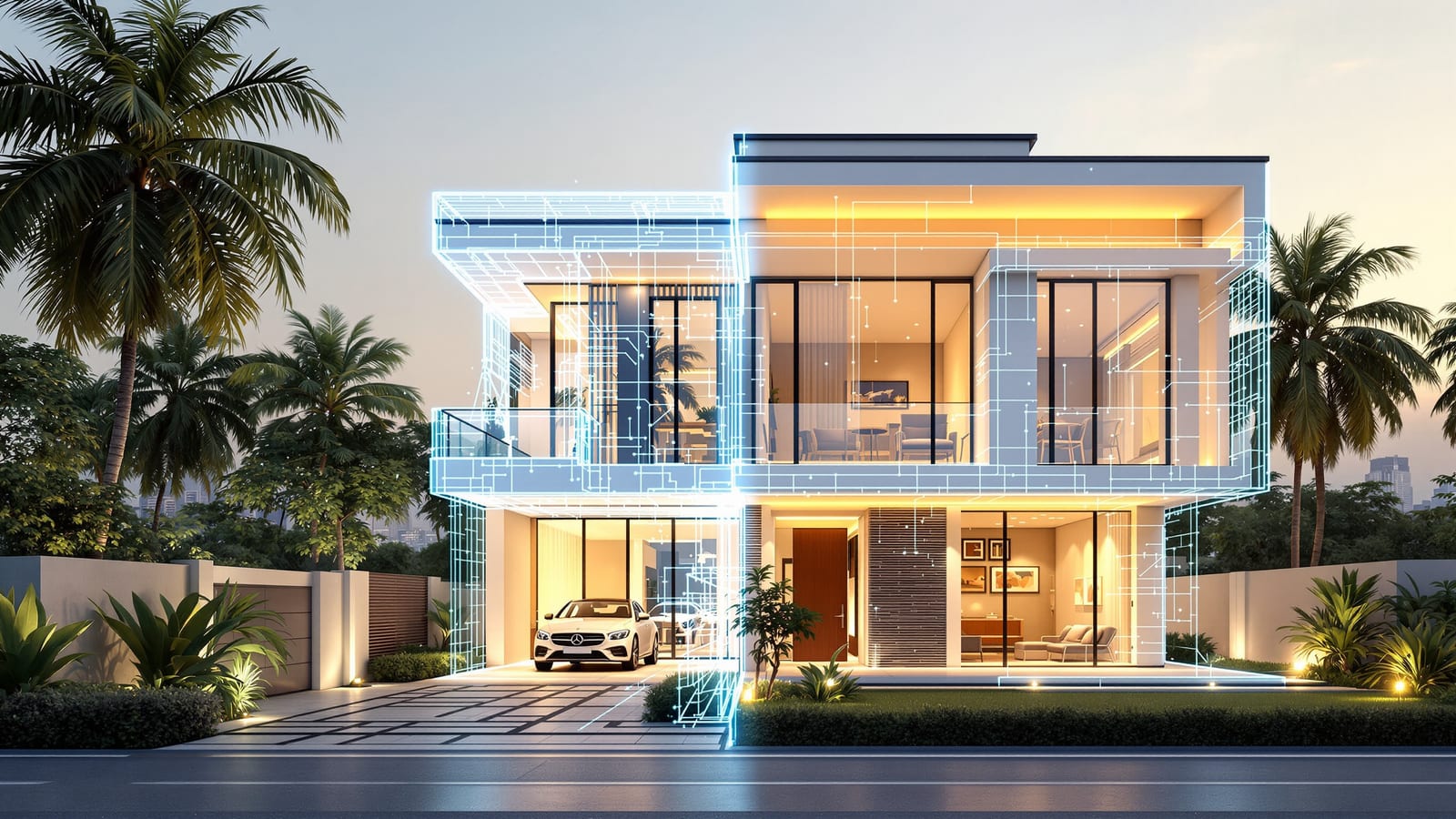
You have probably seen a 3D render of a house before you build it. Pretty pictures, nice lighting, a walkthrough video. A digital twin is a different and more powerful idea. Instead of a one-time picture, it is a living, data-connected 3D model of your home that mirrors the real thing as it actually behaves, day after day.
Think of it this way. A render is a photo of your home. A static model is a detailed drawing of your home. A digital twin is a model of your home that is plugged into the real house, so when the real building gets hotter, uses more water, or a pump starts struggling, the model knows. It is the difference between a photograph of you and a fitness band that tracks your heartbeat in real time.
This is a genuinely exciting direction for how homes are designed, built and run. But you deserve an honest picture, not hype. Digital twins are already mainstream for airports, factories, metro systems and large commercial towers. For ordinary Indian homes, the full live version is still emerging. What you can realistically get today is a very good 3D information model plus, perhaps, some smart-home data. The fully connected, self-monitoring home twin is coming, not here for the mass market. This guide explains the whole spectrum so you know what to ask for and what to ignore.
1. What a digital twin actually is
A digital twin has three ingredients that a normal model does not have all of:
1. A detailed virtual model of the physical thing (your home, its walls, structure, pipes, wiring, equipment).
2. A connection to real data coming from the actual building, usually through sensors.
3. The ability to update, analyse and sometimes predict, so the model reflects current reality and helps you make decisions.
The widely accepted definition from industry is that a digital twin is a dynamic virtual representation of a physical asset that uses real-time data to simulate performance, predict outcomes and improve decisions, kept current by live information from sensors and connected devices.
Strip away one of those ingredients and you have something simpler. A 3D model with no live data is just a model. Live data with no model is just a dashboard. A digital twin is the marriage of the two: the model and the real building stay in sync.
2. BIM, as-built models and live twins: the spectrum
People often confuse digital twins with BIM. They are related but not the same, and understanding the difference protects you from being oversold.
BIM stands for Building Information Modelling. It is a way of designing a building as a smart 3D model where every element (a wall, a window, a beam) carries information, not just shape, but material, size, cost and specification. BIM is mostly used during design and construction. Internationally, the way this information is organised and handed over is governed by a standard called ISO 19650, which sets out how building information should be managed across a project lifecycle. BIM is the foundation. It is detailed and intelligent, but on its own it is a snapshot, not a live feed.
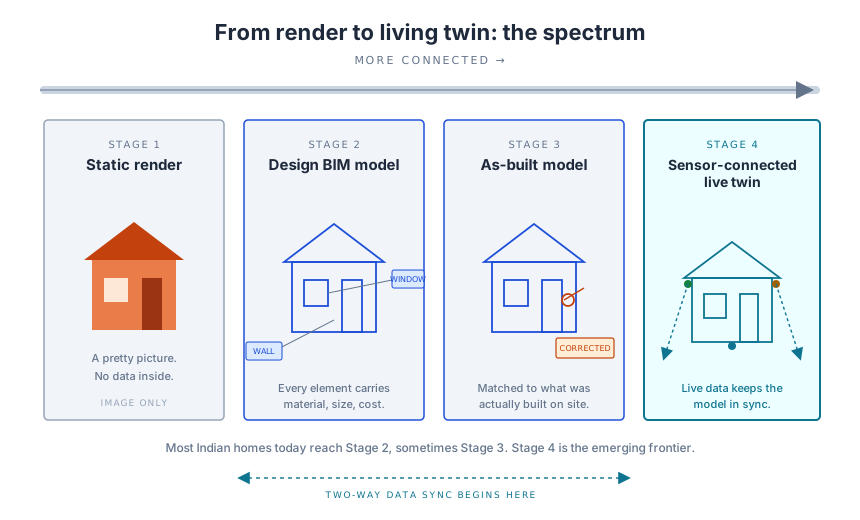
The journey from a design model to a true digital twin runs along a spectrum:
- Design BIM model: the intelligent 3D model created to design and document the home.
- As-built model: the BIM model corrected to match what was actually built on site, including changes made during construction.
- Sensor-connected live twin: the as-built model linked to real-time data from the running house, so it reflects what the building is doing right now.
Most homes today reach the first stage, sometimes the second. The third stage is where digital twins truly begin, and for residential it is the emerging frontier.
3. How a twin helps across your home's life
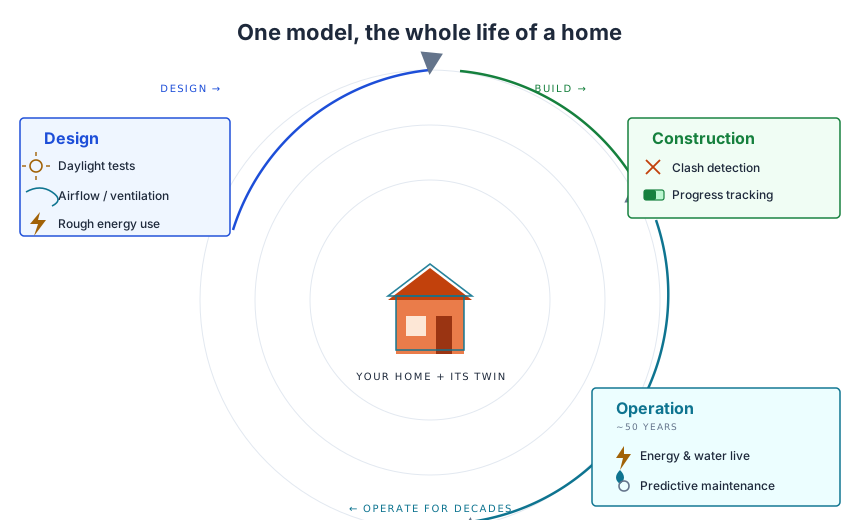
The real value of a digital twin is that it serves the whole life of a home, not just one stage. The same model that helped design your house can help build it and then help run it for decades.
During design, a connected model lets your architect test ideas before a single brick is laid. How much daylight does the living room get in December? Does the cross-ventilation actually work in May? How will the layout perform on the electricity bill? These can be simulated, compared and improved on screen, which is far cheaper than discovering problems after construction.
During construction, the model becomes a coordination tool. Different consultants (structure, plumbing, electrical, air-conditioning) put their work into one shared model, and clashes (a duct running straight through a beam) are caught on the computer instead of on site. Progress can be tracked against the model so you can see whether the build is on schedule.
During operation, which can last fifty years, a live twin watches the running home. It can monitor energy and water use, flag when consumption looks abnormal, predict when a pump or air-conditioner is heading for failure, and help tune comfort and efficiency. This operation phase is exactly where digital twins prove their worth in large buildings, and the maintenance savings reported in commercial settings are significant.
4. Lifecycle table: what the twin does, and how real it is
Here is an honest map of each stage, what a digital-twin approach can do, and how mature it is for ordinary Indian homes today.
| Lifecycle stage | What the twin does | Maturity for homes |
|---|---|---|
| Early design | Test layouts, daylight, ventilation and rough energy use before building | Available now (good architects use BIM and simulation) |
| Detailed design | Coordinate structure, plumbing, electrical, HVAC in one model | Available now on better-organised projects |
| Construction | Detect clashes, track progress, record what was actually built | Partly available; depends on the builder |
| Handover | Deliver an accurate as-built model and documents to the owner | Rare for homes today, more common for villas and apartments by good developers |
| Operation: monitoring | Track energy, water and comfort live through sensors | Emerging; needs smart-home devices |
| Operation: predictive | Predict equipment failure and optimise automatically | Mostly commercial today; early for homes |
The pattern is clear. The earlier design stages are practical and available right now. The live, predictive operation stages are where homes are still catching up to commercial buildings.
5. Where digital twins are real today
It helps to be precise about who is already using this so you can calibrate your expectations.
Digital twins are well established for large and complex assets: commercial office towers, airports, hospitals, factories, data centres, metro and utility networks. These buildings have full-time facility managers, hundreds of sensors and clear financial reasons to optimise energy and maintenance. The market for digital twins in smart buildings is growing strongly precisely because the savings on operation and maintenance justify the investment.
For homes, real examples exist but are the exception, not the rule. They tend to be high-end villas, premium apartment projects by sophisticated developers, sustainable or net-zero homes, and research or pilot projects. In these cases the owner or developer has both the budget and a reason to monitor performance closely.
For the typical Indian home being built or renovated this year, a true live digital twin is not yet a standard offering. That is not a failure; it is simply where the technology is on its journey.
6. The maturity ladder: not all twins are equal
Researchers describe digital twins on a capability ladder, roughly from level zero to five. Understanding it helps you see how far any given offering really goes.
- Standalone or descriptive: a model that simply shows the building and its information.
- Diagnostic: it can tell you what is happening and why, using current data.
- Predictive: it can forecast what is likely to happen, such as equipment wear.
- Prescriptive: it recommends what you should do about it.
- Autonomous: the highest level, where the system senses, decides and adjusts itself with little human input.
Most home-related models live at the lower rungs (descriptive and, with smart devices, a little diagnostic). The glamorous talk of a self-optimising home that runs itself sits at the top of the ladder and is rare even in commercial buildings. When someone offers you a digital twin, a fair question is: which rung is this, really?
7. What you realistically get as a homeowner now
Set the marketing aside and here is the practical situation in 2026.
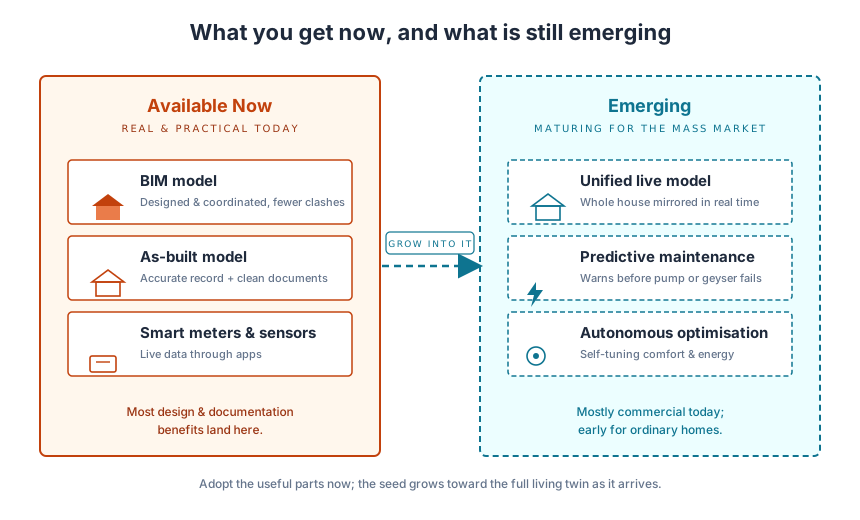
What you can reasonably ask for and receive today:
- A proper BIM model used to design and coordinate your home, which already gives you better-tested daylight, ventilation, layout and fewer construction clashes.
- An accurate as-built model and a clean set of documents at handover, so you (and any future architect) know exactly how the home was built and where the pipes and wires run. Our companion guide on working drawings and documentation explains why this paperwork matters so much.
- Smart-home devices (energy meters, water sensors, thermostats, leak detectors, cameras) that give you live data through apps, even if they are not yet stitched into a single 3D twin.
What is still emerging for the mass market:
- A single, sensor-connected model that mirrors your whole house in real time.
- Predictive maintenance that warns you before the geyser or pump fails.
- Automatic optimisation of comfort and energy across the whole home.
The honest summary: you can get most of the design and documentation benefits now, and you can start collecting live data now. Joining them into a full living twin is the part that is maturing.
8. How it connects to AI and smart-home systems
A digital twin on its own is a faithful mirror. Add artificial intelligence and smart-home systems, and it starts to become genuinely useful.
The smart-home layer supplies the senses. Connected meters, sensors and devices feed the twin a steady stream of data about temperature, electricity, water, occupancy and equipment health. Our companion guide on smart infrastructure planning for homes covers how to wire and plan for this from day one, which is far easier than retrofitting later.
AI supplies the interpretation. With enough data, machine-learning systems can spot patterns a human would miss: a fridge drawing more power than usual, a slow leak showing up as a tiny constant water flow, an air-conditioner losing efficiency. AI can then predict, recommend and, at the highest maturity, adjust settings automatically. This is the same trajectory we describe in AI and the future of residential design.
The twin is the thing that ties the model and the live data together so the AI has somewhere to reason about. Without the twin, AI sees disconnected numbers. With it, AI sees a coherent picture of your actual home.
9. The honest limits
Before you set your heart on a fully connected home, weigh the real constraints.
Cost. Sensors, smart devices, integration software and someone to set it all up add expense that only pays back over time, and mostly in large buildings so far.
Sensors and data. A twin is only as good as its data. Cheap sensors fail, batteries die, and gaps in data make the model misleading rather than helpful.
Maintenance and ownership. This is the biggest unanswered question for homes. Who keeps the model updated when you change a wall, replace the air-conditioner or repaint? A twin that drifts out of sync with reality quietly becomes useless. Commercial buildings have facility teams for this. Most homes do not.
Privacy and security. A live model of your home, full of sensor data about when you are in and what you use, is sensitive. It must be secured properly. ISO 19650 even has a part specifically about security-minded information management, which tells you the industry takes this seriously.
Compatibility. Smart-home devices from different brands do not always talk to each other or to the model, which can leave you with islands of data rather than one twin.
None of these are reasons to dismiss digital twins. They are reasons to adopt the genuinely useful parts now (a good model, sound documentation, sensible smart devices) and to treat the full living twin as something to grow into.
What this means for you
If you are building or renovating in India today, the smart moves are practical and available, not futuristic.
Ask your architect to design with a proper BIM model rather than just renders. You will get a better-tested home with fewer surprises on site. Insist on a clean as-built model and documentation at handover, because that is the seed from which any future twin will grow, and it is invaluable even on its own. When you wire the house, plan the smart-home infrastructure thoughtfully, since adding it later is painful and expensive. Adopt smart meters and sensors gradually for the things you actually care about, such as water leaks and energy use.
Then keep perspective. A full, self-running digital twin of an ordinary home is emerging, not standard. Anyone promising you a magical self-optimising house today is overselling. But everything that leads up to it (a good model, honest documentation, useful sensors) is worth doing now, pays off immediately, and quietly prepares your home for the living-model future as it arrives. For the construction-side breakthroughs heading the same way, see robotics and 3D printing in construction.
Sources
- ISO 19650-1:2018, Organization and digitization of information about buildings and civil engineering works, including building information modelling, Part 1: Concepts and principles. International Organization for Standardization.
- BSI, ISO 19650 Building Information Modelling overview, British Standards Institution.
- IES, Digital Twin Explainer Series: Digital Twins vs BIM.
- IoT For All, Digital Twins vs Building Information Modeling (BIM).
- Matterport, How and Why to Create Digital Twins in Real Estate.
- Intel Market Research, Digital Twin for Smart Building Market Outlook 2026 to 2032.
- F1000Research, Digital twin maturity levels: a theoretical framework for defining capabilities and goals, 2023.
- Xenoss, What Is a Digital Twin? Types, Examples and Maturity Levels.
Export this guide
Related Guides — Deep-dive reading
Digital Twins for STPs: A Live Simulation of Your Sewage Treatment Plant
What a digital twin of an STP actually is, how a live virtual model helps you operate, optimise and train without risk, and an honest read on where the technology stands for building-scale plants in India.
Sewage Treatment PlantsAI in STP Operations: What Actually Works Today (and What Doesn't)
A practical, honest look at how AI and machine learning are used to run sewage treatment plants — optimising aeration and energy, predicting effluent quality, catching faults early, and easing operator dependence — with a clear-eyed view of what is mature and what is still marketing.
Sewage Treatment PlantsAI and the Future of Residential Design
How artificial intelligence is changing the way Indian homes are designed, what it does brilliantly, where it still needs a human, and how you can use it today.
Future-Ready HomesRelated Tools — Try Free
Cross-Ventilation Analyzer
Estimate airflow and air changes per hour (ACH) from room size, window areas, layout, and local wind — with NBC 2016 Part 8 compliance check.
Ventilation CalculatorRainwater Tank Sizer
How big should your rainwater tank be? Computes annual harvest, recommended tank capacity in litres, water-bill savings, and payback — for 10 Indian cities.
RWH CalculatorApartment vs Villa Interior Planning Guide
Compare ceiling height, structural flexibility, lighting, storage, and services between apartments and villas.
Planning Guide