
Smart Water Monitoring India: Track Bathroom Usage, Catch a Running Toilet, Cut the Bill (2026)
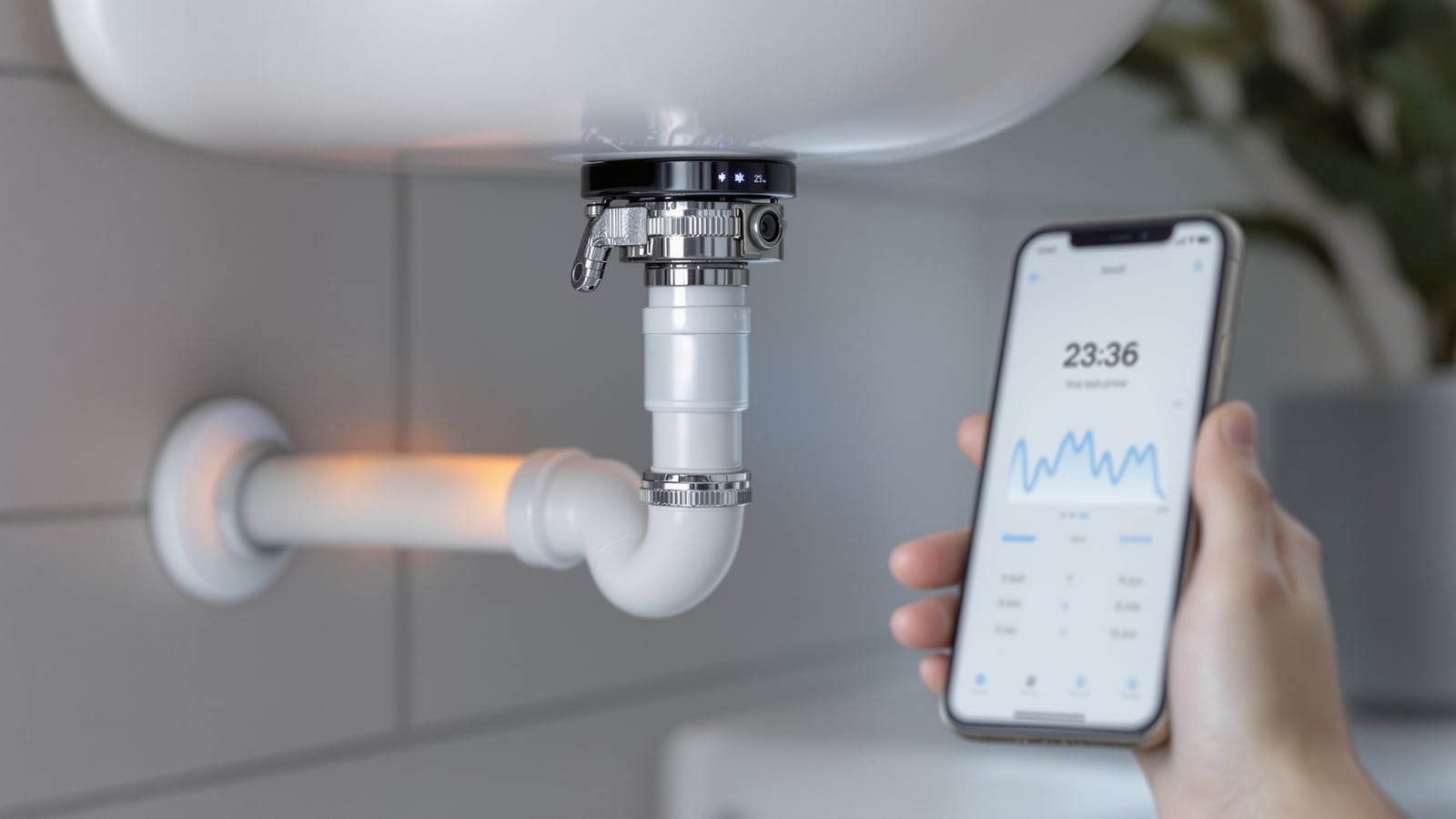
A clamp-on or inline flow sensor turns your water line into a dashboard — litres per shower, a toilet that never stops filling, a hidden drip you would never hear. This is the honest India-first guide to smart water monitoring: how sensors meter each fixture, the apps and alerts, tie-ins with auto shut-off valves, and the real rupee cost against the bill it saves.
You know the sound: the cistern that hisses faintly, hours after the last flush. Or the water bill — or the tanker order — that quietly crept up and nobody can say why. In most Indian homes water is invisible. It arrives from an overhead tank, disappears down drains, and the only feedback is a monthly reading or an empty sump. Smart water monitoring changes that: a single flow sensor on your supply line turns water into data you can see — litres per shower, per flush, per day — so a running toilet, a hidden leak or a habit of 20-minute showers stops being invisible and becomes fixable.
This is metering and usage intelligence, not just leak-catching. A dedicated smart leak detection setup for India exists to stop a burst or drip damaging the building; this guide is about knowing where every litre goes and shrinking the total. The two overlap — unusual flow is how you spot a leak — but the goal here is conservation, cost and awareness. Read it up to the smart bathroom guide for India for the whole connected room, and alongside the fittings that make monitoring pay off: water-saving faucets for India and the wider eco-friendly bathroom guide for India.
A monitor does not save a single drop by itself — it makes waste visible, and visible waste gets fixed. The savings come from you seeing the running toilet on day one instead of on the quarterly bill, and from a household that finally knows a rain shower costs three times a bucket bath.
What smart water monitoring actually measures
A water monitor sits on your incoming supply — typically the main line after the tank or pump, or on a sub-line feeding the bathrooms — and reads flow rate (litres per minute) continuously. From that raw flow it derives everything else:
- Total consumption — litres per day, week and month, so you can compare against your bill or your tanker deliveries.
- Per-fixture "signatures" — a toilet fill, a shower, a washing-machine cycle and a tap each have a distinctive flow shape and duration. Better systems learn these patterns and label usage by fixture without a sensor on each one.
- Anomalies — flow that never stops (a running toilet or open tap), flow at 3 a.m. when the house is asleep (a leak), or a single event far larger than normal (a burst).
- Micro-flow — very low, continuous flow of a fraction of a litre per minute, which is the classic signature of a silent cistern leak or a weeping joint that no one can hear.
The surprise for most households: a running toilet is by far the biggest silent waster. A flapper or float valve that fails to seat can pass 50–200 litres a day, quietly into the pan, invisible unless you dye-test it. A monitor catches it the same day — and that single alert often pays for the device.
Clamp-on vs inline sensors — the two ways to meter
There are two fundamentally different ways to read your flow, and the choice decides how hard the install is and how much you can automate.
Clamp-on (ultrasonic) sensors strap onto the outside of the pipe and read flow by bouncing ultrasound through the wall. Nothing is cut, nothing touches the water, and a plumber is often not even needed. They suit retrofits and renters, and they never restrict flow or become a leak point themselves. The trade-off: they are fussier about pipe material and diameter (they read cleanly on metal and thick-wall pipe, less reliably on some thin plastics), and they only measure — they cannot shut water off.
Inline sensors are cut into the pipe run, so the water flows through the meter. They are more accurate, work on any pipe once fitted, and — crucially — many inline units combine a motorised shut-off valve in the same body, so the system can close the water automatically when it detects a burst or an all-night flow. The trade-off: it is real plumbing (a licensed job, and a society may need to approve work on the common riser), and the valve is one more thing in the line that can, in principle, fail or restrict pressure.
| Feature | Clamp-on (ultrasonic) | Inline flow meter | Inline meter + shut-off valve |
|---|---|---|---|
| Install | Strap on, often DIY | Cut into pipe, plumber | Cut into pipe, plumber |
| Touches the water | No | Yes | Yes |
| Accuracy | Good, pipe-dependent | High | High |
| Can auto shut-off | No | No | Yes |
| Pressure impact | None | Slight | Slight |
| Pipe suitability | Metal / thick-wall best | Any, once fitted | Any, once fitted |
| Typical price (device) | ₹6,000–18,000 | ₹8,000–20,000 | ₹18,000–45,000 |
| Best for | Renters, quick retrofit | Owned home, metering only | Whole-home protection + metering |
For pure awareness and bill-shrinking, a clamp-on unit is the low-friction start. If you want the monitor to act — to slam the water shut when a pipe bursts while you are away — you need an inline unit with an integrated valve, and that is where monitoring and protection merge.
The app, the dashboard and the alerts
The sensor is only half the product; the software is what makes it useful. A good monitoring app should give you:
- Live flow — litres per minute right now, so you can watch a tap and read its rate.
- Breakdowns — usage split by fixture (shower, toilet, taps, appliances) and by day, week and month, with a running total.
- Budgets and trends — a monthly target and a nudge when you will overshoot, plus month-on-month comparison so a creeping leak shows as a rising baseline.
- Anomaly alerts to your phone — the ones that matter: continuous flow beyond X minutes, flow while "away" mode is on, micro-flow overnight, a single event over Y litres — as push notifications, not something you must open the app to find.
- Local history that survives the cloud — Indian broadband and power both drop, so the sensor should log offline and sync later, ideally with a small local display or hub.
The Indian realities to check before you buy: does it run on your 2.4 GHz Wi-Fi, does it buffer data through a power cut and reconnect on its own, and does any core function stop working if the manufacturer's cloud account lapses? A monitor that goes dumb the moment the internet blinks is close to useless here — prefer a device with local logic and a battery-backed sensor.
Tying monitoring to an auto shut-off valve
Metering tells you; a motorised shut-off valve acts. When an inline monitor also carries a valve, you can set rules that close the water without you lifting a finger:
- Burst / high-flow cut-off — if flow exceeds a threshold for longer than, say, 15 minutes continuously, close the valve. This is what saves a ceiling when a hose bursts while you are at work.
- Away mode — while the app is set to "away", any meaningful flow triggers a shut-off and an alert, since nobody should be drawing water.
- Overnight micro-flow — sustained tiny flow between set night hours flags (and optionally closes), catching the slow leak that would otherwise run for weeks.
A few India-specific cautions. A valve that closes the whole supply also stops your overhead tank from filling, so place the logic carefully if the same line feeds the tank pump. Keep the valve's power on an inverter-backed point, or choose one that fails safe (holds its last position) in a power cut rather than defaulting open. And never make auto shut-off the only protection — a hand stopcock the family can close still matters. The smart leak detection guide for India goes deeper on valve types and placement.
What it costs — and what it saves
The honest arithmetic decides whether this is worth it for you. Costs are the device, an optional install, and sometimes a small ongoing app subscription.
| Item | Typical range (₹) | Notes |
|---|---|---|
| Clamp-on monitor (measure only) | 6,000–18,000 | Often self-install |
| Inline monitor (measure only) | 8,000–20,000 | Plumber: add ₹800–2,500 |
| Inline monitor + shut-off valve | 18,000–45,000 | Plumber + electrician point |
| Plumbing / electrical labour | 800–3,500 | Depends on access and valve power |
| App subscription (if any) | 0–2,000 / year | Many have a free tier; buy hardware that is useful without it |
Now the savings. The big silent wastes are a running toilet (50–200 L/day), dripping taps, and over-use no one measured. Municipal slabs commonly run ₹8–60 per kilolitre for higher domestic slabs, while tanker water is far more — often ₹0.30–1.00 per litre in a shortage. A single running toilet at 150 L/day is ~4,500 L/month; on tanker water that alone can be ₹1,500–4,500 a month, so the device pays for itself in weeks the first time it catches one. Beyond leaks, households that simply see their showers and flushes commonly trim 10–20% off consumption through behaviour alone.
Installation and the Indian plumbing reality
Where the sensor sits decides what it can see. A few practical rules:
- On the main line after the tank/pump — one sensor here meters the whole home. For the bathroom alone, put it on the branch feeding it.
- Straight-pipe rule — flow meters (especially clamp-on) need a settling length of straight pipe — around 10× the pipe diameter upstream, 5× downstream. Fit away from elbows, valves and the pump outlet, or readings wander.
- Accessible and dry — mount where a monsoon-damp shaft will not corrode it; respect the IP rating and keep any mains point outside the wet zone per IS 732.
- Hard water — India's hard water scales inline meters over years; ultrasonic clamp-on units, touching nothing, sidestep that. If inline, pick a unit rated for your water.
- Society and shared risers — in an apartment, cutting the common riser usually needs the association's nod; a clamp-on on your own internal line avoids that.
For the wider water network this all attaches to — pipe materials, tank feed and pressure — pair this with the bathroom water supply guide for India.
Do this / skip that
- Do start with a monitor if you have ever had a surprise bill, a tanker that emptied too fast, or a toilet you suspect runs — it pays back fastest exactly there.
- Do choose a device that is useful offline and without a subscription; treat the cloud app as a bonus, not the product.
- Do pair monitoring with actual water-saving fittings — a monitor plus water-saving faucets and dual-flush is where the eco-friendly bathroom numbers really move.
- Skip auto shut-off as your only safeguard — keep a hand stopcock and make sure the valve fails safe in a power cut.
- Skip a clamp-on on thin, undersized plastic pipe if you need precise per-fixture data — it may read roughly; go inline instead.
- Skip any device whose core function dies when the internet does.
Smart water monitoring is one of the rare bathroom upgrades that is almost pure return: modest cost, no aesthetic compromise, and a payback measured in weeks the first time it catches a running toilet. Put the monitor in as part of a genuinely connected room — see the smart bathroom guide for India for how it sits alongside leak detection, smart geysers and sensor taps — and you turn the most invisible utility in your home into something you can finally manage.
References
- National Building Code of India (NBC) 2016, Part 9 (Plumbing Services) — water supply and conservation provisions; Part 8 for electrical installation of connected devices.
- IS 779 — specification for cold-water meters (domestic), the reference for metering accuracy classes.
- IS 1172 — code of basic requirements for water supply, drainage and sanitation (per-capita demand and fixture flow used to interpret usage).
- IS 732 — code of practice for electrical wiring installations (safe powering of sensors and valves in and near wet areas).
- IGBC Green Homes / GRIHA — water metering, sub-metering and leak-monitoring credits for water-efficient homes.
- CPHEEO Manual on Water Supply and Treatment, Ministry of Housing and Urban Affairs — demand norms and conservation guidance; BIS product standards for meters and valves.
Export this guide
Related Guides — Deep-dive reading
Smart Leak Detection India: Water Sensors, Auto Shut-Off Valves, Cost & App Alerts
A practical India-first guide to smart water-leak detection for bathrooms — spot-sensor pucks under the basin, WC and geyser that scream when they get wet, in-line smart valves that sense abnormal flow and shut the main automatically, battery versus wired, app alerts while you are away, and how the whole system protects the flat below in an apartment society.
BathroomsSmart Plumbing System for Indian Homes: Meters, Leak Sensors & Auto Shutoff
What a smart plumbing system actually adds in an Indian home — smart water meters and sub-metering, IoT leak sensors, automatic shutoff valves, tank and pump controllers, water-quality sensors and app monitoring — plus the honest question of when each is worth the money on an intermittent, tank-fed supply.
PlumbingBathroom Water Supply India: Cold & Hot Feed, Pipe Sizing, Pressure & Booster Pumps (2026)
How water actually reaches your fixtures in an Indian home — gravity-fed cold from the overhead tank, hot from the geyser, the pipe sizes that decide whether your shower gushes or dribbles, isolation valves at every fixture, booster pumps and hard-water protection, all mapped to IS 1172.
BathroomsRelated Tools — Try Free
Before vs After — Cost Reality Check
Compare what you expected to pay vs what you actually paid, category by category.
Reality CheckApartment Video Door System Planner
Enter flats, entrances, floors and guard desk for a first-pass building intercom plan — door stations, indoor monitors, guard station, the right architecture and an indicative cost band.
Building PlannerShower Water Flow Calculator
Shower water use per shower, day and month by head type, plus a pressure-adequacy check for your tank height or pump and low-flow savings.
Bathroom Calculator