
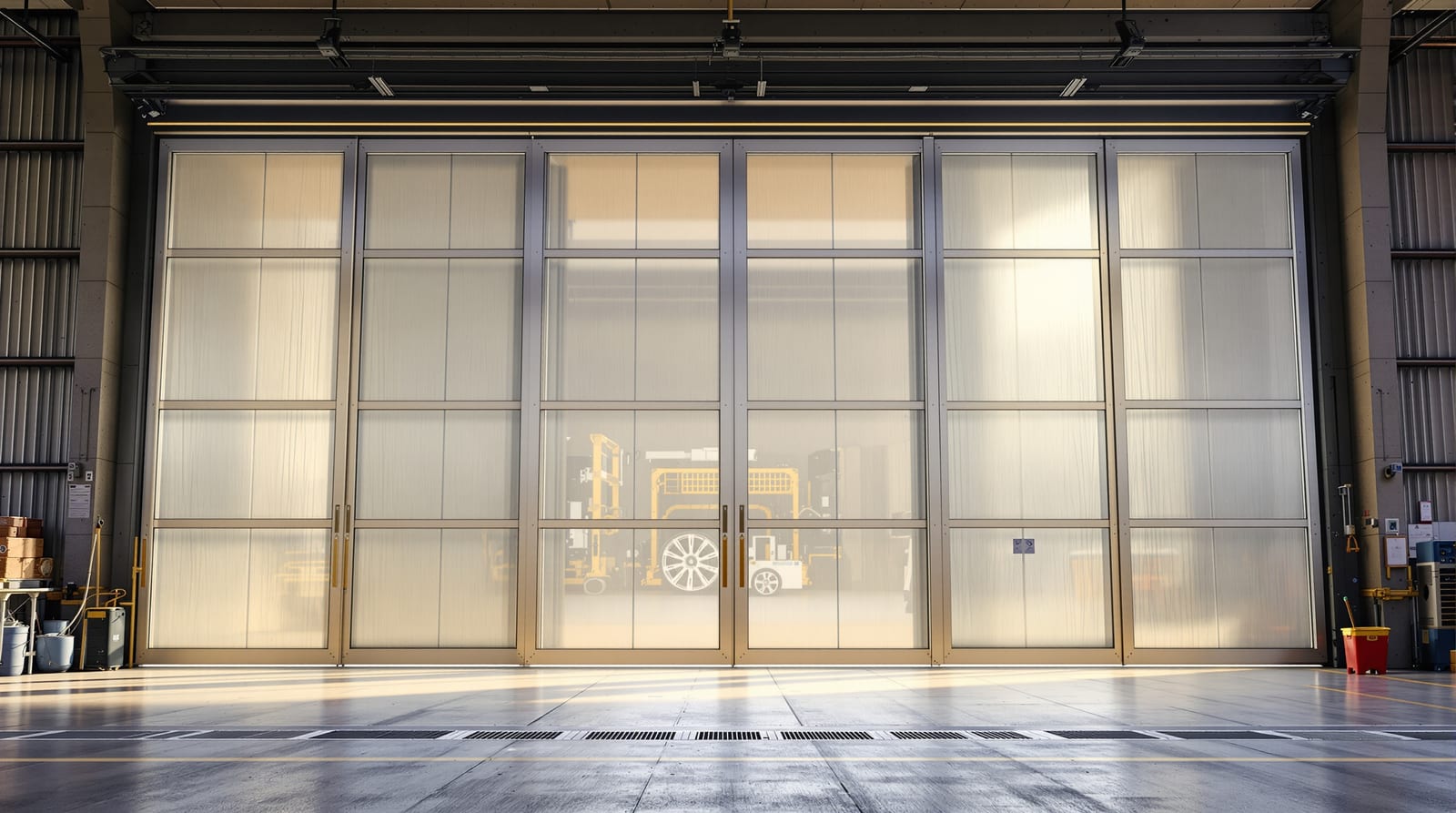
Sliding-Folding Industrial Doors: Wide-Span Guide India 2026
Multi-leaf top-hung and bottom-rolling doors that slide and fold to clear very wide workshop, depot and warehouse openings.
When an opening is simply too wide for a single sectional or rolling shutter — a fire-station appliance bay, a bus depot, an aircraft-component workshop, a fabrication shed — the workhorse answer is the sliding-folding industrial doors family. These are multi-leaf doors hinged in pairs that slide along a track and concertina (fold) into a stack at one or both jambs, clearing openings from about 4 m up to 20 m or more in a single assembly. Because the leaves park flat against the wall rather than rising overhead, they suit very tall, very wide spans where headroom for a sectional door's curve or a shutter's barrel is scarce. This guide covers the critical choice between top-running and bottom-running configurations, wind bracing, the manual-versus-motorised decision, and where you should instead reach for a sectional, rolling or — at the extreme — a hangar door. In India there is no single dedicated product standard for these doors, so they are project-engineered: final spec, leaf count and price come from a vendor's shop drawing against your opening, loads and local wind code.
For the wider family of factory and shed closures, read the industrial doors guide and the cluster's complete door guide; this page sits within specialty doors and industrial door types.
How sliding-folding industrial doors work
A sliding-folding door is built from an even number of leaves hung as hinged pairs. Each pair has one leaf that carries a running gear (a wheeled carriage or trolley) and a partner leaf hinged to it; as the gear travels along the track the pair folds like a book. Multiple pairs in a run let a 12 m opening close with, say, six 2 m leaves and reopen by folding into a stack barely 600-900 mm deep at the jamb. Leaves are typically a welded steel or aluminium frame skinned in profiled GI/colour-coated sheet, with optional PUF or rockwool infill for insulation and glazed or louvred panels for daylight and ventilation. A pass door (wicket) is usually built into one leaf so people can come and go without operating the whole assembly.
The defining engineering question is where the door's weight is carried and guided.
Top-running (top-hung) doors
In a top-hung door the full leaf weight hangs from carriages running on an overhead track fixed to a header beam or lintel; a light bottom guide channel or floor-set pins simply keep the leaves in plane. The floor stays clear — no recessed bottom channel to clog with dirt, water or debris — which is why top-running is the default for dirty, wet or trafficked thresholds: workshops, foundries, wash bays. The penalty is structural: the lintel must take the entire suspended load plus operating and wind forces, so the supporting beam often has to be designed or strengthened by the structural engineer.
Bottom-running (bottom-rolling) doors
In a bottom-rolling door the leaves roll on wheels along a floor track and a top guide keeps them upright. The building structure carries far less load — useful when the lintel is weak or the opening is exceptionally tall and heavy — but the embedded floor track must be kept clear and drained, and it is vulnerable to forklift damage, silting and ice. For very large and heavy industrial doors, and most true hangar doors, bottom-rolling (or a combined top-guide / bottom-roller arrangement) is common precisely because the floor can bear weight the roof cannot.
Top-running vs bottom-running at a glance
| Factor | Top-running (top-hung) | Bottom-running (bottom-rolling) |
|---|---|---|
| Load path | Lintel / header beam carries leaf weight | Floor track carries leaf weight |
| Threshold | Clear floor, easy to clean/drain | Embedded track — needs cleaning, drainage |
| Best for | Dirty/wet thresholds, moderate weight | Very heavy/tall leaves, weak lintel |
| Structural demand | High on lintel; may need beam upsize | High on floor slab/foundation |
| Wind behaviour | Bottom guide must resist out-of-plane wind | Top guide must resist out-of-plane wind |
| Maintenance focus | Overhead carriages, hinges | Floor wheels, track silting |
| Typical max span | Up to ~12-16 m comfortably | Larger / hangar-scale |
Wind bracing and structural design
Large folding leaves act as sails. The governing load on a wide industrial door is rarely its self-weight — it is wind pressure (and suction) on the closed leaf, designed to the basic wind speed for the site under IS 875 (Part 3). The vendor sizes leaf framing, hinge spacing, the number and position of bottom shoot bolts or guide pins, and any intermediate floor sockets so the door does not bow, rattle or unseat in a storm. Tall leaves often need horizontal stiffening rails or a diagonal brace; coastal and high-wind zones push leaf thickness and bracing up sharply. Closed, the leaves should be secured at multiple points — shoot bolts top and bottom into the lintel and floor, plus jamb locks — not relying on the running gear alone. Always confirm the design wind speed and exposure category with your structural engineer before the door is detailed; this is the single most common cause of premature failure in wide folding doors.
Manual vs motorised operation
Light, narrow runs can be hand-operated: leaves on good carriages roll easily, and a manual door has nothing to fail and needs no power — valuable in a remote depot or where a fire appliance must launch in a grid failure. But as leaf count, weight and frequency rise, manual operation becomes slow and tiring, and a single operator may struggle against wind. Motorisation — a chain or rack-and-pinion drive, or individual leaf operators with a control panel — speeds cycles, allows remote and interlocked operation, and is near-essential above roughly 8-10 m of motorised span or for high-traffic bays. Specify a manual override (hand chain or declutch) for power failures, plus safety edges, photocells and a flashing beacon for automated operation. Even motorised folding doors are slow compared with a high-speed door, so where you need both width and rapid cycling, see the trade-offs below.
| Item | Indicative band (₹, India 2026) | Notes |
|---|---|---|
| Manual sliding-folding, GI-skinned leaves | ₹1,200-2,500 / sqft of opening | Supply-only; insulation/glazing extra |
| Insulated (PUF) leaves | + ₹400-900 / sqft | For tempered/cold sheds |
| Motorised drive + controls | ₹1,50,000-6,00,000+ per door | Scales with span, leaf count, safety kit |
| Built-in pass (wicket) door | ₹25,000-60,000 | Per leaf, with closer |
| Wind bracing / heavy framing | Project-specific | High-wind & coastal zones add cost |
Bands are indicative and exclude 18% GST, civil/structural strengthening and installation; folding doors are made to order with multi-week lead times. Get a vendor shop drawing and firm quote against your opening, loads and wind zone. Indian suppliers active in this space include Gandhi Automations, Shakti Hörmann and Avians, among others — frame any brand spec from their drawings, not from this page.
When NOT to use sliding-folding — pick sectional, rolling or hangar
Sliding-folding doors win on very wide, very tall openings with poor headroom and where leaves can park sideways. They are not always the right answer:
- Sectional overhead doors are smoother, better sealed and better insulated for cycling vehicle bays up to ~8-10 m wide with adequate headroom — see sectional overhead doors.
- Rolling shutters and grilles suit narrower shopfronts, godowns and security closures where the barrel can sit above the lintel — see rolling grille doors and the factory door guide.
- High-speed doors beat folding doors wherever rapid cycling, energy saving and air control dominate (cold chain, pharma, busy internal openings) — see high-speed doors.
- Cold-store sheds that are very wide may combine an insulated folding leaf with a cold-storage door at personnel points.
For warehouse and dispatch yards, also weigh warehouse doors and loading-dock doors against a folding closure.
Bridge to hangar doors
At the very top of the size scale — aircraft hangars, very large maintenance sheds, rail and bus mega-depots — the sliding-folding principle scales up into purpose-built hangar doors: huge multi-leaf top-running or bottom-rolling assemblies (and fabric/cable-drawn variants) engineered as bespoke structures with their own wind and seismic design. They are essentially industrial sliding-folding doors taken to extremes of span and weight, almost always motorised and project-engineered end to end. If your opening pushes past ~16-20 m or carries aircraft-scale clearances, you are in hangar-door territory — read the dedicated hangar doors guide.
To size and budget a wide closure, use the industrial door selector and the door cost calculator as a first pass before commissioning a vendor design.
Frequently asked questions
What is the widest opening a sliding-folding industrial door can close?
With enough leaves a single assembly can clear well over 20 m, but the practical sweet spot is roughly 4-16 m; beyond that you move into purpose-built hangar doors, which are engineered as bespoke structures with their own wind and seismic design.
Top-running or bottom-running — which should I choose?
Use top-running (top-hung) where you want a clear, easily drained threshold and your lintel can be designed to carry the leaf weight. Use bottom-running where leaves are very heavy or tall and the floor can bear load the roof cannot, accepting that the floor track must be kept clean and drained. Your structural engineer settles it against the loads.
Do these doors meet an Indian standard?
There is no single dedicated product standard for sliding-folding industrial doors in India; they are project-engineered. The governing design input is wind loading under IS 875 (Part 3), plus the structural design of the supporting lintel or floor. Fire-rated requirements, where applicable, are handled by separate certified assemblies — see fire-rated rolling shutters.
Should I motorise the door?
Motorise above roughly 8-10 m of span, for heavy multi-leaf runs, or for high-traffic and interlocked bays — and always specify a manual override plus safety edges and photocells. Light, narrow manual doors remain a sound, power-independent choice for low-frequency depot use.
How much does a sliding-folding industrial door cost in India?
As a rule of thumb, supply-only manual GI-skinned doors run about ₹1,200-2,500 per sqft of opening, with insulation, glazing, a pass door, wind bracing and a motorised drive (₹1.5-6 lakh+) added on top, before 18% GST and installation. Costs are highly project-specific — get a vendor shop drawing and firm quote. See specialty door cost for the wider picture.
Export this guide
Related Guides — Deep-dive reading
Sectional overhead doors: a specifier's guide India 2026
Insulated hinged panels that lift up and park under the ceiling — track types, wind-load, insulation, safety and motorisation explained.
Home Doors & EntrancesIndustrial Doors in India: The Heavy-Duty Door Menu and How to Choose (2026)
High-speed roll-up, sectional overhead, rolling shutters, strip curtains, fire shutters and dock doors - the complete industrial door menu, ranked by the driver that decides it (cycle speed, load and size, thermal and dust separation, fire compartmentation, security and durability), with indicative per-door costs.
Home Doors & EntrancesHome Garage Door in India: Types, Motorisation, Sizes and Cost (2026)
The big vehicle door for your car porch or garage - sectional overhead, roller shutter, side-hinged and up-and-over compared, with motorisation, safety sensors, weather sealing, car and SUV sizing and indicative rupee costs.
Home Doors & EntrancesRelated Tools — Try Free
Industrial Door Selector
Find the right industrial door by use — loading dock, high-speed, rolling shutter, cold-store or fire shutter.
Door ToolMotorized Curtain Cost Calculator
Estimate the all-in cost to motorise curtains — motors, tracks, hub and installation.
Cost CalculatorWindow Cleaning Cost Calculator
Estimate professional window cleaning cost per visit and per year by access and frequency.
Window Calculator