
High-Speed Doors in India: Rapid Roll-Up Guide (India 2026)
How rapid roll-up and spiral doors opening at 1-3 m/s cut energy loss, dust and downtime in Indian cold-chain, pharma and factory plants.
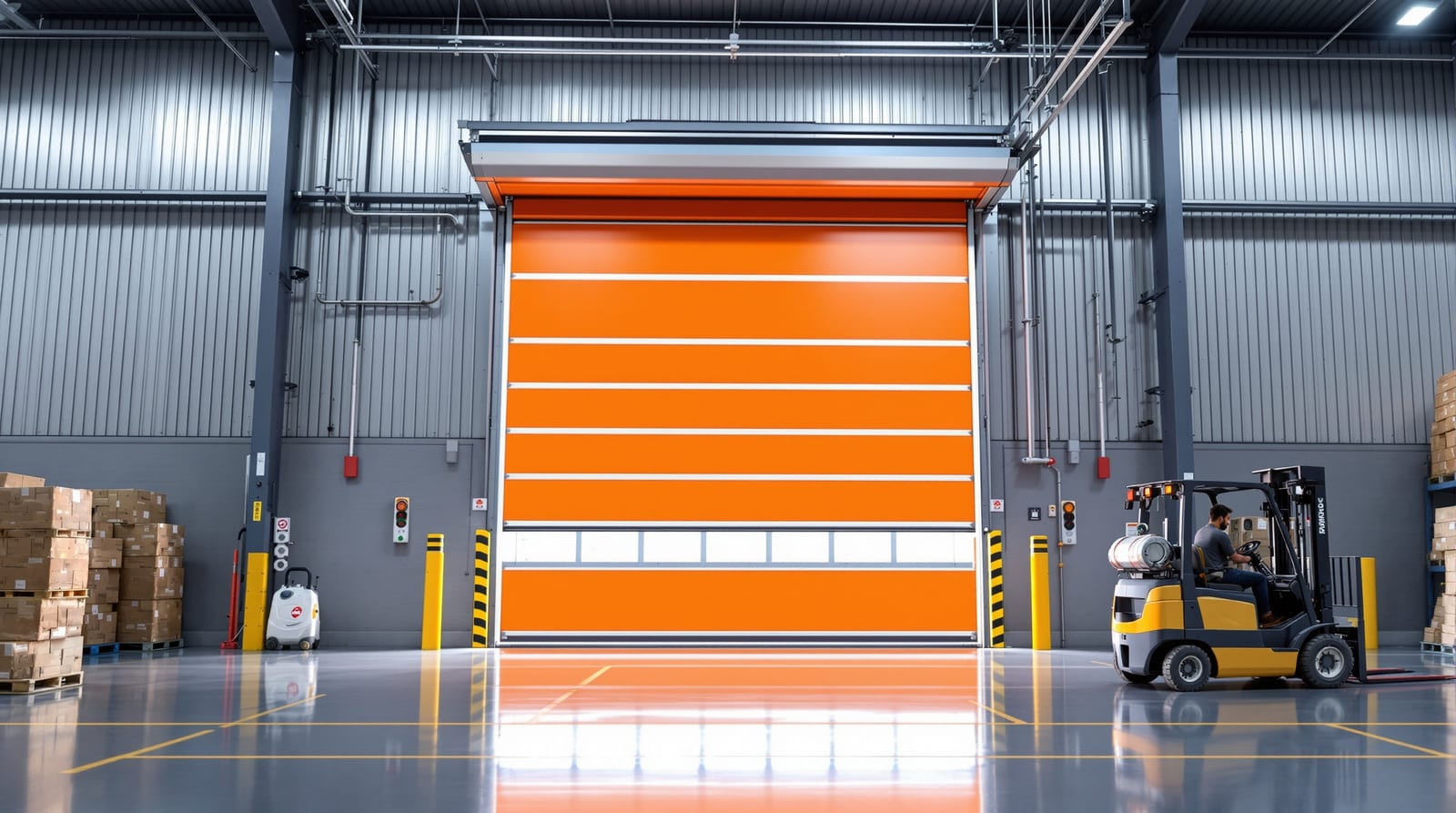
In a busy Indian plant, the slowest part of a doorway is rarely the forklift — it is the door. A sectional shutter that takes 8-12 seconds to cycle leaves an opening yawning while conditioned air, dust and insects pour through. High-speed doors answer that problem directly: a PVC-fabric or rigid aluminium curtain that opens at roughly 1-3 metres per second, closes automatically behind traffic, and survives lakhs of cycles a year. For cold-chain stores, GMP pharma corridors and high-throughput factories, they are less a luxury and more a piece of process equipment that quietly pays for itself.
This guide is written for facility and plant managers, specifiers and informed buyers deciding whether a high-speed door belongs in their layout, which type suits internal versus external openings, how the safety systems work, and what to budget in ₹. As with all specialty doors, the final specification and price come from a vendor sizing the door against your opening, traffic and environment — treat the numbers here as planning bands, not quotations.
Why high-speed doors pay back
The economics are simple: the less time an opening stays open, the less you lose through it. A conventional rolling shutter cycling at 0.2-0.5 m/s may keep a 3 m opening exposed for 15-25 seconds per pass; a high-speed door at 1.5-2.5 m/s cuts that to 3-6 seconds. Across hundreds of passes a day that is a large reduction in air exchange, and air exchange is what drives most of the hidden costs.
- Energy and refrigeration: Less warm, humid air entering a chiller or freezer means less work for the plant and less frost on coils. This is the single biggest payback in cold-chain.
- Dust, pest and contamination control: A fast, sealed cycle keeps airborne particulate, flies and pests out — critical for pharma, food and electronics.
- Throughput: Forklifts and pallet trucks no longer queue or slow at the door, lifting effective line speed.
- Climate comfort and condensation: Stabilising internal temperature and humidity reduces slippery condensation on factory floors.
As a rule of thumb, the higher the traffic and the bigger the temperature or cleanliness gap across the door, the faster the payback. A door between two ambient warehouse bays may never justify the cost; a door into a -20°C freezer crossed 400 times a shift almost always does.
How high-speed doors work
Most high-speed doors are roll-up: a flexible curtain winds onto a barrel above the opening, driven by a three-phase or single-phase motor with a frequency drive (VFD) that ramps speed smoothly and brakes gently. Spiral doors use a rigid aluminium-slat curtain that coils into a spiral track without the slats touching, giving a sealed, insulated, durable leaf for demanding external openings. Activation is hands-free — radar motion sensors, induction loops, pull-cords, push-buttons or remotes — so traffic never stops.
A defining feature of fabric high-speed doors is self-repair. The curtain runs in side guides held by brushes or zips rather than rigid rails. If a forklift strikes the door, the curtain pops out of the guide instead of tearing; on the next cycle it re-threads itself automatically. This is why a well-chosen high-speed door survives accidental impacts that would wreck a conventional shutter.
Interior versus exterior openings
The environment decides the construction. Internal openings prioritise speed and hygiene; external openings must also resist wind load, rain and temperature swings.
| Factor | Interior high-speed door | Exterior high-speed door |
|---|---|---|
| Typical curtain | Light PVC fabric, vision strips | Reinforced fabric or rigid aluminium (spiral) |
| Speed | 1.5-3 m/s (max throughput) | 1-2 m/s (wind-rated) |
| Wind/weather | Not required | Wind-class rated, weather seals |
| Insulation | Minimal; speed-focused | Insulated slats / double-skin for cold-chain |
| Typical use | Production halls, clean corridors, freezer entries | Loading bays, yard access, dispatch docks |
Internally, high-speed doors shine where you need to separate processes — a flour-handling bay from a packing line, or an ambient corridor from a temperature-controlled room — without slowing traffic. Externally, pair them sensibly: a high-speed door behind a loading dock door and dock shelter, or as the fast inner layer of an airlock, gives you both weather-tightness and throughput.
Layering with cheaper barriers
High-speed doors are most cost-effective as part of a strategy, not a solo purchase. Where the budget is tight or the temperature gap modest, PVC strip curtains are a fraction of the cost and can sit inside or behind a high-speed door to catch residual air movement. Air curtains blow a controlled jet across the opening during the brief window the door is open, further cutting infiltration at entrance lobbies and dispatch doors. For genuinely cold rooms, an insulated industrial door or dedicated freezer door may be the right primary barrier with a high-speed door as the fast-traffic companion. To estimate the savings these layers deliver against your tariff and traffic, run the high-speed door savings calculator and cross-check the capital figure with the specialty door cost estimator.
Safety: light curtains and soft edges
A fast-moving door is a crushing and impact hazard, so safety is engineered in. The core protections are:
- Photoelectric light curtains: a vertical grid of infrared beams across the opening; breaking a beam stops and reverses a closing door. This is the primary safety device and should span the full pinch zone.
- Bottom-edge sensing: a pressure-sensitive or photocell-equipped bottom profile that detects an obstruction at floor level.
- Soft/flexible bottom edge: the curtain base is non-rigid, so any contact is a soft touch, not a guillotine.
- Controlled speed and braking: the VFD ramps the curtain rather than slamming it, and emergency stops cut power instantly.
Specify activation and presence-detection so the door cannot close on a person or vehicle, and ensure the controls and emergency stops are positioned for the actual traffic pattern. For high-traffic auto-operated openings, also consider touchless sensor doors logic so staff never need to touch a control. Operators of automatic doors should follow the relevant safety norms for powered pedestrian and vehicle doors.
Cost bands and what drives them
High-speed doors are project-engineered against your opening size, traffic, environment and wind class, so prices vary widely. The bands below are planning figures for India in 2026, exclusive of 18% GST, and you should confirm whether a quote is supply-only or installed.
| Door type / spec | Indicative range (₹ per door) | Notes |
|---|---|---|
| Internal light-duty PVC roll-up (small opening) | 85,000 - 1,30,000 | Lower cycle/speed duty |
| Standard internal high-speed PVC | 1,20,000 - 1,80,000 | Common production/cold-room entry |
| External wind-rated fabric high-speed | 1,60,000 - 2,30,000 | Reinforced, weather-sealed |
| Rigid aluminium spiral / insulated | 2,00,000 - 2,75,000+ | Cold-chain, durable external |
| PVC strip curtain (companion) | 8,000 - 30,000 | Cheap supplementary barrier |
Drivers of cost include opening size, curtain material and insulation, motor and VFD rating, wind class, the level of safety package (single beam versus full light curtain), interlocking with other doors, and stainless versus powder-coated steel for hygienic environments. Lead times are typical of custom equipment — plan several weeks. Indian and global suppliers active in this space include Gandhi Automations, Shakti Hörmann, Hörmann and ASSA ABLOY among others; get a vendor spec against your actual layout rather than fabricating figures from a brochure.
Where high-speed doors fit in the wider door strategy
High-speed doors are one tool in the industrial and specialty door toolkit. For the bigger picture, see the specialty doors overview and the cluster pillar complete door guide. If your facility is a distribution centre, read alongside warehouse door and factory door selection; for temperature-controlled stores, combine this with cold-storage door planning. The right answer is usually a layered openings strategy, sized by a vendor against your throughput, climate gap and code requirements.
Frequently asked questions
How fast does a high-speed door actually open?
Most open at roughly 1-3 metres per second. Internal doors run faster (up to ~3 m/s) for maximum throughput; external and insulated spiral doors are usually 1-2 m/s because they are heavier and wind-rated. The vendor sets the speed via the VFD to balance speed against curtain stress and safety.
Do high-speed doors really cut energy bills?
Yes, where there is a meaningful temperature or humidity gap and high traffic. By shrinking the time the opening stays open from 15-25 seconds to a few seconds per pass, they sharply reduce air exchange into chillers and freezers. The savings depend on tariff, traffic and the temperature gap — model it with the high-speed door savings calculator before committing.
What happens if a forklift hits the door?
Fabric high-speed doors are designed to self-repair. The curtain pops out of its side guides on impact instead of tearing, then re-threads itself on the next cycle. This greatly reduces downtime and repair cost compared with rigid shutters, though heavy or repeated strikes still warrant inspection.
Are they safe around people?
When specified correctly, yes. A full-height photoelectric light curtain stops and reverses the door if a beam is broken, the soft bottom edge prevents crush injuries, and the VFD controls speed and braking. Always specify the safety package to suit your traffic and follow the relevant powered-door safety norms.
Interior or exterior — which type do I need?
Interior openings can use lighter, faster PVC-fabric doors focused on throughput and hygiene. Exterior openings need wind-rated, weather-sealed and often insulated rigid-slat (spiral) doors. Many facilities use both, plus PVC strip curtains and air curtains as supplementary barriers, in a layered strategy.
How much should I budget?
Plan for roughly ₹85,000 for a small internal PVC roll-up up to ₹2,75,000 or more for an insulated external spiral door, excluding 18% GST. Costs rise with size, insulation, wind class and safety package. Confirm supply-only versus installed and get a project-engineered vendor quote against your actual opening.
Export this guide
Related Guides — Deep-dive reading
Cold Storage Doors in India: Insulated Cold-Room and Freezer Doors That Actually Seal (2026)
How to specify cold-room and freezer doors for Indian warehouses, food plants and pharma stores - PUF-insulated sliding and hinged doors, heated-frame sub-zero freezer doors, high-speed insulated roll-ups for traffic, strip and PVC curtains as a buffer, pressure-relief ports and the inside safety release that stops anyone being trapped - with indicative per-door costs by temperature band.
Home Doors & EntrancesIndustrial Doors in India: The Heavy-Duty Door Menu and How to Choose (2026)
High-speed roll-up, sectional overhead, rolling shutters, strip curtains, fire shutters and dock doors - the complete industrial door menu, ranked by the driver that decides it (cycle speed, load and size, thermal and dust separation, fire compartmentation, security and durability), with indicative per-door costs.
Home Doors & EntrancesHygienic food-grade doors: washdown specs, India 2026
Spec SS304/316 and FRP washdown doors for food, dairy, beverage and meat plants — sealed, crevice-free and FSSAI/HACCP-ready.
Home Doors & EntrancesRelated Tools — Try Free
Motorized Curtain Cost Calculator
Estimate the all-in cost to motorise curtains — motors, tracks, hub and installation.
Cost CalculatorInterior Budget Planner
Live room-wise and component-wise cost breakdown in ₹ with contingency, GST, and PDF summary.
Budget CalculatorDoor Cost Calculator
Estimate the all-in cost of a door — leaf, frame, hardware, fitting and GST — by type, material and size.
Door Calculator