
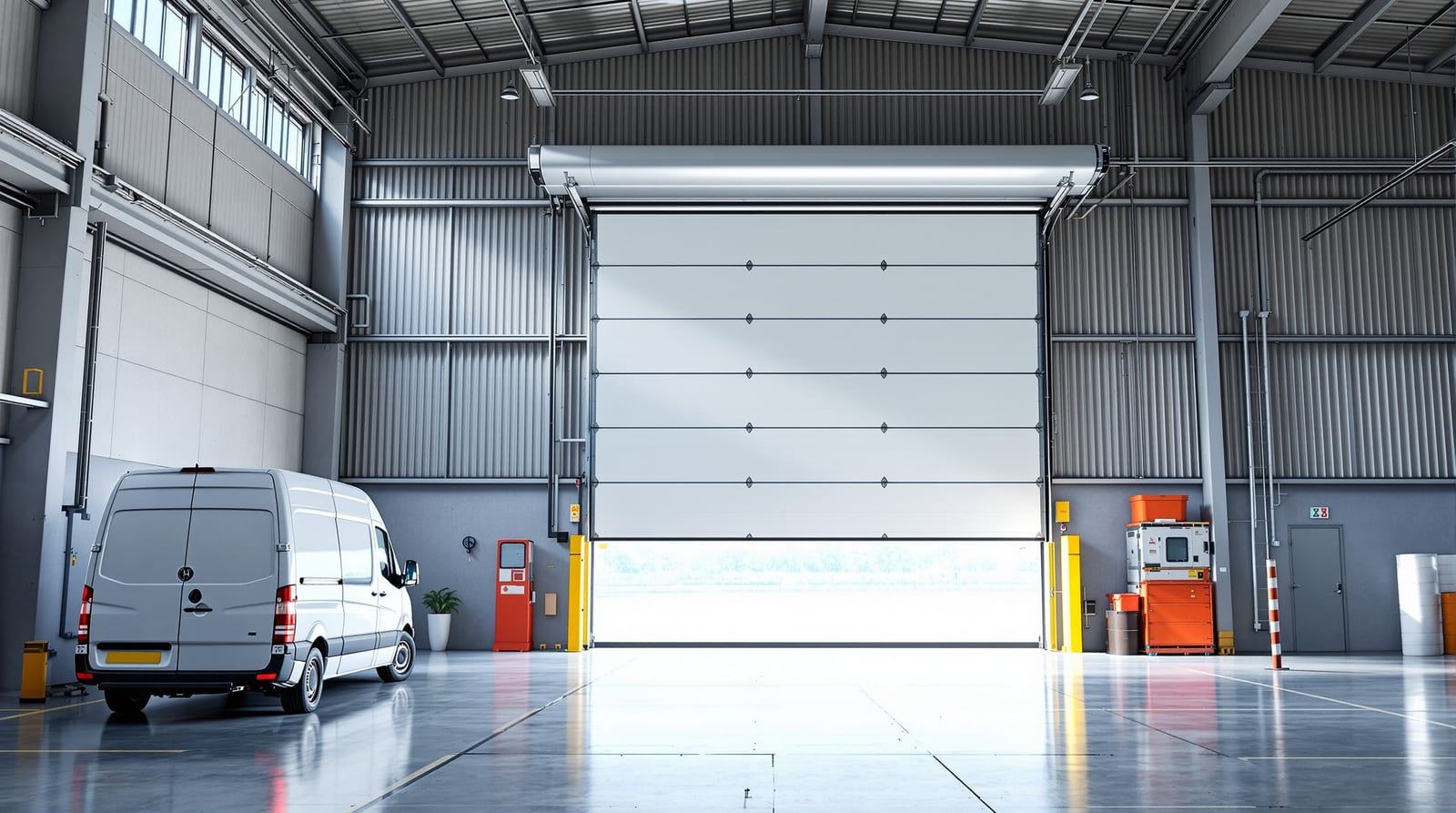
Sectional overhead doors: a specifier's guide India 2026
Insulated hinged panels that lift up and park under the ceiling — track types, wind-load, insulation, safety and motorisation explained.
Sectional overhead doors are the default closure for modern warehouses, loading bays, factory dispatch areas, vehicle showrooms and premium garages because they do something a rolling shutter cannot: they part the leaf into horizontally-hinged insulated panels that travel up a curved track and park flat under the ceiling. That single move frees the entire wall above and beside the opening, gives a clean weather-tight seal, and lets you specify genuine thermal insulation. This guide is a specifier-grade walk through track geometry, panel construction, wind-load, insulation, manual versus motorised operation, safety devices and realistic Indian cost bands — with the honest caveat that every sectional door is project-engineered and the final spec and price come from a vendor sizing against your opening, headroom and wind zone.
How a sectional overhead door works
The leaf is built from rigid horizontal panels (sections), each hinged to the next, running in vertical side tracks that curve through a radius and continue horizontally along the ceiling. As the door opens, each panel rotates over the radius and the whole leaf stacks flat overhead — never projecting into the room or the driveway. Torsion springs (or extension springs on small doors) counterbalance the weight so the leaf is near-neutral to move; a motor or a person only has to overcome friction.
This architecture gives sectional doors their headline advantages. The panels can be foam-filled for real insulation, the perimeter takes continuous flexible seals for a tight envelope, and because the stack sits horizontally rather than coiling into a barrel, the opening stays clear and the door tolerates wider spans than a rolling grille. The trade-off is that you need ceiling depth to receive the horizontal track, and the door's behaviour depends heavily on which track type you choose.
Track types — the spec decision that drives everything
The track configuration is governed by your available headroom (the gap between the top of the opening and the underside of the structure or services). Get this wrong and the door either will not fit or wastes usable height. The four common arrangements:
| Track type | Headroom needed (above lintel) | Where the leaf parks | Typical use |
|---|---|---|---|
| Standard lift | ~300-450 mm | Horizontal, just under ceiling | Most warehouses, factories, garages |
| Low headroom | ~150-250 mm (double track) | Horizontal, very tight ceilings | Retrofits, basements, low sheds |
| High lift | Opening height + ~600-1000 mm vertical, then horizontal | Rises vertically first, then back | Bays with deep eaves, overhead cranes |
| Vertical lift | Full opening height again, fully vertical | Straight up the wall | Tall portal-frame sheds, high-pitch roofs |
Standard lift suits the majority of Indian sheds. High lift exploits the dead space under a deep eave to keep the horizontal run short and the leaf clear of crane paths. Vertical lift, used in tall portal buildings, lifts the leaf straight up with no horizontal track at all. Always confirm the headroom and side-room dimensions on site before ordering — a vendor survey of the opening, lintel, springs anchorage and ceiling obstructions is non-negotiable.
Panel construction and insulation
The panels themselves define thermal and acoustic performance. Most industrial sectional doors use a double-skin steel panel (typically 40-45 mm thick) injected with PUF (polyurethane foam) insulation, giving a sandwich that is rigid, light and thermally efficient. Single-skin or glazed aluminium panels are used where insulation is irrelevant and visibility matters (showrooms, fire stations). Vision sections — acrylic or polycarbonate glazing in a frame — can be inserted at eye level for safety and daylight.
| Panel type | Thickness | Approx. insulation value | Best for |
|---|---|---|---|
| Single-skin steel | 0.5-0.8 mm | Negligible | Sheltered openings, low cost |
| Double-skin PUF steel | 40-45 mm | U ~0.5-1.0 W/m²K (panel) | Warehouses, climate-sensitive bays |
| Aluminium full-vision | 40-45 mm frame | Low (glazed) | Showrooms, fire stations, dealerships |
| Cold-store grade | 60-100 mm+ | High | Chiller/freezer rooms (see below) |
For genuinely cold environments — a chiller or freezer bay — a standard PUF sectional door is not enough; you move to a heavier insulated leaf with heated frame and gaskets, which is the territory covered in the cold storage door guide and freezer doors guide. For high-throughput cold-chain openings where speed beats insulation, a high-speed door backed by PVC strip curtains is often the smarter pairing.
Wind-load and structural rating
For any large external door — and coastal sites especially — wind-load is a real engineering constraint, not a catalogue tickbox. Sectional doors are rated to wind classes (commonly the EN 12424 scale, Class 0-5) that relate to the design wind pressure the leaf and its fixings can resist without permanent deformation. In India the leaf and tracks should be checked against the design wind speed for the zone under IS 875 (Part 3), the wind-load code; coastal and cyclone-prone sites (NDMA-mapped) demand reinforced panels, wind-bars and stronger track brackets.
Manual versus motorised operation
Small, well-balanced sectional doors (a single garage bay) can run manually on a pull-rope or chain hoist. Anything larger, in frequent use, or part of a dispatch line, should be motorised. A tubular or side-mounted operator with limit switches gives push-button or remote control; for high-traffic loading bays you add traffic-light interlocks, induction loops, photocells and timer auto-close. Battery or generator backup and a manual override (chain or release) for power cuts are essential in Indian conditions. Operator duty cycle matters — a dispatch door cycling hundreds of times a shift needs an industrial-rated motor, not a domestic garage unit.
Safety devices — what the spec must include
A powered sectional door is a moving mass overhead, so safety is non-negotiable and should be written into the order:
- Anti-drop / spring-break device: arrests the leaf if a counterbalance spring or cable fails — the single most important safety component.
- Bottom-edge safety (photocell or pressure edge): reverses the door if something is under the closing leaf.
- Finger-trap-resistant panel joints: the panel profile is shaped so fingers cannot be pinched between sections.
- Manual release for power failure, plus clear emergency-stop on motorised units.
Like all industrial doors, a sectional door needs a documented AMC and periodic inspection of springs, cables, rollers and the anti-drop device — see the door maintenance guide and use a planned-maintenance approach to keep cycle life and safety intact.
Sectional overhead doors vs rolling shutters
The most common specifier question is whether to use a sectional door or a rolling shutter. Both close large openings, but they behave very differently:
| Factor | Sectional overhead door | Rolling shutter |
|---|---|---|
| How it stacks | Flat under ceiling | Coils into a barrel above opening |
| Insulation | Excellent (PUF panels) | Limited (insulated lath optional) |
| Weather seal | Continuous perimeter seal | Moderate |
| Headroom needed | Yes (for horizontal track) | Less (barrel only) |
| Wide spans | Good | Good, but heavier coil |
| Cycle smoothness / speed | Smooth, quiet | Noisier, slower |
| Cost | Higher | Lower |
| Best for | Climate-sensitive, premium, dispatch | Basic security, tight ceilings, retail front |
In short: choose a sectional door when insulation, a clean seal, a quiet smooth action and headroom availability matter; choose a rolling shutter when budget and minimal ceiling depth dominate. For the broader landscape see the industrial doors guide, the warehouse door guide and the dispatch-focused loading dock door guide.
Indian cost bands (2026)
Sectional doors are custom-fabricated to the opening, so treat these as planning bands, supply-only unless stated, before 18% GST, and confirm against a vendor quote:
| Configuration | Approx. ₹ band | Notes |
|---|---|---|
| Single-skin manual (small garage) | ₹35,000-70,000 | Sheltered, light duty |
| Double-skin PUF, standard lift, motorised | ₹1,10,000-2,50,000 | Typical warehouse bay |
| High lift / vertical lift, large span, motorised | ₹2,50,000-5,00,000+ | Headroom-driven, custom track |
| Full-vision aluminium (showroom/fire station) | ₹1,50,000-3,50,000 | Glazed panels |
Add installation, the operator and safety package, traffic interlocks, and structural reinforcement for high wind zones. Indian and global suppliers active in this segment include Gandhi Automations, Shakti Hörmann, Hörmann and ASSA ABLOY, among others — frame the brand choice around duty cycle, after-sales reach and a proper site survey rather than headline price.
For a quick first-pass on configuration and budget, the specialty door selector and specialty door cost estimator help scope the door before you brief a vendor. This guide sits within Studio Matrx's wider door knowledge base — start from the complete door guide, browse the specialty doors overview, or compare adjacent industrial types in the insulated industrial doors guide.
Frequently asked questions
How much headroom do I need for a sectional overhead door?
A standard-lift track typically needs about 300-450 mm above the lintel for the horizontal run. Where ceilings are tight, a low-headroom track works with roughly 150-250 mm using a double-track arrangement. High-lift and vertical-lift options suit tall sheds. Always have the vendor survey the opening, lintel and ceiling obstructions before ordering.
Are sectional overhead doors better than rolling shutters?
For insulation, a continuous weather seal, smooth quiet operation and a clear opening, yes — sectional doors outperform rolling shutters. Rolling shutters win on lower cost and minimal ceiling depth. The right choice depends on whether climate control and finish, or budget and headroom, dominate your brief.
Can sectional doors be insulated for cold storage?
Standard double-skin PUF panels (40-45 mm) handle climate-sensitive but ambient bays. True chiller and freezer rooms need a heavier cold-store-grade leaf (60-100 mm+) with heated frame and gaskets — a different product. For high-throughput cold-chain openings, pair a high-speed door with PVC strip curtains instead.
How do I size a sectional door for a coastal, high-wind site?
The leaf, tracks and fixings must be checked against the design wind speed for your zone under IS 875 (Part 3), with reinforced panels, wind-bars and stronger brackets for cyclone-prone coastal locations. Specify a suitable wind class and have the vendor's engineer confirm the leaf rating for the opening size.
What safety devices are mandatory on a powered sectional door?
At minimum: an anti-drop / spring-break device, bottom-edge safety (photocell or pressure edge), finger-trap-resistant panel joints, a manual release for power failure, and an emergency stop. A documented AMC with periodic inspection of springs, cables and the anti-drop device keeps it safe over its cycle life.
Export this guide
Related Guides — Deep-dive reading
Door Wind-Load & Cyclone Performance (India 2026)
How wind pressure attacks external, balcony and high-rise doors, what IS 875 (Part 3) wind zones demand, and how to specify cyclone-resistant frames, locking and glazing.
Home Doors & EntrancesIndustrial Doors in India: The Heavy-Duty Door Menu and How to Choose (2026)
High-speed roll-up, sectional overhead, rolling shutters, strip curtains, fire shutters and dock doors - the complete industrial door menu, ranked by the driver that decides it (cycle speed, load and size, thermal and dust separation, fire compartmentation, security and durability), with indicative per-door costs.
Home Doors & EntrancesBullet-Resistant Doors in India: A Specifier's Guide (India 2026)
How ballistic doors are built, where they belong, and how to specify the right UL 752 or EN 1522 threat level for Indian banks, vaults and VIP rooms.
Home Doors & EntrancesRelated Tools — Try Free
Motorized Curtain Cost Calculator
Estimate the all-in cost to motorise curtains — motors, tracks, hub and installation.
Cost CalculatorIndustrial Door Selector
Find the right industrial door by use — loading dock, high-speed, rolling shutter, cold-store or fire shutter.
Door ToolWindow Grill Design Selector
Pick a window grille style and material by priority — security, looks, budget, view — and estimate cost.
Window Tool