
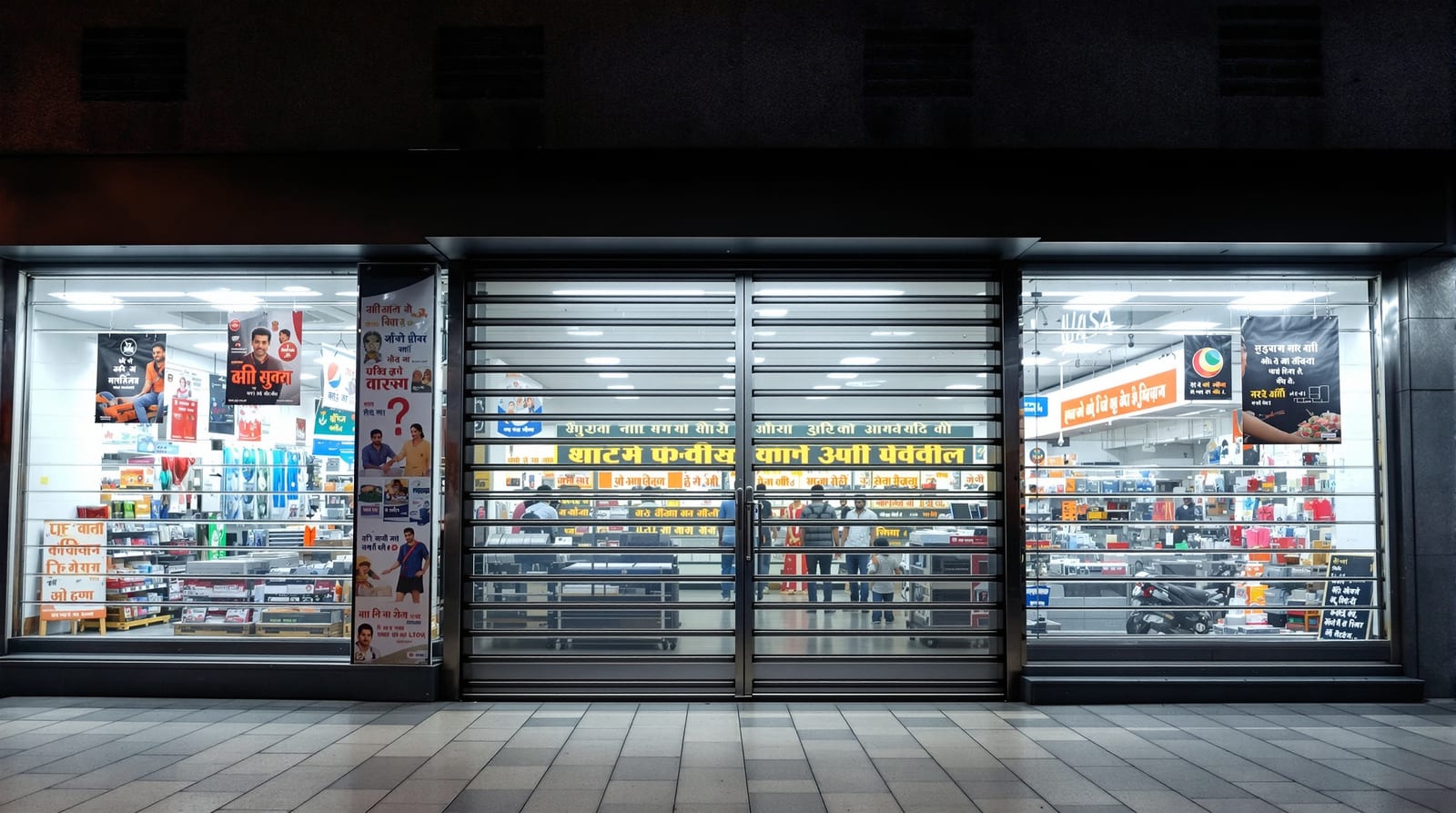
Rolling Grille Doors: See-Through Security (India 2026)
Perforated, link and polycarbonate-rod rolling grilles that secure shopfronts and showrooms while keeping visibility and airflow.
When a mall is locked for the night but the corridor must stay visible to security patrols and CCTV, the answer is rarely a solid steel shutter. Rolling grille doors — see-through security shutters built from interlocking links, perforated slats or clear polycarbonate rods — secure the opening against forced entry while preserving sightlines, daylight and airflow. They are the default closure for showroom fronts, jewellery and electronics shops, car-park entries and food-court tenancies across Indian malls and high streets. This guide covers the grille patterns, manual versus motorised operation, locking, the relevant codes, ₹ bands, and exactly where a grille beats — or loses to — a solid rolling shutter.
What a rolling grille door is
A rolling grille is a coiling closure whose curtain is an open lattice rather than a continuous sheet. The curtain coils onto a barrel inside a headbox above the opening and runs in side guides, exactly like a rolling shutter, but because roughly 60-80% of the curtain area is open mesh, you can see and breathe through it when it is down. That single difference drives where it is used: retail and parking, where deterrence plus visibility matters more than full weather sealing or insulation.
The grille is a security and demarcation device, not a thermal or fire barrier. Where you need privacy, insulation or weather-tightness, a solid rolling shutter or an insulated industrial door is the correct choice; where you need a fire rating, you must specify a tested fire-rated rolling shutter assembly instead — a grille has no rating. Grilles sit in the specialty doors family alongside their close sibling, the security shutter door.
Grille patterns — link, perforated and polycarbonate
Three curtain constructions dominate the Indian market, and the pattern you choose sets both the look and the security level.
Aluminium link (brick-bond) grilles
The classic curtain: vertical aluminium or steel rods connected by hinged links arranged in a brick-bond or straight-bond honeycomb. It is the most open (highest see-through), the lightest, and the cheapest per square metre. Brick-bond — where each row is offset — resists deformation better than straight-bond and is the usual specification for shopfronts. Apertures are typically 75-150 mm; smaller apertures cost more but better resist a hand or tool being pushed through.
Perforated and solid-slat hybrid (curtain) grilles
Here the curtain is rolled steel or aluminium slats, but the slats are perforated with rows of holes or punched with slots, giving partial vision and ventilation with far more sheet metal than a link grille. This is a middle ground — more privacy and physical mass than a link grille, more airflow than a solid shutter. Common over food-court counters and showroom windows where you want airflow but less obvious see-through.
Polycarbonate-rod (clear) grilles
Vertical solid polycarbonate rods replace the metal rods, giving near-glass clarity for premium showroom and jewellery fronts. They display merchandise after hours, look architectural, and resist scratching, but offer lower physical security than steel link grilles and cost the most. Often combined with steel links at the base for a security-plus-display compromise.
| Grille pattern | See-through | Relative security | Indicative ₹/sqm (supply-only) | Best for |
|---|---|---|---|---|
| Aluminium link, brick-bond | Very high | Medium | 3,500 - 6,500 | Mall shopfronts, parking |
| Steel link, brick-bond | High | Medium-high | 5,000 - 9,000 | Electronics/high-value retail |
| Perforated/punched slat | Medium | Medium-high | 6,000 - 11,000 | Food court, showroom windows |
| Polycarbonate-rod (clear) | Very high (clear) | Medium | 9,000 - 16,000+ | Jewellery, premium display |
Bands are supply-only and exclude installation, motor, locking and GST (18%); finishes (powder-coat, anodised) and aperture size shift the number materially. Treat these as planning figures and get a vendor quote against the actual opening.
Manual versus motorised operation
The operating method is the second big specification decision and is largely a function of curtain size and weight.
- Push-up / pull-down (self-coiling): spring-balanced, for small light grilles up to roughly 12-15 sqm. Lowest cost, no power, but tiring and slow for staff at a busy mall closing time.
- Manual chain (gear) operation: a hand chain and reduction gearbox for mid-size grilles. Reliable, no power dependence, but ~20-40 seconds to operate and needs the chain to be reachable.
- Tubular / side motor with controls: a 230 V single-phase tubular motor in the barrel (small grilles) or a side-mounted geared motor (larger curtains), driven by key switch, remote, or push-button. Standard for any grille over ~15 sqm or in frequent daily use. Specify a manual override (chain or crank) so the grille can be operated during a power cut — essential for an exit route, where a grille must never trap occupants.
| Operation | Size suited | Typical add-on cost | Notes |
|---|---|---|---|
| Push-up spring | <= ~12 sqm | Included | Manual, lightest grilles |
| Manual chain/gear | ~12-25 sqm | ₹6,000 - 14,000 | No power needed |
| Tubular motor | <= ~16 sqm | ₹12,000 - 30,000 | In-barrel, quiet |
| Side geared motor | > ~16 sqm | ₹25,000 - 70,000+ | Heavy curtains, frequent use |
As a rule of thumb, automatic operators should comply with the safety requirements for powered doors — a bottom safety edge, obstruction reversing on motorised units, and the manual override above. For wider context on powered closures see automatic sliding doors.
Locking, security and how grilles deter intrusion
A grille deters by visibility and by physical resistance. The locking strategy matters as much as the curtain:
- Bottom-rail locks: central or twin sliding bolts shooting into the side guides; the minimum on a manual grille.
- Anti-lift / locking guides: locks that engage the side guides to stop the curtain being prised up — the common failure point if omitted.
- Electric locking / motor brake: on motorised grilles the geared motor and a sprag brake hold the curtain; add a floor lock for layered security.
- Bullet/anti-cut links and small apertures raise resistance for jewellery and electronics; for genuine break-in resistance ratings, escalate to a security shutter or burglar-resistant door.
Specify hot-dip galvanised or stainless fixings for coastal sites and a powder-coat or anodised finish for corrosion life. Annual servicing — guide cleaning, spring tension, motor and safety-edge checks — keeps the curtain coiling true; see the general door maintenance guide.
Grille cross-section and selection logic
Rolling grille doors versus solid rolling shutters
The two are often confused on tender drawings, so specify deliberately:
| Factor | Rolling grille | Solid rolling shutter |
|---|---|---|
| Visibility | See-through (CCTV, display) | Opaque |
| Airflow / ventilation | Yes | No |
| Weather / dust sealing | Poor | Good |
| Privacy | None | Full |
| Fire rating possible | No | Yes (tested assembly) |
| Insulation | None | Available (PUF) |
| Weight / motor size | Lighter | Heavier |
| Typical ₹/sqm supply-only | 3,500 - 16,000 | 2,800 - 9,000 |
Use a grille where after-hours visibility, deterrence and ventilation are the goal — mall corridors, showrooms, parking. Use a solid shutter where you need to close out weather, dust, light or prying eyes, or where a fire rating or insulation is required. Many tenancies use both: a grille at the corridor face and a solid shutter at the rear stores. For the wider menu of openings see the complete door guide and the types of doors overview.
Because every grille is cut to the structural opening, motor and lock package, the final specification and price come from a vendor quoting against your reveal dimensions, headroom for the coil, power supply and security brief — Indian suppliers such as Gandhi Automations, Shakti Hörmann and others quote project-specific. Size and budget the opening early with the door cost calculator and screen the right closure family with the industrial door selector before you go to tender.
Frequently asked questions
Are rolling grille doors secure enough for a jewellery shop?
A steel link grille with small apertures, anti-lift guides and bottom-rail locks deters opportunistic and snatch attempts and keeps stock visible to CCTV. For genuine break-in resistance against determined, tooled attack, layer a polycarbonate or steel grille at the face with a rated security shutter or burglar-resistant door at the strongroom — a grille alone is a deterrent, not a vault.
Do rolling grilles have a fire rating?
No. A standard rolling grille is an open lattice and has no integrity or insulation rating. Where the opening is a fire/smoke compartment line you must specify a tested fire-rated rolling shutter assembly to NBC 2016 and IS standards — never substitute a grille.
Manual or motorised — which should a mall shopfront use?
For a single small tenancy a manual chain or push-up grille is fine. For frequent daily use, wide openings (over ~15 sqm) or staff convenience at closing, specify a motor with key/remote control, a bottom safety edge and a manual override for power cuts. See automatic sliding doors for powered-door safety context.
How much does a rolling grille door cost in India?
As a rule of thumb, supply-only curtains run ₹3,500-6,500/sqm for aluminium link, up to ₹16,000+/sqm for polycarbonate-rod, before installation, motor (₹12,000-70,000+), locking and 18% GST. Custom sizing and finish move the figure, so treat these as planning bands and get a vendor quote against the actual opening.
Can a rolling grille keep out rain and dust?
Not meaningfully — its open lattice lets air, dust and driven rain through. If you need to seal the opening against weather, dust or noise, choose a solid rolling shutter or an insulated industrial door; a grille is for visibility and ventilation, not enclosure.
What maintenance does a rolling grille need?
Annual or six-monthly servicing: clean and lubricate the side guides, check spring tension or motor and brake, test the safety edge and manual override, and tighten/replace corroded fixings — specify galvanised or stainless on coastal sites. Follow the routine in the door maintenance guide.
Export this guide
Related Guides — Deep-dive reading
Fire-Rated Rolling Shutters & Fire Curtains India 2026
Galvanised steel-lath shutters and fabric fire curtains for large openings — ratings, gravity fail-safe descent, IS standards and motorisation explained for specifiers.
Home Doors & EntrancesBurglar-Resistant Doors India 2026: RC1-RC6 Security Guide
How EN 1627 resistance classes RC1 to RC6 work, what each grade actually resists, and how to spec a tested anti-burglary door set for Indian homes and shops.
Home Doors & EntrancesMall Doors in India: Entrances, Fire Exits and Shop Shutters by Zone (2026)
A footfall-and-fire-led, zone-by-zone guide to specifying doors for a shopping mall or commercial complex in India - automatic glass and revolving main entrances, NBC fire-rated compartment and fire-exit doors with panic bars, anchor-store and tenant shutters, parking entries and service corridors - with indicative per-door costs.
Home Doors & EntrancesRelated Tools — Try Free
Cross-Ventilation Analyzer
Estimate airflow and air changes per hour (ACH) from room size, window areas, layout, and local wind — with NBC 2016 Part 8 compliance check.
Ventilation CalculatorWindow Cleaning Cost Calculator
Estimate professional window cleaning cost per visit and per year by access and frequency.
Window CalculatorWindow Grill Design Selector
Pick a window grille style and material by priority — security, looks, budget, view — and estimate cost.
Window Tool