
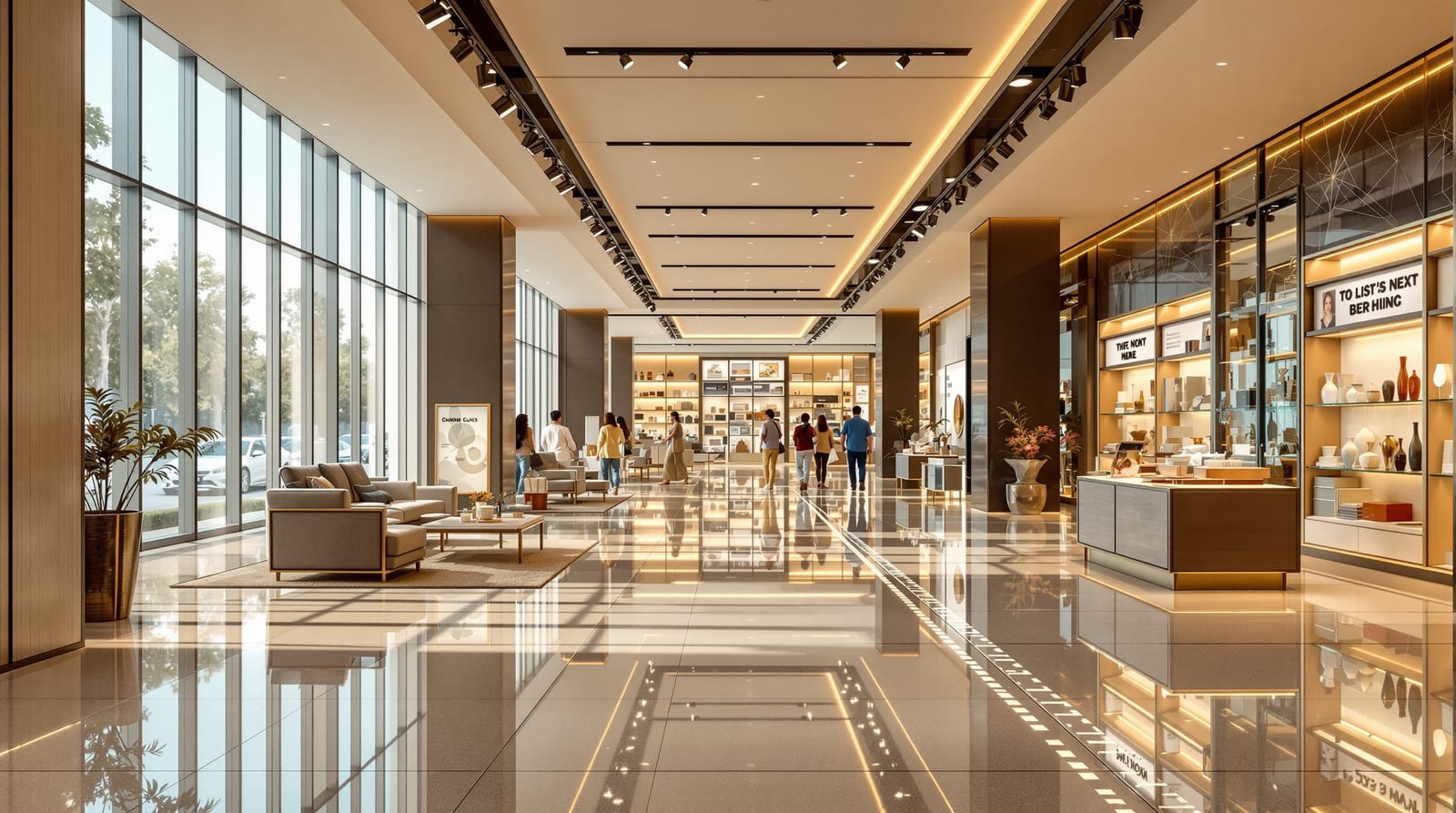
Showroom Flooring in India: Best Floors for Car, Furniture, Tile, Electronics & Fashion Showrooms
How to pick large-format, product-flattering, load-bearing showroom flooring that lifts your brand image without blowing the budget.
A showroom floor has one job that a normal commercial floor does not: it has to make the product look more expensive than it is. Under spotlights, a seamless, large-format, reflective expanse pulls the eye to the car, the sofa, the sanitaryware, the mannequin — and quietly signals that the brand can be trusted. Get the floor wrong and even a premium product reads cheap. This guide ranks the floors Indian showrooms actually use, by showroom type, with loads, looks, lighting and rupees per square foot.
What a showroom floor must do (and why it is different)
A showroom is a stage. The flooring brief is unlike an office or a warehouse because the floor is part of the visual merchandising, not just a surface to walk on. Before you specify, weigh six demands together:
- Product-flattering looks under lighting. Showrooms are lit with bright spots and track lighting. A glossy or polished floor reflects those beams and creates a halo around the product; a matte floor kills glare and suits textiles, fashion and tactile goods. The floor finish is a lighting decision as much as a material one.
- Big seamless expanses, minimal joints. Grout lines and panel joints break the eye and date a space. Large-format tiles (600x1200mm, 800x1600mm, 1200x2400mm slabs) and monolithic finishes like polished concrete or epoxy give the uninterrupted sweep premium brands want.
- Display and vehicle loads. A car showroom floor carries 1.5-2.5 tonnes per vehicle plus point loads under jacks and lift columns. Furniture, appliance and tile showrooms see heavy display units and pallet movement during restocking. The floor and the screed beneath it must be specified for that, not just for footfall.
- Footfall and abrasion. Walk-in retail traffic, trolleys and constant shuffling of stock demand a hard, abrasion-resistant surface (PEI IV-V tiles, or hardened concrete/epoxy).
- Easy, fast cleaning. A showroom must look immaculate at all hours. Seamless or low-grout surfaces with a wipe-clean finish win.
- Brand image and budget. The floor is read by every customer in the first three seconds. It must match the brand tier, yet large showrooms are big areas, so cost per square foot multiplies fast. The art is buying the look without buying the most expensive material.
For the underlying material economics behind each option below, see the complete home flooring guide for India and how to choose flooring in India; this guide focuses on the showroom application.
The shortlist of showroom floors
Five families cover almost every showroom in India.
Large-format double-charged and PGVT vitrified. The default premium-looking, budget-sane choice. Double-charged vitrified tiles have a 3-4mm thick wear layer of colour pigment fused through the body, so they take heavy footfall and survive years of trolley and stock movement; they come in subtle salt-and-pepper and stone looks and a soft satin sheen. Polished glazed vitrified tiles (PGVT) carry a high-definition printed surface that mimics marble, travertine, concrete and metal with a mirror gloss — perfect for reflecting spotlights and getting a marble look at a fraction of marble cost. Large formats minimise joints.
Granite and marble. When the brand IS the premium — luxury cars, high-jewellery, designer furniture, flagship fashion — natural stone reads as unfakeable luxury. Granite flooring is the workhorse: dense, scratch-resistant, takes heavy display and vehicle loads, and a mirror polish flatters product under light. Marble flooring and book-matched Italian marble lift a flagship lobby or entrance, though marble is softer, stains and needs sealing, so it is best reserved for lower-traffic feature zones rather than under tyres.
Polished concrete. The modern, industrial-chic choice for auto, EV, lifestyle and furniture brands chasing a raw, architectural look. Polished concrete flooring is monolithic — no joints across the whole floor — extremely hard-wearing, carries vehicle loads when laid on a properly designed slab, and the ground-and-sealed surface has a soft sheen that suits contemporary brand identities. It is also one of the cheapest ways to floor a very large area.
Epoxy. The classic car showroom and workshop-display floor. Epoxy flooring gives a seamless, glossy, chemical- and tyre-resistant surface that wipes clean of oil and rubber marks, comes in solid showroom-grey, white or branded colours, and reflects light beautifully. Self-levelling epoxy at 2-3mm handles vehicle point loads; it is the go-to for automotive display and service-bay-adjacent areas.
Porcelain slabs. Gauged porcelain panels (up to 1600x3200mm, 6-12mm thick) give the largest possible format with the fewest joints, in marble, stone, concrete and resin looks. Closely related to porcelain tile flooring, slabs suit ultra-premium flagships where a near-seamless stone-look floor is the brief and budget allows.
Showroom type to recommended floor
The right pick depends almost entirely on what you are selling and the brand tier.
| Showroom type | Recommended floor | Why | Indicative ₹/sq ft |
|---|---|---|---|
| Car / two-wheeler (mass) | Epoxy or polished concrete | Tyre/oil resistant, seamless, glossy, vehicle loads, wipe-clean | 120-420 |
| Luxury car / EV | Polished concrete or granite | Architectural sheen or stone luxury; heavy point loads | 130-420 |
| Furniture / home decor | Large-format PGVT or wood-look LVT | Flatters vignettes; warm under lifestyle sets; low joints | 90-260 |
| Tile / sanitaryware | Double-charged vitrified or PGVT | Showcases the very product category; durable, easy-clean | 90-220 |
| Electronics / appliances | PGVT or double-charged vitrified | Bright, glossy, reflective; trolley-tough | 90-220 |
| Fashion flagship | Marble, porcelain slab or matte LVT | Brand-tier luxe; matte to flatter textiles, or polished for glamour | 200-1500 |
| Jewellery / luxury goods | Italian marble or granite | Unfakeable luxury; reflective halo under spots | 350-1500 |
| Modular kitchen / interiors | Large-format PGVT or polished concrete | Neutral canvas for product; seamless | 90-300 |
For a broader view across all commercial spaces, see the commercial flooring guide for India and the application-specific retail store flooring guide.
The lighting-and-finish decision
Finish matters as much as material, because the floor reflects your lighting plan.
Use gloss / mirror-polish floors (PGVT, polished granite, high-gloss epoxy, polished concrete with a high-sheen sealer) where the product is a hard good that benefits from drama and reflection: cars, electronics, sanitaryware, jewellery. Use matte / satin floors where glare would flatten the product or where you want a quieter, editorial mood: fashion textiles, premium furniture upholstery, lifestyle and decor brands. Matte also hides scuffs and footmarks better in very high traffic. Whichever you choose, coordinate it with the lighting designer early — the floor is the largest reflective surface in the room.
Loads, joints and the build-up beneath
The visible tile or finish is only half the spec. Showroom floors fail when the substrate is wrong.
- Vehicle showrooms need a structurally designed slab and screed for point loads under tyres, jacks, scissor-lifts and turntables. Epoxy and polished concrete are applied directly to a power-floated, crack-controlled concrete slab; for tiles, use a thick-bed cement mortar and a high-strength large-format adhesive, never spot-fixing. Specify abrasion- and impact-rated material.
- Minimise joints. Larger formats mean fewer grout lines; epoxy-grout the joints in a colour matched to the tile for a near-seamless read and to resist staining from foot grime and cleaning chemicals. Monolithic finishes (epoxy, polished concrete) have no field joints at all, only saw-cut control joints.
- Flatness matters more in showrooms because raking light across a large reflective floor exposes every dip and lippage. Insist on tight level tolerances and large-format laser-levelled installation.
- Anti-slip at entrances. The display floor can be glossy, but the entrance and any area exposed to monsoon water tracked in from outside should be anti-skid. Read the anti-slip flooring standards for India and treat thresholds and entry zones for grip; a glamorous floor that becomes a slip hazard in the rains is a liability.
Costs and budgeting
Showrooms are large, so per-square-foot choices scale into lakhs quickly. Indicative installed costs (2026, vary by city, brand, format and substrate work):
| Floor | Look / use | ₹/sq ft (installed, indicative) |
|---|---|---|
| Polished concrete | Modern, monolithic, auto/lifestyle | 130-420 |
| Epoxy (self-levelling) | Glossy seamless, car showrooms | 120-350 |
| Double-charged vitrified | Durable satin, tile/electronics | 90-200 |
| PGVT (large format) | Marble/concrete look, gloss | 80-220 |
| Porcelain slab | Largest format, near-seamless | 120-300 |
| Granite | Stone luxury, heavy loads | 130-350 |
| Indian marble | Premium feature zones | 150-450 |
| Italian marble | Flagship lobby / jewellery | 350-1500 |
These are material-and-labour benchmarks; substrate strengthening for vehicle loads, large-format adhesives and epoxy grout add to the figure. Model the full project against the flooring cost per square foot guide for India, and budget the whole area — including back-of-house and display platforms — with the flooring cost calculator and the retail flooring cost calculator. To weigh material options side by side, use the flooring material comparison tool.
Design tips for showroom floors
- Zone with the floor. A subtle change in tile module, a polished-concrete band, or an inlay can define the display zone, the walkway and the consultation area without walls.
- Keep the field neutral. Greys, off-whites, warm beiges and stone tones let the product be the hero. Save bold colour and pattern for the brand wall, not the floor.
- Continuity reads premium. Run the same floor from entrance through display in one large format; breaks and transitions cheapen the space.
- Plan for the product, not the photo. A jewellery floor needs reflection; a sofa floor needs a warm matte base. Specify finish to the goods on display.
- Protect during fit-out. Lay floors late and protect them, or the trades will scratch your premium surface before opening day.
Do and don't
| Do | Don't |
|---|---|
| Use large formats to minimise joints | Use small tiles with wide grout in a premium showroom |
| Match floor finish (gloss/matte) to product and lighting | Put a glossy floor under matte textiles and create glare |
| Design the slab/screed for vehicle and display point loads | Lay epoxy or tiles on an unprepared, cracking slab |
| Anti-skid the entrance and monsoon-exposed zones | Let a glamorous gloss floor become a wet-weather slip hazard |
| Colour-match epoxy grout for a seamless read | Use white cement grout that stains grey in months |
| Buy the look smartly (PGVT for marble look) | Overspend on Italian marble under tyres |
Care and maintenance
Showroom floors must look flawless at all hours, which means a daily wipe-down regime more than deep periodic work. Dust-mop and damp-mop daily; use pH-neutral cleaner on stone and vitrified, and follow the floor cleaning guide for India. Epoxy and polished concrete need periodic re-coat or re-burnish of the sealer to keep the sheen; granite and marble need periodic re-sealing per the floor resealing guide for India. For tiled floors, the routine in the vitrified tile maintenance guide for India keeps the gloss and grout looking new. Tackle tyre marks in car showrooms promptly before they set.
Frequently asked questions
What is the best flooring for a car showroom in India?
Epoxy and polished concrete are the two leaders. Epoxy gives a seamless, glossy, tyre- and oil-resistant surface that wipes clean and reflects light; polished concrete gives a tougher, monolithic, architectural look favoured by modern and EV brands. Both demand a properly designed, power-floated slab to carry vehicle point loads. For mass-market budgets, large-format double-charged vitrified tiles are a durable alternative.
Should a showroom floor be glossy or matte?
It depends on the product and lighting. Gloss reflects spotlights and adds drama, ideal for cars, electronics, sanitaryware and jewellery. Matte kills glare and suits fashion textiles, upholstered furniture and lifestyle brands, and hides scuffs in high traffic. Coordinate the finish with your lighting designer, since the floor is the largest reflective surface in the room.
How do I get a marble look in a showroom without the marble cost?
Use large-format PGVT (polished glazed vitrified) or porcelain slabs. They carry a high-definition marble print with a mirror gloss, come in 800x1600mm and larger formats for minimal joints, cost a fraction of Italian marble, and are far more stain- and scratch-resistant under showroom traffic.
How much does showroom flooring cost per square foot in India?
Indicatively in 2026: large-format PGVT 80-220, double-charged vitrified 90-200, epoxy 120-350, polished concrete 130-420, granite 130-350 and Italian marble 350-1500 per square foot installed, before substrate strengthening for vehicle loads. Showrooms are large areas, so model the full project with the flooring cost calculator and the flooring cost per square foot guide.
Does a showroom floor need to be anti-slip?
The display field can be glossy, but the entrance and any zone where monsoon water is tracked in should be anti-skid to avoid slip injuries and liability. Treat thresholds and entry mats per the anti-slip flooring standards for India, keeping the dramatic gloss for the dry interior display areas.
Export this guide
Related Guides — Deep-dive reading
Supermarket Flooring in India: Zone-by-Zone Floors for Aisles, Fresh & Wet Areas, Checkout, Cold Storage and Loading
How to specify a trolley-tough, anti-slip, fast-to-clean floor across every zone of a supermarket or hypermarket — large-format vitrified or polished concrete for the aisles, R11 anti-slip for fruit-veg and dairy, PU resin for cold rooms, and VDF for the back-of-house and loading bay — at the lowest lifecycle cost per square foot.
Flooring & SurfacesMall Flooring in India: The Right Floor for Concourse, Atrium, Food Court and Anchor Stores, with Costs
Shopping malls floor millions of footfalls a year while projecting a premium image and passing slip checks — here is the floor, ₹/sq ft and key driver for the concourse, atrium feature, food court, entrance, anchor stores, lift lobbies, parking and washrooms.
Flooring & SurfacesPorcelain, Ceramic & Sintered-Stone Facade Cladding in India: A Practical Guide
Thin large-format porcelain and sintered-stone slabs can clad a building with the look of marble, concrete or weathered steel at a fraction of stone's weight — but on a facade, the fixing system is a life-safety decision, not a finish choice.
Building FacadesRelated Tools — Try Free
Flooring Cost Calculator
Estimate the all-in cost of a floor — material, laying, wastage, skirting and GST — by area and material.
Flooring CalculatorMarble Flooring Cost Calculator
Estimate installed marble-floor cost — material, laying, grinding and polishing, sealing, wastage and GST.
Flooring CalculatorRetail Flooring Cost Calculator
Estimate a retail store flooring fit-out cost by store type — apparel, jewellery, supermarket, electronics.
Flooring Calculator