
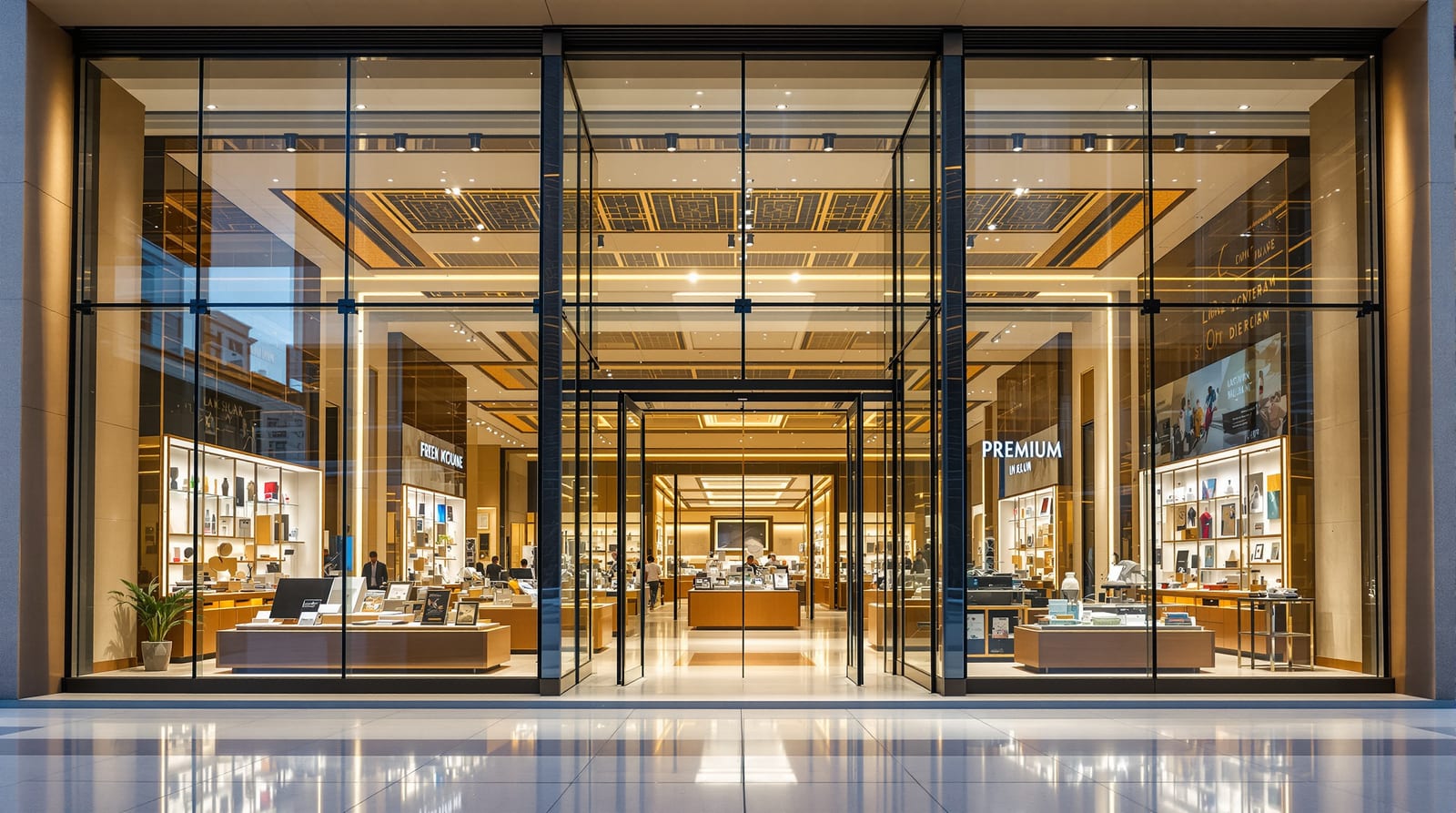
Showroom Doors in India: Frameless Glass Facades, Pivot Entrances and Security Shutters by Showroom Type (2026)
A visibility-led guide to specifying showroom doors in India - frameless glass facades, automatic and oversized pivot entrances, and wide doors for moving cars, furniture and large products - matched to car, furniture, electronics, fashion-flagship and tile showrooms, with indicative per-door and per-facade costs.
A showroom is, at its core, an argument made of glass. Everything inside - the car on the turntable, the modular sofa, the 85-inch television, the tile mock-up wall - is staged to be seen from the pavement, and the door is the one thing standing between the product and the eye it is meant to catch. Get the showroom door wrong and you have, quite literally, built a wall in front of your sales pitch: a heavy frame, an opaque leaf, a narrow opening that says "office" instead of "experience". Get it right and the boundary between street and showroom seems to dissolve, the brand reads as confident and premium, and a customer is half-sold before they touch a handle. This guide treats the showroom door as a display instrument first and an entrance second. It walks the main showroom types found in India, ranks the door choices for each, and gives indicative per-door and per-facade costs for 2026. For the wider logic of matching a door to its building, start with the master overview on choosing a door by space; a showroom is the visibility-maximising extreme of that idea, and a close cousin of the retail store door, which leans more to footfall and shutter security than to display grandeur.
The forces that shape every showroom door
A showroom door is decided by where it sits on a handful of demands that pull in different directions. The weighting changes from a car showroom to a fashion flagship, but the forces are the same:
- Maximum transparency and visibility. This is the whole point. The facade exists to show product from outside, so glass area is the headline specification and frames, mullions and rails are the enemy of the view. A showroom that hides its stock behind solid walls has thrown away its best advertising.
- Premium brand image. A showroom door is brand architecture. Oversized, tall, frameless and beautifully detailed reads as confidence and quality; a standard 7-foot domestic-looking door reads as a shop. Car and luxury brands in particular mandate this in their dealership design manuals.
- Large clear openings for product movement. Cars must drive in and out, three-seater sofas and wardrobes must pass without dismantling, large appliances and tile crates must move on trolleys. The entrance or a dedicated product door must give a genuinely wide, clear, low-threshold opening.
- Climate sealing and air-conditioning. A glass box in Indian heat is an air-conditioning challenge. The entrance door and facade must seal well, ideally with an automatic-sliding airlock or vestibule, double-glazed or high-performance glass, so the cooled showroom is not bleeding into the street all day.
- After-hours security. All that glass is wide open to the night. A showroom needs a way to turn its transparent day face into a secured night face - rolling shutters, collapsible gates, or laminated security glazing - without compromising the daytime display.
- Accessibility and footfall. Customers, including elderly and wheelchair users, must enter easily: clear width at least 900 mm, low threshold, and ideally hands-free automatic opening.
No single door maxes out all of these. The craft is reading the showroom type and specifying for its dominant pair of forces - usually visibility plus one of grandeur, product-movement or security.
Showroom type, recommended door, and why
Read a showroom by two questions: what is on display, and what has to move through the door? Those two answers decide everything. A jewellery or eyewear showroom shows small high-value product and moves nothing large, so it leans to a jewel-box frameless glass front with discreet high security. A car showroom shows and moves something enormous, so its facade must double as a vehicle door. The table below ranks the door strategy by showroom type.
| Showroom type | Recommended door / facade | Why - dominant driver | Indicative ₹ (2026) |
|---|---|---|---|
| Car / automobile dealership | Frameless structural-glass facade + automatic sliding customer entrance + a wide vehicle door (often a sliding or oversized glass/aluminium leaf) for driving cars in and out; rolling shutter behind | Showcase whole cars from the road; move vehicles in/out; brand-mandated glass grandeur | Glass facade ₹6,000-12,000 per sq ft; vehicle door 1,50,000-5,00,000+; auto entrance 1,80,000-4,50,000 |
| Furniture / modular kitchen showroom | Frameless glass facade + wide automatic-sliding or double-leaf entrance for moving large pieces; rolling shutter | Display room-sets from outside; pass sofas, wardrobes, beds without dismantling | Facade ₹6,000-11,000 per sq ft; wide entrance 80,000-3,00,000 |
| Electronics / appliance showroom | Automatic sliding glass entrance + frameless glass display front; AC-tight vestibule; shutter | Heavy footfall hands-free; AC sealing for sensitive stock; visible product wall | Auto door 1,80,000-3,50,000; facade ₹5,000-10,000 per sq ft |
| Fashion / luxury flagship | Oversized / tall pivot or frameless glass entrance, minimal hardware, premium detailing; laminated security glass; discreet shutter or grille | Brand grandeur and theatre; transparency to mannequins/displays; premium feel | Pivot/frameless entrance 1,50,000-6,00,000+; facade ₹7,000-14,000 per sq ft |
| Tile / sanitaryware / bath studio | Frameless glass facade + wide entrance for moving crates and large display slabs on trolleys; shutter | Show large display walls and mock-ups; trolley access; clean premium look | Facade ₹5,000-10,000 per sq ft; wide entrance 70,000-2,50,000 |
| Jewellery / eyewear / watch boutique | Compact frameless glass entrance with high-security laminated glazing + access control + roller/collapsible grille; small footprint | Maximum visibility of small high-value product + serious after-hours security | Security glass entrance 1,50,000-5,00,000+; access control 30,000-1,00,000 |
| After-hours security (all types) | Rolling shutter (perforated/grille or solid) or collapsible gate behind the glass | Turns transparent day face into secured night face | Shutter 35,000-1,50,000+; collapsible gate 25,000-90,000 |
Frameless glass facades: making the boundary disappear
The defining move of a modern Indian showroom is the frameless toughened-glass facade - a wall of 12 mm toughened or laminated glass held on patch fittings, spider fittings or slim structural channels, with the mullions reduced to almost nothing. The point is uninterrupted sightlines: from the pavement or the car, a passer-by sees the product, not the building. This is structural-glass territory, not ordinary glazing, so it must be engineered for wind load, point loads and human-impact safety - always toughened or laminated safety glass, never annealed. The mechanics of patch fittings, floor springs and frameless detailing are covered in depth in the frameless glass doors guide and the broader glass doors guide; this guide is about deploying them at showroom scale.
Two cautions specific to showrooms. First, manifestation: a fully transparent glass wall is a collision hazard, so it needs a visible band, logo frosting or pattern at eye and knee height - which doubles neatly as branding. Second, heat and glare: a west- or south-facing glass box in Pune, Chennai or Ahmedabad will turn into a greenhouse and roast both the products and the AC bill. Specify high-performance solar-control or double-glazed units and a generous AC design, and read the trade-offs in the energy-efficient doors guide. The transparency is worth fighting for, but only if the showroom inside stays cool and comfortable.
The entrance: automatic sliding for footfall, oversized pivot for grandeur
The entrance door has to do two jobs at once - move people through effortlessly and make a brand statement - and the two leading answers split along exactly that line.
For footfall and air-conditioning, the workhorse is the automatic sliding glass door, usually as a sealed vestibule or airlock so the cooled showroom does not bleed into the street. It opens hands-free for customers carrying bags or pushing strollers, gives a flush accessible path with no heavy leaf to wrestle, and seals tightly when closed. It is the default for electronics and appliance showrooms and large furniture stores where volume and AC sealing dominate. Specify it to the standards in the automatic sliding doors guide: toughened glass, redundant safety sensors, and a battery backup that fails to a manually openable state so a power cut never traps customers inside or locks them out.
For grandeur and brand theatre, the move is the oversized or tall pivot door - a single tall leaf, often 2.4 to 3 metres or more, swinging on a floor-spring pivot rather than side hinges, so it can be far larger and heavier than a hinged leaf while still opening with one hand. Pivot doors are the signature of luxury fashion flagships, premium car brands and high-end studios precisely because the scale reads as confidence and the minimal hardware reads as quality. The engineering - floor springs, top pivots, sizing limits and glass-versus-timber options - is set out in the pivot doors guide. A pivot makes a poor high-traffic everyday door (it does not seal as tightly as a sliding airlock and the swing eats floor space), so many flagships pair a statement pivot for the brand moment with a discreet automatic or revolving door alongside for actual footfall and AC.
Wide doors for moving cars, furniture and large products
The detail that catches out first-time showroom builders is getting the product in and out. A car showroom is the obvious case - the cars have to drive in, and that needs a clear opening wide and tall enough for the largest model in the range, with a flush, ramped or level threshold the suspension can cross and a turning path inside. This is usually solved by making a section of the facade a wide sliding or oversized leaf that opens fully, or a dedicated vehicle door at the side. But the problem is just as real for furniture and modular-kitchen showrooms (three-seater sofas, six-foot wardrobes, double beds), tile and sanitaryware studios (large display slabs and crates on trolleys), and appliance showrooms (double-door refrigerators, large televisions).
The rule: size the product door to your largest item plus handling clearance, not to the average customer. A door that is fine for people can be useless for stock. Where a genuinely wide opening is needed, look at wide sliding leaves, double doors or folding/sliding-folding arrangements - the sliding doors and double doors guides cover the mechanisms. Keep the threshold low (under about 12 mm, ramped if needed) so trolleys and the wheels of heavy product cross without a fight, which also keeps the door accessible. Plan a separate service or rear loading route where you can, so big deliveries do not have to come through the showpiece front door.
After-hours security: the night face of a glass box
A frameless glass showroom is wide open to the night, and a single brick through the glass can reach lakhs of rupees of stock. Every showroom therefore needs a second, secured night face, and there are three honest options. The most common is a rolling shutter dropped behind or in front of the glass at closing - choose a perforated or grille shutter to keep the lit display and brand visible after hours (a deterrent in itself), or a solid insulated shutter for maximum closure and AC retention. The mechanics of choosing and sizing one are in the shutter doors guide. For smaller boutiques and jewellery showrooms, a collapsible gate is a slimmer alternative that still shows the interior. The third route, common in luxury flagships that refuse to spoil the facade with a shutter, is laminated security glazing plus electronic access control and alarms - the glass itself resists attack and the premises are monitored - which leans on the door access control guide.
Whatever the choice, the after-hours system must never compromise the daytime display or the fire-exit route. A showroom is an assembly-type occupancy: it needs IS 3614 fire-rated exits with panic hardware, opening outward in the direction of escape, that can never be locked or shuttered against people inside - a point covered for every commercial space in the doors-by-space master guide.
Costs in 2026 (indicative, varies by size, finish and city)
| Door / facade item | Indicative cost | Notes |
|---|---|---|
| Frameless toughened-glass facade | ₹5,000-14,000 per sq ft | Patch/spider fittings, toughened/laminated; higher for structural-glass and luxury detailing |
| Automatic sliding glass entrance | ₹1,80,000-4,50,000+ | Sensors, battery backup, vestibule/airlock for AC |
| Oversized / tall pivot entrance | ₹1,50,000-6,00,000+ | Floor-spring pivot, glass or timber, premium detailing |
| Wide vehicle / product door | ₹80,000-5,00,000+ | Sliding or oversized leaf sized to largest product/car |
| Rolling shutter (night face) | ₹35,000-1,50,000+ | Grille/perforated or solid insulated, motorised |
| Collapsible gate (boutique) | ₹25,000-90,000 | Slim after-hours security for small fronts |
| Security/access control package | ₹30,000-1,00,000+ | Reader, alarm, CCTV link for high-value showrooms |
| Fire exit door (panic bar) | ₹14,000-45,000+ | IS 3614, outward swing, push bar |
Add 18% GST on supply. Glass facades are usually priced per square foot or square metre and dwarf the per-door figures, so a showroom door budget is driven by facade area first and statement-door choice second. Use the commercial door cost calculator to scope the package, and for the underlying single-door numbers see the glass door cost guide. Always get the structural-glass facade engineered and quoted by a specialist glazing contractor, not a general carpenter.
Do and don't for showroom doors
- Do lead with transparency: maximise glass area, minimise frames and mullions, and treat the facade as your primary advertisement.
- Do size at least one opening to your largest product or vehicle plus handling clearance, with a low or ramped threshold.
- Do add an automatic-sliding airlock or vestibule on AC showrooms so cooling is not lost to the street.
- Do plan the after-hours night face (shutter, gate or security glass) and the fire exits at design stage, not as an afterthought.
- Don't use annealed glass anywhere - frameless showroom glass must be toughened or laminated safety glass, engineered for wind and impact.
- Don't forget manifestation banding on full-height glass, and don't ignore solar heat gain on a west/south glass face.
- Don't ever let a shutter, automatic door or display priority block or lock a fire exit against escape.
For the closely related high-footfall version of this space, see the retail store door guide; for the door types referenced throughout, the frameless glass doors, pivot doors and automatic sliding doors guides go deeper, and the doors-by-space master guide places the showroom in the wider family of commercial spaces.
Frequently asked questions
What kind of door is best for a showroom in India?
For most showrooms the best combination is a frameless toughened-glass facade for maximum visibility, paired with either an automatic sliding glass entrance (for footfall and air-conditioning) or an oversized pivot door (for brand grandeur), plus a rolling shutter or security glazing for after-hours protection. The exact mix depends on whether you also need to move large products like cars or furniture through the opening.
How wide should a car showroom door be?
Wide and tall enough for the largest vehicle in your range to drive through with handling clearance, on a flush or gently ramped threshold the suspension can cross. This is usually achieved by making part of the glass facade a wide sliding or oversized leaf, or by providing a dedicated vehicle door at the side. Size it to your biggest model, not the average customer doorway.
How do you keep a glass showroom secure at night?
With a secured night face: a rolling shutter (perforated to keep the lit display visible, or solid for maximum closure) or a collapsible gate behind the glass, or for luxury flagships, laminated security glazing combined with electronic access control, alarms and CCTV. Whichever you choose, it must never block or lock the fire exits against people inside.
How much does a showroom glass facade cost in India in 2026?
Indicatively, a frameless toughened-glass facade runs about ₹5,000-14,000 per square foot depending on the glass, fittings and luxury detailing, so facade area drives the budget. An automatic sliding entrance is ₹1,80,000-4,50,000+, an oversized pivot ₹1,50,000-6,00,000+, and a rolling shutter ₹35,000-1,50,000+. Add 18% GST. Figures are indicative and vary by size, finish, city and vendor.
Should a showroom use a pivot door or an automatic sliding door?
Use an automatic sliding door when footfall and air-conditioning matter most - it is hands-free, accessible and seals well as a vestibule, ideal for electronics, appliance and large furniture showrooms. Use an oversized pivot door for brand grandeur and theatre, typical of fashion flagships and premium car brands. Many luxury showrooms use both: a statement pivot for the brand moment and a discreet automatic or revolving door alongside for actual traffic.
Export this guide
Related Guides — Deep-dive reading
Office Entrance Door in India: Automatic, Revolving and Frameless Glass Entrances (2026)
The main entrance for offices and commercial buildings in India - what makes a first impression, moves footfall, controls access and seals in the AC, with system costs and standards.
Home Doors & EntrancesLibrary Door in India: Quiet, Access-Controlled and Anti-Theft Reading-Room Entrances (2026)
Doors for public, college and corporate libraries in India - acoustic silence, RFID security gates, controlled single entry and a calm scholarly look, with zone-by-zone choices and costs.
Home Doors & EntrancesEmergency Exit Planning in India (2026): Number of Exits, Travel Distance & Two-Way Escape
The building-scale means of egress that a home escape plan sits inside: why you need two independent, remote exits, how travel distance and exit width scale with occupant load, and why exits must open outward, discharge to safety, and never be locked.
SecurityRelated Tools — Try Free
Access-Control Battery-Backup Calculator
Size the standby battery so an access system keeps running through a power cut, with an egress life-safety note.
Battery BackupBrise-Soleil Visualizer
Interactive horizontal-louvre cut-off angle calculator — sun altitude, louvre depth, and spacing inputs with a live shadow preview. Computes θ = arctan(spacing/depth) for façade shading, ECBC envelope compliance, hospital daylight design, and tropical sun-control detailing.
Sun Shading ToolHealing View Impact Calculator
Evidence-Based Design dashboard quantifying the recovery impact of nature view + daylight factor on analgesic use, length of stay, and HCAHPS patient-experience uplift. Calibrated against Ulrich 1984 (Science), Park & Mattson 2008, and the CHD EBD evidence base.
EBD Calculator