
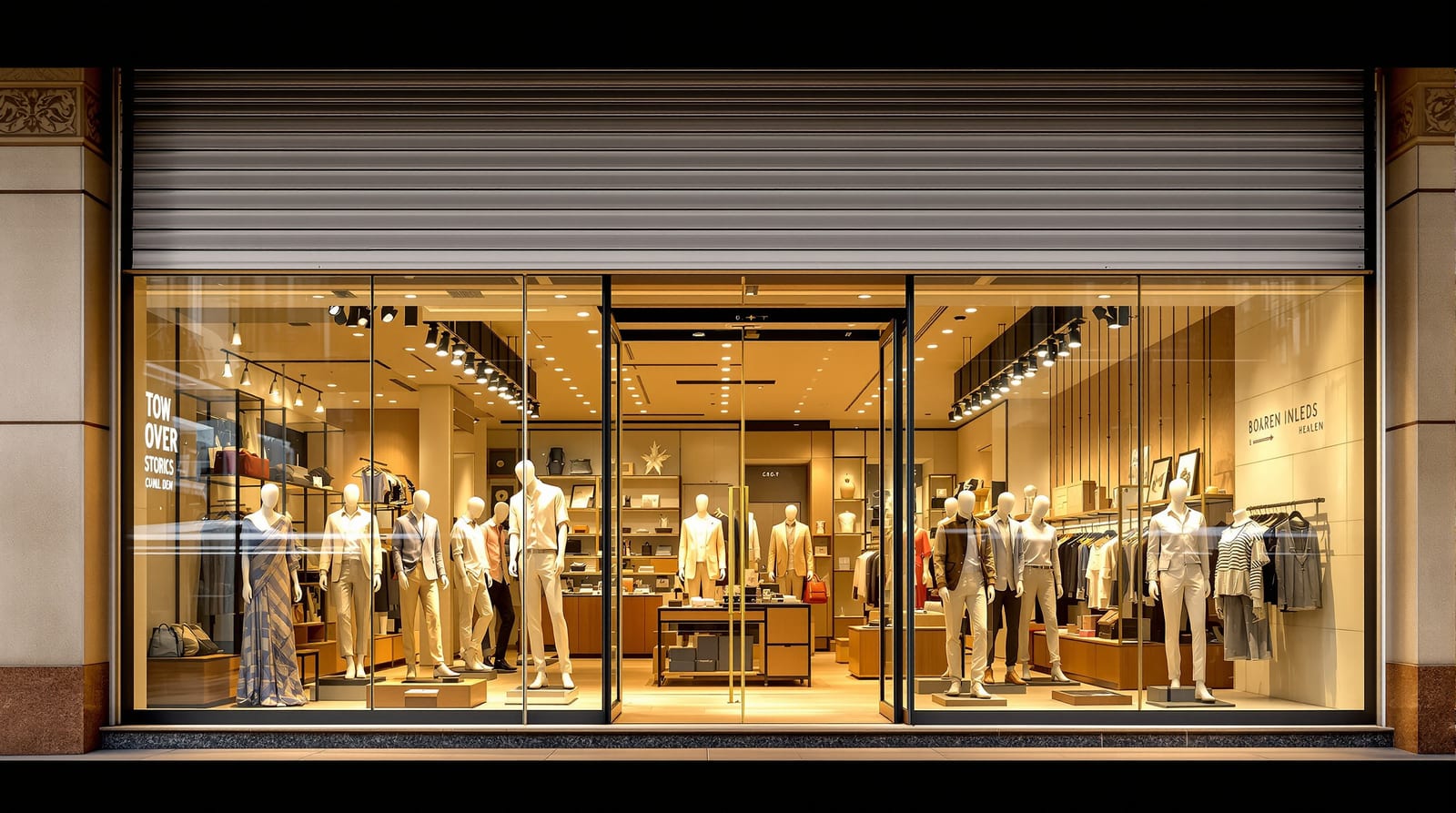
Retail Store Door in India: Storefront Entrance, Rolling Shutter and Fitting-Room Doors (2026)
A footfall-and-security guide to specifying doors for a shop in India - the open, welcoming storefront entrance by day, the rolling-shutter lockdown by night, plus fitting-room, stockroom and fire-exit doors - with indicative per-door and per-shutter costs.
A shop door has to do two jobs that pull in opposite directions, and it has to switch between them every single day. By daylight the storefront must almost disappear - the whole point of retail is to lower the threshold so that a passer-by drifts in without deciding to, sees the merchandise from the pavement, and feels the cool air-conditioning invite them off a hot street. By night the same opening must become a sealed, pry-resistant box that a thief cannot get through, because a shop is a room full of saleable goods left unattended for twelve hours. The retail entrance is therefore never one door; it is a pairing - a transparent, inviting day face and a hard security face - and the shops that get this wrong either lose footfall to a heavy, closed-looking front or lose stock to a flimsy one. This guide walks the shop opening by opening, from the storefront to the trial room and stockroom, and tells you which door belongs where, the day-versus-night function each must serve, the Indian codes that apply, and what each costs in 2026. For the wider logic of matching a door to its building type, start with the master overview on choosing a door by space; this is its high-footfall, high-theft-risk application.
The forces that shape every retail door
A shop door is decided by where it sits on these competing demands, and the balance flips between the front-of-house and the back:
- Maximum visibility and easy footfall by day. The single biggest driver at the storefront. The door must be transparent, wide, and ideally hands-free, so the shop reads as open and a customer carrying bags can walk straight in. Friction at the entrance is lost sales.
- Full security lockdown by night. The defining force after closing. With no staff present, the shut shop must resist break-in, jemmy attack and grab-raids - which is why the rolling shutter, not the glass door, is the must-have retail door.
- Air-conditioning sealing. In Indian heat, a leaky entrance bleeds cooling and runs up the electricity bill all day. Automatic doors that close themselves and air curtains both exist to keep the cold in and the dust and street air out.
- Brand image. The shopfront is the brand's most expensive billboard. A frameless glass swing reads premium and boutique; an automatic slider reads modern and high-traffic; a fully retractable shutter-up shopfront reads as an open-market bazaar stall. The door choice is a positioning decision.
- Theft prevention and grab-raid resistance. Beyond the night lockdown, the daytime entrance layout, plus a fire-exit that cannot become an unwatched escape route for shoplifters, all feed loss prevention.
- Fire and egress. A shop is a mercantile occupancy under NBC 2016. Customers must be able to get out fast; the entrance and any fire exit must meet egress width and outward-swing rules, and the security regime must never trap people inside.
No single product scores high on all of these, which is exactly why the retail entrance is built as a layered pair: a light, transparent door for the day, and a heavy shutter for the night.
Retail openings and the door each one needs
Read the shop as a front-of-house display zone and a back-of-house service zone, with a security skin that wraps the whole thing at night. The table below ranks the door for each opening against its dominant driver.
| Opening | Recommended door | Day / night function | Indicative ₹ (2026) |
|---|---|---|---|
| Storefront entrance (high footfall) | Automatic toughened-glass sliding door + air curtain | Day: hands-free open, AC-sealed. Night: shutter behind takes over | Auto door 1,50,000-4,00,000+; air curtain 12,000-40,000 |
| Storefront entrance (premium / boutique) | Frameless toughened-glass swing door, patch fittings + floor spring | Day: dignified, transparent brand face. Night: shutter behind | 18,000-55,000 per leaf |
| Open-market / bazaar shopfront | Full-width rolling shutter (no separate door) | Day: shutter rolled fully up, shop wide open. Night: shutter down | Shutter only 8,000-40,000 (by type/size) |
| Security skin (every shop) | Rolling shutter - MS / aluminium / polycarbonate / grille | Day: coiled in box, invisible. Night: the lockdown face | 8,000-1,20,000+ by type, size, motorised |
| Fitting / trial room | Lockable louvered or flush door, or heavy curtain on a track | Privacy + quick turnover; no AC/security role | Door 3,000-9,000; curtain + track 2,000-6,000 |
| Back-store / stockroom | Solid flush or steel door, self-closing, lockable | Staff-only, stock security, separates clutter from sales floor | 4,000-18,000 |
| Fire exit | IS 3614 fire-rated steel door + panic / push bar, outward swing | Egress only; resists entry, releases instantly from inside | 14,000-45,000+ |
| Service / rear delivery | Steel security door, multi-point lock | Goods-in by day, locked otherwise | 8,000-30,000 |
The storefront entrance: open by day
The front door does the marketing, and modern Indian retail gives you three honest options, each making a different brand statement.
Automatic toughened-glass sliding door is the default for any shop chasing footfall - supermarkets, electronics chains, pharmacies, mid-market apparel. It opens hands-free as a customer approaches, which removes the psychological "push to enter" barrier entirely, lets a shopper laden with bags walk straight through, and gives a wheelchair user a flush, sensor-opened path. Crucially for India, an automatic door closes itself the instant the customer is through, so it seals the air-conditioning far better than a propped-open swing - pair it with an air curtain over the opening and the cooling loss drops sharply. Specify it to the standards in the automatic sliding doors guide: toughened glass, redundant safety sensors, and a battery backup that fails to a manually openable state so a power cut never traps anyone inside.
Frameless toughened-glass swing door is the premium move - fashion boutiques, jewellery, eyewear, premium showrooms. With patch fittings and a floor spring it reads as a clean, almost invisible sheet of glass that says "considered, expensive, curated," and it keeps the merchandise on full display from the pavement. The trade-off is that a swing leaf is not hands-free and seals the AC less perfectly than an automatic slider, so it suits lower-footfall, higher-margin shops. The detailing - patch fittings, floor spring, glass thickness - is covered in the frameless glass doors guide.
Fully-open shutter-up shopfront is the open-market answer - a sweet shop, a kirana, an electronics-market stall, a high-street mobile shop. Here there is no separate entrance door at all: the rolling shutter is the whole front, rolled completely up during trading hours so the shop opens onto the street with zero threshold, and dropped at night to seal it. It maximises the open, accessible, walk-straight-in feel and is the cheapest configuration, but it offers no AC sealing and no premium image. Many such shops add a collapsible gate inside the shutter as a second, see-through security layer that lets the lit interior stay visible at night while still being locked.
Whichever face you choose, the entrance must stay genuinely accessible and code-compliant: clear width at least 1000 mm at a main entrance, threshold under 12 mm, lever or push hardware, and - because a mercantile occupancy must let crowds out fast - a manual egress path that does not depend on power. An automatic door is not, on its own, an acceptable sole means of escape.
The rolling shutter: the must-have security door
If the glass front is the shop's face, the rolling shutter is its night skin, and it is the one retail door you cannot skip. It is what turns a transparent, goods-filled room into a sealed, pry-resistant box for the twelve-or-more hours the shop is unattended, and it is the single biggest factor in whether the shop gets burgled. Choose the shutter type by how much security, visibility and budget you need - the mechanics of sizing, motorising and locking one are in the shutter doors guide.
- MS (mild steel) shutter - the workhorse. Interlocking galvanised steel slats, the strongest common option, fully opaque when down. Best for shops with high-value or easily-grabbed stock (electronics, mobiles, jewellery-adjacent). Manual (push-up) for small openings, motorised for wide ones.
- Aluminium shutter - lighter, rust-free, neater finish, easier to motorise, but less brute-force resistant than MS. Good for malls, AC showrooms and premium high streets where corrosion and looks matter and the building has its own perimeter security.
- Polycarbonate / transparent shutter - clear or tinted slats that lock the shop yet leave the window display lit and visible at night. A working showcase doubles as advertising after hours; popular for jewellers, eyewear, branded apparel and showrooms. Less impact-resistant than steel, so often used where there is a guarded mall or street.
- Grille / perforated shutter - open mesh or perforated slats that let air and light through and keep the interior visible (a deterrent in itself) while resisting reach-through theft. Common in malls where fire and smoke must not be trapped behind a solid face, and on street shops that want a ventilated, see-in night front.
For most independent street shops the practical answer is a motorised MS or aluminium shutter for the bulk of the opening, sometimes with a transparent or grille section over the display window so the merchandise keeps selling overnight. Size it, choose the slat type and price it with the rolling shutter cost calculator, and remember the fire rule below: a security shutter must never be the only thing between a customer and the street while the shop is open.
Fitting rooms, stockroom, fire exit and service doors
Fitting / trial rooms. Apparel and footwear retail lives or dies on the trial room, and its door is all about privacy plus fast turnover - not security or AC. The two standard answers are a lockable louvered or flush door (a more premium, private feel, with a louvered top for ventilation) or a heavy curtain on a ceiling track (cheaper, faster for the customer, and space-saving in a tight fit-out). Either way, fit a clear engaged/vacant indicator, allow at least 900 mm clear width and a turning space so a wheelchair user can use one, and keep a small gap at the floor for staff safety checks. The louvered option, with its ventilated top, is detailed in the louvered doors guide.
Back-store / stockroom. The door between the sales floor and the stockroom is a solid flush or steel door, self-closing and lockable - staff-only, it secures the bulk stock and hides the working clutter from customers. A vision panel helps staff carrying boxes; a self-closer keeps it shut so customers do not wander in.
Fire exit. A shop is a mercantile occupancy, so escape routes must use IS 3614 fire-rated steel doors fitted with panic / push bars, swinging outward in the direction of escape, per NBC 2016. The rule that overrides every theft instinct: the fire exit must release instantly from the inside even though it resists entry from outside, so it may be alarmed and monitored but never chained, locked or blocked with stock. Many retail thefts and most retail tragedies trace back to a fire exit that was sealed "for security."
Service / rear delivery door. Goods come in through a steel security door with a multi-point lock at the rear, controlled during delivery hours and locked otherwise. It is part of the night security skin as much as the shutter.
Costs in 2026 (indicative, varies by type, size and city)
| Door / item | Indicative cost | Notes |
|---|---|---|
| Automatic glass entrance (sensor sliding) | ₹1,50,000-4,00,000+ | Toughened glass, sensors, battery backup |
| Frameless glass swing entrance | ₹18,000-55,000 per leaf | Patch fittings + floor spring; premium look |
| Air curtain over entrance | ₹12,000-40,000+ | Cuts AC loss and dust at an open/auto door |
| Rolling shutter (MS / aluminium) | ₹8,000-60,000+ | By size; motorised costs more than push-up |
| Polycarbonate / grille shutter | ₹15,000-1,20,000+ | See-through or perforated; display stays visible |
| Collapsible gate (inner security layer) | ₹6,000-30,000+ | See-through night lock behind glass/shutter |
| Fitting-room door / curtain set | ₹2,000-9,000 | Louvered/flush door, or curtain on track |
| Stockroom door (flush / steel) | ₹4,000-18,000 | Self-closing, lockable, vision panel |
| Fire exit door (panic bar) | ₹14,000-45,000+ | IS 3614, outward swing, push bar |
| Rear / service security door | ₹8,000-30,000 | Steel, multi-point lock |
Add 18% GST on supply. The two big-ticket items are the automatic entrance (if you choose one) and the shutter; everything else is modest. Price the entrance, stockroom and fire doors with the commercial door cost calculator, and size and cost the shutter specifically with the rolling shutter cost calculator.
Do and don't for retail store doors
- Do treat the entrance as a pair: a transparent, inviting day face and a rolling shutter behind it for the night lockdown - the shutter is non-negotiable.
- Do match the day face to the brand - automatic slider for footfall, frameless glass swing for premium, shutter-up shopfront for an open-market stall.
- Do add an air curtain (and self-closing/automatic entrance) so AC does not bleed out of an open door in Indian heat.
- Do keep the entrance accessible - at least 1000 mm clear, low threshold, lever hardware, and a manual egress path that works in a power cut.
- Don't ever chain, lock or block the fire exit "for security"; it is illegal, and in a fire it is lethal.
- Don't rely on glass alone overnight, or on a single solid shutter where a transparent or grille shutter would keep the display selling and let smoke escape.
- Don't let the rolling shutter or automatic door become the only means of escape while customers are inside.
For the related building-type applications of these same ideas, the showroom doors guide covers larger display-led spaces, the mall doors guide covers the shared-fire-strategy mall context, and the doors-by-space master guide places this retail logic in the wider family of commercial spaces.
Frequently asked questions
What is the best door for a retail shop entrance in India?
It depends on the brand and footfall. High-traffic shops chasing footfall use an automatic toughened-glass sliding door with an air curtain - hands-free, AC-sealing and accessible. Premium boutiques use a frameless glass swing door for a curated look. Open-market and street shops use a shutter-up shopfront. Whichever you pick, fit a rolling shutter behind it for night security.
Do I really need a rolling shutter if I have a glass door?
Yes. A glass entrance is for footfall by day; it is hopeless as overnight security. The rolling shutter is the one retail door you cannot skip - it turns a goods-filled, unattended shop into a sealed, pry-resistant box for the closing hours. Choose MS for maximum strength, aluminium for a lighter neat finish, or polycarbonate/grille if you want the display to stay visible and lit at night.
How much does a retail shutter cost in India in 2026?
Indicatively, a plain MS or aluminium rolling shutter runs ₹8,000-60,000+ depending on size and whether it is push-up or motorised, and a polycarbonate or grille shutter ₹15,000-1,20,000+. Add 18% GST. Size and price your exact opening with the rolling shutter cost calculator; figures are indicative and vary by type, size, city and vendor.
What door should a fitting room have?
A fitting room needs privacy and fast turnover, not security. Use a lockable louvered or flush door (more private, with ventilation) or a heavy curtain on a ceiling track (cheaper and quicker). Fit a vacant/engaged indicator, allow at least 900 mm clear width with a turning space for accessibility, and leave a small floor gap for staff safety checks.
How are shop fire exits kept secure without inviting theft?
Use an IS 3614 fire-rated door with a panic / push bar that releases instantly from inside but resists entry from outside, swinging outward per NBC 2016. It may be alarmed and CCTV-monitored to deter staff or shoplifter misuse, but it must never be chained, locked or blocked with stock - a sealed fire exit is illegal and dangerous.
Export this guide
Related Guides — Deep-dive reading
Universal Design Doors for Indian Homes: Inclusive Doors That Work for Everyone (2026)
How to design and specify doors that serve children, the elderly, pregnant women, the injured and wheelchair users by default - generous width, lever handles, near-flush thresholds, low-force closing, contrast and good lighting - without your home ever looking medical.
Home Doors & EntrancesLibrary Door in India: Quiet, Access-Controlled and Anti-Theft Reading-Room Entrances (2026)
Doors for public, college and corporate libraries in India - acoustic silence, RFID security gates, controlled single entry and a calm scholarly look, with zone-by-zone choices and costs.
Home Doors & EntrancesFire Exit Doors in India: NBC 2016 Egress, Panic Bars & Costs (2026)
How fire exit and emergency egress doors must be sized, swung, hardware-fitted and signed to NBC 2016 Part 4 in Indian buildings, and what they cost.
Home Doors & EntrancesRelated Tools — Try Free
Cross-Ventilation Analyzer
Estimate airflow and air changes per hour (ACH) from room size, window areas, layout, and local wind — with NBC 2016 Part 8 compliance check.
Ventilation CalculatorWindow Size Calculator
Get the right window size, glazing area and openable area for any room using NBC daylight rules.
Window ToolAccess-Control Battery-Backup Calculator
Size the standby battery so an access system keeps running through a power cut, with an egress life-safety note.
Battery Backup