
Office Entrance Door in India: Automatic, Revolving and Frameless Glass Entrances (2026)
The main entrance for offices and commercial buildings in India - what makes a first impression, moves footfall, controls access and seals in the AC, with system costs and standards.
The office entrance is the single most-used, most-seen door in any commercial building. It greets every client, every interview candidate and every employee twice a day. It must look like the brand, move heavy footfall without a bottleneck, decide who gets in, keep the lobby air-conditioning sealed against Indian heat, stay open to wheelchairs and strollers, and lock down hard after hours. No single ordinary swing door does all of that well - which is why office entrances in India have converged on a small set of purpose-built systems: the automatic sliding glass door, the revolving door, the frameless glass swing, and the aluminium-glass framed entrance.
This guide ranks those options for an Indian office or commercial building, gives you the system costs, and shows how to layer access control, branding and after-hours security on top. It is the application companion to the mechanism guides - for how each system actually works, follow the links through.
What an office entrance actually has to do
Before picking a system, line up the six drivers that should decide it. Almost every disappointing office entrance failed on one of these:
- Brand image / first impression. The entrance is the face of the firm. Frameless glass, clean stainless or brushed-aluminium framing, and a clean logo manifestation read as confident and modern.
- Footfall flow. A 200-person office at 9:30 am, or a showroom on a Saturday, generates pulses of traffic. A single swing leaf jams; a wide automatic slider or a revolving door keeps people moving hands-free.
- Access control. Most offices want the entrance integrated with the security plan - card/face readers, turnstiles, visitor management - so the door is both welcoming by day and a controlled boundary.
- AC / energy sealing. This is the quiet money driver in India. Every open swing leaf dumps cooled air and pulls in hot, humid outside air, spiking the HVAC load. Automatic sliders close instantly behind each person; revolving doors never fully open the building to outside air. See energy-efficient doors for India.
- Accessibility. Under RPwD 2021 a commercial entrance should give a clear opening width of at least 900 mm, with a threshold no higher than 12 mm and no heavy manual force to operate. Automatic doors satisfy this effortlessly; heavy frameless swings often do not.
- Security after hours. When the office is empty the glamorous glass front becomes the weak point. The standard answer is a rolling shutter or collapsible gate behind or in front of the glass line - see shutter doors for India.
The four entrance systems, ranked
1. Automatic sliding glass door - the default
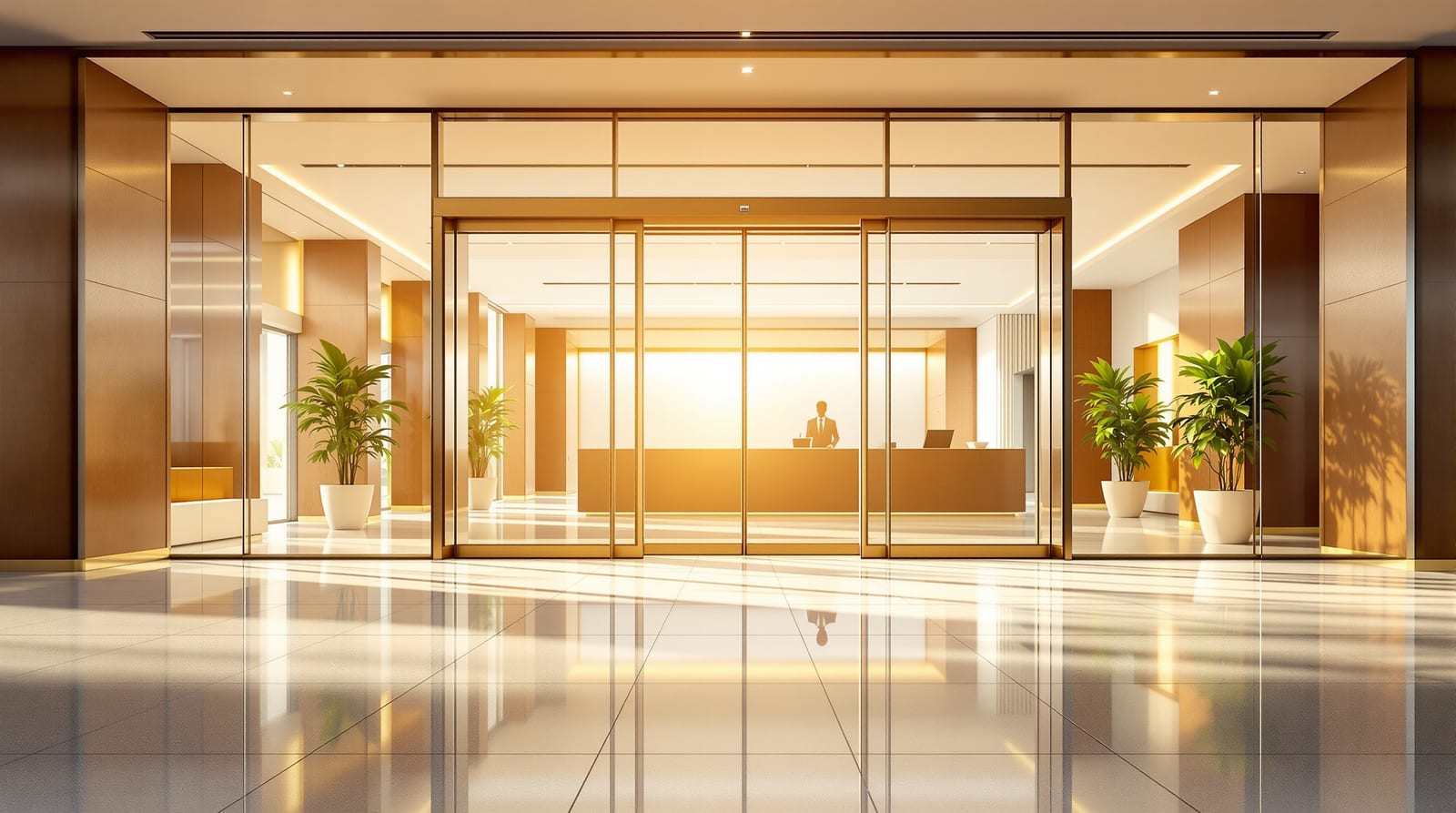
For the great majority of Indian offices, showrooms, clinics, banks and corporate lobbies, the automatic sliding glass door is the right answer. A motion/presence sensor opens twin toughened-glass leaves that part sideways and close behind the person. It is completely hands-free (a hygiene and accessibility win), it seals the AC the instant the gap clears, and it carries branding beautifully. This is the system most clients picture when they say "modern office entrance." Read the mechanism in depth in automatic sliding doors for India and automatic glass doors for India.
Specify a battery/UPS backup so the doors break out manually in a power cut, and a fire-mode interface so they hold open or swing free on a fire alarm.
2. Revolving door - for large lobbies and maximum AC efficiency
A revolving door never creates a straight-through opening, so it leaks almost no conditioned air and blocks wind, dust and street noise - the best energy performance of any entrance. It suits high-footfall, high-prestige lobbies: corporate headquarters, five-star-grade office towers, large bank head offices. It is costly and needs floor space, and critically it is not wheelchair-accessible on its own, so the code expectation in India is to pair every revolving door with an adjacent automatic swing or sliding door for accessible and emergency use. Treat the revolver as the showpiece and the slider beside it as the workhorse.
3. Frameless glass swing with floor spring and patch lock
Where the budget or the architecture calls for a swing rather than a slide, the frameless toughened-glass door on a floor spring, with patch fittings and a patch lock, is the classic clean-glass office front. It is the most affordable of the glamorous options and looks superb, but it is a manual door: heavier to push, less AC-tight, and it needs care to meet accessible operating force. Best for boutique offices, design studios and smaller reception fronts. See frameless glass doors for India.
4. Aluminium-glass framed entrance - the value workhorse
A framed aluminium entrance - glazed leaves in a slim powder-coated or anodised aluminium frame, on hinges or a floor spring - is the durable, weather-sealed, value choice for mid-market offices, institutional buildings and tenant fit-outs. It accepts good weatherstripping (better AC sealing than frameless), takes a closer and access hardware easily, and survives heavy use. It looks less "premium frameless" but it is robust and economical.
Entrance system comparison
| Entrance system | Footfall / flow | Access control fit | AC / energy seal | Accessible alone | Indicative cost (system, ex-GST) |
|---|---|---|---|---|---|
| Automatic sliding glass | Excellent (hands-free) | Excellent (reader + sensor logic) | Very good (auto-close) | Yes | 1,80,000 - 6,00,000+ |
| Revolving door | Excellent (continuous) | Good (with side gate) | Best (never fully open) | No - needs paired door | 8,00,000 - 30,00,000+ |
| Frameless glass swing | Moderate (manual) | Moderate (patch lock + reader) | Moderate | Marginal | 18,000 - 55,000 per leaf |
| Aluminium-glass framed | Moderate (manual / auto-fit) | Good | Good (weatherstripped) | If auto-fitted | 8,000 - 25,000 per leaf |
Costs are indicative and vary by size, glass thickness, finish, operator brand and city; add 18% GST. Use the commercial door cost calculator and the office door planner to size a quote.
How the automatic entrance works - and seals the AC
The leaves part only as wide and as long as a person needs, then close behind them - so the building is never held open the way a propped swing door is. That instant reseal is what protects the AC load and keeps the lobby comfortable through a Chennai or Delhi summer.
Layering access control onto the entrance
Most office entrances are not just doors - they are the first security checkpoint. The common pattern in Indian offices:
- Daytime, public face: the automatic doors open freely for visitors arriving at reception, where a visitor-management desk or kiosk issues passes.
- Staff / secure zones: card, mobile or face readers release the doors (or a turnstile line just inside) so only authorised people pass into the workspace beyond. Plan this with door access control for India.
- After hours: the automatic doors lock, readers govern entry for late workers, and a rolling shutter or collapsible gate drops to protect the glass line.
Integrate the entrance operator with the access system from day one - retrofitting readers and fire-alarm interfaces later is far more expensive than specifying them in the original quote.
Branding, manifestation and safety
Frameless and large glass entrances must carry manifestation - a frosted band, logo film or etched pattern at roughly eye and waist height - so people do not walk into the glass. This is both a safety requirement and your best free branding surface: the firm logo, etched and lit, becomes the entrance signature. Specify toughened (and ideally laminated, for safety and after-hours security) glass for any entrance leaf.
Standards and clearances to specify
- Accessibility (RPwD 2021): entrance clear width at least 900 mm, threshold no higher than 12 mm, no high operating force - automatic operation is the cleanest way to comply. See door access control for India for integrating accessible release.
- NBC 2016 egress: the entrance often doubles as an exit; in many occupancies emergency egress doors must open in the direction of escape, so automatic doors need a break-out (manual swing-out) function and the fire-alarm interface that triggers it.
- Glass safety: toughened/laminated glass with manifestation on all transparent entrance leaves.
- Power resilience: UPS/battery backup on automatic and revolving operators so people can always get out in a power failure.
For the broader picture of doors across an office, see office doors for India, and to pick the right door for any commercial space, the doors by space guide for India.
Do and don't
- Do pair a revolving door with an adjacent automatic or accessible door - always.
- Do specify break-out / manual override and fire-alarm interface on every powered entrance.
- Do plan the rolling shutter or collapsible gate for after-hours security with the entrance, not as an afterthought.
- Don't rely on a single manual frameless swing for a high-footfall entrance - it bottlenecks and bleeds AC.
- Don't leave large glass un-manifested - it is a safety and liability risk.
- Don't treat access control and visitor management as a later add-on; cabling and operator logic are cheapest at first fit.
Frequently asked questions
Which entrance door is best for an Indian office?
For most offices, an automatic sliding glass door is the best all-round choice: hands-free, accessible, AC-sealing, brandable and access-control friendly. Reserve revolving doors for large, high-prestige lobbies where maximum energy efficiency justifies the cost - and always add a paired accessible door beside them.
How much does an automatic office entrance cost in India?
An automatic sliding glass entrance typically runs about 1,80,000 to 6,00,000 plus GST as a system, depending on size, glass, operator brand and sensors. Revolving doors start far higher (8,00,000 upward). Frameless glass swings are the budget glamour option from roughly 18,000 per leaf. Use the commercial door cost calculator.
Are automatic office doors wheelchair-accessible?
Yes - automatic sliding doors are the easiest way to meet RPwD 2021: hands-free operation, a clear width of at least 900 mm and a near-flush threshold. Revolving doors are not accessible alone and must be paired with an automatic or swing door for wheelchair and emergency use.
How do automatic entrance doors save on air-conditioning?
They open only as wide and as long as each person needs and close instantly behind them, so the lobby is never held open to hot, humid outside air. That reduces the heat and moisture the HVAC must remove - a meaningful saving in Indian summers. Revolving doors seal even better. See energy-efficient doors for India.
How do I secure a glass office entrance after hours?
Lock the automatic operator, govern late entry through access-control readers, and drop a rolling shutter or collapsible gate across the glass line. Specify toughened/laminated glass and plan the shutter with the entrance. See shutter doors for India.
Export this guide
Related Guides — Deep-dive reading
Accessible Doors in India: Wheelchair & Senior-Friendly Door Design Guide
Clear width, lever handles, flush thresholds, swing vs sliding, lock reach and sensor doors - how to specify wheelchair- and senior-friendly doors to the RPwD Harmonised Guidelines 2021 and NBC 2016.
Home Doors & EntrancesLibrary Door in India: Quiet, Access-Controlled and Anti-Theft Reading-Room Entrances (2026)
Doors for public, college and corporate libraries in India - acoustic silence, RFID security gates, controlled single entry and a calm scholarly look, with zone-by-zone choices and costs.
Home Doors & EntrancesWheelchair Accessible Doors for Indian Homes: Clear Width, Thresholds & Hardware (2026)
The exact specs that make a door usable from a wheelchair - clear opening width, near-flush threshold, lever hardware, approach clearance and low-force or auto operation, mapped to the RPwD Harmonised Guidelines 2021.
Home Doors & EntrancesRelated Tools — Try Free
Access-Control Battery-Backup Calculator
Size the standby battery so an access system keeps running through a power cut, with an egress life-safety note.
Battery BackupAccessible Door Checker
Check a door against wheelchair-accessibility guidance — clear width, threshold, handle and closer force per RPwD 2021.
Compliance ToolVisitor Access Planner
Size visitor handling at a gate or reception — lanes needed at peak and the temporary-pass pool.
Visitor Flow